Does Google Cloud Functions Work in China? Data Residency, PIPL & No Mainland Region
Google Cloud runs no region inside mainland China — and, unlike AWS or Azure, no separate China partition at all — so a Cloud Function and the data it handles run offshore, a cross-border transfer under PIPL with no in-country region to localize on. A compliance-first look at the real exposure.
Does Google Cloud Functions work in China?
No — not from inside mainland China. Google Cloud operates no region in the mainland and, unlike AWS or Azure, no separate China partition at all, so a Cloud Function and every byte of data it touches run offshore.
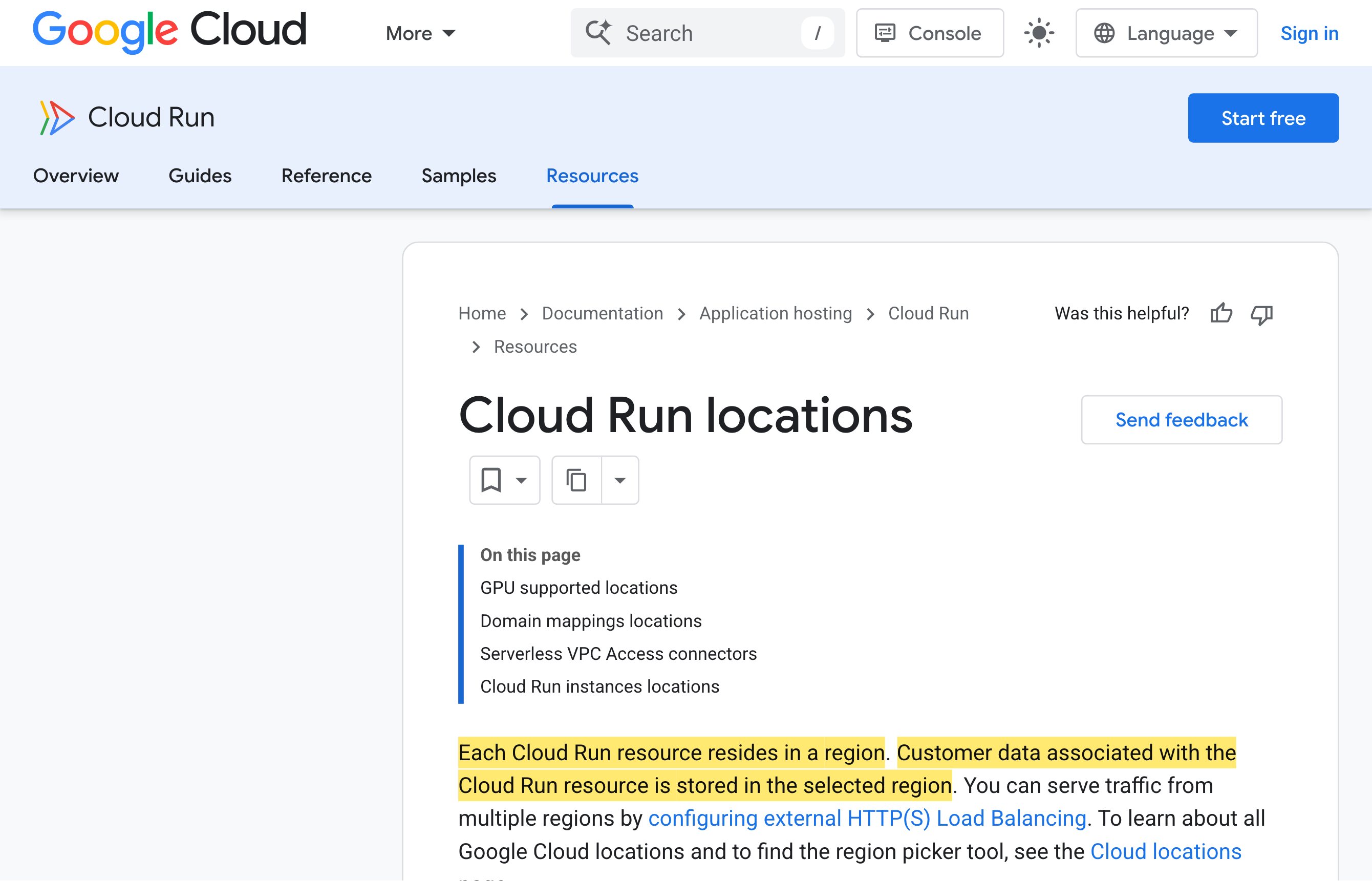
In Google's own words, "Each Cloud Run resource resides in a region" and "Customer data associated with the Cloud Run resource is stored in the selected region" — and the nearest selectable regions are Hong Kong, Taiwan and Tokyo, all outside the mainland. So any personal data a function processes, stores or logs for Chinese users is a cross-border transfer PIPL governs (notice, separate consent and one transfer mechanism; Articles 38–43), a CIIO or large-volume handler's data-localization duty (PIPL Article 40; Cybersecurity Law Article 39 (formerly Article 37)) has no mainland region to land on, and the ICP filing sits on the public app the function backs — not on Cloud Functions itself. The table below is Google's own wording and the rule each line triggers.
This is a risk map, not a verdict — which obligations actually bite turns on your entity, your data and who your users are. Our China team can map your exposure with you →
Compliance snapshot
- ✕ Google Cloud runs no region inside mainland China — functions execute offshore
- ✕ No separate China partition or account exists — unlike some other global clouds
- ! Personal data a function handles leaves the mainland — PIPL cross-border applies
- ! Data-localization duties (CIIO / high-volume) have no mainland region to land on
- ! ICP sits on the public app the function backs, not on Cloud Functions itself
What Google Cloud Function's own documentation says about China
| Fact | Primary source |
|---|---|
Google Cloud Functions runs only in Google Cloud regions — and none is inside mainland China. Google's own locations list puts every region offshore, the nearest being asia-east2 (Hong Kong), asia-east1 (Taiwan) and asia-northeast1 (Tokyo), and Google states "Each Cloud Run resource resides in a region" (gen-2 Cloud Functions now run on Cloud Run). There is no mainland-China region to deploy a function into. | Google Cloud — Cloud Functions / Cloud Run locations (docs.cloud.google.com/run/docs/locations), retrieved 2026-10-07 |
| The data a function handles stays in the offshore region you pick — so for Chinese users it leaves the mainland. Google states "Customer data associated with the Cloud Run resource is stored in the selected region." With no mainland region to select, the personal information your function reads, writes or logs for Chinese users lives in Hong Kong, Taiwan, Tokyo or further afield — a cross-border transfer under PIPL requiring notice, separate consent and a transfer mechanism (Articles 38–43). | Google Cloud — Cloud Functions / Cloud Run locations (docs.cloud.google.com/run/docs/locations), retrieved 2026-10-07; PIPL Articles 38–43 |
| There is no separate China partition to switch to — the structural difference from some other global clouds. Google describes a footprint "available across six continents" with "43 global regions and 130 zones," none inside mainland China and reachable through no separate China account. So there is nothing in-country to host on, and the compute, environment and execution logs your function produces live offshore alongside its data. | Google Cloud — Global locations (cloud.google.com/about/locations), retrieved 2026-10-07 |
| Google pitches data residency "within country borders" — but for China there is no region to stay within. Google's locations page sells regions built to ensure "valuable data remains securely resident within country borders"; mainland China has none. A critical information infrastructure operator or large-volume handler whose China-collected personal information must stay in the mainland (PIPL Article 40; Cybersecurity Law Article 39 (formerly Article 37)) cannot meet that duty on Google Cloud at all. | Google Cloud — Global locations (cloud.google.com/about/locations), retrieved 2026-10-07; PIPL Article 40; Cybersecurity Law Article 39 (formerly Article 37) |
| For backend compute, the ICP filing lands on the public app the function serves — not on Cloud Functions itself. A function is reached through an auto-assigned URL on Google's own domains, not a mainland-registrable domain of yours; the ICP filing (State Council Order No. 292; MIIT Order No. 33) attaches to the public site or app you serve to mainland visitors and must sit on a mainland hosting resource — which Google Cloud, with no mainland region, cannot provide. What Cloud Functions decides for you is narrower and sharper: where its data and its compute live, both offshore. | Google Cloud — Cloud Functions documentation; State Council Order No. 292; MIIT Order No. 33 |
Sources verified by the 21YunBox compliance team on 2026-10-07.
For a mainland-China audience, the deciding question about Google Cloud Functions — now delivered as Cloud Run functions — is not how quickly a function returns. It is where that function is allowed to run and where the data it touches is allowed to live. Google answers both in its own documentation, and the answer points one way: offshore. Google Cloud operates no region inside mainland China, and — unlike the walled-off China partitions some other global clouds run through local operators — no separate China account either. So a function that serves Chinese users executes outside the mainland, and every byte of personal data it reads, writes or logs crosses the border with it. Reaching the endpoint is the easy half; the licensing and the data residency are the exposure.
Google Cloud Functions in China at a glance
| What decides it | In Google's own terms |
|---|---|
| Where it runs | A function runs only in a Google Cloud region — “Each Cloud Run resource resides in a region” (gen-2 functions run on Cloud Run). The nearest on Google's list are asia-east2 (Hong Kong), asia-east1 (Taiwan) and asia-northeast1 (Tokyo); none is inside mainland China. |
| Google's footprint | “Available across six continents” with “43 global regions and 130 zones” — not one in mainland China, and no separate China account to create. There is no in-country Google Cloud to switch to. |
| Where the data sits | “Customer data associated with the Cloud Run resource is stored in the selected region.” Every selectable region is offshore, so personal data a function handles for Chinese users leaves the mainland. |
| Serving the public | A function has no mainland-registrable domain of its own; the ICP filing attaches to the public app or site it backs, which must sit on a mainland hosting resource — something Google Cloud has no region to provide. |
| Is it reachable? | Served only from offshore regions. Google runs no mainland network presence, so reaching a function from inside China rides on cross-border connectivity Google does not provision in-country — the delivery half, not the legal half. |
No mainland region — and, unlike other clouds, no China door at all
Google Cloud Functions runs wherever Google Cloud runs, and Google Cloud does not run inside mainland China. On Google’s own locations list the Asia-Pacific regions are Hong Kong (asia-east2), Taiwan (asia-east1), Tokyo (asia-northeast1), Osaka, Seoul, Singapore, Mumbai, Delhi, Jakarta, Bangkok and the two Australian regions — every one of them offshore, and the closest three still across a border from the mainland. Google frames the whole footprint as “available across six continents” with “43 global regions and 130 zones,” and states plainly that “Each Cloud Run resource resides in a region” (second-generation Cloud Functions now run on Cloud Run). None of those regions is in mainland China.
What makes Google different from the other large clouds is not just the missing region — it is the missing door. AWS reaches the mainland through a separate partition operated by Sinnet and NWCD; Azure through one operated by 21Vianet. Each is a walled-off China cloud you enter with a Chinese entity and a new account. Google operates no such partition and no separate China account. So “we’ll just stand up a China region” is not an option here: there is nothing in-country to stand it up on.
Your China users’ data — and the function’s own state — stay offshore
Serverless compute does not escape data residency; it inherits it from the region it runs in. Google’s locations documentation says it directly: “Customer data associated with the Cloud Run resource is stored in the selected region.” Because every selectable region is offshore, the personal information your function processes, stores or writes to its logs for Chinese users lives in Hong Kong, Taiwan, Tokyo or beyond — outside the mainland.
Under China’s Personal Information Protection Law that is a cross-border transfer, and the handler — you, not Google — must give notice, obtain separate consent, and clear one transfer mechanism: a CAC security assessment, the CAC standard contract, or certification (Articles 38–43). If you are a critical information infrastructure operator or a large-volume handler, personal information collected in China must be stored in the mainland (PIPL Article 40; Cybersecurity Law Article 39 (formerly Article 37)) — a residency duty Google’s locations page frames as keeping “valuable data remains securely resident within country borders,” yet one it offers no mainland region to satisfy. The function’s environment variables, execution state and logs sit offshore with the data, so this is not a corner case you can configure away.
Where the ICP filing actually lands
Because Cloud Functions is backend compute, the ICP question does not attach to the functions themselves. A function is reached through an auto-assigned URL on Google’s own domains, not a domain you register and point at a mainland host. The ICP filing — ICP 备案 under State Council Order No. 292 and MIIT Order No. 33 — attaches instead to the public website or app you serve to mainland visitors, the one that calls your functions, and that filing must bind to a hosting resource physically inside the mainland. Google Cloud has none, so it can give the app neither an ICP footing nor the in-country delivery a filing presumes. “Our backend is on Cloud Functions” therefore settles nothing about the public app’s licensing; it only fixes where the backend’s data and compute sit — offshore.
This is a risk map, not a verdict: which obligations actually bite — cross-border transfer, data-localization, ICP on the public app, or all three — turns on what your functions handle, how much personal data you hold and who your users are, and it is worth settling with counsel before you build.
Where 21YunBox fits — a compliant overlay, not a migration
Your functions keep running on Google Cloud. What we add is the one thing a platform with no mainland region cannot provide on its own: compliant, ICP-filed delivery from inside the mainland, placed in front of the public app your functions power — no rebuild, no second codebase, and no move off Google Cloud. Our China team maps your PIPL cross-border and data-residency obligations against your entity, data volumes and users, then stands up the in-country delivery and storage a lawful China presence needs, while your functions keep executing exactly where they already run.
Related reading:
Frequently Asked Questions
Does our existing Google Cloud Functions setup work for users in mainland China?
Not from inside the mainland. Google Cloud runs no region in mainland China and no separate China account, so your functions execute offshore — Google's own locations list puts the nearest regions in Hong Kong, Taiwan and Tokyo. The functions keep running, but any personal data they process, store or log for Chinese users leaves the mainland, which PIPL treats as a cross-border transfer, and there is no in-country Google region on which to meet a data-localization duty.
Do we need an ICP filing for Google Cloud Functions?
Not for the functions themselves — Cloud Functions is backend compute reached through an auto-assigned URL on Google's own domains, with no mainland-registrable domain of its own. The ICP filing (State Council Order No. 292; MIIT Order No. 33) attaches to the public website or app that calls your functions and that you serve to mainland visitors, and it must sit on a mainland hosting resource. What Cloud Functions decides is the data question: because it runs offshore, the personal data it handles is a cross-border transfer, and the mainland-facing app it powers still needs its own ICP-filed, in-country footing — which Google Cloud has no region to provide.
Can 21YunBox help make our Google Cloud Functions setup work in China?
Yes. Our China team can map your exposure — assessing the PIPL cross-border and data-residency implications of the data your functions handle, for your entity, data volumes and users — and stand up the ICP-filed, in-country delivery and storage Google Cloud has no region to provide, in front of the global stack you already run. Get in touch to work through your specific case.