Does OVHcloud Work in China? ICP Filing & Data Residency
OVHcloud runs no data center in mainland China; its nearest regions are Singapore and Sydney. A compliance-first look at the ICP-filing and data-residency questions for serving China.
Does OVHcloud work in China?
Whether you can run a public site or app on OVHcloud for mainland China is a compliance question before it is a performance one — and it runs into two doors, not one.
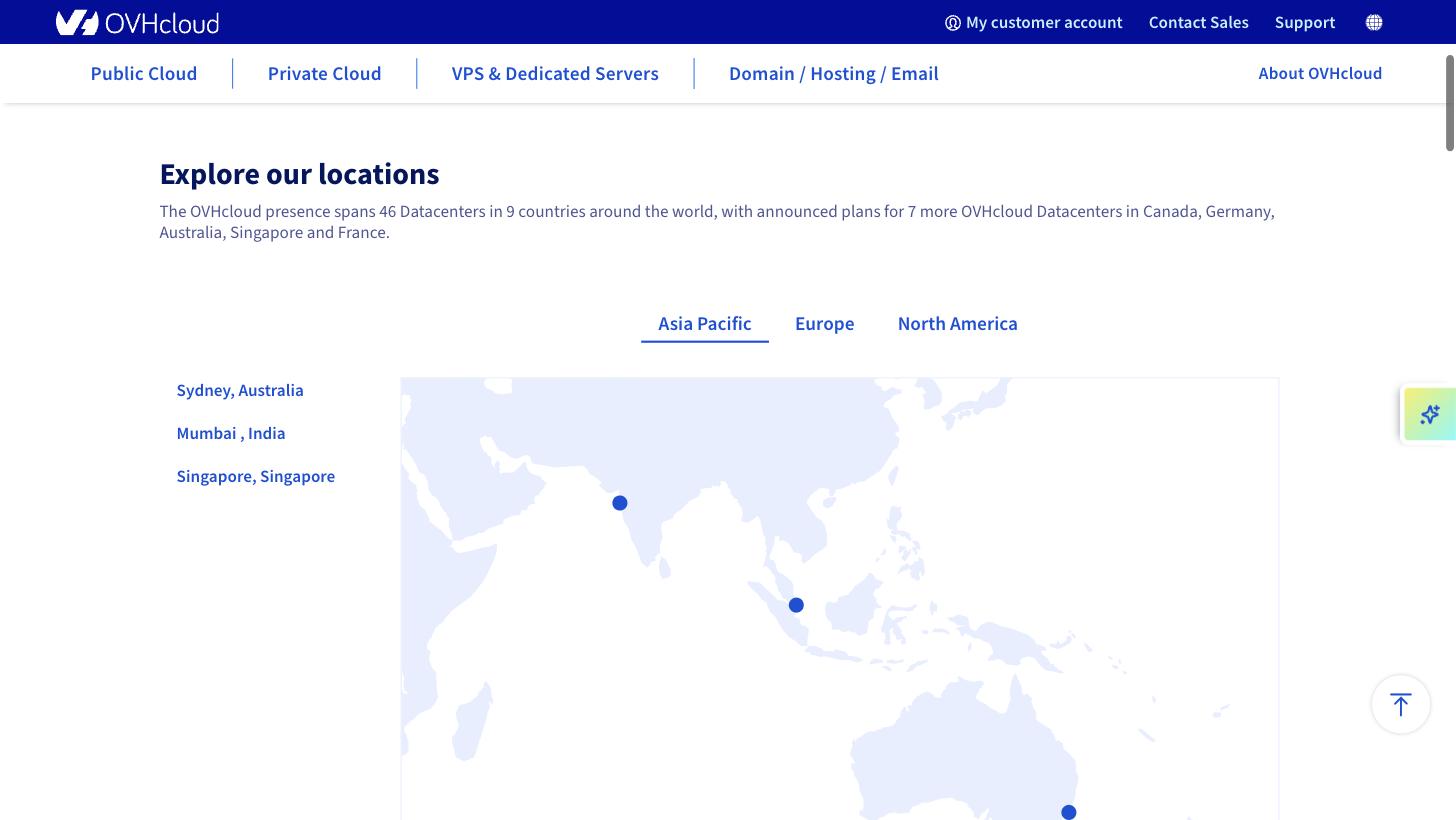
By its own infrastructure pages, OVHcloud operates "46 Datacenters in 9 countries … on 4 Continents" across Europe, North America and Asia-Pacific — its closest regions to China are Singapore and Sydney, and it lists no data center in mainland China. So anything you serve to China leaves the mainland, and that opens two doors in order. First, a public-facing site or app served to users in China must carry an ICP filing, and that filing can only attach to a licensed mainland host — which OVHcloud's overseas data centers are not — so an OVHcloud-only deployment has no lawful way to be served, filed, from inside China. Second, if your application stores personal information collected in China, holding it in OVHcloud's European or Asia-Pacific regions is a cross-border transfer of personal information that PIPL governs. The table below is OVHcloud's own wording, the rule each door triggers, and the ICP-filed, in-country path that satisfies them.
This is a risk picture, not a verdict — your obligations turn on whether you serve the public in China, your data volumes, and your role. Our China team can map your exposure with you →
What OVHcloud's documentation says, and what we measured from inside China
| Fact | Primary source |
|---|---|
| In OVHcloud's own words: its infrastructure spans "46 Datacenters in 9 countries … on 4 Continents" across Europe, North America and Asia-Pacific. Its Asia-Pacific data centers are in Singapore, Sydney and Mumbai; it lists no data center in mainland China (nor Hong Kong), and the nearest to the mainland is Singapore. | OVHcloud — Datacenter locations and Global-infrastructure / regions pages, retrieved 2026-10-07 |
| To provide internet information services from inside mainland China you must complete an ICP filing (备案): State Council Decree 292 requires it, and MII Decree 33 (now under MIIT), Article 18 prohibits any mainland access or hosting provider from carrying an unfiled site. A filing therefore binds to a licensed mainland host — and OVHcloud operates none, so a site served only from its overseas data centers cannot be lawfully filed and served from inside China. | State Council Decree 292 (2000); MII Decree 33 (2005), Articles 5 and 18 |
| If your OVHcloud-hosted application stores or processes personal information collected in mainland China, keeping it in OVHcloud's European, North-American or Asia-Pacific regions is a cross-border transfer under PIPL (Chapter III, Articles 38–43): it requires notice, separate consent, and one of the permitted transfer mechanisms. A CIIO or large-volume handler must additionally store that data inside mainland China (CSL Article 39 (formerly Article 37); PIPL Article 40) — an obligation no overseas OVHcloud region can meet. | PIPL Chapter III, Articles 38–43 and Article 40; Cybersecurity Law Article 39 (formerly Article 37) |
| OVHcloud completed only 1 of 3 page loads from a probe inside mainland China (Alibaba Cloud cn-zhangjiakou) on 2026-08-28, with a median time to first byte of 170ms. Delivery into China is unsettled on its own — but that is the second question here; the operating-permission and data-residency doors above are decided first. | 21YunBox — 280-site China delivery census, measured from inside mainland China |
Sources verified by the 21YunBox compliance team on 2026-10-07.
Whether OVHcloud “works” in mainland China is a compliance question before it is a performance one. And for OVHcloud the question is settled by a single fact on its own infrastructure pages: it runs no data center inside the mainland. Everything you serve to China from OVHcloud is delivered from offshore — and that opens two doors, in order: one about the permission to operate inside China, and one about where your users’ data is allowed to live.
OVHcloud China at a glance
| What decides it | In OVHcloud's own terms |
|---|---|
| Where it runs | Data centers across Europe, North America and Asia-Pacific — with no region in mainland China. |
| Nearest to the mainland | Its Asia-Pacific data centers are Singapore, Sydney and Mumbai; the closest to China is Singapore. None sit in mainland China or Hong Kong. |
| Serving the public | A public-facing site served to China needs an ICP filing — which binds to a licensed mainland host OVHcloud does not operate. |
| Where your data sits | Personal information collected in China stays in OVHcloud's European or Asia-Pacific regions — a cross-border transfer PIPL governs. |
| ICP on OVHcloud alone | No lawful way to be filed and served from inside the mainland on overseas data centers. |
Door one — OVHcloud has no ICP-filed home inside the mainland
OVHcloud runs no data center inside mainland China. By its own infrastructure pages it operates data centers across Europe, North America and Asia-Pacific — its closest regions to the mainland are Singapore and Sydney, with Mumbai also in Asia-Pacific. None sit in mainland China or Hong Kong. So a public-facing site or app you serve to users in China is served from offshore.
That is where the first door opens. To provide internet information services from inside the mainland, a site must carry an ICP filing: State Council Decree 292 requires it, and MII Decree 33 (now under MIIT), Article 18, bars any mainland access or hosting provider from carrying an unfiled site. A filing can only attach to a licensed mainland host — which OVHcloud’s overseas data centers are not — so an OVHcloud-only deployment has no lawful home to be filed and served from inside China. “We’re already on OVHcloud” does not carry across the border.
Door two — your China data lives offshore on OVHcloud
Keep serving China from OVHcloud and, if your application stores personal information collected in the mainland, that data sits in OVHcloud’s European or Asia-Pacific regions. Under China’s Personal Information Protection Law that is a cross-border transfer: the handler — you, not OVHcloud — must give notice, obtain separate consent, and satisfy one transfer mechanism (a CAC security assessment, the CAC standard contract, or certification). A critical information infrastructure operator or large-volume handler must additionally store personal information collected in China inside the mainland (Cybersecurity Law Article 39 (formerly Article 37); PIPL Article 40) — an obligation no overseas OVHcloud region can meet.
None of this is a verdict. Which door applies to you — and how heavily — depends on whether you serve the public in China, how much personal data you hold, and your role under the law, so it is worth settling with counsel before you commit.
Where 21YunBox fits — a compliant overlay, not a migration
You keep your OVHcloud stack exactly where it is. We add the one thing its overseas data centers can’t give you: ICP-filed, in-country delivery, sitting ahead of your OVHcloud origin so requests from China resolve to licensed mainland infrastructure — without a rebuild, a migration, or a second codebase. Our China team works out which door applies to you, weighs your PIPL cross-border and data-residency exposure against your entity and data volumes, and stands up the filed in-country delivery and storage a lawful China presence needs.
Related reading: