Does Captivate Work in China? ICP, PIPL & an Offshore Podcast Host
Captivate is a UK-run, offshore podcast host with no mainland-China region — its own privacy policy says your data may be processed in the U.S. So a China-facing show is reachable but served offshore, the page that distributes the feed has no ICP-filing path, and your listeners' data crosses the border under PIPL. A compliance-first look.
Does Captivate work in China?
Reachable, but not a China presence. Captivate is an offshore podcast host with no mainland-China region, so the question is not whether an episode plays — it is whether collecting your Chinese listeners' data offshore, and serving the show from outside the mainland, is compliant.
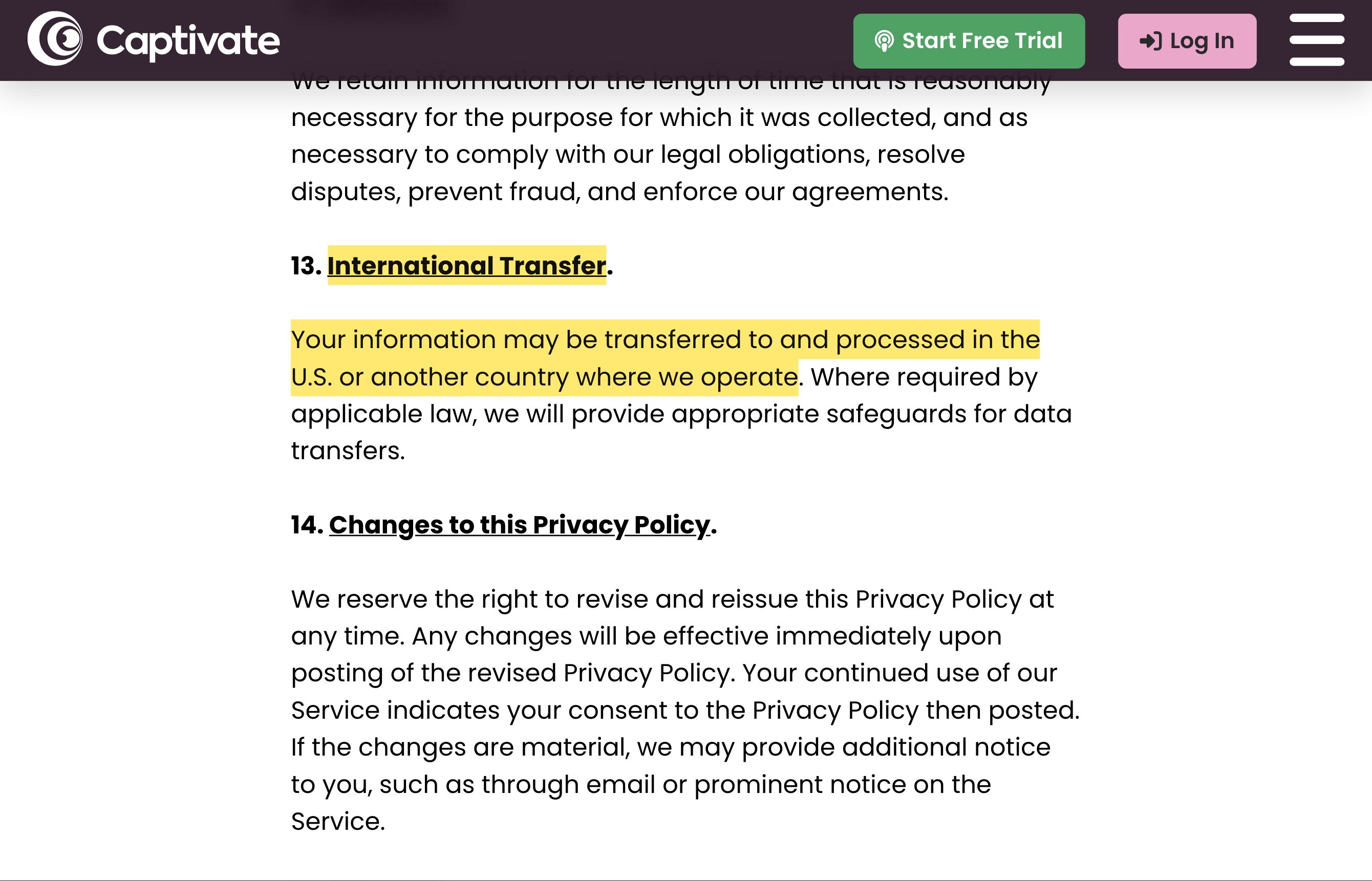
Captivate's own privacy policy says your information "may be transferred to and processed in the U.S. or another country where we operate," and that it collects each listener's "device's IP address, browser identifiers, user-agent strings," non-precise location and "podcast download metrics." Gathered from users in mainland China and held offshore, that is a cross-border transfer of personal information PIPL governs (notice, separate consent and a transfer mechanism, Articles 38–43); and the public page that embeds the player or publishes the RSS feed is served from outside the mainland, where it cannot hold an ICP filing. The table below pairs Captivate's own words with the rule each one triggers.
This is a risk map, not a verdict — what applies turns on who your listeners are, how much data you hold, and whether your show falls under China's online audio-visual rules. Our China team can map your exposure with you →
Compliance snapshot
- ! Listener IP, location and download data from China lands offshore — a PIPL cross-border transfer
- ! Captivate's own policy: data may be processed "in the U.S." — no mainland-China region
- ✕ The page that distributes the feed is served offshore — no ICP-filing path
- ! Online audio distribution to a mainland audience may touch China's audio-visual rules
- ! Audio and the RSS feed are delivered from offshore origins — a delivery exposure, not the legal one
What Captivate's own documentation says about China
| Fact | Primary source |
|---|---|
| Captivate is an offshore podcast host, not a China presence. Captivate describes itself as "Podcast hosting to manage, grow and monetize your podcast," distributing episodes "to leading directories including Apple Podcasts, Spotify, YouTube and Amazon." It publishes no mainland-China region, and its privacy policy states your information "may be transferred to and processed in the U.S. or another country where we operate" (that it runs no China region is an inference from the locations it names, not a line in the policy). | Captivate (captivate.fm) — homepage & Privacy Policy, retrieved 2026-10-07 |
| Your Chinese listeners' personal data is collected into an offshore system. Captivate's privacy policy says it collects a listener's "device's IP address, browser identifiers, user-agent strings," "non-precise location data" and "podcast download metrics, impression counts, completion metrics," and notes that "Because we operate globally, the personal data we collect from you may be transferred to and processed by us." Collected from users in mainland China and stored offshore, that is a cross-border transfer of personal information under PIPL — notice, separate consent and a transfer mechanism, Articles 38–43. | Captivate (captivate.fm) — Privacy Policy, retrieved 2026-10-07; PIPL Articles 38–43 |
| An offshore host cannot give you in-country data residency. Captivate names the U.S. as a processing destination and leans on the "EU-U.S. Data Privacy Framework (DPF)" for its EEA/UK transfers — safeguards built for GDPR and UK law, not for China. None of them stores your Chinese listeners' data in the mainland, so if you are a critical information infrastructure operator or a large-volume handler, the rule that personal information collected in China be stored in China (PIPL Article 40; Cybersecurity Law Article 39 (formerly Article 37)) is one an offshore host structurally cannot meet. | Captivate (captivate.fm) — Privacy Policy, retrieved 2026-10-07; PIPL Article 40; Cybersecurity Law Article 39 (formerly Article 37) |
| The page that distributes your feed is where the ICP and content doors open. A website that embeds Captivate's player or republishes its RSS feed to a mainland audience is a public-facing internet information service; served from offshore it has no path to the ICP filing a mainland site requires (State Council Order No. 292; MIIT Order No. 33). Distributing online audio programs to a mainland audience can also fall under China's internet audio-visual program regime (SARFT/MII Order No. 56) — a point to settle with counsel, not a given. | Captivate (captivate.fm) — homepage, retrieved 2026-10-07; State Council Order No. 292; MIIT Order No. 33; SARFT/MII Order No. 56 |
Sources verified by the 21YunBox compliance team on 2026-10-07.
For a mainland-China audience, the deciding question about Captivate is not whether an episode plays — it is whether you are allowed to collect your Chinese listeners’ data the way Captivate does, and to serve your show the way it is served. Captivate is an offshore podcast host: it keeps your audio, your subscriber records and your listener analytics outside mainland China, and its own privacy policy says that information may be processed in the United States. Reaching Chinese listeners is the straightforward half. The ICP filing the distributing page needs, and the cross-border handling of every listener’s IP address and download, are where the exposure actually sits.
Captivate in China at a glance
| What decides it | In Captivate's own terms |
|---|---|
| Where it runs | An offshore host — the controller is “Captivate.fm” at 30 Leicester Square, London, and the policy says data “may be transferred to and processed in the U.S. or another country where we operate.” No mainland-China region is published. |
| Your listeners' data | Captivate collects each listener's “device's IP address, browser identifiers, user-agent strings,” “non-precise location data” and “podcast download metrics, impression counts, completion metrics.” |
| Where that data lands | Outside mainland China. The policy names the U.S. as a destination and leans on the “EU-U.S. Data Privacy Framework (DPF)” for EEA/UK transfers — frameworks built for GDPR, not a China-residency option. |
| Serving the public | A mainland-facing page that embeds the player or publishes the RSS feed is a public internet information service; served offshore, it has no ICP-filing path. |
| Audio-visual content | Distributing online audio programs to a mainland audience can touch China's internet audio-visual program regime (SARFT/MII Order No. 56) — worth confirming with counsel. |
Door one — your listeners’ data is collected and held offshore
Captivate’s business is hosting and measurement, and both touch personal data. Its privacy policy says it records each listener’s “device’s IP address, browser identifiers, user-agent strings,” “non-precise location data” and “podcast download metrics, impression counts, completion metrics” — and that, “Because we operate globally,” the personal data it collects “may be transferred to and processed” by Captivate, including “in the U.S. or another country where we operate.” For an audience in mainland China, that flow is exactly what China’s Personal Information Protection Law treats as a cross-border transfer: before the data leaves, the handler — you, not Captivate — has to give notice, obtain separate consent, and clear one transfer mechanism (a CAC security assessment, the CAC standard contract, or certification) under Articles 38–43. Captivate’s published safeguards — the EU-U.S. Data Privacy Framework and standard contractual clauses — are instruments of GDPR and UK law; they are not a mechanism China recognises, and they do not put the data in the mainland.
Door two — the page that distributes the feed needs an ICP filing
Captivate holds the audio and generates the RSS feed, but the surface a Chinese regulator looks at is the public page your listeners land on — the site that embeds Captivate’s player, or that publishes the feed to a mainland audience. That page is a public-facing internet information service, and delivering it to mainland visitors turns on an ICP filing (ICP 备案) under State Council Order No. 292 and MIIT Order No. 33, a filing that has to attach to a hosting resource physically inside the mainland. An offshore origin gives it nothing to attach to. So “our podcast is already live on Captivate” does not settle the China question: a feed being reachable is a different thing from the distributing page being cleared to operate, and no amount of tuning the hosting setup creates the mainland footing a filing requires.
A content door to check, not assume
There is a third consideration that is easy to miss and just as easy to overstate: China regulates internet audio-visual program services. The Provisions on the Administration of Internet Audio-Visual Program Services (SARFT/MII Order No. 56) sit over online audio and video distributed to a mainland audience, and depending on what your show is and how it reaches listeners, it may fall within that regime. This one is genuinely for counsel — scope, licensing and enforcement here are fact-specific — so we flag it as a risk to assess, not a verdict to assume. The honest point is only that distributing a podcast into China can engage a content regulator alongside the data and licensing rules, and a proper review should weigh all three rather than stop at hosting.
Reachability itself is the smallest part. Captivate is a mainstream global host, not a service built on a China-specific partition, so its feed is fetched over the open internet rather than blocked outright; the audio and the feed are simply delivered from offshore origins. That is a delivery consideration — distance and dependence on a cross-border path — and it is separate from, and smaller than, the legal exposure above. Whether people can hear the episode is not what decides whether you may lawfully run the show in China.
This is a risk map, not a verdict: whether you need a China-recognised transfer mechanism, in-country data residency, an ICP filing on the distributing page, or a content-rules review depends on who your listeners are, how much personal data you hold, and what your show publishes — all worth settling with counsel before you scale into the mainland.
Where 21YunBox fits — a compliant overlay, not a migration
Nothing moves off Captivate. You go on producing, hosting and distributing there exactly as you do now, and we add the parts an offshore podcast host structurally cannot: compliant, ICP-filed delivery from inside the mainland, set in front of the page that distributes your feed — no rebuild, no second codebase, and no move off Captivate. Our China team maps your PIPL cross-border and data-residency obligations against your entity and your listener volumes, flags whether your distribution could engage China’s audio-visual content rules, and stands up the in-country delivery and storage a lawful China presence needs, while your show stays right where you already publish it.
Related reading:
Frequently Asked Questions
Is my podcast blocked in China if I host it on Captivate?
Keep reachability and compliance separate. Captivate is a legitimate global host, and its feed is fetched over the open internet rather than from a China-specific partition, so the usual issue is not a clean on/off block — it is that your audio and your listeners' data are served from outside the mainland. Even an episode that plays can be delivered in a way that is not compliant, because the axis that decides "does it work in China" is legal risk — ICP and cross-border data — not whether the file arrives.
We only host audio — does PIPL really apply to us?
If people in mainland China listen, it is worth assessing. Captivate's own policy says it collects each listener's IP address, user-agent, non-precise location and download metrics, and that data "may be transferred to and processed in the U.S." Personal information gathered from individuals in China and sent offshore is a cross-border transfer PIPL governs — notice, separate consent and a transfer mechanism (Articles 38–43) — whether or not you also run listener logins or store names. Whether a data-localization duty applies on top turns on your role and your data volumes.
Can 21YunBox help us keep the show on Captivate and make the China side compliant?
Yes. You keep producing, hosting and distributing on Captivate. Our China team maps your PIPL cross-border and data-residency exposure for your entity, your listeners and your data volumes, flags whether your distribution could touch China's online audio-visual rules, and stands up the ICP-filed, in-country delivery a compliant mainland presence needs — placed in front of your existing setup, with no rebuild and no second codebase. Get in touch to work through your specific case.