Does Pinecone Work in China? Vector Data Residency & PIPL
Pinecone runs no index region inside mainland China — your serverless indexes live in AWS, GCP or Azure regions across the US, Europe and Singapore, all offshore — so the embeddings and metadata it holds for your Chinese users are a PIPL cross-border transfer with a data-localization question attached. A compliance-first look.
Does Pinecone work in China?
Pinecone runs only in offshore cloud regions — AWS, GCP and Azure across the US, Europe and Singapore, with none inside mainland China — so the vectors and metadata it holds for your Chinese users live offshore, and that is a cross-border transfer of personal information under PIPL, not a performance footnote.
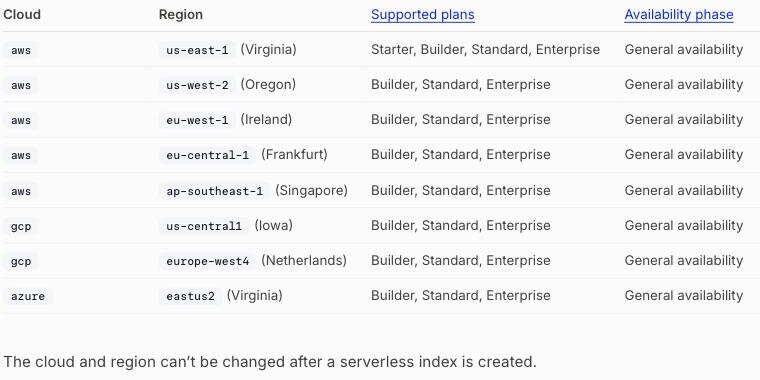
In Pinecone's own documentation, "Pinecone runs as a managed service on AWS, GCP, and Azure cloud platforms," and when you create an index "you must choose the cloud and region where you want the index to be hosted" — a menu that runs from Virginia to Ireland, Frankfurt and Singapore, where "the cloud and region can't be changed after a serverless index is created." Because an embedding and its metadata are derived from a person's message, profile or document, they stay personal information — so holding them in an offshore region is a cross-border transfer under PIPL (notice, separate consent and a transfer mechanism, Articles 38–43), with an in-mainland storage duty for CIIOs and large-volume handlers (Article 40; Cybersecurity Law Article 39 (formerly Article 37)). An ICP filing is not Pinecone's door — a database serves no public site — so that obligation sits on the app in front of it. The table below is Pinecone's own wording and the rule each line triggers.
This is a risk map, not a verdict — which transfer mechanism fits, and whether a localization duty applies, turns on your entity, your data volumes and whose data it is. Our China team can map your exposure with you →
What Pinecone's own documentation says about China
| Fact | Primary source |
|---|---|
| Pinecone runs only on offshore cloud regions — none in mainland China. Its docs say that when you create an index, "you must choose the cloud and region where you want the index to be hosted," and the published menu spans AWS, GCP and Azure — Virginia, Oregon, Ireland, Frankfurt, Singapore, Iowa and the Netherlands. Not one is inside mainland China, and "the cloud and region can't be changed after a serverless index is created." | Pinecone Docs — Available cloud regions (docs.pinecone.io), retrieved 2026-10-07 |
| Your vectors physically rest in the region you pick — Pinecone is a managed service on US, EU and Singapore clouds. Its architecture docs state "Pinecone runs as a managed service on AWS, GCP, and Azure cloud platforms," that "the data plane handles all requests to write and read records in indexes within a specific cloud region," and that "all your vector data is stored in highly efficient, distributed object storage." The data does not merely pass through a region; it lives there — and Pinecone offers none in the mainland. | Pinecone Docs — Architecture (docs.pinecone.io), retrieved 2026-10-07 |
| A vector is still personal information when it is derived from a person's data. An embedding is computed from a user's message, profile or document, and Pinecone indexes routinely carry metadata like user IDs and text snippets — so an index built for Chinese users holds their personal information in transformed form. Keeping it in an offshore region makes it a cross-border transfer under PIPL: you — the handler, not Pinecone — must give notice, obtain separate consent and satisfy one transfer mechanism (Articles 38–43). | Pinecone Docs — Architecture & data model (docs.pinecone.io), retrieved 2026-10-07; PIPL Articles 38–43 |
| For some handlers the data must stay in China — and Pinecone has nowhere in-country to keep it. If you are a critical information infrastructure operator, or you process personal information above the regulators' volume thresholds, China-collected personal data must be stored in the mainland (PIPL Article 40; Cybersecurity Law Article 39 (formerly Article 37)). Pinecone's region list — AWS, GCP and Azure across the US, Europe and Singapore — has no mainland option that can satisfy that duty. | Pinecone Docs — Available cloud regions (docs.pinecone.io), retrieved 2026-10-07; PIPL Article 40; Cybersecurity Law Article 39 (formerly Article 37) |
| ICP filing is the application's door, not Pinecone's. Pinecone describes itself as a "managed service" reached over an API, and a vector database serves no public website of its own — so it triggers no ICP filing (ICP 备案, under State Council Order No. 292 and MIIT Order No. 33). That obligation attaches to the public-facing app in front of Pinecone, if it serves a mainland audience. Pinecone's compliance weight sits in one place instead: data residency. | Pinecone Docs — Architecture (docs.pinecone.io), retrieved 2026-10-07; State Council Order No. 292; MIIT Order No. 33 |
Sources verified by the 21YunBox compliance team on 2026-10-07.
For a China-facing application, the deciding question about Pinecone is not how fast it returns a nearest-neighbor match — it is where the vectors behind that match are allowed to live. Pinecone is a managed vector database: it holds the embeddings and metadata your app builds from user messages, profiles and documents, which means it holds personal information about your Chinese users in a transformed form. Pinecone answers the residency question plainly in its own documentation — every index runs in a cloud region you choose at creation, across AWS, GCP and Azure in the US, Europe and Singapore, with none inside mainland China. The service is reachable as an API; the exposure is that the personal data embedded in it sits offshore, where China’s cross-border and data-localization rules reach it.
Pinecone in China at a glance
| What decides it | In Pinecone's own terms |
|---|---|
| Where it runs | Serverless indexes run on AWS, GCP and Azure — Virginia, Oregon, Ireland, Frankfurt and Singapore (AWS), Iowa and the Netherlands (GCP), and Virginia (Azure). All are offshore; no region is inside mainland China. |
| Where your data physically sits | “The data plane handles all requests to write and read records in indexes within a specific cloud region,” and “all your vector data is stored in highly efficient, distributed object storage.” Your vectors rest in the region you chose — and Pinecone offers none in the mainland. |
| What the index is holding | Embeddings built from users' messages, profiles and documents, plus metadata that routinely includes user IDs and text snippets — personal information in transformed form. For Chinese users, holding it offshore is a cross-border transfer PIPL governs (Articles 38–43). |
| Data localization | A CIIO or large-volume handler must keep China-collected personal data in the mainland (PIPL Article 40; Cybersecurity Law Article 39 (formerly Article 37)). Pinecone has no in-China region to satisfy it. |
| ICP filing | Not Pinecone's door. A vector database serves no public site, so the ICP filing a mainland audience needs sits on the application in front of your index, not on Pinecone. |
No mainland region, so your vectors can’t sit in China
Pinecone runs your index on Amazon Web Services, Google Cloud or Microsoft Azure, in whichever region you select when the index is created. Its published region list spans the US, Europe and — now — Singapore: in AWS, Virginia, Oregon, Ireland, Frankfurt and Singapore; in GCP, Iowa and the Netherlands; in Azure, Virginia. Mainland China is not among them, and Pinecone is explicit that the choice is fixed — “the cloud and region can’t be changed after a serverless index is created.” Its architecture docs go further on where the records actually live: “the data plane handles all requests to write and read records in indexes within a specific cloud region,” and “all your vector data is stored in highly efficient, distributed object storage.” So the data does not merely pass through a region — it rests there. Pick any region Pinecone offers for a China-facing app and your users’ vectors are bound to a place outside the mainland. This is the data-residency question in its plainest form: the index is not a cache in front of your data, it is your data, and Pinecone has nowhere in China to keep it.
”It’s just vectors” doesn’t take it outside PIPL
It is tempting to treat a vector index as exempt — it stores arrays of floating-point numbers, not names and addresses. That instinct is wrong in the way that matters here. An embedding is computed directly from a person’s message, profile, support ticket or document; it is a mathematical derivative of that personal data, kept precisely because it preserves the meaning of the original. Alongside it, Pinecone indexes almost always carry metadata — user IDs, source text, timestamps — so a match can be tied back to a record. Put together, an index built from Chinese users’ activity holds their personal information, transformed but not anonymized. China’s Personal Information Protection Law reaches it accordingly: storing that index in an offshore Pinecone region is a cross-border transfer of personal information, and the handler — you, not Pinecone — must give notice, obtain separate consent, and clear one transfer mechanism (a CAC security assessment, the CAC standard contract, or certification) under Articles 38–43. If you are a critical information infrastructure operator or a large-volume handler, that data must also be stored in the mainland (PIPL Article 40; Cybersecurity Law Article 39 (formerly Article 37)) — a residency duty no offshore region can meet.
ICP isn’t Pinecone’s door — and that’s worth saying plainly
It would be easy to staple an ICP warning onto every China page, but on Pinecone it would be misplaced. An ICP filing (ICP 备案) under State Council Order No. 292 and MIIT Order No. 33 attaches to a public-facing website and the mainland hosting that delivers it — and a vector database delivers no public site of its own. That obligation therefore lives on the application sitting in front of your Pinecone index, if that application serves a Chinese audience, not on the database layer. Naming this precisely is the point: Pinecone’s compliance weight is concentrated in one place — data residency — and blurring a storage question into a licensing one only hides where the real exposure is.
This is a risk map, not a verdict: whether a localization duty applies, and which cross-border mechanism fits, turns on your entity, how much personal data you hold, and whose it is — worth settling with counsel before you build.
Where 21YunBox fits — a compliant overlay, not a migration
Pinecone stays your vector database; nothing moves. What we add is the piece a managed index cannot carry on its own — compliant, ICP-filed delivery from inside the mainland for the application that queries your vectors, plus any in-China storage your residency obligations call for — wrapped around the stack you already run, with no rebuild and no second codebase. Our China team works out your PIPL cross-border and data-localization position for your entity and data volumes, then stands up the in-country delivery and storage a lawful China presence requires, while your index keeps running exactly where it is.
Related reading: