What Vercel's own documentation says about China
| Fact | Primary source |
|---|---|
Vercel states directly that it has no infrastructure in mainland China: "Vercel does not have servers or CDN nodes in mainland China." It also notes China's network controls may block or throttle foreign domains, including .vercel.app subdomains. | Vercel — Accessing Vercel-hosted sites from mainland China |
| Vercel's published region list contains 20 compute-capable regions and no mainland China entry. The nearest are hkg1 (Hong Kong), hnd1 and kix1 (Japan), icn1 (Seoul) and sin1 (Singapore) — all on the far side of the Great Firewall from a mainland user. | Vercel — Global network and regions |
| Vercel confirms the regulatory gate applies to any in-country delivery: "Hosting within China requires an ICP license and adherence to local compliance requirements." An ICP filing requires a mainland China legal entity. | Vercel — Accessing Vercel-hosted sites from mainland China |
Sources verified by the 21YunBox China engineering team on 2026-08-27.
TLDR; This Vercel China article provides you with a simple solution to get your Vercel powered websites fast, stable, and compliant in China.
Vercel is candid that it has no points of presence in mainland China, and it advises against putting a generic layer in front of a deployment. That gap is exactly what 21YunBox is built for: you keep deploying to Vercel — it stays your origin and source of truth — and the 21YunBox Optimizer delivers your existing site inside mainland China, compliantly. The same in-country delivery that removes the cross-border round trip is what an ICP filing attaches to, so speed and compliance are one decision, not two.
Understanding Vercel and Its Limitations in China
What is Vercel and Why It’s Popular Globally
Vercel is a cutting-edge cloud platform that revolutionizes static and dynamic site hosting. Known for its seamless integration with popular frameworks like Next.js, Vercel offers powerful features including:
- Automatic deployments triggered by Git pushes
- Built-in CI/CD pipeline for streamlined development
- Global CDN for fast content delivery worldwide
- Serverless functions for dynamic capabilities
These features make Vercel a go-to choice for developers seeking efficient, scalable hosting solutions.
The Challenge: Vercel’s Performance Issues in China
Despite its global success, Vercel faces significant hurdles in China:
-
Lack of Local Infrastructure: Vercel doesn’t operate servers within mainland China, leading to increased latency.
-
Great Firewall Impact: China’s internet regulations can interfere with Vercel’s CDN and serverless functions.
-
Unstable Connections: Users in China often experience slow load times and intermittent accessibility issues with Vercel-hosted sites.
-
Compliance Concerns: Vercel’s global infrastructure doesn’t address China’s strict website hosting regulations.
As a result, while Vercel sites perform excellently worldwide, they struggle to deliver a satisfactory user experience within China’s unique digital landscape.
Vercel works great globally, but not in China
Vercel has revolutionized web development and hosting for many developers worldwide. Its seamless integration with popular frameworks like Next.js, and its global CDN make it an excellent choice for most markets. However, China presents unique challenges that Vercel’s infrastructure isn’t equipped to handle.
The Great Firewall of China significantly impacts the performance of websites hosted outside the country. This includes Vercel-hosted sites, which can experience:
- Slow and, more importantly, variable loading times: the same page can be tolerable in the morning and unusable in the evening, because the bottleneck is a congested border crossing rather than a fixed distance.
- Intermittent availability: Connections may time out or fail unpredictably.
- Incomplete asset loading: Images, scripts, or stylesheets may fail to load, breaking site functionality.
These issues stem from China’s complex internet infrastructure and regulations, which Vercel’s current setup doesn’t account for.
Don't let the Great Firewall slow you down
Get your Vercel site optimized for China's unique internet landscape
Optimize My SiteLegal and Compliance Challenges
Beyond performance issues, websites operating in China face significant legal and compliance hurdles:
-
ICP License Requirement: To legally operate a website in China, you need an Internet Content Provider (ICP) license. Vercel doesn’t provide this, leaving your site potentially vulnerable to being taken offline.
-
Content Regulations: China has strict content regulations. Websites must comply with local laws, which can be challenging to navigate without local expertise.
-
Data Localization Laws: Certain types of data must be stored on servers within China, which Vercel’s global infrastructure doesn’t accommodate.
-
Censorship Concerns: The Great Firewall may block certain content or services commonly used in Western web development, potentially breaking site functionality.
Navigating these challenges requires a solution tailored specifically for the Chinese market, which is where 21YunBox comes in.
Speed test results of websites deployed with Vercel and 21YunBox in China
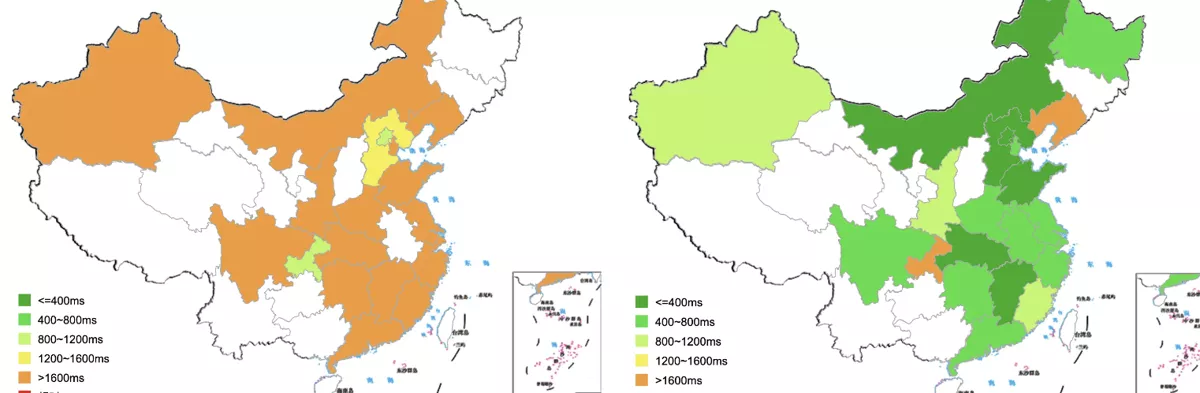
The color results means: green being faster, and red being extremely slow or even inaccessible. As you can see, the site deployed with Vercel in China performs much slower than 21YunBox.
Make your web app work properly in mainland China.
Get started now, and our staff will assist your journey in China.
Get Started NowHow to Improve the Access Speed of Vercel in China?
While there are several approaches to improving website speed in China, many come with significant drawbacks or complexity. Let’s explore the options and see why 21YunBox offers the most comprehensive solution.
Traditional Approaches and Their Limitations
-
Using China-based cloud storage (e.g., Alibaba Cloud OSS, AWS S3 China):
- Pros: Improved speed for static assets
- Cons: Complex setup, lack of CI/CD integration, doesn’t solve dynamic content issues
-
Putting your own intermediary layer in China:
- Pros: Can improve access speeds
- Cons: Technically challenging, requires ongoing maintenance, doesn’t address compliance issues
-
Building a separate version of the site for China:
- Pros: Can be optimized for Chinese users
- Cons: Doubles development effort, creates synchronization challenges
These methods often fall short in providing a complete solution that addresses both performance and compliance issues while maintaining the developer experience you’re accustomed to with Vercel.
The Simple and Cost-Effective Way: 21YunBox
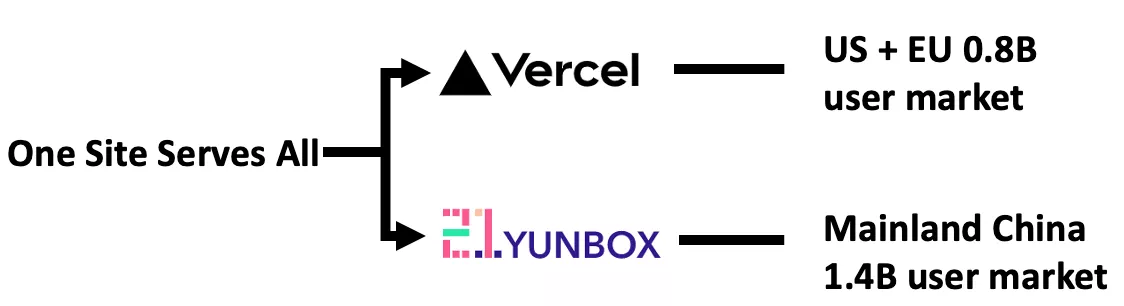
There are two ways to run on 21YunBox, and both keep Vercel as your origin and source of truth — no rebuild, no migration, no forked codebase. Most teams use the 21YunBox Optimizer, a China delivery overlay that sits in front of your existing Vercel deployment. Teams that want source-level control of a dedicated China build pipeline can instead use 21YunBox Build & Deploy.
21YunBox Build & Deploy — a China build pipeline (for source-level control)
This is the specialized option — most teams use the 21YunBox Optimizer overlay described below. For teams that want a “Vercel deploy” experience running inside China, Build & Deploy gives you full control at the source-code level while addressing the compliance, connectivity, and loading issues caused by the Great Firewall.
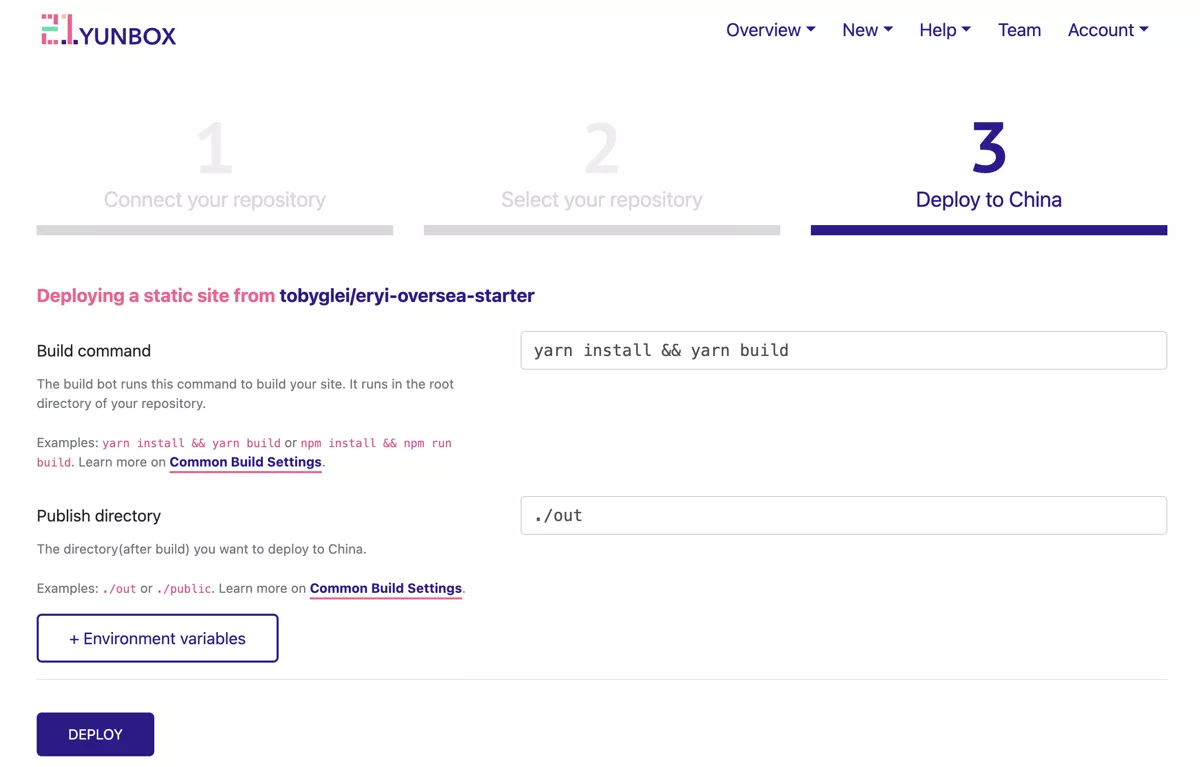
Key benefits:
- Seamless CI/CD integration
- Automatic compliance with Chinese regulations
- Optimized performance through local CDN
Deploy your Vercel site in China with ease
Experience Vercel-like deployment with China-specific optimizations
Start Building for ChinaThe 21YunBox Optimizer — a China delivery overlay (what most teams use)
The Optimizer sits in front of your existing Vercel deployment and delivers it inside mainland China. It decides per resource: what already loads fast from inside China stays on its direct path, and only the slow, unstable or blocked parts — including dynamic APIs, which a caching CDN cannot fix — are delivered over our compliant in-country network. Vercel stays your origin and build pipeline; nothing is rebuilt or migrated.
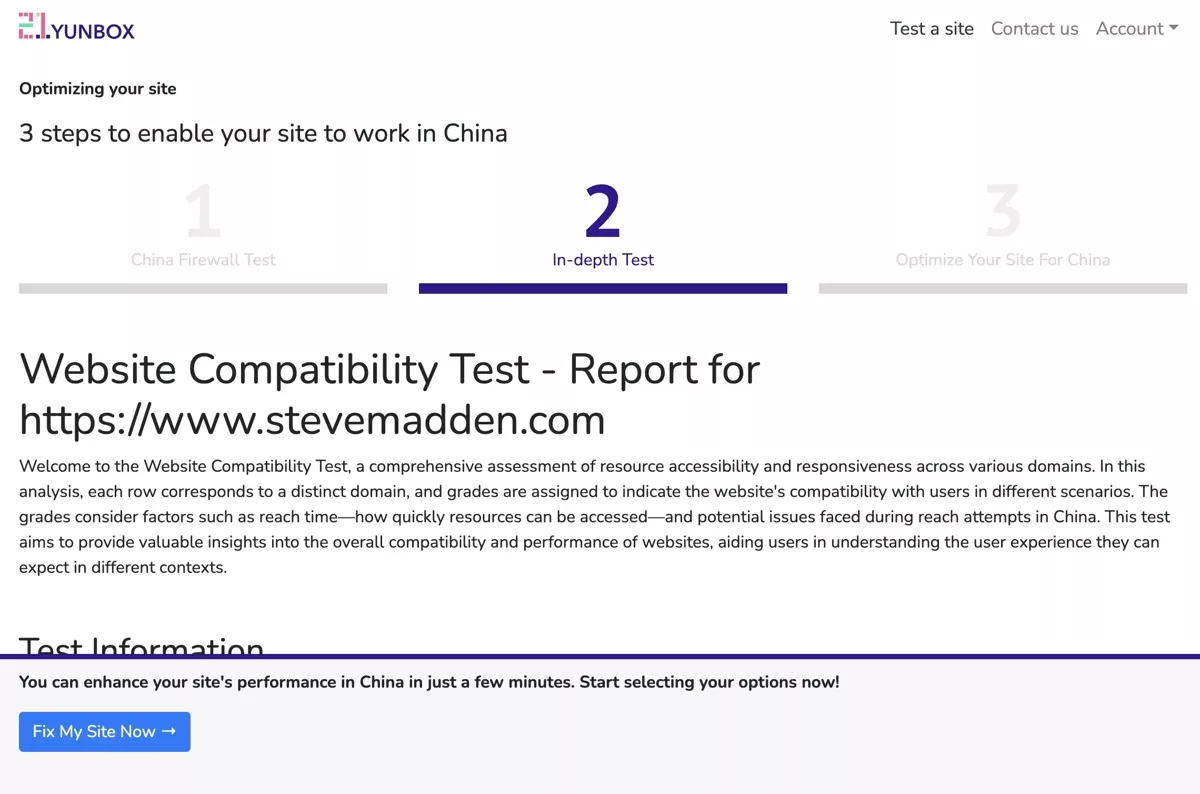
The process is streamlined into three steps:
-
Hosting Infrastructure Evaluation: We analyze your current setup for compatibility with China’s digital landscape.
-
Site Component Analysis: We scan for elements that may be slow or blocked in China.
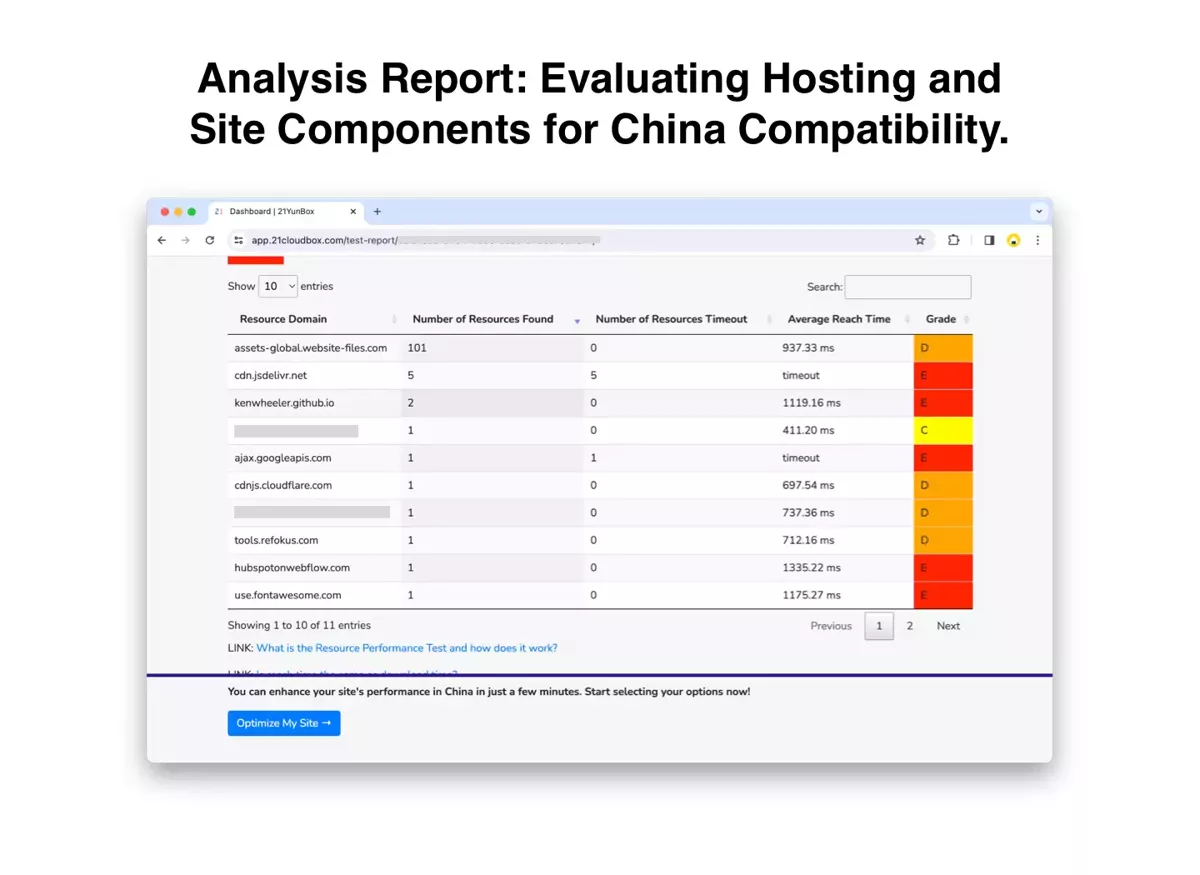
- Optimization Implementation: We optimize your site for China without affecting its performance elsewhere.
This approach requires minimal technical involvement from your team, making it an excellent choice for businesses looking to expand into the Chinese market quickly and efficiently.
Optimize your Vercel site for China without the hassle
Let our experts handle the complexities of China's internet landscape
Get Your China OptimizationCommon CMS and Commerce Challenges with Vercel in China
While Vercel offers excellent global performance, combining it with popular CMS and commerce systems can lead to unique challenges in China. Let’s explore some common scenarios:
Prismic and Vercel: Content Delivery Hurdles
Prismic, a headless CMS popular among Vercel users, faces significant obstacles in China. Our tests reveal that Prismic’s CDN often times out, leaving Chinese users unable to access crucial content.
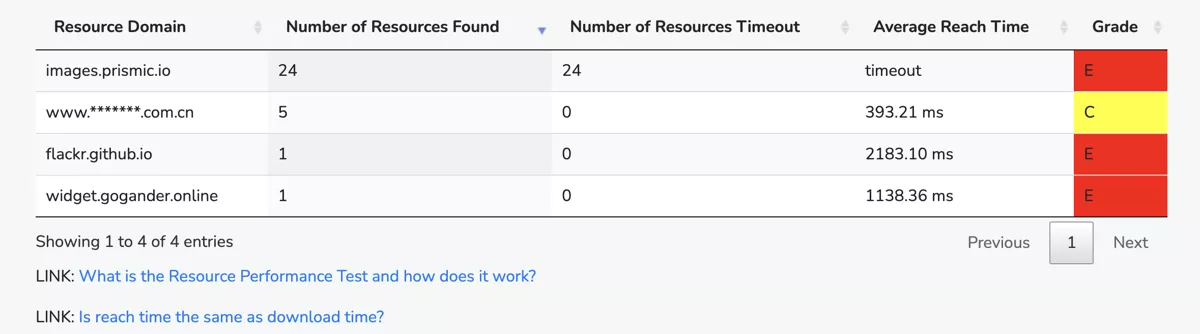
This timeout issue can severely impact your site’s performance and user experience in China, even if your Vercel hosting is optimized for the region.
Get Your Free China Website Performance Report
Discover how your Vercel site performs in China
Get My Free ReportStoryblok and Vercel: Content Accessibility Issues
Storyblok, another popular headless CMS, can also experience difficulties when serving content to Chinese users through Vercel. The Great Firewall can intermittently block or slow down Storyblok’s CDN, resulting in incomplete or slowly loading pages.
Sitecore and Vercel: Enterprise-Level Complications
For enterprise-level websites using Sitecore with Vercel, the challenges are magnified. Sitecore’s complex architecture and resource-heavy nature can lead to significant performance issues in China, where network conditions are less than ideal.
Contentful and Vercel: API and Asset Delivery Challenges
Contentful, known for its robust API-first approach, can encounter API call timeouts and slow asset delivery when accessed from China. This can result in partially loaded pages or missing content, severely impacting user experience.
Headless Shopify with Vercel: E-commerce Roadblocks
For e-commerce sites using a headless Shopify setup with Vercel, performance in China can be particularly problematic. Shopify’s CDN and API calls may experience delays or timeouts, leading to broken product pages, slow checkouts, and lost sales opportunities.
How the Optimizer delivers your whole stack in China
These challenges highlight a crucial point: even with optimized Vercel hosting, your site can still underperform if CMS and commerce system assets aren’t properly served within China. This is where 21YunBox’s Approach #2 – Website Performance Optimization Solution for China – becomes invaluable.
Our solution goes beyond hosting or static caching. Working as an overlay in front of your Vercel origin, the Optimizer delivers everything your pages depend on inside China — not only static assets (CSS, JavaScript, images, video) but the dynamic API calls, forms and third-party services that a caching CDN leaves stranded at the border — while leaving resources that are already fast on their direct path.
Here’s how it works:
- We analyze your entire site structure, including third-party CMS and commerce integrations.
- Our system identifies resources that are likely to be slow or inaccessible in China.
- We implement a China-specific asset delivery network that seamlessly serves these resources to Chinese users.
- Your site maintains its global Vercel setup while gaining optimized performance for the Chinese market.
This approach allows you to leverage the power of your chosen CMS or commerce platform globally while ensuring a fast, reliable experience for your Chinese audience.
Optimize Your Entire Web Stack for China
Ensure your CMS and commerce assets perform flawlessly behind the Great Firewall
Get Started with 21YunBoxBy addressing both Vercel hosting and CMS/commerce asset delivery, 21YunBox provides a comprehensive solution for businesses looking to succeed in the Chinese market. Don’t let the complexities of China’s internet infrastructure hold your digital presence back – optimize your entire web stack with 21YunBox today.
What Vercel itself recommends
Worth reading before evaluating any vendor, including us. Vercel’s own guidance is short:
- Move off
.vercel.apponto your own custom domain, which is less likely to be flagged. Vercel notes that China’s network controls may block or throttle foreign domains, including.vercel.appsubdomains — so staging and preview environments are the most exposed. - Reduce reliance on third-party scripts and services that may be blocked — self-host fonts, analytics and other key resources where possible.
- Vercel advises against putting an intermediary layer in front of a deployment. It notes that some customers have instead improved access by deploying a static mirror on infrastructure with more reliable routing into China, and others maintain a dedicated version of the site on local infrastructure inside mainland China, “which requires an ICP license and compliance with local regulations.”
Both of the first two steps are free, and both are worth doing whatever you decide next. They will not make a dynamic, form-driven site work well in China, but they remove avoidable failure modes.
On that recommendation
21YunBox’s China delivery layer sits in front of the deployment, so Vercel’s guidance is a point against us, and it should be read that way rather than skipped.
The warning is well earned. A layer that blindly forwards everything in front of a Vercel deployment causes exactly the problems Vercel is describing: revalidation stops firing, headers get mangled, content goes stale, and the origin can no longer tell real users apart from the layer in front of it.
What decides the outcome is not the category but whether the layer is engineered for the specific application. The origin has to stay authoritative. ISR and on-demand revalidation have to keep running at the origin, untouched. next/image and middleware have to be left alone. Blocked third-party calls have to be rewritten individually rather than blindly forwarded — and calls that are already fast from inside China have to be left on their direct path. If a vendor cannot explain how they handle revalidation and third-party rewriting on your stack specifically, Vercel’s warning applies to them.
The four paths, compared
| ICP filing needed | Effect on your global stack | Does Vercel document it | |
|---|---|---|---|
| Do nothing, tune what you can | No | None | Yes — custom domain, fewer third parties |
| Near-shore CDN (Hong Kong / Singapore) | No | None | Not recommended — still crosses the border |
| Rebuild a separate site inside China | Yes | A second codebase and content workflow to maintain | Mentioned — “a dedicated version on local infrastructure” |
| China delivery layer over the existing build | Yes | None — Vercel stays origin and source of truth | Mentioned — “a static mirror using infrastructure with more reliable routing” |
The near-shore option is the one most teams try first and the one that disappoints most reliably. Hong Kong and Singapore sit outside the Great Firewall, so the border crossing is still there. It helps static assets and does nothing for APIs, forms, or anything dynamic.
The rebuild option genuinely works, and is genuinely expensive — not in infrastructure but in operations. It means a second codebase, a second content workflow, and a marketing team that publishes twice and has to remember which market gets what.
The ICP gate applies to every path that touches China
Any site actually served from inside mainland China needs a valid ICP filing. Vercel says the same: hosting within China requires an ICP license and adherence to local compliance requirements.
Two details that catch teams out:
- The filing is bound to the hosting/access provider, not only to the domain. Changing where the site is delivered from means an access-provider update to the filing, not just a DNS change. It sits on the critical path and takes weeks, so it should be started early rather than discovered in the final fortnight.
- The filing requires a mainland China legal entity. Companies without one — and with no intention of forming one — cannot obtain a filing directly at all. See China ICP License for Websites.
Conclusion
While Vercel excels in global markets, it faces significant challenges in China. 21YunBox bridges this gap, offering solutions that maintain the developer-friendly experience of Vercel while addressing the unique performance and compliance requirements of the Chinese market.
Whether you choose the hands-on build and deployment approach or the fully managed optimization solution, 21YunBox ensures your Vercel-powered website performs optimally in China, opening up vast opportunities in one of the world’s largest online markets.
Ready to make your Vercel site shine in China? Get started with 21YunBox today and unlock the full potential of your web presence in this crucial market.