
Does Vimeo work in China?
Whether Vimeo works in China is first a reachability question, not a licensing one. Vimeo's player and content delivery network sit offshore, and Vimeo itself says the mainland blocks the service — so an embedded Vimeo video can simply fail to load for your visitors in China.
In Vimeo's own words, "China and Indonesia have currently blocked access to Vimeo," and its standard delivery runs from "a global CDN" that serves "the right rendition from the nearest edge" in places like "Sao Paulo, Singapore, or San Francisco" — none inside the mainland. Vimeo does name one narrow exception: "Vimeo Enterprise users on select plans can deliver on-demand video to employees in China via our in-country content delivery network" — a sales-gated enterprise feature for internal employee video, not the embeddable player most public pages use. There is a secondary, narrower angle too: if your page collects personal data around the video, or relies on Vimeo's offshore infrastructure to serve China viewers, that can be a cross-border transfer under PIPL.
This is a reachability-and-exposure picture, not a verdict — what applies turns on whether your video is public-facing, what data you collect, and your role and volumes. Our China team can map an in-country delivery path with you →
What actually decides whether Vimeo reaches your mainland-China viewers
| Fact | Primary source |
|---|---|
| In Vimeo's own words, the mainland blocks the service. Vimeo's Help Center states, "China and Indonesia have currently blocked access to Vimeo." So a standard embedded Vimeo player, or a link to vimeo.com, can fail to load for visitors inside mainland China regardless of the clip's content — the problem is where the request has to travel, not what the video contains. | Vimeo Help Center — Vimeo availability and regional restrictions, retrieved 2026-10-07 |
| Vimeo's standard delivery is a global, offshore CDN. On its CDN product page Vimeo says "Edge delivery from a global CDN keeps first-frame latency low for every viewer, whether they're in Sao Paulo, Singapore, or San Francisco," and that the player "serves the right rendition from the nearest edge." None of the edges Vimeo names is in mainland China. [Inference: with delivery pinned to offshore edges and no mainland presence in the standard product, a China viewer's request still has to leave the mainland to reach the video.] | Vimeo — CDN video hosting product page, retrieved 2026-10-07 |
| The only in-China delivery Vimeo offers is a narrow enterprise feature. Vimeo's availability page states, "Vimeo Enterprise users on select plans can deliver on-demand video to employees in China via our in-country content delivery network." By Vimeo's own wording it is limited to Enterprise customers on select plans, is for on-demand video to employees (internal distribution), and is arranged with Vimeo's sales team — not the embeddable player a public marketing, course, or landing page relies on. | Vimeo Help Center — Vimeo availability and regional restrictions, retrieved 2026-10-07 |
| Where personal data rides along with the video, where it is processed becomes a second question. If your page gathers viewers' personal information around the player — a sign-in, a gated video, form fields, or analytics — or you rely on Vimeo's offshore infrastructure to serve identified China users, personal information collected in China leaves the mainland. That is a cross-border transfer under PIPL (Chapter III, Articles 38–43: notice, separate consent, and one statutory transfer mechanism), with a data-localization duty for CIIOs and large-volume handlers (PIPL Article 40; Cybersecurity Law Article 39 (formerly Article 37)). This applies only where personal data is actually involved. | PIPL Chapter III, Articles 38–43 and Article 40; Cybersecurity Law Article 39 (formerly Article 37) |
Requested three times from a probe inside mainland China (Alibaba Cloud cn-zhangjiakou) on 2026-08-30, vimeo.com produced no first byte in any attempt and completed none of the three within a 60-second ceiling. The same URL returned HTTP 200 when checked from outside China on the same day, so the failure is specific to the vantage rather than to the host being down. | 21YunBox — China delivery census, measured from inside mainland China |
Sources verified by the 21YunBox compliance team on 2026-10-07.
For a mainland-China audience the first question about Vimeo is not how well it is tuned — it is whether the video arrives at all. Vimeo answers that in its own documentation: the mainland blocks the service, and its standard delivery runs from a global content delivery network whose edges sit offshore. So an embedded Vimeo player on a China-facing page is reachable only as far as the network lets it be, and often that is not far enough, leaving a blank frame where the hero video, product demo, or course lesson should play. The licensing and data questions come after — and only for the parts you serve and the data you collect.
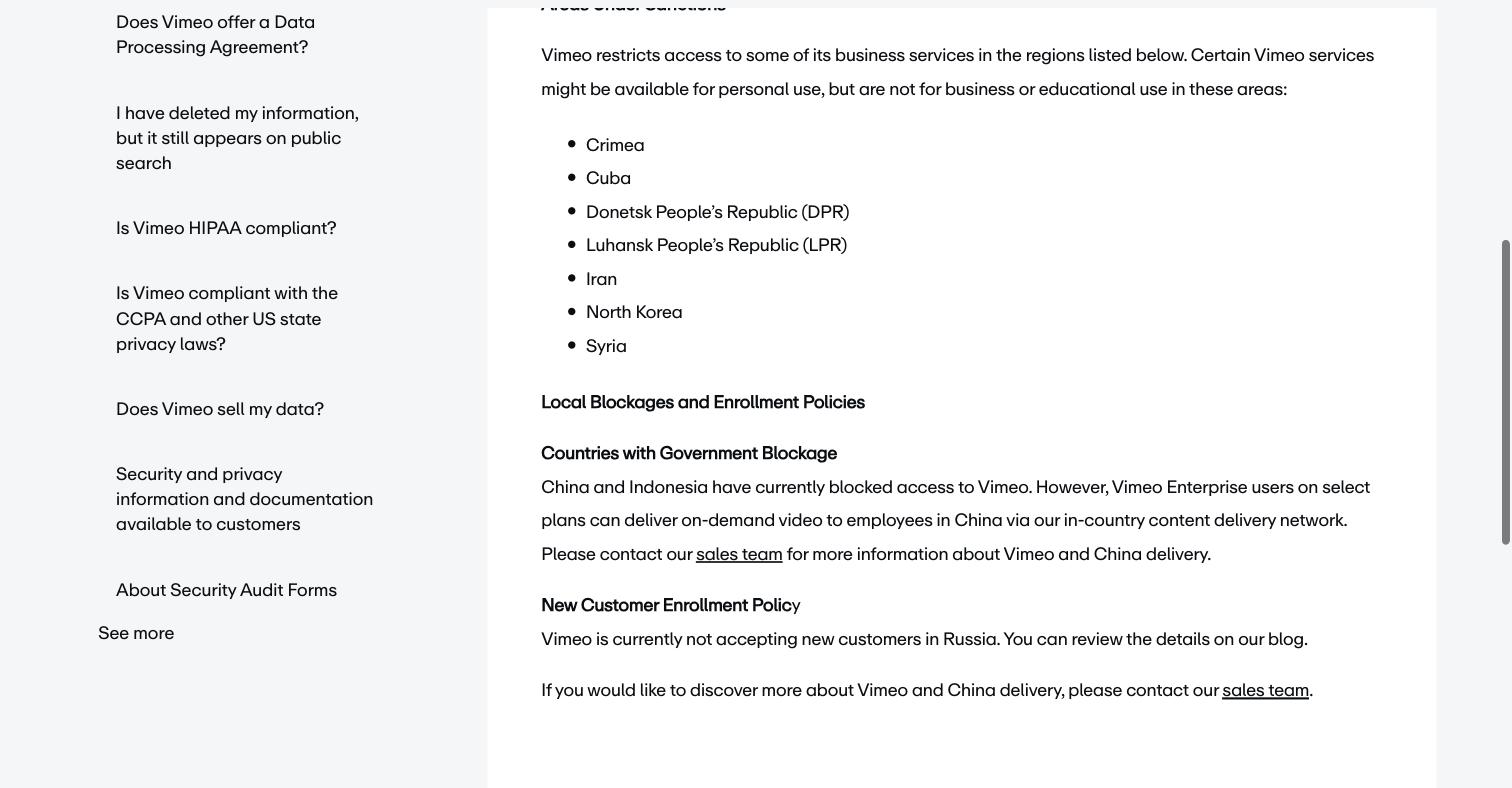 Vimeo’s own Help Center, on availability and regional restrictions: “China and Indonesia have currently blocked access to Vimeo. However, Vimeo Enterprise users on select plans can deliver on-demand video to employees in China via our in-country content delivery network.” The standard embeddable player is offshore and blocked; the only in-China path is a sales-gated Enterprise feature. Source: help.vimeo.com — Vimeo availability and regional restrictions" rel="noopener">Source: vimeo.com/product/cdn-video-hosting
Vimeo in China at a glance
| What decides it | In Vimeo's own terms |
|---|---|
| Does it load? | By Vimeo's own Help Center, “China and Indonesia have currently blocked access to Vimeo.” A standard embedded player, or a vimeo.com link, can fail to load for mainland visitors. |
| Where it's served from | Vimeo delivers from “a global CDN” that serves “the right rendition from the nearest edge” — it names Sao Paulo, Singapore and San Francisco, none inside mainland China. |
| The one China option Vimeo offers | A narrow Enterprise feature on “select plans” to deliver on-demand video “to employees in China,” arranged with Vimeo sales — not the standard public embed. |
| Your data around the video | Sign-ins, gated video, forms or analytics tied to the player send China users' personal data offshore — a cross-border transfer PIPL governs. |
| The durable fix | Deliver your own video and site content from inside the mainland; where it's a public site, that in-country serving is what needs an ICP filing. |
Blocked in the mainland, and served from offshore
Vimeo states the block plainly. Its Help Center article on availability says, “China and Indonesia have currently blocked access to Vimeo.” That one line settles the common case: a page that embeds the standard Vimeo player, or links out to vimeo.com, is asking a mainland browser to reach a destination the mainland blocks. Nothing you tune on your side changes where that request has to go.
The delivery architecture is the other half. On its own CDN product page Vimeo describes delivery from “a global CDN” whose “edge delivery … keeps first-frame latency low for every viewer, whether they’re in Sao Paulo, Singapore, or San Francisco” — not the mainland. Vimeo does name one China exception, and it is worth reading precisely: “Vimeo Enterprise users on select plans can deliver on-demand video to employees in China via our in-country content delivery network.” Narrow by design — Enterprise customers, select plans, on-demand video, to employees, arranged with sales. It is an internal-distribution product, not the embeddable player a public marketing page, course, or landing page drops onto a site.
What breaks for your visitors
The visible symptom is a video that never starts. Because the player and its CDN are offshore and the domain is blocked, a mainland visitor often sees a spinner that never resolves, or a blank frame where the video should be — and whatever you laid out around that frame inherits the gap. This is not a slow load that patience fixes; a destination the mainland blocks does not begin to answer because a visitor waits longer.
That also rules out the tempting shortcut. Changing where a request appears to originate does not make a blocked offshore destination deliver, and it is not a lawful footing to build a China presence on. The durable fix runs the other way: serve the video from a path that is genuinely reachable inside the mainland — your own content, delivered in-country — rather than depending on an offshore player to reach across the border. Where that content is a public site shown to mainland visitors, the in-country serving is what brings an ICP filing into scope. That is a licensing step, not a performance one.
The narrower cross-border-data angle
If all you embed is a video and you collect nothing around it, this stays a reachability problem. The moment personal data rides along, a second question opens. Gate the video behind a sign-in, wrap it in a lead form, or load analytics and the player’s telemetry, and you are collecting viewers’ personal information — which, handled through Vimeo’s offshore infrastructure, leaves mainland China. Under the Personal Information Protection Law that is a cross-border transfer, and the handler — you, not Vimeo — must give notice, obtain separate consent, and clear one transfer mechanism: a CAC security assessment, the CAC standard contract, or certification. Critical information infrastructure operators and large-volume handlers carry an added duty to store personal information collected in China inside the mainland (PIPL Article 40; Cybersecurity Law Article 39 (formerly Article 37)). None of this is triggered by the video alone; it is triggered by the data you choose to collect around it, so scope it against your own flows with counsel.
Where 21YunBox fits — a compliant overlay, not a migration
Be clear about what can and cannot be promised. We do not make a blocked third-party domain open, and we would not claim to. What we do is deliver the content you control — your site, and the video you host or embed — from inside mainland China, as a compliant overlay set in front of your existing stack: no rebuild, no second codebase, no move off the tools you already use. Our China team works out whether your video needs in-country delivery, whether a public mainland site brings an ICP filing into scope, and where any personal data you collect crosses the border under PIPL — then stands up the in-country delivery and, where it is required, the ICP-filed footing a lawful China presence needs. Your application stays exactly where it runs today.
Related reading:
