Does Adobe Experience Manager (AEM) Work in China? ICP, Data Residency & Where You Host It
AEM as a Cloud Service is Adobe-operated and, in Adobe's own words, delivered from outside mainland China — so a China-facing site is a PIPL cross-border transfer with no ICP footing of its own; self-managed AEM can run on mainland servers, but then the ICP filing and data residency are yours. A compliance-first look at both hosting doors.
Does Adobe Experience Manager (AEM) work in China?
Yes — but whether Adobe Experience Manager "works" in China is a compliance question, and the answer depends on how you host it. As a Cloud Service, AEM is Adobe-operated and, in Adobe's own words, delivered from outside China; self-managed, you can run it on mainland servers — but the ICP filing and the PIPL posture for the public site are yours either way.
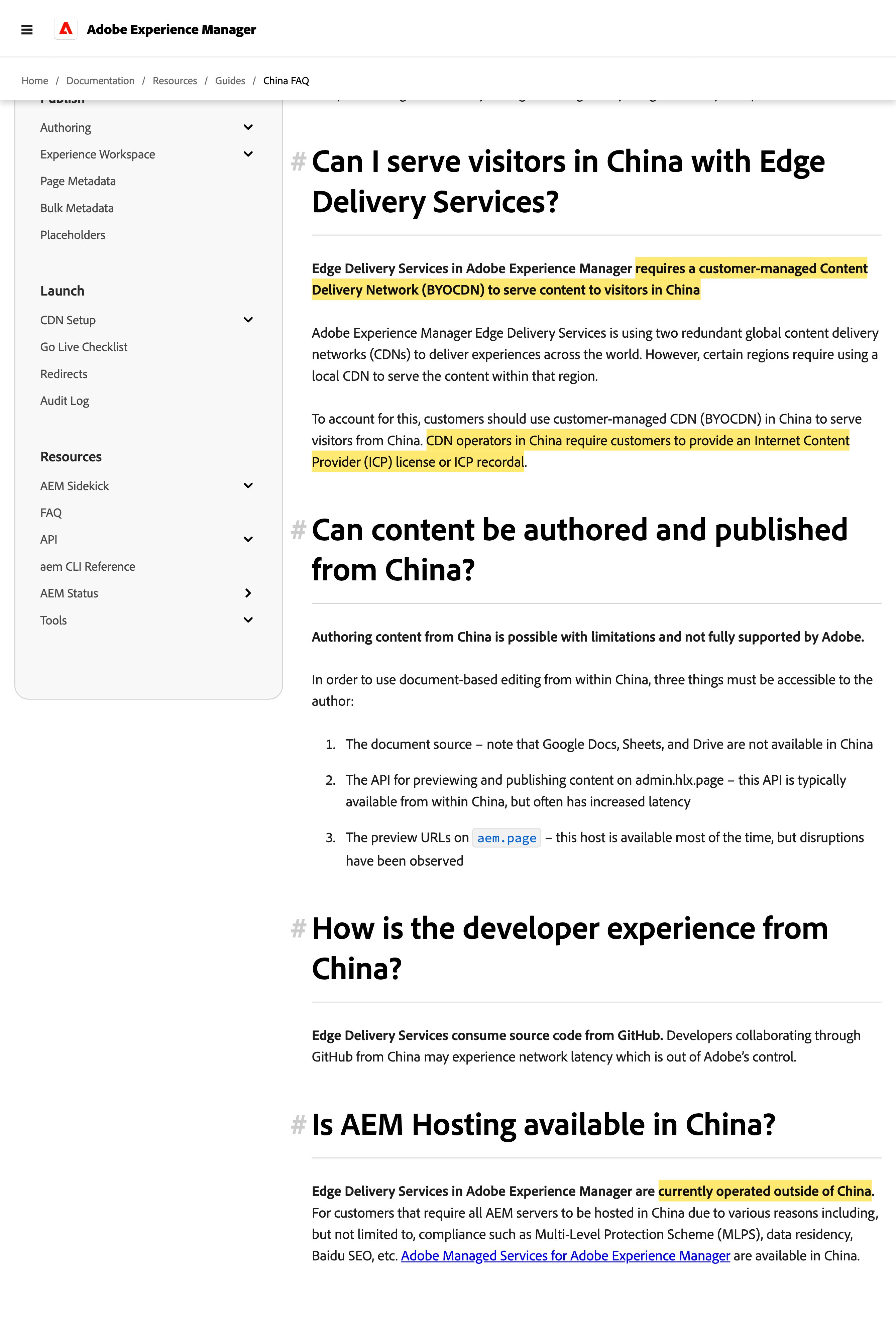
Adobe states that its Edge Delivery Services "are currently operated outside of China" and that reaching the mainland "requires a customer-managed Content Delivery Network (BYOCDN) to serve content to visitors in China," where "CDN operators in China require customers to provide an Internet Content Provider (ICP) license or ICP recordal." Serve China from the offshore Cloud Service and your users' personal information leaves the mainland — a cross-border transfer PIPL governs, on delivery that still needs an ICP filing to run lawfully in-country. Self-host AEM on mainland infrastructure and the data can stay in-country, but Adobe is explicit that it "does not host, manage, or store your AEM On-Premise data or logs" — the ICP and data-residency duties sit with you. The table below is Adobe's own wording and the rule each door triggers.
This is a risk map, not a verdict — which door fits turns on your entity, your data and who your users are. Our China team can map your exposure and the filing path with you →
Compliance snapshot
- ! As a Cloud Service, AEM is Adobe-operated and delivered from outside the mainland
- ! Serve China from offshore AEM and users' data crosses the border — PIPL applies
- ✓ Self-managed AEM can run on mainland servers, keeping data in-country
- ! Either way, the public site's ICP filing and data-residency call are yours
- ! Adobe's own fix for China is a customer-run CDN — which needs your ICP
What Adobe Experience Manager (AEM)'s own documentation says about China
| Fact | Primary source |
|---|---|
| By Adobe's own account, AEM's delivery runs from outside the mainland. Adobe states that "Edge Delivery Services in Adobe Experience Manager are currently operated outside of China," on "two redundant global content delivery networks," and that the service "requires a customer-managed Content Delivery Network (BYOCDN) to serve content to visitors in China." Reaching mainland users is something you arrange — not something the Cloud Service does in-country. | Adobe — Edge Delivery Services China FAQ (aem.live/docs/china), retrieved 2026-10-07 |
| Adobe points the China door straight at an ICP filing. In the same FAQ Adobe writes that "CDN operators in China require customers to provide an Internet Content Provider (ICP) license or ICP recordal" — the ICP regime under State Council Order No. 292 and MIIT Order No. 33. No ICP, no China CDN; and without a China CDN, mainland delivery has no lawful in-country footing. | Adobe — Edge Delivery Services China FAQ (aem.live/docs/china), retrieved 2026-10-07; State Council Order No. 292; MIIT Order No. 33 |
| Self-managed AEM can sit inside China — but the hosting and the data are yours to answer for. For on-premise AEM, Adobe says "your organization, or your chosen hosting provider, hosts and operates AEM On-Premise," that you "host your AEM servers and storage in regions that comply with your organization's policies and regulatory requirements," and that "Adobe does not host, manage, or store your AEM On-Premise data or logs." Running on mainland infrastructure can keep data in-country, but the ICP filing and data-residency posture are the operator's, not Adobe's. | Adobe — Data Center Location, Disaster Recovery, and Data Residency Responsibilities in AEM On-Premise (experienceleague.adobe.com), retrieved 2026-10-07 |
| Host offshore and your China users' data crosses the border. Serve the mainland from the Adobe-operated, offshore Cloud Service and your users' personal information is stored outside China — a cross-border transfer under PIPL that requires notice, separate consent and a transfer mechanism (Articles 38–43). For a critical information infrastructure operator or a large-volume handler, personal information collected in China must be stored in the mainland (PIPL Article 40; Cybersecurity Law Article 39 (formerly Article 37)) — a duty an offshore deployment cannot meet. | Adobe — Edge Delivery Services China FAQ (aem.live/docs/china), retrieved 2026-10-07; PIPL Articles 38–43 & 40; Cybersecurity Law Article 39 (formerly Article 37) |
Sources verified by the 21YunBox compliance team on 2026-10-07.
For a mainland-China audience, whether Adobe Experience Manager “works” is settled by where you host it and whose name the compliance sits under — not by how quickly a page paints. AEM gives you two honest answers at once. Run it as a Cloud Service and it is Adobe-operated and, by Adobe’s own account, delivered from outside China, so a China-facing site is served offshore and leans on a customer-supplied China CDN. Self-manage it and you can place servers inside the mainland, keeping data in-country — but the ICP filing and the data-residency duties then become yours. Either way, because AEM serves a public website, the ICP question is in play; the only choice is who carries it.
Adobe Experience Manager in China at a glance
| What decides it | In AEM's own terms |
|---|---|
| Where it runs | AEM as a Cloud Service is Adobe-operated; its Edge Delivery Services are, in Adobe's words, “currently operated outside of China,” on “two redundant global content delivery networks.” No delivery node sits in the mainland. |
| Reaching China visitors | Adobe says the service “requires a customer-managed Content Delivery Network (BYOCDN) to serve content to visitors in China” — a China CDN you supply, not one Adobe runs in-country. |
| Serving the public | “CDN operators in China require customers to provide an Internet Content Provider (ICP) license or ICP recordal.” No ICP, no China CDN — and no China CDN, no lawful in-country delivery. |
| The self-managed option | On-premise, “your organization, or your chosen hosting provider, hosts and operates AEM On-Premise,” and “Adobe does not host, manage, or store your AEM On-Premise data or logs.” You may host in China — but the obligations follow the servers to you. |
| Your China users' data | On the offshore Cloud Service, personal data of Chinese users sits outside the mainland — a cross-border transfer PIPL governs. A self-managed in-China deployment can keep it in-country, but the ICP filing and residency duties are then yours. |
Door one — AEM as a Cloud Service runs from outside the mainland
Adobe Experience Manager as a Cloud Service is Adobe-operated — you do not pick its data centers, and its delivery does not sit inside China. Adobe says so plainly in its own Edge Delivery Services FAQ: the service’s Edge Delivery Services “are currently operated outside of China,” running on “two redundant global content delivery networks,” and reaching the mainland “requires a customer-managed Content Delivery Network (BYOCDN) to serve content to visitors in China.” In other words, the Cloud Service hands you the China-delivery problem; it does not solve it in-country.
And the moment you stand up that China CDN, the licensing door opens. Adobe’s FAQ states that “CDN operators in China require customers to provide an Internet Content Provider (ICP) license or ICP recordal” — the ICP regime under State Council Order No. 292 and MIIT Order No. 33. So “we’re already on AEM” does not carry into China on its own: the in-country door is a China CDN bound to an ICP filing, and that filing attaches to a mainland operator, not to Adobe.
Door two — self-managed AEM can sit inside China, but the compliance is yours
AEM also ships as an on-premise, self-managed product, and here the geography is yours to choose. Adobe’s on-premise guidance is explicit that “your organization, or your chosen hosting provider, hosts and operates AEM On-Premise,” that you “host your AEM servers and storage in regions that comply with your organization’s policies and regulatory requirements,” and that “Adobe does not host, manage, or store your AEM On-Premise data or logs.” Deploy those servers on mainland infrastructure and your content and user data can stay in-country — which is why Adobe’s China FAQ acknowledges customers who “require all AEM servers to be hosted in China,” for reasons it lists as “compliance such as Multi-Level Protection Scheme (MLPS), data residency, Baidu SEO,” and points them to a managed in-China arrangement.
What self-hosting does not do is make the compliance disappear. The same documentation that lets you choose the region also hands you the duties that come with it: the public site still needs an ICP filing, and the data-residency posture — where personal data lives, how it is backed up, who can reach it — is now yours to design and defend rather than Adobe’s. In-country hosting is the honest path to data residency; it is not a shortcut around the filing.
Either way, the public site turns on an ICP filing and a cross-border decision
Both doors meet at the same two obligations, because AEM is serving a public website to people inside China. First, ICP: a site delivered to mainland visitors needs a filing tied to a mainland hosting or CDN resource (State Council Order No. 292; MIIT Order No. 33), and Adobe’s own words make that unavoidable on the Cloud-Service path — the China CDN operator “require[s] customers to provide an Internet Content Provider (ICP) license or ICP recordal.” Second, data. Serve China from the offshore Cloud Service and your users’ personal information is stored outside the mainland — a cross-border transfer under PIPL, which asks for notice, separate consent and one transfer mechanism (Articles 38–43). If you are a critical information infrastructure operator or a large-volume handler, personal information collected in China must be stored in the mainland (PIPL Article 40; Cybersecurity Law Article 39 (formerly Article 37)) — a residency duty the offshore Cloud Service cannot satisfy, and one a self-managed in-China deployment is built to.
This is a risk map, not a verdict: whether you need an ICP filing, in-country storage, or both depends on which deployment you run, how much personal data you hold, and who your users are — worth settling with counsel before you commit a China rollout.
Where 21YunBox fits — a compliant overlay, not a migration
You keep building on AEM — Cloud Service or self-managed, one instance and one content model. We add the piece Adobe tells you to arrange yourself: compliant, ICP-filed delivery from inside the mainland, set in front of your existing AEM origin — no rebuild, no second codebase, and no move off the platform you already run. Our China team maps which hosting door fits, weighs your PIPL cross-border and data-residency exposure against your entity and data volumes, then stands up the in-country delivery and storage a lawful China presence needs, while AEM stays exactly where it is.
Related reading:
Frequently Asked Questions
Does AEM as a Cloud Service have a mainland-China region?
No. Adobe states that Edge Delivery Services in AEM "are currently operated outside of China" and that serving mainland visitors "requires a customer-managed Content Delivery Network (BYOCDN)." The Cloud Service is Adobe-operated and delivered from offshore; where Adobe does offer an in-China path, its own FAQ routes customers who need all AEM servers inside China to a separate managed arrangement — not to the standard Cloud Service.
Is it a compliance problem to serve mainland China from AEM hosted offshore?
Treat it as a risk to assess with counsel, not a flat yes or no. Two things follow from hosting offshore: your China users' personal information leaves the mainland, which PIPL governs as a cross-border transfer (notice, separate consent and a transfer mechanism), and the public site still needs an ICP filing to be delivered lawfully in-country — Adobe's own note is that China CDN operators "require customers to provide an Internet Content Provider (ICP) license or ICP recordal." Whether a data-localization duty also applies turns on your role (for example, a CIIO) and your data volumes.
Can 21YunBox help make our AEM setup work in China?
Yes. Our China team can map which hosting door fits — assessing your PIPL cross-border and data-residency exposure for your entity, data volumes and users — and stand up the ICP-filed, in-country delivery a compliant China presence needs, in front of the AEM instance you already run, whether that is AEM as a Cloud Service or a self-managed deployment. Get in touch to work through your specific case.