Does MongoDB Atlas Work in China? Data Residency, PIPL & No Mainland Region
MongoDB Atlas runs on AWS, Azure and Google Cloud and lets you pick a region — but none is inside mainland China, so a cluster serving Chinese users stores their personal data offshore: a cross-border transfer under PIPL. A compliance-first look at the data-residency exposure.
Does MongoDB Atlas work in China?
Atlas reaches China fine — but reachability was never the question. On standard Atlas you deploy to AWS, Azure or Google Cloud, and none of them offers a mainland-China region, so a cluster serving Chinese users stores their personal data offshore. Under PIPL that is a cross-border transfer, not a hosting detail.
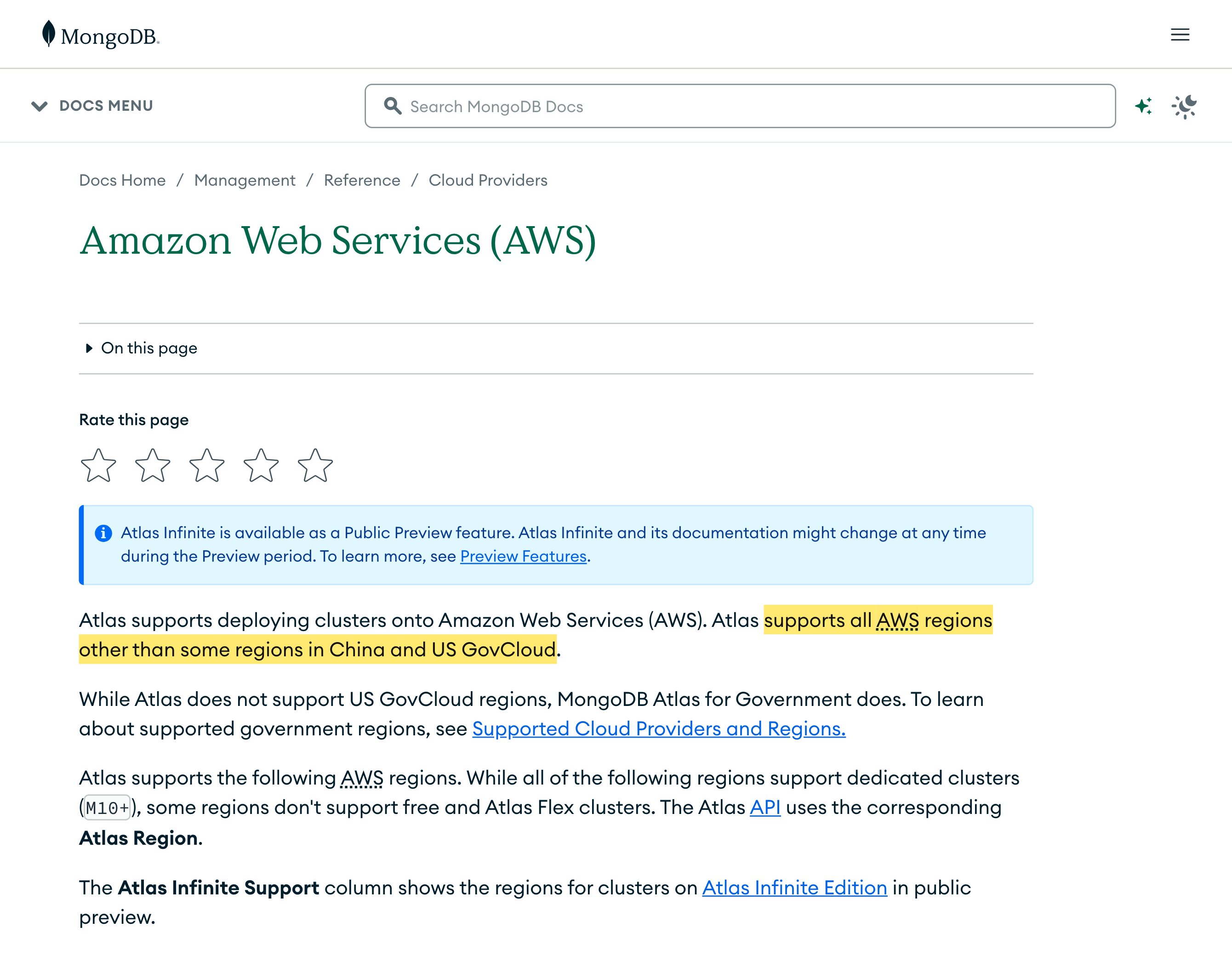
In MongoDB's own words Atlas "runs on different cloud platforms, such as Amazon Web Services, Microsoft Azure, and Google Cloud Platform," and its Atlas AWS reference adds that Atlas "supports all AWS regions other than some regions in China and US GovCloud." The nearest regions it does offer — Hong Kong and Taiwan — are still outside the mainland. So whichever region you choose, your Chinese users' personal information lands offshore: a cross-border transfer PIPL governs (notice, separate consent and a transfer mechanism), and for a CIIO or large-volume handler, data the law says must stay in the mainland. The table below is MongoDB's own wording and the rule each choice triggers.
This is a risk map, not a verdict — whether you owe in-country storage, a transfer mechanism, or both turns on your data, your volumes and who your users are. Our China team can map your exposure with you →
Compliance snapshot
- ✕ No standard Atlas region sits inside mainland China
- ! Any region you pick stores your China data offshore
- ! Serving mainland users is a cross-border transfer under PIPL
- ! CIIO or high-volume handlers owe in-China storage Atlas can't meet
- ✓ Atlas is reachable — this is residency, not a block
What MongoDB Atlas's own documentation says about China
| Fact | Primary source |
|---|---|
| You don't host on MongoDB — you host on a cloud region you choose. In MongoDB's own words, Atlas "runs on different cloud platforms, such as Amazon Web Services, Microsoft Azure, and Google Cloud Platform, all of which provide extensive offerings in terms of data center location and SLAs." The region you pick is where the cluster's data physically lives — MongoDB notes even "your backups are stored in the same cloud region as your managed databases." | MongoDB Atlas FAQ (mongodb.com), retrieved 2026-10-07 |
No standard Atlas region is inside mainland China. MongoDB's Atlas AWS reference states Atlas "supports all AWS regions other than some regions in China and US GovCloud." The AWS and Azure China partitions are separate clouds Atlas does not deploy into, and Google Cloud has no mainland region at all. The closest regions Atlas offers — Hong Kong (ap-east-1) and Taiwan (ap-east-2) — are still outside the mainland for data-residency purposes. | MongoDB — Atlas Amazon AWS reference (mongodb.com/docs/atlas), retrieved 2026-10-07 |
| Serving mainland users from an offshore region is a cross-border transfer. MongoDB says Atlas lets organizations "choose the geographic location of their data, helping them comply with local data residency and sovereignty regulations" — but with no mainland option, that location is always outside China. Your Chinese users' personal information therefore leaves the mainland: a cross-border transfer under PIPL requiring notice, separate consent and one transfer mechanism — a CAC security assessment, the CAC standard contract, or certification (Articles 38–43). | MongoDB — What is Data Sovereignty (mongodb.com), retrieved 2026-10-07; PIPL Articles 38–43 |
| Some handlers owe in-China storage no Atlas region can provide. If you are a critical information infrastructure operator, or you process personal information above the regulated volume thresholds, personal information collected in the mainland must be stored in the mainland (PIPL Article 40; Cybersecurity Law Article 39 (formerly Article 37)). Because Atlas has no mainland region, no Atlas configuration can satisfy that localization duty on its own. | PIPL Article 40; Cybersecurity Law Article 39 (formerly Article 37) (cac.gov.cn) |
| Reaching Atlas is not the same as being compliant on it. Atlas is a managed database your application connects to, not a public web page — so the deciding question is not whether it loads but where it keeps data. A mainland-hosted app pointed at an offshore cluster moves personal data across the border on every query, and an offshore cluster can hold neither an in-country copy of that data nor the ICP-filed footing a public mainland site needs. Reachability is the delivery half; residency is the half the law turns on. | MongoDB — Atlas cloud providers & regions (mongodb.com/docs/atlas), retrieved 2026-10-07; 21YunBox compliance analysis |
Sources verified by the 21YunBox compliance team on 2026-10-07.
For a mainland-China audience, the question about MongoDB Atlas is not whether your database responds — it is where that database is allowed to keep its data. Atlas is a managed service you run on top of AWS, Azure or Google Cloud, and you choose the region; MongoDB is clear in its own documentation that none of the regions you can choose sits inside mainland China. So an Atlas cluster that serves Chinese users is reachable, but it stores their personal information offshore — and that turns a routine hosting decision into a cross-border data transfer China’s law governs. Response time is the easy half; data residency is the exposure.
MongoDB Atlas in China at a glance
| What decides it | In MongoDB's own terms |
|---|---|
| Where it runs | Atlas is managed on AWS, Azure and Google Cloud — you choose a cloud provider and a region, not a MongoDB datacenter. The region you pick is where the cluster's data physically lives. |
| A mainland-China region? | None on standard Atlas. MongoDB's AWS reference: Atlas “supports all AWS regions other than some regions in China and US GovCloud.” The AWS and Azure China partitions are separate clouds Atlas does not deploy into; Google Cloud has no mainland region. |
| Nearest regions | Hong Kong (ap-east-1) and Taiwan (ap-east-2) — close and reachable, but outside mainland China for data-residency purposes. |
| Your China users' data | On any Atlas region it is stored offshore — a cross-border transfer PIPL governs, plus an in-country storage duty for CIIOs and large-volume handlers that no Atlas region can meet. |
| Is it reachable? | Yes — Atlas is a managed database your app connects to, not a blocked site. But a mainland app reaching an offshore cluster moves data across the border on every query. Reachability is the delivery half, not the legal half. |
No mainland region, so the data sits offshore by default
Atlas does not run on MongoDB’s own datacenters — in its own words it “runs on different cloud platforms, such as Amazon Web Services, Microsoft Azure, and Google Cloud Platform.” You deploy a cluster by choosing one of those clouds and a region, and that region is where the data physically lives; MongoDB notes even “your backups are stored in the same cloud region as your managed databases.” The catch for China is the region list itself: MongoDB’s Atlas AWS reference states Atlas “supports all AWS regions other than some regions in China and US GovCloud,” the AWS and Azure China partitions are separate clouds Atlas does not deploy into, and Google Cloud has no mainland region at all. There is simply no mainland-China region to choose, so your Chinese users’ data has nowhere in-country to land.
Hong Kong and Taiwan are close — and still outside the mainland
The nearest regions Atlas offers are Hong Kong (ap-east-1) and Taiwan (ap-east-2). They are low-latency to the mainland and easy to reach, which is exactly why they get mistaken for a China option. For data residency they are not one: Hong Kong is a separate jurisdiction under PIPL, and personal information moved from the mainland to either region is still leaving the mainland. Proximity is a performance fact, not a compliance one — a fast hop to Hong Kong is still a cross-border hop.
What PIPL turns on once the data is offshore
Once your Chinese users’ personal information is stored on an offshore Atlas region, China’s Personal Information Protection Law treats holding it there as a cross-border transfer, and the handler — you, not MongoDB — has to give notice, obtain separate consent, and clear one transfer mechanism: a CAC security assessment, the CAC standard contract, or certification (Articles 38–43). If you are a critical information infrastructure operator, or you process personal information above the regulated volume thresholds, the law goes further — personal information collected in the mainland must be stored in the mainland (PIPL Article 40; Cybersecurity Law Article 39 (formerly Article 37)), a residency duty no Atlas region can meet. And where Atlas backs a public-facing site served to mainland visitors, that front end separately needs an ICP filing under State Council Order No. 292 and MIIT Order No. 33 — which offshore infrastructure cannot hold.
This is a risk map, not a verdict: whether you owe a transfer mechanism, in-country storage, or both depends on the data you hold, your volumes, and who your users are — worth settling with counsel before you build.
Where 21YunBox fits — a compliant overlay, not a migration
You keep running MongoDB Atlas. We add the piece a global database service does not give you: a compliant, ICP-filed presence inside the mainland, set in front of the stack that already uses your clusters — no rebuild, no second codebase, and no move off Atlas. Our China team maps your PIPL cross-border and data-residency obligations against your entity, your data volumes and your users, then stands up the in-country delivery and the in-mainland storage a lawful China presence requires, while your application keeps reading and writing the Atlas data it already does.
Related reading:
Frequently Asked Questions
Does MongoDB Atlas have a mainland-China region?
No. On standard Atlas you deploy to AWS, Azure or Google Cloud, and MongoDB's own Atlas AWS reference states Atlas "supports all AWS regions other than some regions in China and US GovCloud." The AWS and Azure China partitions are separate clouds Atlas does not deploy into, and Google Cloud has no mainland region at all. The nearest regions Atlas offers — Hong Kong (ap-east-1) and Taiwan (ap-east-2) — are low-latency to the mainland but are not inside it, so for data-residency purposes your data is still stored offshore.
Is it illegal to run our Atlas database offshore for Chinese users?
Treat it as a risk to assess with counsel, not a blanket yes or no. One thing follows directly from Atlas having no mainland region: personal information you collect from Chinese users is stored outside China, which PIPL governs as a cross-border transfer — you must give notice, obtain separate consent, and clear a transfer mechanism (a CAC security assessment, the CAC standard contract, or certification). Whether a data-localization duty also applies, requiring in-mainland storage, turns on your role (for example a critical information infrastructure operator) and the volume of personal information you handle.
Can 21YunBox help make our MongoDB Atlas setup work in China?
Yes. Our China team can map your PIPL cross-border and data-residency exposure for your entity, your data volumes and your users, and stand up the ICP-filed, in-country presence a compliant China footprint needs — placed in front of the stack that already uses Atlas, with no rebuild and no move off your clusters. Get in touch to work through your specific data flows.