Does Hello Audio Work in China? Listener Data, ICP & an Offshore Feed
Hello Audio is operated in the United States with no mainland-China region, so a China-facing private feed stores your listeners' names, emails and listening activity offshore under PIPL — and the public page that distributes it has no ICP-filing path. A compliance-first look at the doors.
Does Hello Audio work in China?
It plays fine in a podcast app — but that is not the question. Hello Audio is a US service that hosts your audio and holds your listeners' personal data with no mainland-China region, so running a private feed for Chinese listeners is a cross-border-data and licensing question before it is a delivery one.
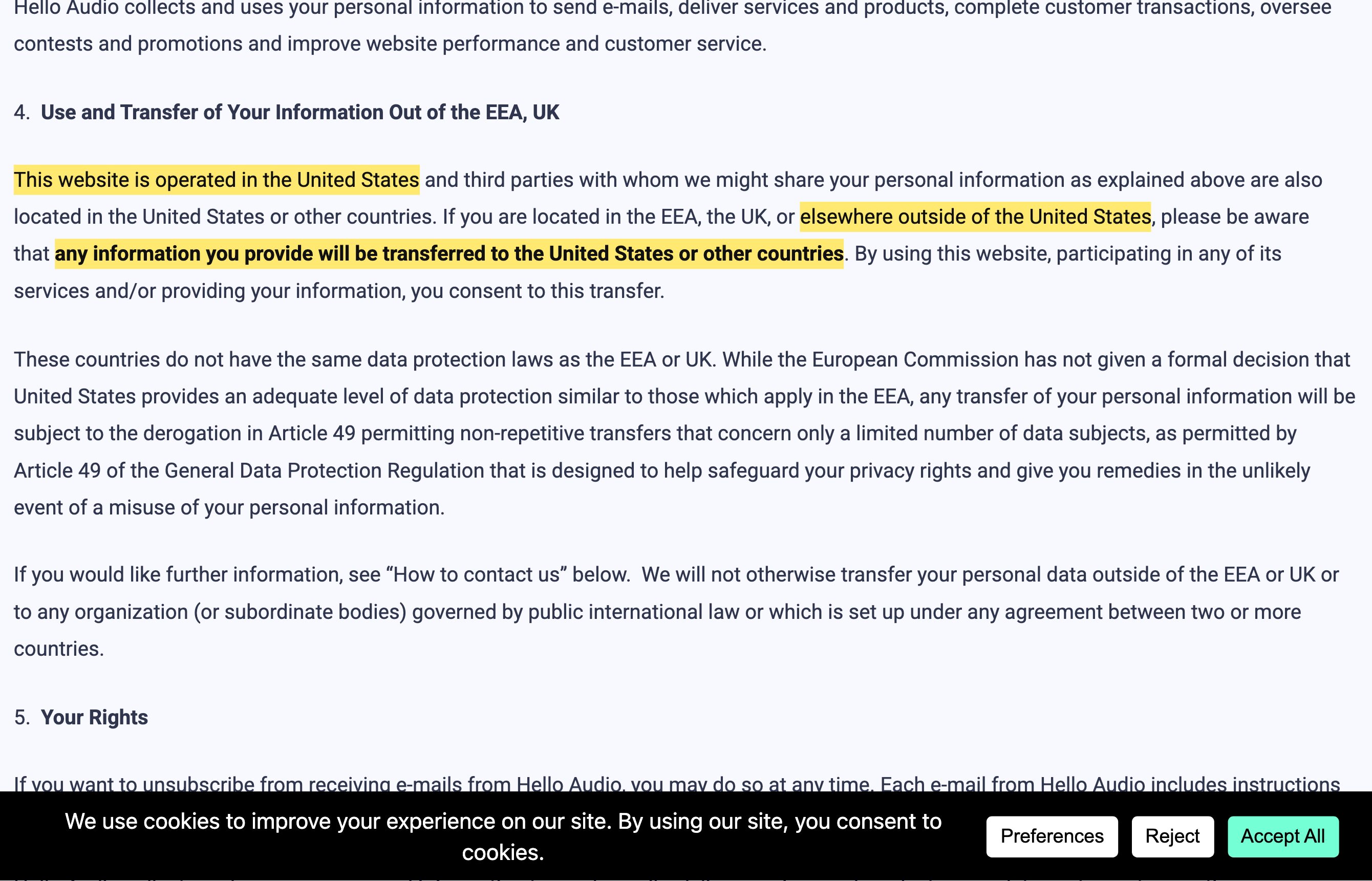
Hello Audio's privacy policy states, “This website is operated in the United States,” and warns anyone “elsewhere outside of the United States” that “any information you provide will be transferred to the United States or other countries.” Your Chinese listeners' names, e-mails and listening activity — which the policy says “the User will share … with Hello Audio” — therefore cross the border, a transfer PIPL governs (Articles 38–43), while the public page that distributes the feed has no footing for an ICP filing. The table below is Hello Audio's own wording and the rule each line triggers.
This is a risk map, not a verdict — what applies turns on your entity, how much personal data you hold and who your listeners are. Our China team can map your exposure with you →
Compliance snapshot
- ! Hello Audio holds your China listeners' names, emails and activity
- ! That listener data is stored in the US — a PIPL cross-border transfer
- ✕ US-operated, no mainland region — the host can't be ICP-filed
- ! A public page distributing the feed to China visitors needs ICP
- ! Distributing audio to a China audience may touch the audio-visual rules
What Hello Audio's own documentation says about China
| Fact | Primary source |
|---|---|
| Hello Audio holds your listeners' personal data — and you are its handler. Hello Audio's privacy policy states that for a private feed “the User will share the Listeners personal information with Hello Audio” — the listener's “name, e-mail address” and listening activity such as “how many times their content was downloaded and streamed.” Collected from a mainland audience, that move offshore is a cross-border transfer under PIPL — notice, separate consent and a transfer mechanism (Articles 38–43) — and the handler is you, the creator who collected them, not Hello Audio. | Hello Audio Privacy Policy (helloaudio.fm/privacy), retrieved 2026-10-07; PIPL Articles 38–43 |
| That data is stored in the United States, not the mainland. The same policy says plainly, “This website is operated in the United States,” and warns anyone “located in the EEA, the UK, or elsewhere outside of the United States” that “any information you provide will be transferred to the United States or other countries.” China is “elsewhere outside of the United States,” so your Chinese listeners' data lands offshore — and for a critical information infrastructure operator or large-volume handler, personal information collected in China must be stored in the mainland (PIPL Article 40; Cybersecurity Law Article 39 (formerly Article 37)), which a US-only service cannot do. | Hello Audio Privacy Policy (helloaudio.fm/privacy), retrieved 2026-10-07; PIPL Article 40; Cybersecurity Law Article 39 (formerly Article 37) |
| The feed is delivered from offshore, and the page that hands it out has nothing to ICP-file. Hello Audio calls itself “the delivery system, not the content owner,” turning your upload into “a private feed only the people you choose can access,” reached by a subscribe link in “the podcast app they already use.” It is a US operation with no mainland region, so a public page that distributes, embeds or sells that feed to mainland visitors has no in-country host to attach an ICP filing to (State Council Order No. 292; MIIT Order No. 33). | Hello Audio — What is Hello Audio (help.helloaudio.fm), retrieved 2026-10-07; State Council Order No. 292; MIIT Order No. 33 |
| It is a US service governed by California law, with no China entity or region. Hello Audio's terms are entered with “Audio First, Inc. d/b/a Hello Audio,” are “governed in accordance with the laws of the State of California,” and route disputes to “the state or federal courts located in San Diego County.” Nothing in Hello Audio's own documents names a mainland-China region, entity or ICP-filing path — which is what turns the question from “does it load” into “may we operate this way,” a line worth drawing with counsel. | Hello Audio Terms of Use (helloaudio.fm), retrieved 2026-10-07 |
Sources verified by the 21YunBox compliance team on 2026-10-07.
For a mainland-China audience, the question about Hello Audio is not how quickly a feed plays — it is whose personal data you are moving and where, and what the page that hands out that feed is allowed to do. Hello Audio answers the first part in its own privacy policy: it is operated in the United States, and it holds your listeners’ names, e-mail addresses and listening activity. A private feed served to Chinese listeners is reachable through their podcast apps, yet it carries two compliance exposures the delivery never resolves — a cross-border transfer of personal information, and a public distribution page with no footing for an ICP filing. The audio arriving is the easy half; the data and the license are the exposure.
Hello Audio in China at a glance
| What decides it | In Hello Audio's own terms |
|---|---|
| Where it runs | A US operation — the privacy policy states “This website is operated in the United States,” and the terms are entered with “Audio First, Inc. d/b/a Hello Audio” in San Diego. No mainland-China region or entity is named. |
| What it holds | Per-listener personal data: Hello Audio “lets you manage exactly who can hear your content and track their listening behavior,” and the policy says “the User will share the Listeners personal information with Hello Audio” — name, e-mail and activity. |
| Where your China data goes | Anyone “elsewhere outside of the United States” has their data “transferred to the United States or other countries” — a cross-border transfer of personal information PIPL governs for the handler, which is you. |
| Serving the public | The feed plays inside a listener's podcast app, but a public page that distributes, embeds or sells it to mainland visitors needs an ICP filing tied to a mainland host — which an offshore page cannot hold. |
| A second content caveat | Distributing online audio programs to a mainland audience may also engage China's internet audio-visual program rules (SARFT/MIIT Order No. 56) — a point to confirm with counsel, not a settled bar. |
Door one — your listeners’ data crosses the border
Hello Audio is built to collect data about individual listeners, not just play files at them. In its own glossary it “lets you manage exactly who can hear your content and track their listening behavior,” and its features page offers to let you “see exactly who is listening, what they’re listening to and when.” The privacy policy names the data that changes hands: for each private feed “the User will share the Listeners personal information with Hello Audio,” including the listener’s “name, e-mail address” and activity such as “how many times their content was downloaded and streamed.”
Where that data sits is the exposure. The policy states flatly, “This website is operated in the United States,” and tells anyone “located in the EEA, the UK, or elsewhere outside of the United States” that “any information you provide will be transferred to the United States or other countries.” China falls squarely inside “elsewhere outside of the United States,” so a Chinese listener’s personal information leaves the mainland the moment it reaches the platform. Under China’s Personal Information Protection Law that is a cross-border transfer, and the handler — you, the creator who gathered the audience, not Hello Audio — must give notice, obtain separate consent, and clear one transfer mechanism: a CAC security assessment, the CAC standard contract, or certification (Articles 38–43). If you are a critical information infrastructure operator or a large-volume handler, personal information collected in China must be stored in the mainland (PIPL Article 40; Cybersecurity Law Article 39 (formerly Article 37)) — a residency duty a US-only service cannot meet.
Door two — the page that hands out the feed needs an ICP filing
A Hello Audio feed is consumed in a podcast app, so the licensing question does not attach to the audio file itself — it attaches to the public page you use to distribute it. Hello Audio describes itself as “the delivery system, not the content owner,” turning your upload into “a private feed only the people you choose can access,” reached through a subscribe link in “the podcast app they already use.” Somewhere a mainland listener still meets a web page: a subscribe page, a paid course or membership page, or an embed on your own site.
Serve that page to mainland visitors from inside China and it turns on an ICP filing (ICP 备案) under State Council Order No. 292 and MIIT Order No. 33 — a filing that must attach to a hosting resource physically inside the mainland. Hello Audio is operated in the United States with no mainland region, so its subscribe pages have nothing in-country to file against, and neither does an offshore landing page of your own. “We already use Hello Audio” settles that the feed will play; it does not create the mainland footing a public distribution page needs to be cleared to operate there.
A delivery note, and a content caveat worth flagging
Reachability is the delivery-side question, and it is a different one. The feed is pulled from an offshore host into the listener’s podcast app, so whether a given mainland listener’s app resolves it reliably is a network matter — real, but separate from, and downstream of, whether you are permitted to run the arrangement at all. We are not putting a performance number on it here; the legal exposure above stands regardless of how the paint renders.
Separately, distributing online audio programs to a mainland audience can touch a content regime as well as a data one. China’s internet audio-visual program service rules (the SARFT/MIIT regime, Order No. 56) govern who may provide audio-visual programming online to users in the mainland, and depending on what your feed carries and who hears it, they may be in scope. Treat this as a question to raise with counsel rather than a settled requirement — it is a caveat, not a verdict.
This is a risk map, not a verdict: whether PIPL cross-border rules, a data-localization duty, an ICP filing, or the audio-visual program rules apply to you turns on your entity, how much personal data you hold and who your listeners are — worth settling with counsel before you launch.
Where 21YunBox fits — a compliant overlay, not a migration
You keep running Hello Audio exactly as you do now. What we add is the piece a US-operated feed platform cannot give you on its own: compliant, ICP-filed delivery from inside the mainland, set in front of the public pages that distribute and sell your feed — no rebuild, no second codebase, and no move off Hello Audio. Our China team maps which obligations actually bind you — the PIPL cross-border and data-residency position for your entity, your listener data and your audience — and stands up the in-country delivery and data handling a lawful China presence requires, while your feed stays right where your listeners already subscribe to it.
Related reading:
Frequently Asked Questions
Does serving China listeners through Hello Audio trigger PIPL?
Treat it as very likely in-scope, then confirm the detail with counsel. Hello Audio's privacy policy says it is “operated in the United States” and that information from anyone “elsewhere outside of the United States” is “transferred to the United States or other countries.” Your Chinese listeners' names, emails and listening activity therefore leave the mainland, which PIPL governs as a cross-border transfer — notice, separate consent and one transfer mechanism (Articles 38–43). The handler is you, the creator who collected them, not Hello Audio. Whether a data-localization duty also applies turns on your role (for example, a CIIO) and your data volumes.
Do I need an ICP filing to run a Hello Audio feed for listeners in China?
The audio itself plays inside a listener's podcast app, so the ICP question lands on the public page you use to distribute, embed or sell the feed to mainland visitors — a subscribe page, a course or membership page, or an embed on your own site. Served from inside China, that page needs an ICP filing tied to a mainland host (State Council Order No. 292; MIIT Order No. 33), and an offshore page — Hello Audio's or your own — has nothing to file against. Distributing online audio programs to a mainland audience can also engage China's internet audio-visual program rules (SARFT/MIIT Order No. 56); flag that for counsel rather than assume it.
Can 21YunBox help make our Hello Audio setup work in China?
Yes. Our China team can map your exposure — the PIPL cross-border and data-residency position for your entity, your listener data and who your audience is — and stand up the ICP-filed, in-country delivery a lawful mainland presence needs, in front of the public pages that distribute your feed, while your Hello Audio feed stays exactly where it is. Get in touch to work through your specific case.