Does Podbean Work in China? Media Delivery, Audio-Content Rules & PIPL
Podbean stores and serves your podcast from offshore AWS, so mainland playback rides a cross-border path — and "does it work" is really a compliance question: China's online audio-visual content rules, ICP filing for a public site, and PIPL for your listeners' data. A compliance-first look at the doors Podbean leaves for you to open.
Does Podbean work in China?
Podbean is reachable from mainland China, but "does it work" is the wrong test. Podbean stores and serves your audio from offshore AWS, your listeners' data is handled by a US company, and distributing audio programming to a Chinese audience can touch content-licensing rules that speed never answers.
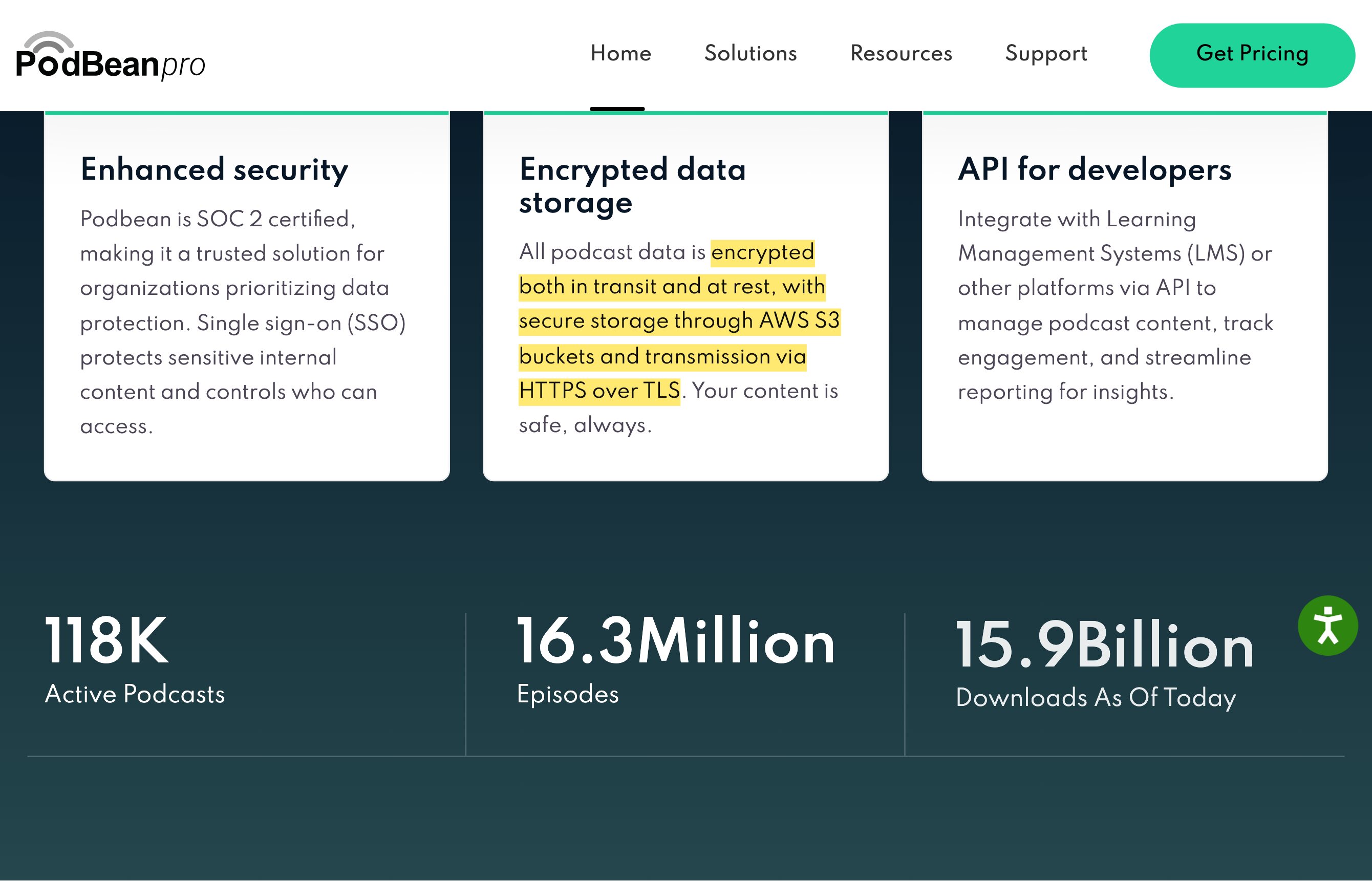
Podbean's own enterprise pages state "all podcast data is encrypted both in transit and at rest, with secure storage through AWS S3 buckets," with "transmission via HTTPS over TLS" — an origin outside the mainland — and its privacy policy tells users their "personal information is being collected directly by a US-based company, and processing occurs mainly in the United States of America." So every mainland play is a cross-border fetch, any listener data you collect is a cross-border transfer PIPL governs, a public China-facing site served this way has no mainland footing for an ICP filing, and the audio itself may engage China's online audio-visual program rules. The table below is Podbean's own wording and the rule each point triggers.
This is a risk map, not a verdict — which rules bite turns on who you are, what you publish and who is listening. Our China team can map your exposure with you →
Compliance snapshot
- ! Podbean stores your audio on offshore AWS S3 — mainland playback rides a cross-border path
- ! Listener data is collected by a US company, processed mainly in the US — PIPL applies
- ! Serving audio programming to China may engage online audio-visual program rules
- ✕ No mainland region on Podbean, so a public China-facing site has no ICP footing there
- ! Reachable but offshore: often slow or unreliable — a delivery fact, not legal clearance
What Podbean's own documentation says about China
| Fact | Primary source |
|---|---|
| Podbean's audio and player are served from offshore AWS, not from inside China. On its own enterprise pages Podbean states "all podcast data is encrypted both in transit and at rest, with secure storage through AWS S3 buckets," with "transmission via HTTPS over TLS" — the audio origin, and the player that fetches it, live outside the mainland. Reaching them from China means a cross-border fetch on every play, which is why mainland playback is often slow or unreliable rather than instant. That is the delivery half of the question — real, but not the half that decides whether you may operate. | Podbean — Enterprise / Podcast Networks (podbean.com), retrieved 2026-10-07 |
| Your listeners' personal data is handled by a US company and processed mainly in the US. Podbean's privacy policy tells users that if they are "located outside the United States," their "personal information is being collected directly by a US-based company, and processing occurs mainly in the United States of America," and may be "transferred to, stored in, and processed in countries that may not offer the same level of data protection as your home jurisdiction." For Listeners and Visitors, Podbean Inc. — a Nevada company — "is the Data Controller." If you collect subscriber or listener personal information through Podbean, that is a cross-border transfer under PIPL (notice, separate consent and a transfer mechanism, Articles 38–43), with in-China storage required of a CIIO or large-volume handler (PIPL Article 40; Cybersecurity Law Article 39 (formerly Article 37)). | Podbean Privacy Policy (podbean.com/privacy), retrieved 2026-10-07; PIPL Articles 38–43 & 40; Cybersecurity Law Article 39 (formerly Article 37) |
| Distributing audio programming to a mainland audience may engage China's online audio-visual content rules — a licensing layer beyond delivery. China regulates internet audio and video programming through the Provisions on the Administration of Internet Audio-Visual Program Services (SARFT/MIIT Order No. 56, 2007), which require a License for Spreading Audio-Visual Programs via Information Network and, for that license, a state-owned or state-controlled applicant. Whether your podcast distribution engages this regime turns on how you operate, what you publish and who your audience is — treat it as a question to settle with counsel, not a given. | SARFT/MIIT Order No. 56 — Provisions on the Administration of Internet Audio-Visual Program Services (2007), per public law databases; confirm current text with counsel |
| A public, China-facing website or embedded player has no ICP footing on Podbean. Because Podbean runs no region inside mainland China — your content sits on AWS S3 and is processed mainly in the US — there is no in-mainland hosting resource to attach a filing to. A site served to mainland visitors turns on an ICP filing (ICP 备案) under State Council Order No. 292 and MIIT Order No. 33, and "we already publish on Podbean" does not create that footing. This bites your own China-facing web presence more than Podbean's audio feed — but if you run one, it is a door you have to open elsewhere. | Podbean Privacy Policy & Enterprise pages (podbean.com), retrieved 2026-10-07; State Council Order No. 292; MIIT Order No. 33 |
Sources verified by the 21YunBox compliance team on 2026-10-07.
For a mainland-China audience, the real question about Podbean is not how quickly an episode plays — it is whether you are cleared to publish it there, and what happens to your listeners’ data. Podbean answers the delivery part in its own documentation: your audio is stored on AWS S3 and served from offshore, so mainland playback rides a cross-border path. The harder parts sit underneath that. Distributing audio programming to a Chinese audience can engage China’s online audio-visual content rules; any listener data you collect is handled by a US company and governed by China’s data-transfer law; and a public China-facing site served this way has no mainland footing for an ICP filing. Reachability is the easy half — the licensing and the data are the exposure.
Podbean in China at a glance
| What decides it | In Podbean's own terms |
|---|---|
| Where your audio lives | All podcast data is “encrypted both in transit and at rest, with secure storage through AWS S3 buckets” — on offshore AWS, with no region inside mainland China. |
| Reaching listeners in China | The audio origin and player are offshore, so every mainland play is a cross-border fetch — reachable, but often slow or unreliable, not a legal clearance. |
| Publishing audio programming | Distributing internet audio/video to a mainland audience may engage the online audio-visual program rules (SARFT/MIIT Order No. 56) — a content-licensing layer Podbean does not carry for you. Confirm with counsel. |
| Your listeners' data | Podbean's privacy policy: personal information is “collected directly by a US-based company, and processing occurs mainly in the United States of America” — a cross-border transfer PIPL governs. |
| A public China-facing site | With no mainland region on Podbean, there is no in-country hosting resource to attach an ICP filing to. |
Reachable, but served from offshore — the delivery half
Podbean does not run a region inside mainland China. In its own enterprise security section it states that all podcast data is “encrypted both in transit and at rest, with secure storage through AWS S3 buckets and transmission via HTTPS over TLS” — so both the audio files and the player that pulls them sit outside the mainland. A listener in China is therefore reaching an offshore origin on every play, and that distance tends to show up as slow or unreliable playback rather than a clean block. This is the part most “does it work in China” checks stop at, and it is genuinely the easy half: the stream is reachable. What it is not is clearance to operate — tuning the audio path does not change where you are allowed to publish or where your data is allowed to live.
The second door — audio-content regulation, not speed
China treats internet audio and video as regulated content, not just bits to deliver. The Provisions on the Administration of Internet Audio-Visual Program Services (SARFT/MIIT Order No. 56, 2007) govern internet audio-visual program activities directed at the public in China, and the License for Spreading Audio-Visual Programs via Information Network they require is, by the rule’s own terms, available only to a state-owned or state-controlled applicant. Whether your podcast distribution actually engages this regime is genuinely fact-specific — it turns on how you operate, what you publish, and who your audience is — so treat it as a risk to examine with counsel, not a settled yes or no. The point for a planning conversation is only this: an audio-content layer exists in China that has nothing to do with how fast Podbean loads, and an offshore podcast host does not carry it for you.
Your China listeners’ data leaves the mainland
If you collect anything from listeners — subscriptions, accounts, analytics tied to a person — Podbean’s privacy policy is explicit about where that goes. Users located “outside the United States” are told their “personal information is being collected directly by a US-based company, and processing occurs mainly in the United States of America,” and may be “transferred to, stored in, and processed in countries that may not offer the same level of data protection as your home jurisdiction.” For listeners and visitors, Podbean Inc. — a Nevada company — is named as the data controller. For your Chinese users that is a cross-border transfer under PIPL: as the handler you owe notice, separate consent, and one cleared transfer mechanism (a CAC security assessment, the CAC standard contract, or certification). A critical information infrastructure operator or large-volume handler must additionally store personal information collected in China inside the mainland (PIPL Article 40; Cybersecurity Law Article 39 (formerly Article 37)) — a residency duty an offshore, US-processed platform cannot meet.
No mainland region, so no footing for an ICP filing
If your China presence is not just an episode link but a public-facing site or embedded player, the licensing question arrives before performance does. A site served to mainland visitors from inside China turns on an ICP filing (ICP 备案) under State Council Order No. 292 and MIIT Order No. 33, and that filing has to attach to a hosting resource physically in the mainland. Podbean has none — your content sits on AWS S3 and is processed mainly in the US — so there is nothing on Podbean to file against. “We already publish on Podbean” reaches China; it does not make you cleared to operate there, and no setting inside Podbean creates the mainland footing a filing needs.
This is a risk map, not a verdict: whether you need a content license, an ICP filing, compliant data handling, or some combination depends on what you publish, how much listener data you hold, and who is listening — worth settling with counsel before you lean on Podbean for China.
Where 21YunBox fits — a compliant overlay, not a migration
You keep hosting on Podbean. What we add is the piece an offshore podcast host cannot: compliant, ICP-filed delivery from inside the mainland, set in front of the audio and player you already publish — no rebuild, no second feed, and no move off Podbean. Our China team first maps which rules actually reach you — reachability, the audio-visual content regime, ICP, and PIPL cross-border data — against your entity, your content and your audience, then stands up the in-country delivery and the compliant data handling a lawful China presence needs, while your podcast stays exactly where it already lives.
Related reading:
Frequently Asked Questions
Is Podbean blocked in mainland China?
There is no well-documented nationwide block the way there is for some platforms, and Podbean runs no mainland region. But because your audio lives in offshore AWS S3 and the player fetches it across the border, mainland playback is often slow or unreliable rather than instant. The more important point is that reachability is not the test: even when it loads, serving audio programming and collecting listener data from China raises content-licensing and PIPL questions that speed does not answer.
Do we need a license to distribute our podcast to listeners in China?
Treat it as a risk to assess with counsel, not a yes/no. China regulates internet audio and video programming (the Provisions on the Administration of Internet Audio-Visual Program Services, SARFT/MIIT Order No. 56), a public China-facing site turns on an ICP filing, and any listener personal data you collect is a cross-border transfer under PIPL. Which of these actually binds you depends on how you operate, what you publish and who your audience is — that is exactly what an assessment is for.
Can 21YunBox help make our Podbean podcast work in China?
Yes. Our China team can map your exposure — reachability, the audio-visual content rules, ICP and PIPL cross-border data — for your entity, your content and your audience, and stand up compliant, ICP-filed, in-country delivery in front of the audio you already host on Podbean, with no rebuild and no move off Podbean. Get in touch to work through your specific case.