Does Render Work in China? ICP, Data Residency & an Offshore PaaS
Render runs no region inside mainland China — its services deploy to Oregon, Ohio, Virginia, Frankfurt and Singapore — so a China-facing site is served offshore with no ICP-filing path, and the personal data your app stores lands outside the mainland under PIPL. A compliance-first look at the two doors.
Does Render work in China?
Whether Render works for a mainland-China audience is a licensing and data-residency question first, and a speed question only after that. Render is a platform-as-a-service: it runs your apps, sites and their datastores in the regions you pick — and China's law turns on where those regions are.
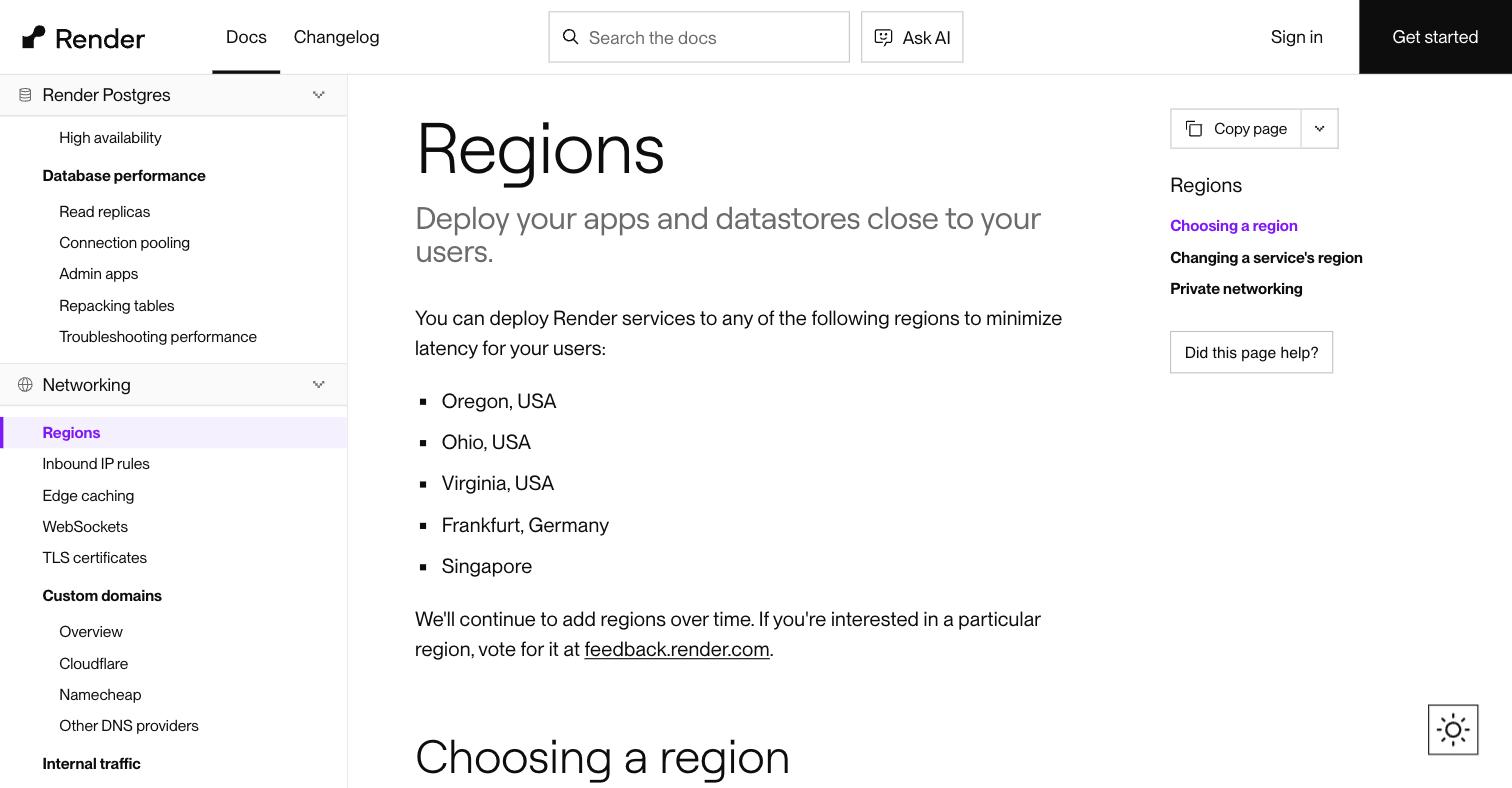
By Render's own documentation you can deploy services to five regions — Oregon, Ohio and Virginia in the United States, Frankfurt in Germany, and Singapore — and none sits inside mainland China. So a public site you run on Render reaches mainland users from offshore, with no ICP-filing path on Render itself, and any personal data your app keeps there — including in a Render-managed database — is a cross-border transfer PIPL governs. The snapshot below maps Render's own footprint to the China rules it triggers, and the compliant, ICP-filed in-country path that closes them.
This is a risk map, not a legal verdict — what you owe turns on what you serve and the personal data you hold. Our China team can map the ICP and cross-border path with you →
Compliance snapshot
- ✕ Render runs no mainland-China region, so a public site on it has no ICP-filing path
- ! Your Render services and their datastores run offshore (Oregon, Ohio, Virginia, Frankfurt, Singapore)
- ! Chinese users' personal data in a Render app or database is a cross-border transfer under PIPL
- ! A Render site can be reached from China, but reaching it is delivery — it creates no ICP filing or residency
- ✓ A compliant path exists: ICP-filed in-country delivery in front of your Render origin
What Render's own documentation says about China
| Fact | Primary source |
|---|---|
| In Render's own documentation, you can deploy services to five regions — "Oregon, USA; Ohio, USA; Virginia, USA; Frankfurt, Germany; Singapore" — chosen to "minimize latency for your users." None is inside mainland China; the nearest, Singapore, is still offshore, and Render's datastores run in those same regions. | Render Docs — Regions, retrieved 2026-10-07 |
| Serving a public website to mainland-China visitors from inside the mainland requires an ICP filing (ICP 备案) under the State Council's Order No. 292 and MIIT's Order No. 33, and that filing must attach to a hosting resource physically inside the mainland. Because Render operates no mainland-China region, a Render-hosted site has nothing on Render to file against — it is reaching China from offshore. | PRC Regulations on Telecommunications (State Council Order No. 292); Administrative Measures for the Filing of Non-operational Internet Information Services (MIIT Order No. 33) |
| Keep Chinese users' personal data in a Render app or a Render-managed database and it lives in one of those offshore regions, so PIPL treats it as a cross-border transfer: the handler — you, Render's customer, not Render — must give notice, obtain separate consent, and clear one transfer mechanism (a CAC security assessment, the CAC standard contract, or certification). | Personal Information Protection Law, Chapter III, Articles 38–43 |
| For a critical information infrastructure operator or large-volume handler, personal information collected in China must be stored inside the mainland (PIPL Article 40; Cybersecurity Law Article 39 (formerly Article 37)). Render publishes no mainland-China region, so none of its five locations can meet that residency duty — holding the data on Chinese soil means running the storage on infrastructure inside the mainland, which is where an ICP filing re-enters. | PIPL Article 40; Cybersecurity Law Article 39 (formerly Article 37) |
| How heavy the duty is scales with volume and role, not with the mere fact of using an offshore host: under the CAC's March 2024 cross-border rules, a non-CIIO moving the non-sensitive personal information of fewer than 100,000 people in a calendar year is exempt from the security assessment, standard contract and certification — a line worth pinning down before you assume you are in the clear. | CAC — Provisions on Promoting and Regulating Cross-border Data Flows, March 2024 |
Sources verified by the 21YunBox compliance team on 2026-10-07.
For a mainland-China audience, the deciding question about Render is not how fast it paints — it is where your services are allowed to run and where the data they hold is allowed to live. Render is a platform-as-a-service, and it answers both questions in its own documentation: it operates no region inside mainland China. A China-facing app on Render is therefore reachable but entirely offshore, which leaves it with no footing for the ICP filing a public mainland site requires, and turns any personal data your app stores for Chinese users into a cross-border transfer China’s law governs. The reachability is a delivery detail; the licensing and the data residency are the exposure.
Render in China at a glance
| What decides it | In Render's own terms |
|---|---|
| Where it runs | Five regions — Oregon, Ohio and Virginia (USA), Frankfurt (Germany) and Singapore. No region is inside mainland China; the nearest, Singapore, is still offshore. |
| What runs there | Render deploys your web services, static sites, background workers and its managed datastores into those same regions — its Regions page is headed “Deploy your apps and datastores close to your users.” The data your app stores lives wherever the region is. |
| Serving the public | A site served to mainland visitors from inside China needs an ICP filing tied to a mainland hosting resource. With no mainland region, Render offers no ICP-filing path of its own. |
| Your data on Render | Personal data of Chinese users held in a Render app or a Render-managed database sits offshore — a cross-border transfer PIPL governs, plus a data-localization duty for CIIOs and large-volume handlers that offshore regions cannot meet. |
| Is it reachable? | Reachability is a delivery question, not a compliance one. Even when a Render app loads for mainland users, it is served from offshore and creates neither an ICP filing nor in-country data residency. |
No mainland region, so no footing for an ICP filing
Render deploys your services to five regions — Oregon, Ohio and Virginia in the United States, Frankfurt in Germany, and Singapore — and, in its own words, you pick among them to “minimize latency for your users.” Not one is in mainland China, and the closest, Singapore, is still outside it. Render notes it “will continue to add regions over time,” but as published there is no mainland option.
That geography settles the licensing question before performance ever enters it. A public-facing website delivered to mainland visitors from inside China turns on an ICP filing (ICP 备案) under State Council Order No. 292 and MIIT Order No. 33, and that filing has to attach to a hosting resource physically located in the mainland. Render has none, so there is simply nothing on Render to file against. That is where “we already run on Render” runs out: reaching China is not the same as being cleared to operate there, and nothing in the build or the region picker creates the mainland footing a filing needs.
Your China users’ data stays offshore
Because Render runs the application and its datastores in the same offshore region, the personal data your app collects from Chinese users lives wherever you deployed — the United States, Germany or Singapore, never the mainland. Under China’s Personal Information Protection Law that is a cross-border transfer, and the handler — you, Render’s customer, not Render — has to give notice, obtain separate consent, and clear one transfer mechanism: a CAC security assessment, the CAC standard contract, or certification. If you are a critical information infrastructure operator or a large-volume handler, personal information collected in China must be stored in the mainland (PIPL Article 40; Cybersecurity Law Article 39 (formerly Article 37)) — a residency duty none of Render’s five locations can satisfy.
Reachable is not the same as compliant
A Render app is not a service China categorically blocks, but that is the delivery half of the question, and it is the half that misleads. Whether or not the app loads quickly for a mainland visitor, it is served from offshore, and serving it there gives you neither an ICP filing nor in-country data residency. Those two gaps are compliance facts about where hosting sits and where data lands — not latency you can tune away. A faster offshore paint is still an offshore paint.
This is a risk map, not a verdict: whether you need an ICP filing, in-country storage, or both depends on what you serve, how much personal data you hold, and who your users are — worth settling with counsel before you build.
Where 21YunBox fits — a compliant overlay, not a migration
You keep building on Render. We add the one piece a platform with no mainland presence cannot: compliant, ICP-filed delivery from inside the mainland, set in front of your existing Render origin — no rebuild, no second codebase, and no move off Render. Our China team maps your ICP and data-residency obligations against your entity and data volumes, then stands up the in-country delivery and storage a lawful China presence needs, while your application stays exactly where it already runs.
Related reading:
Frequently Asked Questions
Does Render have a data center in mainland China?
No. By Render's own region list its services deploy to Oregon, Ohio and Virginia in the United States, Frankfurt in Germany, and Singapore — none inside mainland China. The nearest, Singapore, is still offshore, so a site served to mainland visitors from Render is delivered from outside the country and has no ICP-filing path on Render itself.
Is it against the law to run a China-facing site on Render?
Not inherently. Two separate duties create the exposure: serving a public site to mainland visitors from inside China needs an ICP filing, which attaches to mainland hosting Render does not offer; and holding Chinese users' personal data in an offshore Render app or database is a cross-border transfer PIPL governs, with an in-country storage duty for CIIOs and large-volume handlers. Treat it as a risk to size with counsel for your data and role, not a blanket ban.
Can 21YunBox help run a Render app in China?
Yes. Our China team can assess your ICP and data-residency exposure and provide the compliant, ICP-filed in-country delivery and storage an offshore PaaS cannot — placed in front of the Render origin you already run, with no rebuild. Get in touch to work through your specific setup.