Does Tigris Work in China? Data Residency, PIPL & an Offshore Object Store
Tigris runs no region inside mainland China — its object storage sits in the US, Europe, Singapore, Tokyo, Sydney and beyond — so the personal data a China-facing app stores on it lives offshore, a PIPL cross-border transfer with a localization duty no Tigris region can meet. A compliance-first look at the data-residency door.
Does Tigris work in China?
Tigris is reachable, but it runs no region inside mainland China — so every object a China-facing app stores on it, your users' personal data included, lives offshore. That makes Tigris a data-residency and PIPL question, not a speed one.
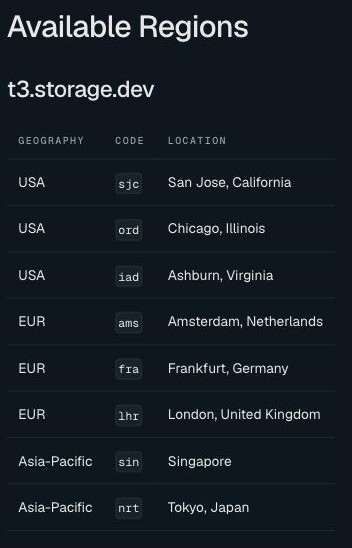
In its own documentation Tigris is "globally distributed object storage" where "Data is automatically stored close to the users that access it," and it "is deployed globally across multiple regions" — San Jose, Chicago and Ashburn in the US, Amsterdam, Frankfurt and London in Europe, and Singapore, Tokyo and Sydney, with São Paulo and Johannesburg, and not one in the mainland. You can pin a bucket for "Data residency across two specific regions of your choice," but every region on offer is offshore. So the personal information you collect in China and keep on Tigris is a cross-border transfer PIPL governs (Articles 38–43), and a CIIO or large-volume handler's duty to store China data in-country (PIPL Article 40; Cybersecurity Law Article 39 (formerly Article 37)) is one no Tigris region can meet — while the ICP filing a public mainland site needs belongs to the app in front of your storage, not to Tigris. The table below is Tigris's own wording and the rule each point triggers.
This is a risk map, not a verdict — which obligations bite turns on your entity, your data volumes and who your users are. Our China team can map your exposure with you →
What Tigris's own documentation says about China
| Fact | Primary source |
|---|---|
| Tigris is object storage — it holds your data, and by default it scatters it worldwide. In its own words Tigris is "globally distributed object storage built for performance, simplicity, and cost efficiency," where "Data is automatically stored close to the users that access it" and "This happens transparently, with no configuration required." The files it keeps for you can include your Chinese users' personal information, which makes where that data lives the compliance question — not how fast it loads. | Tigris Data — Features (tigrisdata.com/docs), retrieved 2026-10-07 |
| None of Tigris's regions is inside mainland China. Tigris states it "is deployed globally across multiple regions," and its own list runs across San Jose, Chicago and Ashburn (US); Amsterdam, Frankfurt and London (EU); Singapore, Tokyo and Sydney; plus São Paulo and Johannesburg — not one in the mainland, the nearest being Singapore, Tokyo and Sydney. For anything else it says, "If you need a region that isn't listed, contact us at help@tigrisdata.com to discuss your requirements." Personal data you collect in China therefore lands offshore — a cross-border transfer PIPL governs (Articles 38–43). | Tigris Data — Regions (tigrisdata.com/docs), retrieved 2026-10-07; PIPL Articles 38–43 |
| Tigris does let you pin data to regions — but every region you can pin to is offshore. Residency is configurable: "To store data in specific regions, set the bucket location when you create the bucket," and "The region in your client configuration does not select where Tigris stores your data." A dual-region bucket even offers "Data residency across two specific regions of your choice." Genuine controls — yet with no mainland region on the menu they cannot meet China's localization duty, under which a CIIO or large-volume handler must keep personal information collected in China inside the mainland (PIPL Article 40; Cybersecurity Law Article 39 (formerly Article 37)). | Tigris Data — Regions (tigrisdata.com/docs), retrieved 2026-10-07; PIPL Article 40; Cybersecurity Law Article 39 (formerly Article 37) |
The ICP filing is not Tigris's to give — it sits with the public app in front of the storage. Tigris is an S3-compatible storage endpoint (its buckets are served from hosts such as t3.storage.dev), not the website your visitors load; it stores objects, it does not operate your public service. So the ICP filing a mainland public-facing site requires — under State Council Order No. 292 and MIIT Order No. 33 — attaches to that app and its in-country hosting, and no storage setting on Tigris creates or carries it. | Tigris Data — Regions (tigrisdata.com/docs) for the storage endpoint, retrieved 2026-10-07; State Council Order No. 292; MIIT Order No. 33 |
Sources verified by the 21YunBox compliance team on 2026-10-07.
For a mainland-China audience, the question to ask about Tigris is not whether its objects load quickly — it is where those objects are allowed to live. Tigris is storage: it holds the files you put in it, and for a China-facing app those files can include your users’ personal information. Tigris answers the residency question plainly in its own documentation — it is deployed across a global set of regions, and not one of them is in mainland China. So a Tigris-backed app is reachable, but the data it keeps sits offshore, which turns your Chinese users’ personal information into a cross-border transfer China’s law governs and leaves any data-localization duty with nowhere on Tigris to land. The speed is beside the point; the residency is the exposure.
Tigris in China at a glance
| What decides it | In Tigris's own terms |
|---|---|
| Where it runs | Tigris “is deployed globally across multiple regions” — San Jose, Chicago and Ashburn (US); Amsterdam, Frankfurt and London (EU); Singapore, Tokyo and Sydney; plus São Paulo and Johannesburg. No region is inside mainland China; the nearest are Singapore, Tokyo and Sydney. |
| What it holds | Object storage: “Data is automatically stored close to the users that access it,” and “This happens transparently, with no configuration required.” The files it keeps can include your Chinese users' personal data. |
| Residency controls | You can pin a bucket — a dual-region option gives “Data residency across two specific regions of your choice” — but every selectable region is offshore, none in the mainland. |
| Serving the public | An ICP filing for a public mainland site attaches to the app in front of the storage and its in-country host — not to a storage endpoint like Tigris. |
| Your data on Tigris | Personal data of Chinese users stored on Tigris sits offshore — a cross-border transfer under PIPL, plus a localization duty for CIIOs and large-volume handlers that no Tigris region can meet. |
No mainland region, so the data lives offshore
Tigris is clear about its geography: it “is deployed globally across multiple regions,” and its own list runs across San Jose, Chicago and Ashburn in the United States; Amsterdam, Frankfurt and London in Europe; Singapore, Tokyo and Sydney; and São Paulo and Johannesburg. Not one of them is in mainland China, and the closest — Singapore, Tokyo, Sydney — are all still outside it. For anything beyond that footprint Tigris simply points you to a conversation: “If you need a region that isn’t listed, contact us at help@tigrisdata.com to discuss your requirements.”
That geography decides the data question before performance enters it. Serve a China-facing app and store its objects on Tigris, and the personal information of your Chinese users lives in one of those offshore regions. Under China’s Personal Information Protection Law that is a cross-border transfer, and the handler — you, not Tigris — has to give notice, obtain separate consent, and clear one transfer mechanism: a CAC security assessment, the CAC standard contract, or certification (PIPL Articles 38–43). Reaching the bucket quickly does nothing to change where its contents sit.
Residency controls that stop at the border
Tigris is not silent on residency — it gives you real controls. “To store data in specific regions, set the bucket location when you create the bucket,” it states, and it warns that “The region in your client configuration does not select where Tigris stores your data.” A dual-region bucket is offered for “Data residency across two specific regions of your choice,” and a single-region bucket is described as “redundant within a single region for strict data residency.”
Those are the right tools for a residency problem — but the menu they draw from has no mainland entry. Pinning a bucket to Singapore or Tokyo keeps your data in a place you chose, yet still outside China. So for a critical information infrastructure operator or a large-volume handler, whose personal information collected in China must be stored in the mainland (PIPL Article 40; Cybersecurity Law Article 39 (formerly Article 37)), Tigris’s controls cannot satisfy the duty — there is simply no in-country region to pin to.
The ICP filing belongs to your app, not your storage
It is worth being precise about where the ICP obligation actually sits. Tigris is an S3-compatible storage endpoint — your buckets are served from hosts such as t3.storage.dev — not the website your visitors open. It stores objects; it does not operate your public service. So the ICP filing a public-facing mainland site requires, under State Council Order No. 292 and MIIT Order No. 33, attaches to the application you run in front of the storage and to that application’s in-country hosting. No bucket setting on Tigris creates an ICP filing, and none carries one — which is exactly why “our storage is on Tigris” never answers the licensing half of the question.
This is a risk map, not a verdict: whether a localization duty applies, and which transfer mechanism you must clear, depends on what you store, the volume of personal data involved, and who your users are — settle it with counsel before you commit.
Where 21YunBox fits — a compliant overlay, not a migration
Keep Tigris exactly where it is. What we add is the piece a storage layer with no mainland footing cannot provide on its own: compliant, ICP-filed delivery from inside the mainland, set in front of the origin you already run — no rebuild, no second codebase, and no move off Tigris. Our China team maps your PIPL cross-border and data-residency obligations against your entity and your data volumes, then stands up the in-country delivery and storage a lawful China presence requires, while your application and your object store stay where they are.
Related reading: