Does Flywheel Work in China? ICP, Data Residency & an Offshore Host
Flywheel runs no data center inside mainland China — its hosting sits in the US, EU, UK, Canada and Australia — so a China-facing site is served offshore with no ICP-filing path, and your users' data lands outside the mainland under PIPL. A compliance-first look at the hosting door.
Does Flywheel work in China?
Flywheel reaches mainland China, but it cannot make a site there compliant. Flywheel runs no data center inside the mainland, so a China-facing Flywheel site is hosted offshore — leaving it with no footing for an ICP filing and your users' personal data sitting outside China under PIPL.
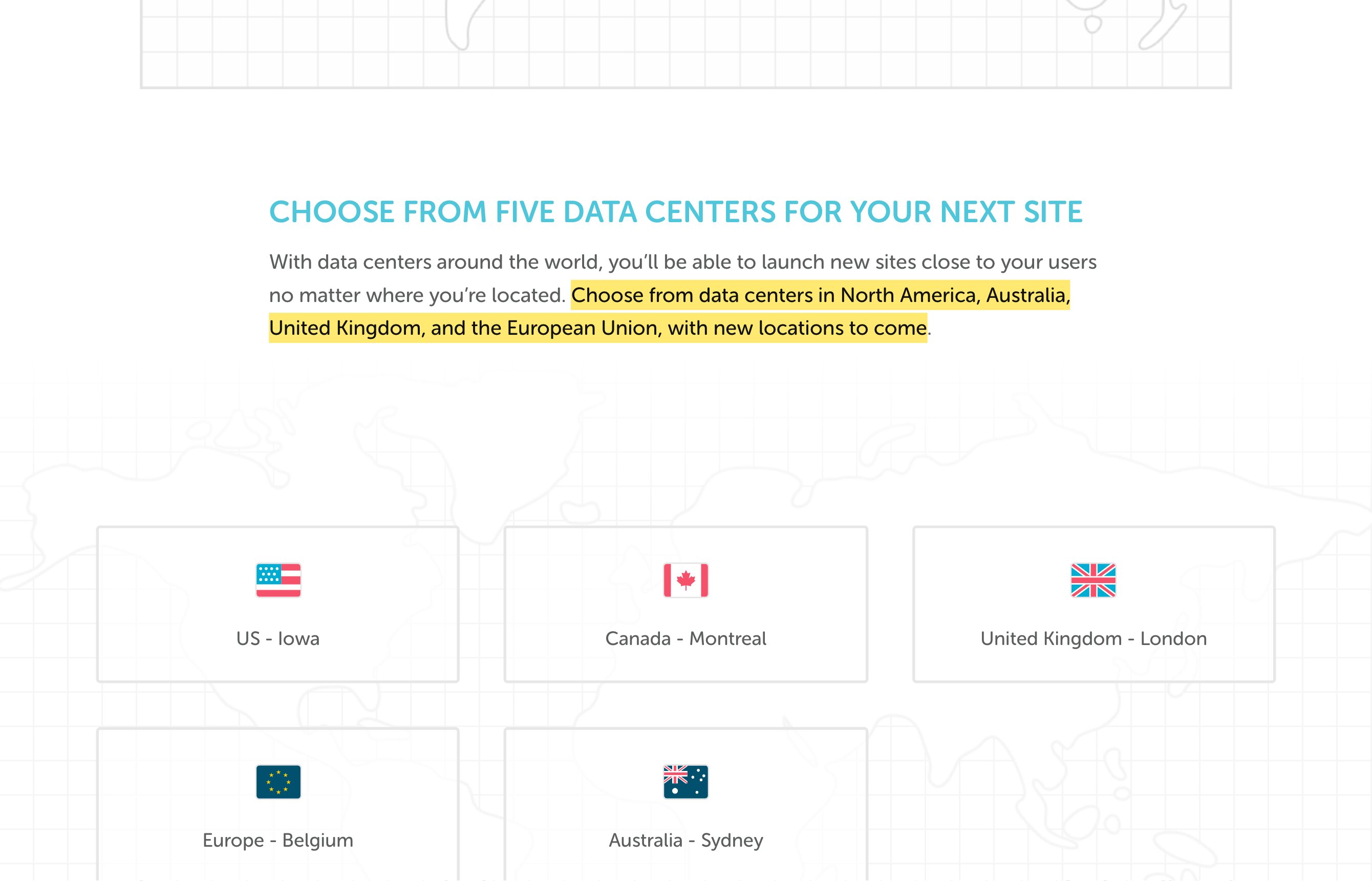
Flywheel's own global-data-centers page lists exactly five: "US - Iowa," "Canada - Montreal," "United Kingdom - London," "Europe - Belgium" and "Australia - Sydney," and invites you to "Choose from data centers in North America, Australia, United Kingdom, and the European Union, with new locations to come." None is in mainland China. So a public mainland site has no in-country hosting resource to carry an ICP filing, and the personal data of your Chinese users becomes a cross-border transfer PIPL governs. Flywheel is a WP Engine company, and nothing in that group puts hosting inside the mainland. The table below is Flywheel's own wording and the rule each line triggers.
This is a risk map, not a verdict — whether you need an ICP filing, in-country storage, or both turns on what you serve, how much personal data you hold and who your users are. Our China team can map your exposure with you →
Compliance snapshot
- ! Flywheel runs no data center in mainland China — a China site is served offshore
- ✕ Hosted outside the mainland, a Flywheel site can't carry a China ICP filing
- ! China visitors' data lands in the US, EU, UK, Canada or Australia — PIPL applies
- ! CIIOs and large-volume handlers owe a data-residency duty these regions can't meet
- ! Reachable isn't compliant — the Great Firewall isn't the question here; licensing is
What Flywheel's own documentation says about China
| Fact | Primary source |
|---|---|
| Flywheel runs no data center in mainland China. On its own global-data-centers page Flywheel tells you to "Choose from data centers in North America, Australia, United Kingdom, and the European Union, with new locations to come," and lists exactly five — "US - Iowa," "Canada - Montreal," "United Kingdom - London," "Europe - Belgium" and "Australia - Sydney." Not one sits inside the mainland, and "new locations to come" is a future promise, not a China region today. | Flywheel — Global WordPress data centers (getflywheel.com), retrieved 2026-10-07 |
| With no mainland hosting resource, a Flywheel site has nothing to file an ICP against. A public website served to mainland visitors needs an ICP filing (ICP 备案) attached to hosting physically located in China, under State Council Order No. 292 and MIIT Order No. 33. Flywheel's five data centers are all offshore, so there is no in-country resource for a filing to bind to — "we already run on Flywheel" does not carry into a compliant China presence. | Flywheel — Global WordPress data centers (getflywheel.com), retrieved 2026-10-07; State Council Order No. 292; MIIT Order No. 33 |
| Your China users' personal data lives wherever you pick — and every option is offshore. Flywheel's globalization feature lets you choose which of its data centers hosts a site, but each choice (Iowa, Montreal, London, Belgium or Sydney) is outside the mainland. Storing Chinese users' personal information there is a cross-border transfer under PIPL — notice, separate consent and a transfer mechanism (Articles 38–43) — and for a CIIO or large-volume handler the data must stay in China (PIPL Article 40; Cybersecurity Law Article 39 (formerly Article 37)), which no Flywheel region can satisfy. | Flywheel — Global WordPress data centers (getflywheel.com), retrieved 2026-10-07; PIPL Articles 38–43 & 40; Cybersecurity Law Article 39 (formerly Article 37) |
| Flywheel's CDN is not a China presence. Flywheel pairs hosting with "a Content Delivery Network (CDN) with more than 30 nodes across the world," but a CDN edge only caches content — it is not a hosting region, it carries no ICP filing, and it does not change where your origin or your personal-data store legally sits. The licensing and data-residency questions attach to the data center you host in, and all five of those are offshore. | Flywheel — Global WordPress data centers (getflywheel.com), retrieved 2026-10-07 |
Sources verified by the 21YunBox compliance team on 2026-10-07.
For a mainland-China audience, the question about Flywheel is not how quickly it paints a page — it is where Flywheel is allowed to host your site and where your users’ data is allowed to live. Flywheel answers the first in its own words: it runs data centers in North America, the European Union, the United Kingdom and Australia, and none inside mainland China. That makes a China-facing Flywheel site reachable but entirely offshore — with no footing for the ICP filing a public mainland site requires, and with your Chinese users’ personal data landing in another country under China’s data law. Flywheel is a WP Engine company, and nothing in that group places hosting inside the mainland. The reachability is real; the licensing and the data residency are the exposure.
Flywheel in China at a glance
| What decides it | In Flywheel's own terms |
|---|---|
| Where it runs | Five data centers — US (Iowa), Canada (Montreal), United Kingdom (London), Europe (Belgium) and Australia (Sydney). Flywheel tells you to “Choose from data centers in North America, Australia, United Kingdom, and the European Union” — none inside mainland China. |
| Choosing a location | Flywheel's globalization feature lets you “Choose from five data centers for your next site,” but every option is offshore; the nearest to China, Sydney, is still outside the mainland. |
| Serving the public | A site served to mainland visitors needs an ICP filing tied to in-country hosting. With no mainland data center, Flywheel offers no ICP-filing path of its own. |
| Your data on Flywheel | Personal data of Chinese users is stored in the US, EU, UK, Canada or Australia — a cross-border transfer PIPL governs, plus a data-localization duty for CIIOs and large-volume handlers that offshore regions cannot meet. |
| Is it reachable? | Flywheel is not blocked in China; it is built for “unbeatable page speeds for a global audience.” But reaching a site and being cleared to operate it are different questions — reachability is the delivery half, licensing and data residency are the legal half. |
No mainland region, so no footing for an ICP filing
Flywheel’s hosting runs in the United States, Canada, the United Kingdom, Belgium and Australia. On its own global-data-centers page Flywheel invites you to “Choose from data centers in North America, Australia, United Kingdom, and the European Union, with new locations to come,” and names the five it offers today — Iowa, Montreal, London, Belgium and Sydney. Not one is in mainland China, and the closest, Sydney, is still outside it.
That geography settles the licensing question before performance ever enters it. A public-facing website delivered to mainland visitors turns on an ICP filing (ICP 备案) under State Council Order No. 292 and MIIT Order No. 33, and that filing must attach to a hosting resource physically located in the mainland. Flywheel has none, so there is simply nothing on Flywheel to file against. This is where “we already run on Flywheel” runs out: reaching China is not the same as being cleared to operate there, and choosing a nearer data center does not create the mainland footing a filing needs.
Your China users’ data stays offshore
Pick any Flywheel data center and your users’ personal information lives in Iowa, Montreal, London, Belgium or Sydney — all outside the mainland. Under China’s Personal Information Protection Law that is a cross-border transfer, and the handler — you, not Flywheel — has to give notice, obtain separate consent, and clear one transfer mechanism: a CAC security assessment, the CAC standard contract, or certification. If you are a critical information infrastructure operator or a large-volume handler, personal information collected in China must be stored in the mainland (PIPL Article 40; Cybersecurity Law Article 39 (formerly Article 37)) — a residency duty none of Flywheel’s five locations can satisfy, and one its globalization feature cannot opt into because the mainland is not on the list.
It is worth separating the content delivery network from the hosting here. Flywheel pairs its hosting with “a Content Delivery Network (CDN) with more than 30 nodes across the world,” but a CDN edge only caches a copy closer to the visitor. It is not a hosting region, it carries no ICP filing, and it does not move where your origin or your personal-data store legally resides. The compliance questions follow the data center, and every Flywheel data center is offshore.
Same group, same geography
Flywheel is a WP Engine company — WP Engine acquired it in 2019 — and the acquisition does not add a mainland footprint. WP Engine’s managed-WordPress platform is built on Google Cloud, and Google Cloud operates no region inside mainland China, so the infrastructure beneath the Flywheel brand lands in the same place its data-center page already shows: offshore. Moving to another product in the group, or to a nearer region such as Sydney, relocates your origin around the world but never into the mainland — which is the one place an ICP filing and in-country data residency actually require it to be.
This is a risk map, not a verdict: whether you need an ICP filing, in-country storage, or both depends on what you serve, how much personal data you hold, and who your users are — worth settling with counsel before you build.
Where 21YunBox fits — a compliant overlay, not a migration
You keep building on Flywheel. We add the one thing an offshore-only host cannot give you: compliant, ICP-filed delivery from inside the mainland, set in front of your existing Flywheel origin — no rebuild, no second codebase, and no move off Flywheel. Our China team reads your ICP and data-residency duties against your entity and the volume of personal data you handle, then stands up the in-country delivery and storage a lawful China presence needs, while your WordPress site stays exactly where it already runs on Flywheel.
Related reading:
Frequently Asked Questions
Does our existing Flywheel site work for a mainland-China audience?
It will usually load, but loading is not the compliance question. Flywheel hosts only from offshore data centers — Iowa, Montreal, London, Belgium or Sydney — so a China-facing Flywheel site has no in-country hosting resource to attach an ICP filing to, and your Chinese users' personal data is stored outside the mainland, which PIPL treats as a cross-border transfer. Treat it as exposure to assess, not a clean yes.
Is it against the rules to serve mainland China from Flywheel?
Treat it as a risk to work through with counsel, not a flat yes or no. Two duties follow from hosting offshore: a public website served to the mainland needs an ICP filing bound to in-country hosting, which Flywheel cannot provide, and your China users' personal information leaving the mainland is a cross-border transfer under PIPL (notice, separate consent, a transfer mechanism). Whether a data-localization duty also applies turns on your role — for example a CIIO — and your data volumes.
Can 21YunBox help make our Flywheel site work in China?
Yes. Your site stays on Flywheel. Our China team maps your ICP and PIPL cross-border exposure for your entity, data volumes and users, then stands up compliant, ICP-filed, in-country delivery in front of your existing Flywheel origin — no rebuild and no second codebase. Get in touch to work through your specific case.