Does UpCloud Work in China? ICP, Data Residency & an Offshore Host
UpCloud operates no data center inside mainland China — every region it runs sits in Europe, North America or Asia-Pacific — so a China-facing deployment is served offshore with no ICP-filing path, and your users' personal data lands outside the mainland under PIPL. A compliance-first look at the two doors.
Does UpCloud work in China?
Whether you can run a China-facing site on UpCloud is an ICP-filing question, not a speed one. UpCloud's own site answers quickly from inside the mainland — what it cannot give you is a lawful way to serve China from within its network.
By UpCloud's own data-center list, every region it operates is offshore — across Europe, North America, Singapore and Sydney, with nothing in mainland China. Serving Chinese visitors from those regions is cross-border delivery, and it carries no route to an ICP filing — the credential a site needs to be hosted and served legally from inside the mainland. If you also store Chinese users' personal data in those offshore regions, PIPL's cross-border transfer rules attach on top. The table below is UpCloud's own footprint and the rules it triggers.
This is a risk picture, not a legal verdict — your obligations turn on where you serve from and what data you hold. Our China team can map your exposure with you →
What UpCloud's documentation says, and what we measured from inside China
| Fact | Primary source |
|---|---|
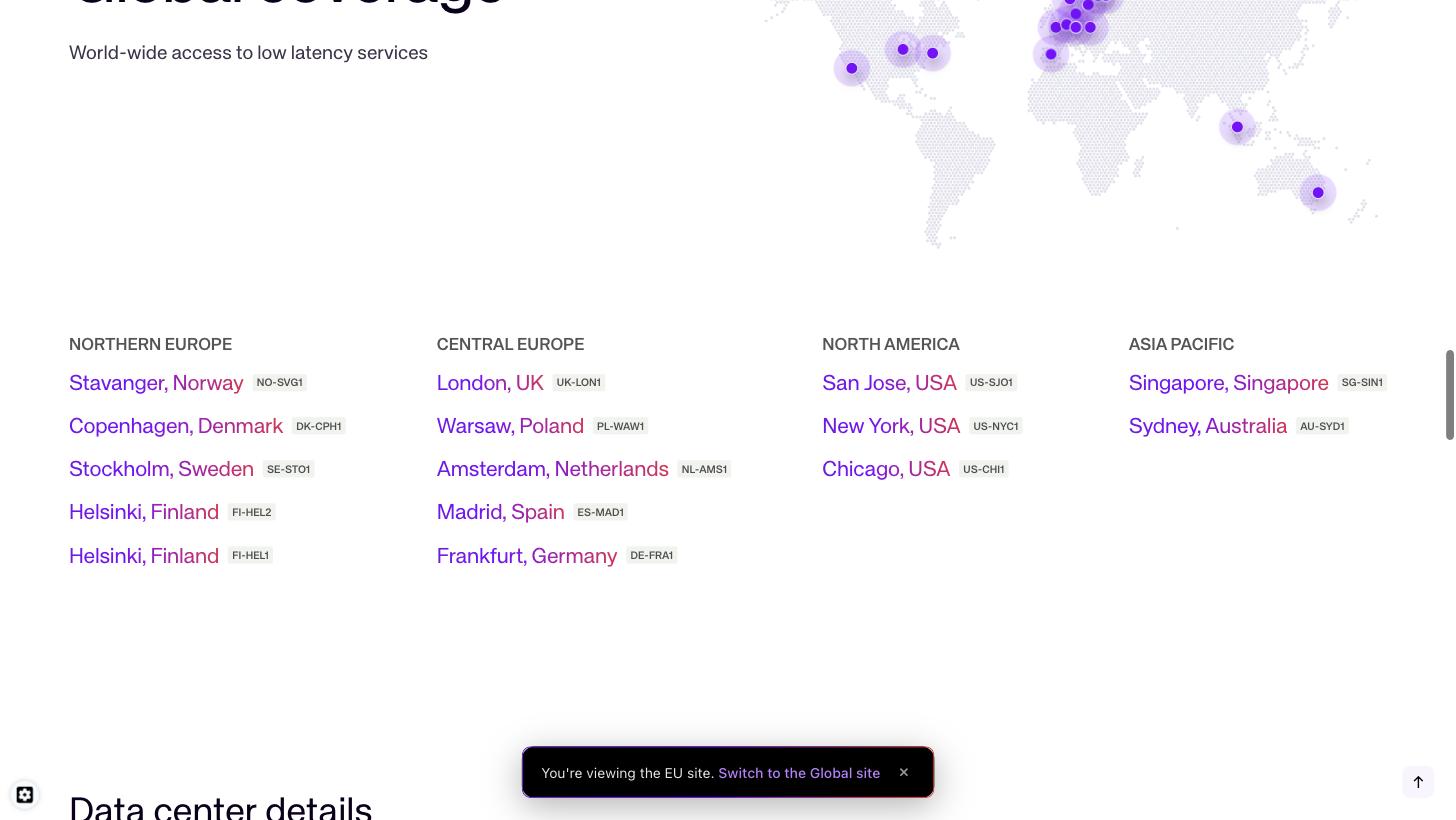
| In UpCloud's own data-center list: it operates 15 locations — Northern Europe (Stavanger, Copenhagen, Stockholm, Helsinki ×2), Central Europe (London, Warsaw, Amsterdam, Madrid, Frankfurt), North America (San Jose, New York, Chicago) and Asia-Pacific (Singapore, Sydney). None is in mainland China; the nearest is Singapore. Hosting a China-facing site on UpCloud therefore serves it from outside the mainland. | UpCloud — Data Center Information, retrieved 2026-10-07 |
| Serving a website to mainland-China audiences from infrastructure inside China requires an ICP filing with the MIIT, available only for services hosted on licensed, in-country infrastructure. Because UpCloud operates no mainland-China data center, an UpCloud-hosted deployment has no in-country, ICP-filed path — its traffic is delivered across the border. | PRC Administrative Measures on Internet Information Services (State Council Order No. 292); ICP filing measures (MIIT Order No. 33) |
| If a China-facing deployment stores Chinese users' personal data in UpCloud's offshore regions, that is a cross-border transfer of personal information. PIPL (Chapter III, Articles 38–40) requires the handler to give notice, obtain separate consent and meet a transfer mechanism; CSL Article 37 adds in-country storage for a CIIO or large-volume handler. The exposure scales with your data volume and role. | PIPL Chapter III, Articles 38–40; Cybersecurity Law Article 39 (formerly Article 37) |
| upcloud.com itself is reachable and fast from inside the mainland: from a probe inside China (Alibaba Cloud cn-zhangjiakou), 3 runs on 2026-08-28, it completed all 3 loads — median time to first byte 235ms, largest-contentful-paint 1,881ms, full load ~3.1s; a residential-broadband line inside China corroborated this on 2026-08-30 (3 of 3). This measures UpCloud's corporate site reaching China, not an application you host in its offshore regions — and reachability is not the ICP question. | 21YunBox — China delivery measurement, measured from inside mainland China |
Sources verified by the 21YunBox compliance team on 2026-10-07.
For a mainland-China audience, the question to ask about UpCloud is not whether it is quick — it is — but whether you are allowed to serve China from it, and where your users’ data is permitted to live. UpCloud’s own data-center list answers the first point plainly: it operates no region inside mainland China. A China-facing deployment on UpCloud is therefore reachable, and in our tests fast, yet entirely offshore — which leaves it with no footing for the ICP filing a public mainland site requires, and turns any personal data you hold for Chinese users into a cross-border transfer Chinese law governs. The speed is genuine; the license to operate and the data residency are where the risk actually sits.
UpCloud in China at a glance
| What decides it | What that means on UpCloud |
|---|---|
| Where it runs | Offshore only. By UpCloud's own list, 15 locations across Northern Europe (Stavanger, Copenhagen, Stockholm, Helsinki ×2), Central Europe (London, Warsaw, Amsterdam, Madrid, Frankfurt), North America (San Jose, New York, Chicago) and Asia-Pacific (Singapore, Sydney). No region is inside mainland China; the nearest, Singapore, is still offshore. |
| Choosing where to deploy | Every region UpCloud offers sits outside the mainland — the closest being Singapore, then Sydney. There is no mainland-China region to select. |
| Serving the public | A site served to mainland visitors from inside China needs an ICP filing, issued against the mainland hosting resource it runs on. With no mainland region, UpCloud offers no ICP-filing path of its own. |
| Your data on UpCloud | Personal data of Chinese users stored in UpCloud's offshore regions is a cross-border transfer PIPL governs (notice, separate consent, one transfer mechanism), plus an in-country storage duty for CIIOs and large-volume handlers that offshore locations cannot meet. |
| Is it reachable? | Yes — and fast. From inside mainland China upcloud.com loaded on every attempt: median TTFB 235ms, largest-contentful-paint 1,881ms, full load ~3.1s (Alibaba Cloud cn-zhangjiakou probe, 3 runs, 2026-08-28; a Beijing residential line corroborated 3 of 3 on 2026-08-30). That measures UpCloud's own site reaching China, not an app in its offshore regions — speed isn't the blocker. |
Door one — an UpCloud deployment has no ICP-filing path
UpCloud — the Helsinki-based cloud host, in business since 2012 — runs its servers in Europe, North America and Asia-Pacific. By its own data-center list that is 15 locations: Stavanger, Copenhagen, Stockholm and Helsinki (twice) in Northern Europe; London, Warsaw, Amsterdam, Madrid and Frankfurt in Central Europe; San Jose, New York and Chicago in North America; and Singapore and Sydney in Asia-Pacific. Not one of them is in mainland China, and the closest — Singapore — is still outside it.
That geography settles the licensing question before performance is ever in play. A public-facing website delivered to mainland visitors from inside China turns on an ICP filing (ICP 备案) under State Council Order No. 292 and MIIT Order No. 33, and that filing has to attach to a hosting resource physically located in the mainland. UpCloud operates none, so there is simply nothing on UpCloud to file against. This is where “we already run on UpCloud” stops: reaching China is not the same as being licensed to operate there, and no amount of tuning conjures the mainland footing a filing needs.
Door two — your China users’ data stays offshore under PIPL
Serve China from UpCloud and your users’ personal information lives in one of its European, North American or Asia-Pacific regions — outside the mainland. Under China’s Personal Information Protection Law that is a cross-border transfer, and the handler — you, the operator, not UpCloud — has to give notice, obtain separate consent for the overseas transfer, and clear one transfer mechanism: a CAC security assessment, the CAC standard contract, or certification (PIPL Chapter III, Articles 38–40). If you are a critical information infrastructure operator or a large-volume handler, personal information collected in China has to be stored in the mainland (Cybersecurity Law Article 39 (formerly Article 37)) — a residency duty none of UpCloud’s offshore regions can satisfy.
Reachable and fast — which is why speed is the wrong test
UpCloud is not blocked in China, and it is not slow to reach, either. In 21YunBox’s own measurements from inside the mainland, upcloud.com loaded on every attempt: from an Alibaba Cloud probe in cn-zhangjiakou, 3 runs on 2026-08-28, it completed all three — a median time to first byte of 235ms, a largest-contentful-paint of 1,881ms, and full load in about 3.1 seconds — and a residential broadband line in Beijing corroborated this on 2026-08-30 (3 of 3). Read that figure for exactly what it is: it measures UpCloud’s own corporate site reaching China, not an application you would host in its offshore regions, and reachability is not the ICP question.
Speed is the part UpCloud already gets right, and it is the part that decides the least. A page that paints quickly but has no ICP filing behind it, and holds Chinese users’ data offshore, is fully reachable and still not cleared to operate — which is why the test here is the license and the data residency, not the stopwatch.
This is a risk map, not a legal verdict: whether you need an ICP filing, in-country storage, or both turns on what you serve, how much personal data you hold, and who your users are — worth settling with counsel before you build.
Where 21YunBox fits — a compliant overlay, not a migration
You keep building on UpCloud. We add the one piece a host with no mainland presence cannot: compliant, ICP-filed delivery from inside the mainland, set in front of your existing UpCloud origin — no rebuild, no second codebase, and no move off UpCloud. Our China team maps your ICP and data-residency obligations against your entity and your data volumes, then stands up the in-country delivery and storage a lawful China presence needs, while your application stays exactly where it already runs.
Related reading: