Does Couchbase Capella Work in China? Data Residency, PIPL & Your Database
Couchbase Capella is a managed database that runs only on AWS, GCP and Azure — none inside mainland China — so the personal data your app keeps on Chinese users sits offshore under PIPL, with a data-localization question attached. A compliance-first look at the residency door.
Does Couchbase Capella work in China?
Couchbase Capella is reachable from inside China — but that was never the question. Capella is the managed service that holds your application's data, your Chinese users' personal information included, and it runs no cluster inside mainland China. That makes this a data-residency case: your users' records sit offshore by design, and China's law reaches them there.
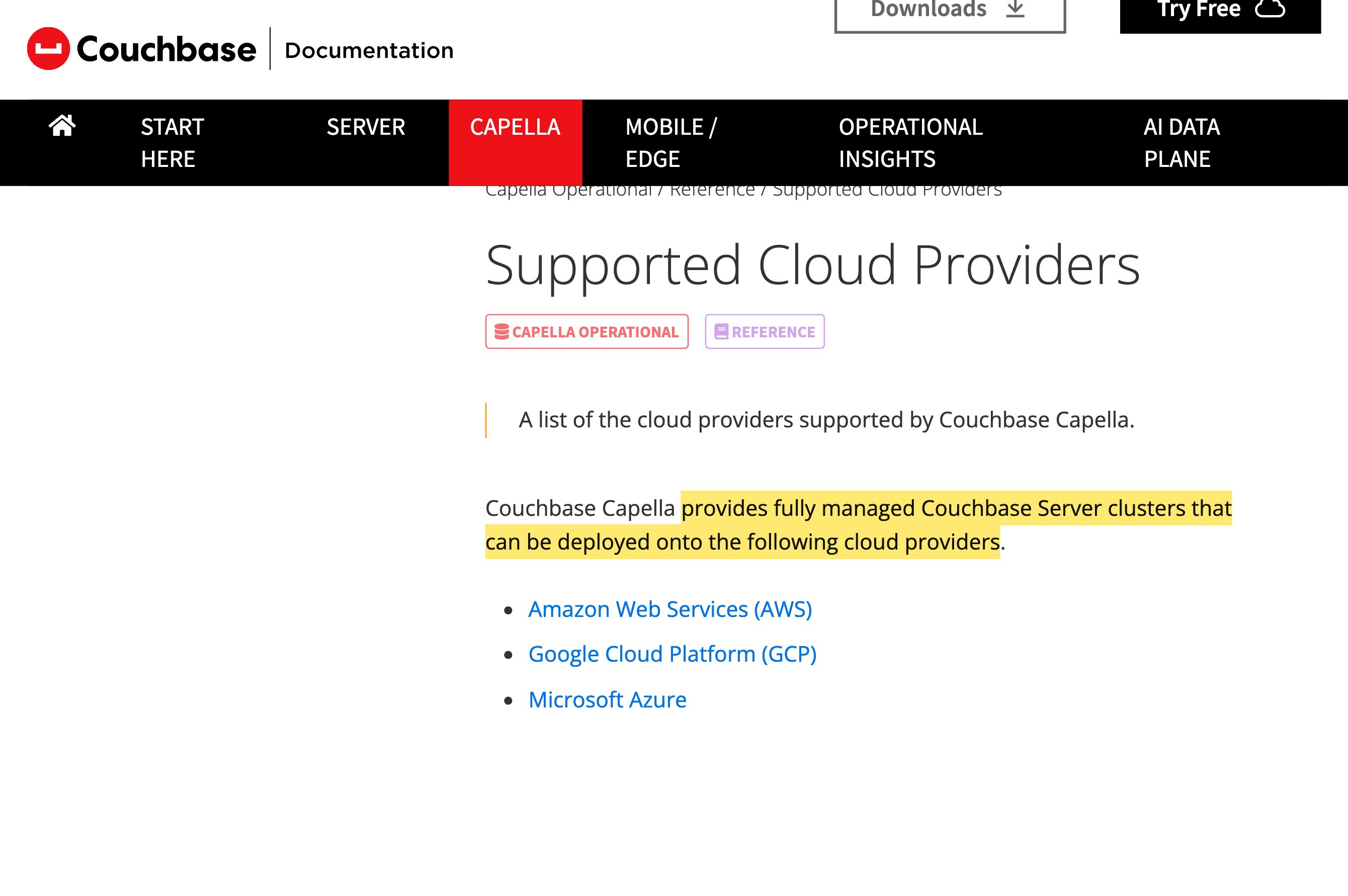
In Couchbase's own words, Capella "provides fully managed Couchbase Server clusters that can be deployed onto the following cloud providers" — Amazon Web Services, Google Cloud Platform and Microsoft Azure — and you choose the one cloud and region when you create a cluster. None of the three offers a Capella region inside mainland China; the nearest is Hong Kong. Keep a China-facing app on Capella and your users' personal data is stored abroad — a cross-border transfer PIPL governs (notice, separate consent and one transfer mechanism, Articles 38–43), and for a CIIO or large-volume handler a localization duty Capella's regions cannot meet (PIPL Article 40; Cybersecurity Law Article 39 (formerly Article 37)). ICP is not Capella's door — a database serves no public site, so that filing falls on the application in front of it. The table below is Couchbase's own wording and the rule each line triggers.
This is a risk map, not a verdict — whether a localization duty bites, and which cross-border mechanism fits, turns on your entity, your data volumes and whose personal information you hold. Our China team can map your exposure with you →
Compliance snapshot
- ! Capella holds your app's data — your Chinese users' PII lives in it
- ! Storing it in an offshore Capella region is a PIPL cross-border transfer
- ✕ No Capella region inside mainland China on AWS, GCP or Azure
- ✕ A CIIO or large-volume handler can't meet data localization on Capella
- ✓ Self-managed Couchbase Server can run on in-country infrastructure
What Couchbase Capella's own documentation says about China
| Fact | Primary source |
|---|---|
| Capella is a managed service that runs only on AWS, GCP and Azure — none inside mainland China. In Couchbase's own words, Capella "provides fully managed Couchbase Server clusters that can be deployed onto the following cloud providers": "Amazon Web Services (AWS)," "Google Cloud Platform (GCP)" and "Microsoft Azure." A cluster lives on the single cloud and region you pick when you create it, and no mainland-China region is on any of those menus. | Couchbase Capella Documentation — Cloud Providers (docs.couchbase.com), retrieved 2026-10-07 |
| Where your data physically sits is the region you pick — and the menu stops short of the mainland. Couchbase states Capella "supports deploying clusters onto Amazon Web Services (AWS)" and "supports deploying clusters onto Microsoft Azure"; the Asia-Pacific lists reach Singapore, Tokyo, Seoul, Mumbai, Jakarta and Hong Kong (AWS ap-east-1, Azure East Asia), but include no Beijing, Shanghai or Ningxia region. The cluster — and the personal data in it — is bound to whichever offshore region you choose. | Couchbase Capella Documentation — AWS & Microsoft Azure references (docs.couchbase.com), retrieved 2026-10-07 |
| Your Chinese users' personal data in Capella is a cross-border transfer under PIPL. Because a Capella cluster holds personal information collected from people in China on an offshore cloud region, storing it there is a cross-border transfer of personal information the handler — you, not Couchbase — must support with notice, separate consent and one transfer mechanism (PIPL Articles 38–43). A critical information infrastructure operator, or a handler above the regulators' volume thresholds, must keep China-collected personal information in the mainland (PIPL Article 40; Cybersecurity Law Article 39 (formerly Article 37)) — which Capella's region menu cannot do. | PIPL Articles 38–43 and 40; Cybersecurity Law Article 39 (formerly Article 37) (gov.cn), applied to Couchbase Capella's offshore regions, retrieved 2026-10-07 |
| Self-managed Couchbase Server — not Capella — can be deployed on in-country infrastructure. Couchbase's Server docs say it "can be deployed on a variety of platforms, from traditional bare metal servers" to "containers running in a public or private cloud," including in "a traditional data center on bare metal servers." That is a different product and operating model from the managed Capella service: Capella itself has no mainland region, so an in-China deployment means running Couchbase Server yourself on mainland infrastructure, not switching a Capella region. | Couchbase Server Documentation — Get Started / deployment platforms (docs.couchbase.com), retrieved 2026-10-07 |
Sources verified by the 21YunBox compliance team on 2026-10-07.
For a mainland-China audience, the question to ask about Couchbase Capella is not how quickly it answers a query — it is where the data inside it is allowed to live. Capella is Couchbase’s fully managed database-as-a-service: it holds your application’s real records, your Chinese users’ personal information among them. Couchbase settles the residency question in its own documentation — every cluster runs on one of three offshore clouds, in a region you choose, and none of those regions sits inside mainland China. The endpoint responds; the exposure is that the personal data it stores lives abroad, where China’s cross-border and data-localization rules reach it.
Couchbase Capella in China at a glance
| What decides it | In Couchbase's own terms |
|---|---|
| Where it runs | Capella “provides fully managed Couchbase Server clusters that can be deployed onto the following cloud providers”: AWS, Google Cloud Platform and Microsoft Azure. No region is inside mainland China; the nearest, Hong Kong, is still outside it. |
| Where your data physically sits | You choose the one cloud and region when you create a cluster, and the data lives there. Every option Couchbase offers is offshore — there is no mainland-China region to pick. |
| Your China users' data | Personal information collected in China and stored in a Capella cluster sits abroad — a cross-border transfer PIPL governs (Articles 38–43). |
| Data localization | A CIIO or large-volume handler must keep China-collected personal data in the mainland (PIPL Article 40; Cybersecurity Law Article 39 (formerly Article 37)). Capella has no in-China region to satisfy it. |
| ICP filing | Not Capella's door. A database serves no public site, so the ICP filing a mainland audience needs sits on the application in front of your cluster, not on Capella. |
| Self-managed alternative | Couchbase Server — the self-hosted product, not Capella — “can be deployed… in a public cloud” or “on bare metal servers,” including on in-country infrastructure you run yourself. |
A managed service on three offshore clouds — none in the mainland
Capella runs your database on Amazon Web Services, Google Cloud Platform or Microsoft Azure — the three clouds Couchbase names on its own cloud-providers page, where Capella “provides fully managed Couchbase Server clusters that can be deployed onto the following cloud providers.” You bind each cluster to a single cloud and a single region at creation. Couchbase’s reference pages bear this out: Capella “supports deploying clusters onto Amazon Web Services (AWS)” and “supports deploying clusters onto Microsoft Azure,” and the Asia-Pacific lists reach Singapore, Tokyo, Seoul, Mumbai, Jakarta and Hong Kong — but no Beijing, Shanghai or Ningxia region. The closest any of the three comes to China is Hong Kong, which is outside the mainland for every purpose that matters here: ICP, data localization and the cross-border rules.
That geography is the whole data-residency question, in its plainest form. The database is not a cache or an edge that sits in front of your records — it is your records, and Couchbase has nowhere in the mainland to keep them. “We already run on Capella” tells you the service responds from China; it does not put your data inside the country, and no amount of tuning the connection creates a mainland region that Couchbase does not offer.
Your China users’ data is a cross-border transfer
Because a Capella cluster holds personal information collected from people in China, storing it in an offshore region is a cross-border transfer under the Personal Information Protection Law. The handler — you, not Couchbase — has to give notice, obtain separate consent, and clear one transfer mechanism: a CAC security assessment, the CAC standard contract, or certification (PIPL Articles 38–43). And if you are a critical information infrastructure operator, or you process personal information above the regulators’ volume thresholds, that data must be stored in the mainland (PIPL Article 40; Cybersecurity Law Article 39 (formerly Article 37)) — a residency duty that an offshore AWS, GCP or Azure region simply cannot meet. The obligation does not soften because the database is managed for you; it follows the personal data, wherever Couchbase runs it.
ICP isn’t Capella’s door — and naming that honestly matters
It would be easy to staple an ICP-filing warning onto every China page, but it does not belong on Capella. An ICP filing (ICP 备案), under State Council Order No. 292 and MIIT Order No. 33, attaches to a public-facing website and the mainland hosting that serves it — and a database serves no public site of its own. So that obligation lives on the application in front of your Capella cluster, if that application faces a Chinese audience, not on the database layer. Capella’s compliance weight is narrower and concentrated in one place: data residency. Keeping the two doors apart is the point — it tells you exactly which risk sits where, instead of folding a storage question into a licensing one.
Self-hosting is the one in-country path — but that’s Couchbase Server, not Capella
There is an honest exception worth naming. Couchbase’s self-managed product — Couchbase Server, not the managed Capella service — is not tied to Couchbase’s cloud menu at all. Its documentation says Couchbase Server “can be deployed on a variety of platforms, from traditional bare metal servers” to “containers running in a public or private cloud,” including in “a traditional data center on bare metal servers.” Nothing stops you running Couchbase Server on infrastructure physically inside the mainland. But that is a different product and a different operating model: you take on the provisioning, patching, scaling and backups that Capella handles for you, and you still have to arrange compliant in-country hosting and, for the public application, its ICP filing. Capella itself stays offshore; the in-China option is to run the engine yourself, not to flip a Capella region.
This is a risk map, not a verdict: whether a localization duty applies, and which cross-border mechanism fits, depends on your entity, how much personal data you hold, and whose it is — worth settling with counsel before you build.
Where 21YunBox fits — a compliant overlay, not a migration
You keep Capella as your managed database. We add the layer it was never meant to provide: compliant, ICP-filed delivery from inside the mainland for the application that sits in front of your cluster, together with any in-China storage your data-residency obligations call for — arranged around your existing stack, with no rebuild, no second codebase, and no move off Couchbase. Our China team maps your PIPL cross-border and data-localization exposure against your entity and data volumes, then stands up the in-country delivery and storage a lawful China presence needs, while your database keeps running exactly where it is today.
Related reading:
Frequently Asked Questions
Does Couchbase Capella have a region inside mainland China?
No. Capella is a managed service that runs only on Amazon Web Services, Google Cloud Platform and Microsoft Azure, and you choose one cloud and region when you create a cluster. None of those menus includes a mainland-China region — the nearest is Hong Kong, which sits outside the mainland's data-localization and ICP regime. If your data has to live inside the mainland, Capella's region list cannot put it there.
Is it a problem to keep our China users' data in Couchbase Capella?
Treat it as a risk to assess with counsel, not a flat yes or no. Because a Capella cluster stores personal information collected in China on an offshore region, it is a cross-border transfer under PIPL — you must give notice, obtain separate consent and clear one transfer mechanism (Articles 38–43). If you are a critical information infrastructure operator or a large-volume handler, that data must instead be stored in the mainland (PIPL Article 40; Cybersecurity Law Article 39 (formerly Article 37)), which Capella cannot do. ICP, by contrast, is not Capella's door — it falls on the public application in front of the database.
Can 21YunBox help make our Couchbase setup work in China?
Yes. Our China team can map your data-residency and PIPL cross-border exposure for your entity, data volumes and users, and stand up the ICP-filed, in-country delivery — and any in-China storage your localization duties require — for the application in front of your database, while Capella stays exactly where it already runs. Get in touch to work through your specific case.