Does Rocket.net Work in China? ICP, Data Residency & an Offshore WordPress Host
Rocket.net is managed WordPress hosting that serves your site from its own servers outside mainland China and caches it on a global edge with no mainland location — so a China-facing site is served offshore with no ICP-filing path, and the WordPress and visitor data it stores lands outside the mainland under PIPL. A compliance-first look at the two doors.
Does Rocket.net work in China?
Reachable, but not clearable. Rocket.net hosts your WordPress site on its own servers outside mainland China and caches it on a global edge with no mainland location — so there is nothing in-country to hang an ICP filing on, and your users' data sits offshore.
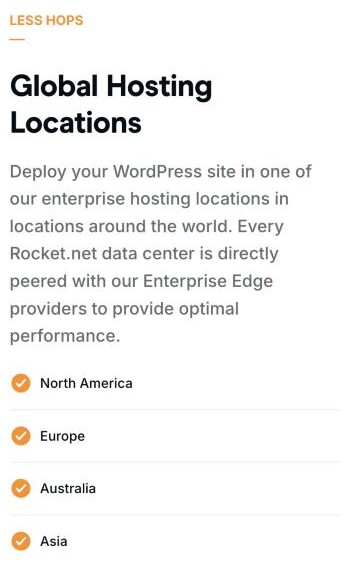
On its network page Rocket.net says "Our WordPress servers are strategically placed around the world in large cities" and runs "over 330 edge locations around the world for caching and security services," with Global Hosting Locations in North America, Europe, Australia and Asia — not one inside the mainland. A public site served to mainland visitors needs an ICP filing bound to an in-country hosting resource (State Council Order No. 292; MIIT Order No. 33), and Rocket.net has none to file against; meanwhile the WordPress content, accounts and visitor data it stores for Chinese users is a cross-border transfer of personal information PIPL governs. The table below is Rocket.net's own wording and the rule each line triggers.
This is a risk map, not a verdict — which obligations bind you turns on your entity, your data and who your users are. Our China team can map your exposure with you →
What Rocket.net's own documentation says about China
| Fact | Primary source |
|---|---|
| Rocket.net hosts your site from its own servers outside mainland China. It calls itself "Lightning-fast, secure, fully-managed WordPress 7.0 hosting," and on its network page says "Our WordPress servers are strategically placed around the world in large cities" that "reside at the Edge of the Cloud in what's known as Internet Exchanges." Its "Global Hosting Locations" are grouped as North America, Europe, Australia and Asia — with no location inside mainland China named anywhere on the page. | Rocket.net — homepage & Network page (rocket.net/features/network), retrieved 2026-10-07 |
| Nothing on Rocket.net can carry an ICP filing. A public website served to mainland visitors from inside China must hold an ICP filing (ICP 备案) bound to a hosting resource physically in the mainland — the regime under State Council Order No. 292 and MIIT Order No. 33. Rocket.net lists hosting regions only in North America, Europe, Australia and Asia and names no mainland location, so there is no in-country resource to attach a filing to. | Rocket.net — Network page (rocket.net/features/network), retrieved 2026-10-07; State Council Order No. 292; MIIT Order No. 33 |
| Your WordPress data sits offshore — a cross-border transfer under PIPL. As a managed WordPress host, Rocket.net stores your CMS content, registered-user accounts, form submissions and visitor logs on its servers outside the mainland. For users in China, that is a cross-border transfer of personal information under PIPL — notice, separate consent and one transfer mechanism (Articles 38–43); a CIIO or large-volume handler must also store China-collected personal information in the mainland (PIPL Article 40; Cybersecurity Law Article 39 (formerly Article 37)), which an offshore host cannot do. | Rocket.net — homepage (managed WordPress hosting), retrieved 2026-10-07; PIPL Articles 38–43 & 40; Cybersecurity Law Article 39 (formerly Article 37) |
| A global edge is the delivery half, not the legal half. Rocket.net says it is "partnered with several Edge providers to create our Enterprise Edge" and runs "over 330 edge locations around the world for caching and security services" — an edge long reported to be built on Cloudflare's Enterprise network (inference). But a global edge of that kind serves mainland visitors from points of presence outside the border, and operating an edge physically inside the mainland is itself gated on an ICP filing (inference). A worldwide CDN footprint is not the same as an in-China presence, and reachability is never what decides whether you may lawfully operate there. | Rocket.net — Network page (rocket.net/features/network), retrieved 2026-10-07 |
Sources verified by the 21YunBox compliance team on 2026-10-07.
With a mainland-China audience in view, the first thing to pin down about Rocket.net is not its page-load speed — it is whether a WordPress site it hosts can be operated inside China lawfully at all. Rocket.net settles the deciding part in its own materials: it is fully-managed WordPress hosting that runs your site on its own servers in large cities across North America, Europe, Australia and Asia, fronted by a global edge of over 330 caching-and-security locations — and none of those locations sits inside the mainland. So a China-facing Rocket.net site is reachable, but hosted entirely offshore: there is nothing in-country to attach an ICP filing to, and the WordPress and visitor data it holds for Chinese users becomes a cross-border transfer China’s law governs. The delivery distance is real; the licensing and the data residency are where the exposure lives.
Rocket.net in China at a glance
| What decides it | In Rocket.net's own terms |
|---|---|
| Where it runs | Fully-managed WordPress hosting whose servers are “strategically placed around the world in large cities” and “reside at the Edge of the Cloud in what's known as Internet Exchanges.” Its Global Hosting Locations span North America, Europe, Australia and Asia — none inside mainland China. |
| Content delivery | An always-on global edge: Rocket.net is “partnered with several Edge providers to create our Enterprise Edge” and runs “over 330 edge locations around the world for caching and security services” — all outside the mainland, so China traffic is served across the border. |
| Serving the public | A site served to mainland visitors from inside China needs an ICP filing tied to a mainland hosting resource. With no mainland location, Rocket.net offers no ICP-filing path of its own. |
| Your data on Rocket.net | CMS content, user accounts, form submissions and visitor logs for Chinese users sit on Rocket.net's offshore servers — a cross-border transfer PIPL governs, plus a data-localization duty for CIIOs and large-volume handlers that offshore locations cannot meet. |
| Is it reachable? | Yes — the site loads, but from offshore and with no mainland edge, so distance shows up as slow, cross-border delivery rather than a block. |
Hosted offshore, so there’s nothing to file an ICP against
Rocket.net hosts your WordPress site on its own machines, and its published footprint stops at the mainland’s edge. In its own words its servers are “strategically placed around the world in large cities” and “reside at the Edge of the Cloud in what’s known as Internet Exchanges,” and its “Global Hosting Locations” are grouped as North America, Europe, Australia and Asia. Not one of those locations is named inside mainland China.
That geography settles the licensing question before performance is ever in play. A public-facing website delivered to mainland visitors from inside China turns on an ICP filing (ICP 备案) under State Council Order No. 292 and MIIT Order No. 33, and that filing has to attach to a hosting resource that physically sits in the mainland. Rocket.net runs none, so there is simply nothing on the platform to file against. This is where “our site is already on Rocket.net” stops short: being reachable from China is not the same as being cleared to operate there, and no amount of caching or edge tuning conjures the in-country footing a filing needs.
Your WordPress data sits offshore — which is PIPL’s concern
Rocket.net is managed hosting for WordPress, so the personal data your site handles rides along with it — CMS records, registered-user accounts, form submissions and visitor logs all live on Rocket.net’s servers in North America, Europe, Australia or Asia. For users in China, moving that information offshore is a cross-border transfer under China’s Personal Information Protection Law, and the handler — you, not Rocket.net — has to give notice, obtain separate consent, and clear one transfer mechanism: a CAC security assessment, the CAC standard contract, or certification (Articles 38–43). If you are a critical information infrastructure operator or a large-volume handler, personal information collected in China must be stored in the mainland (PIPL Article 40; Cybersecurity Law Article 39 (formerly Article 37)) — a residency duty none of Rocket.net’s offshore regions can satisfy.
A global edge still serves the mainland from outside it
A Rocket.net site is not a blank screen in China; it loads. Its strength is an always-on global edge — Rocket.net says it is “partnered with several Edge providers to create our Enterprise Edge” and runs “over 330 edge locations around the world for caching and security services.” That edge has long been reported to be built on Cloudflare’s Enterprise network (inference). But a global edge of that kind serves mainland visitors from points of presence outside the border, and operating an edge physically inside the mainland is itself gated on an ICP filing (inference) — so for a Chinese user the bytes still arrive across the border, slow and uneven. The exposure on a China-facing Rocket.net site is therefore not only that delivery is cross-border — it is that reaching the site gives you neither an ICP filing nor in-country data residency. Those gaps are compliance facts, and no cache or edge configuration closes them.
None of this is a verdict — it is a map of where the risk sits. Whether you owe an ICP filing, in-country storage, or both depends on what your WordPress site serves, the volume of personal data it holds, and where your users are; settle it with counsel before you commit to a build.
Where 21YunBox fits — a compliant overlay, not a migration
Rocket.net stays your host. The one thing it cannot hand a mainland audience — a lawful, in-country footing — we supply alongside it: compliant, ICP-filed delivery from inside the mainland, placed ahead of the WordPress origin you already publish from on Rocket.net, with no rebuild, no second codebase and no move off the managed workflow your team relies on. Our China team starts by mapping which obligations actually bind you — ICP filing, PIPL cross-border transfer, data residency — against your entity and your data volumes, then stands up the in-country delivery and storage a compliant presence requires, so your site keeps running exactly where it does today.
Related reading: