Does Plesk Work in China? The Control Panel, Your Server's ICP, and an Offshore License Check
Plesk is a control panel you install on your own server, not a host — so it runs on a machine anywhere, including inside mainland China, and is not blocked. What decides compliance is the server it manages: a public mainland site needs an ICP filing and in-country hosting, and Plesk's own licensing server is external and must stay reachable. A compliance-first look at where the line really falls.
Does Plesk work in China?
Whether Plesk "works" in China is really a question about the server it manages, not about Plesk itself. Plesk is a control panel you install on a server you already own — it is software, not a hosting provider, and it runs on a machine located anywhere, including one inside mainland China. The panel is not blocked.
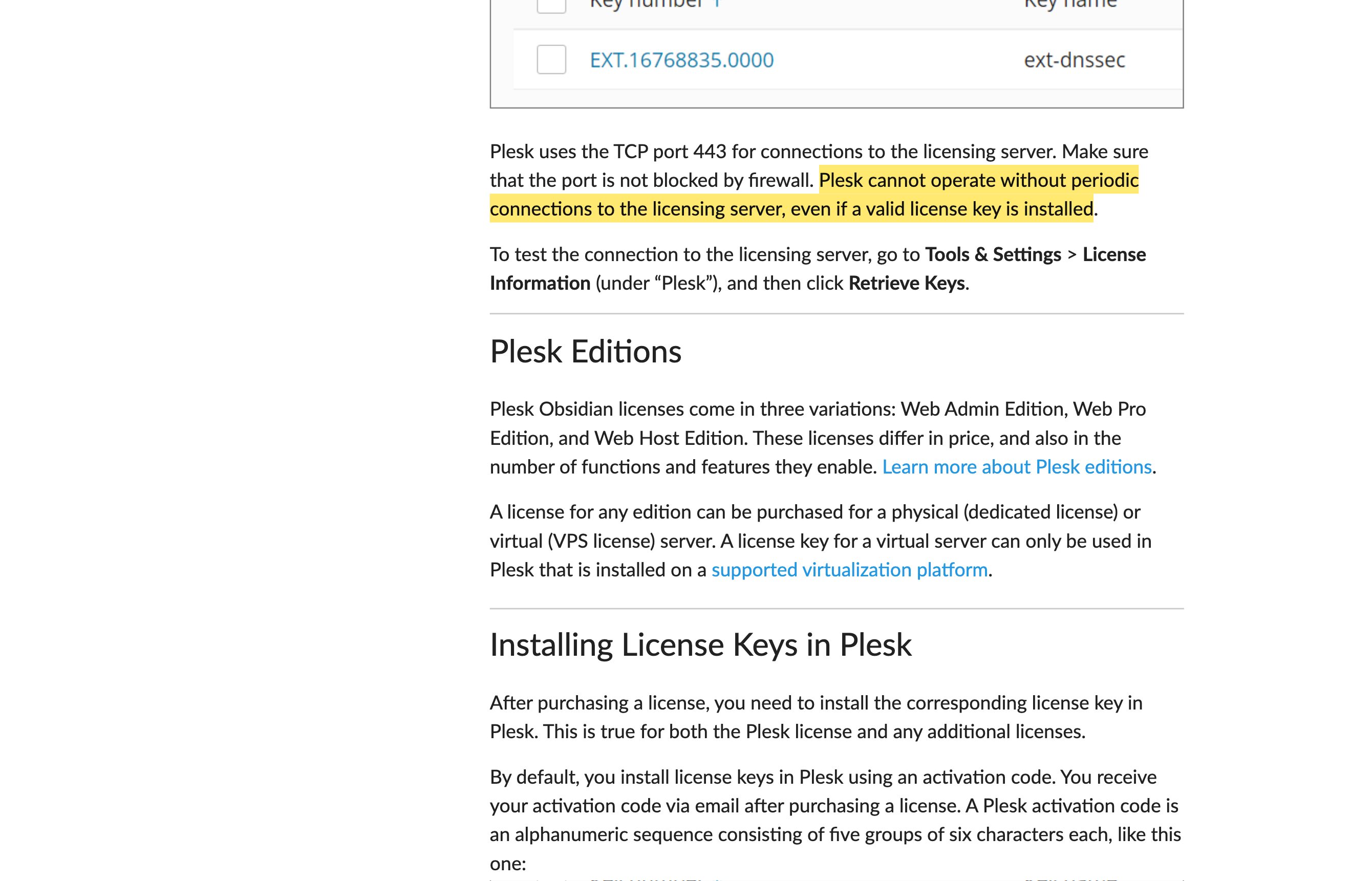
That splits the question into two honest parts. First, what China licenses is the server and the public site it serves, not the panel: a site reaching mainland visitors from inside China needs an ICP filing tied to a mainland hosting resource, and Plesk is simply the tool you administer it with. Second, Plesk has one dependency of its own — by Plesk's Administrator Guide, "Plesk cannot operate without periodic connections to the licensing server, even if a valid license key is installed," and that licensing server is Plesk's external service, so your server, wherever it sits, must be able to reach it over the public internet. The table below lays out what each piece turns on.
This is a risk map, not a verdict — whether the site your Plesk server hosts needs ICP filing, in-country storage, or both depends on what you serve and who your users are. Our China team can map that exposure with you →
Compliance snapshot
- ✓ Plesk is a control panel you install on your own server — it runs on a machine anywhere, including inside mainland China, and is not blocked
- ✓ Run Plesk on a mainland server whose site is ICP-filed and the panel itself adds no China-specific barrier
- ! What needs the ICP filing is the server Plesk manages and the public site on it — not Plesk
- ! Plesk must periodically reach its own external licensing server over TCP 443; on a mainland server that cross-border connection has to stay open
- ✓ For a site that must reach China, a compliant ICP-filed in-country delivery path exists — no rebuild, no move off Plesk
What Plesk's own documentation says about China
| Fact | Primary source |
|---|---|
| Plesk is management software, not a host. You install Plesk on a server you already control to administer websites, mail and applications; it operates no data centers of its own. Because it is software on a machine you choose, it runs wherever that machine sits — a server in Frankfurt, in Singapore, or inside mainland China — and the panel itself is not blocked by China's network. Where you put the Plesk server is a choice you make, and that choice is what carries the compliance consequences below. | Plesk — Plesk Licensing, Plesk Obsidian Administrator Guide, retrieved 2026-10-07 |
| In Plesk's own words: "Plesk cannot operate without periodic connections to the licensing server, even if a valid license key is installed," and "Plesk uses the TCP port 443 for connections to the licensing server." That licensing server is Plesk's own external service, not something that runs on your machine — so wherever you host Plesk, it has to reach Plesk over the public internet. On a server inside mainland China that means an outbound, cross-border connection your network path must allow: a reachability dependency to confirm for a mainland deployment, not a block we have measured. | Plesk — Plesk Licensing, Plesk Obsidian Administrator Guide, retrieved 2026-10-07 |
| The public site your Plesk server serves to mainland visitors is what needs an ICP filing (ICP 备案) under State Council Order No. 292 and MIIT Order No. 33, and that filing must attach to a hosting resource physically inside mainland China. Plesk is the management layer, not the filing subject — so put the panel on an ICP-filed mainland server and Plesk itself raises no additional barrier; keep the server offshore and no amount of Plesk configuration creates the mainland footing a filing needs. | State Council Order No. 292 (Measures for the Administration of Internet Information Services); MIIT Order No. 33; MIIT ICP filing system |
| Where you put the Plesk server also settles data residency. Personal data your server stores lives wherever the server lives: on a mainland server it stays in-country; on an offshore server, the data of your China users becomes a cross-border transfer under PIPL, and a CIIO or large-volume handler must keep China-collected personal information inside the mainland (PIPL Article 40; Cybersecurity Law Article 39 (formerly Article 37)). The same choice — where the box sits — drives both the ICP question and the residency one. | PIPL Article 40; Cybersecurity Law Article 39 (formerly Article 37) |
Sources verified by the 21YunBox compliance team on 2026-10-07.
For a mainland-China audience, the useful question about Plesk is not how fast it is, and it is not even really about Plesk. Plesk is a control panel — software you install on a server you already run — so it goes wherever that server goes, including onto a server inside mainland China, and China’s network does not block it. What decides whether your setup is compliant is the server Plesk manages and the site it serves: a public mainland site turns on an ICP filing and in-country hosting, while Plesk itself adds just one dependency — the external licensing service it has to check in with. Reaching China and being cleared to operate there are two different things, and for Plesk the line falls on the server, not the panel.
Plesk in China at a glance
| What decides it | The honest answer |
|---|---|
| Is Plesk itself blocked? | No. Plesk is software you install on your own server, not a service hosted for you. It runs on a machine anywhere, including one inside mainland China, and the panel is not blocked by China's network. |
| Where can you run it? | On any server you control — offshore, or a mainland server that is ICP-filed. The panel does not care where the box sits; your placement choice is what carries the compliance weight. |
| What needs the ICP filing? | The server and the public site it serves to mainland visitors — not Plesk. An ICP filing attaches to a hosting resource physically inside the mainland; Plesk is only the management layer on top. |
| License & updates | Plesk installs with an activation code and must keep reaching its own external licensing server over TCP 443 to keep operating. On a mainland server that is a cross-border connection to keep open — a dependency to confirm, not a block we have measured. |
| Your users' data | Lives wherever the server lives. A mainland server keeps China users' data in-country; an offshore server makes it a cross-border transfer PIPL governs. |
Plesk goes where your server goes
Start from what Plesk actually is. It is a web hosting and server management platform you install on a server you already run — the layer you use to create sites, mailboxes, databases and certificates. It is not a hosting provider and it operates no data centers; it is software sitting on a machine you chose. That one fact answers the crude version of the question immediately: because Plesk is software on your own server, it runs wherever that server runs, and a server inside mainland China runs Plesk just as a server in Frankfurt or Singapore does. The panel is not something China’s network blocks.
So “does Plesk work in China” is the wrong altitude. The decision that matters is the one you make when you pick where the server lives, because that single choice is what the rest of this page turns on.
What China licenses is the server, not the panel
If the site your Plesk server hosts is public and meant to reach mainland visitors from inside China, it needs an ICP filing (ICP 备案) under State Council Order No. 292 and MIIT Order No. 33, and that filing must attach to a hosting resource physically located in the mainland. Notice who the subject is: the hosting resource and the site, not the control panel. Plesk is the tool you administer the site with — it is never what the filing is granted against.
That is why the placement choice decides everything. Put Plesk on an offshore server and there is nothing on the mainland to file against, so no amount of Plesk configuration creates the footing a filing needs. Put Plesk on a mainland server whose site carries its ICP filing, and the panel itself adds no China-specific barrier — it simply manages a site that is already cleared to operate. “We already run Plesk” is not the finish line; being cleared to operate is a property of the server and its filing, not of the software on top.
Plesk’s one dependency: its external licensing server
There is a single Plesk-specific thing to get right, and it is operational rather than legal. Plesk has to phone home. By its own Administrator Guide, “Plesk cannot operate without periodic connections to the licensing server, even if a valid license key is installed,” and “Plesk uses the TCP port 443 for connections to the licensing server.” You install a license with an activation code, but the key still has to be revalidated against Plesk’s licensing service on a recurring basis.
That licensing service is Plesk’s own, external to your machine — so wherever you host the panel, the server must be able to reach Plesk over the public internet. On a server inside mainland China that is an outbound, cross-border connection, and the only requirement is that your network path keeps TCP 443 to Plesk’s licensing endpoint open. Treat it as a reachability dependency to confirm for a mainland deployment, not as a block — we have not measured one, and we do not claim one.
Where the server sits also decides your data residency
Because Plesk runs on a server you place, where you place it quietly settles a second question too. Personal data your server stores lives wherever the server lives. Keep it on a mainland server and your China users’ data stays in-country; keep it offshore and that data becomes a cross-border transfer under PIPL, with notice, separate consent and a transfer mechanism to clear — and, for a critical information infrastructure operator or a large-volume handler, a duty to store China-collected personal information inside the mainland (PIPL Article 40; Cybersecurity Law Article 39 (formerly Article 37)). The same decision that governs the ICP question governs this one.
Treat this as a risk map rather than a ruling: whether the site your Plesk server hosts needs an ICP filing, in-country storage, or both comes down to what it serves, how much personal data it holds, and who its users are — questions worth closing with counsel before you launch.
Where 21YunBox fits — a compliant overlay, not a migration
Keep managing your stack in Plesk exactly as you do now. What we add sits one layer out from the panel: compliant, ICP-filed delivery from inside the mainland, placed in front of the site your Plesk server hosts — so a China audience is served in-country, with no rebuild, no second control panel, and no move off Plesk. Our China team maps your ICP and data-residency obligations against your entity and data volumes, then stands up the in-country delivery and, where the law requires it, the in-country storage a lawful China presence needs — while your server and your Plesk setup stay right where they are.
Related reading:
Frequently Asked Questions
Does Plesk run on a server inside mainland China?
Yes. Plesk is software you install on your own server, so it runs on a machine anywhere — including inside the mainland — and the panel is not blocked by China's network. On a mainland server whose site carries its ICP filing, Plesk runs as it does anywhere else. The one thing to confirm is that the server can reach Plesk's external licensing service, which Plesk's documentation says it must contact periodically to keep operating.
Is it Plesk or the server that needs an ICP filing in China?
The server and the public site it serves — not Plesk. An ICP filing attaches to a hosting resource physically inside mainland China; Plesk is only the management layer you administer that site with. Putting Plesk on an offshore server does not create a filing path, and putting it on an ICP-filed mainland server does not add any Plesk-specific barrier.
Can 21YunBox help make our Plesk setup compliant in China?
Yes. Our China team can assess whether the site your Plesk server hosts needs an ICP filing, in-country storage, or both for your users and data volumes, and stand up compliant, ICP-filed in-country delivery in front of your origin — with no rebuild and no move off Plesk. Get in touch to work through your specific setup.