Does Neon Work in China? Data Residency, PIPL & an Offshore Database
Neon is a serverless Postgres database — your application's system of record — and it runs only in offshore AWS regions (US, Europe, Singapore, Sydney, São Paulo), none in mainland China. So your China users' personal data lives offshore and crosses the border on every read and write: a PIPL data-residency and cross-border-transfer question, not a speed one.
Does Neon work in China?
Whether you can use Neon in China is first a data-residency question, not a speed one. Neon is a serverless Postgres database — the system of record that holds your application's data, which routinely includes personal information — and China's law responds to where that data lives.
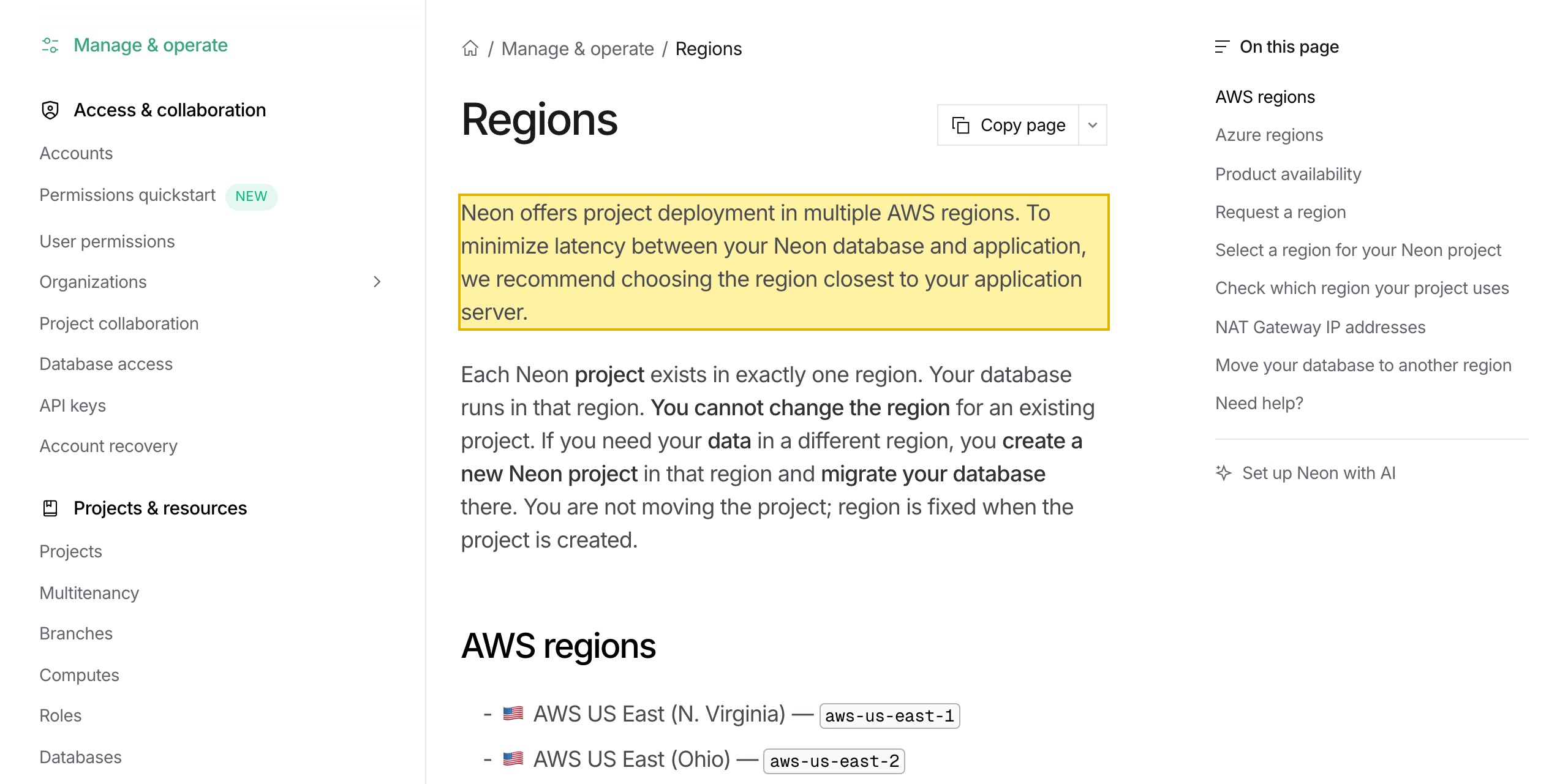
By Neon's own documentation, "Neon offers project deployment in multiple AWS regions" — N. Virginia, Ohio, Oregon, Frankfurt, London, Singapore, Sydney and São Paulo — with none in mainland China (its Azure regions are deprecated). So the personal data your app stores in Neon for Chinese users is held offshore, and because the database is the data of record, every read and write from China carries that data across the border too — a cross-border transfer PIPL governs. For a CIIO or large-volume handler, that data must stay on the mainland, which no Neon region can do. The table below is Neon's own wording and the rules it triggers.
This is a risk picture, not a verdict — your obligations turn on your data volumes and role. Our China team can map your Neon data-residency exposure with you →
What Neon Postgres's own documentation says about China
| Fact | Primary source |
|---|---|
| In Neon's own documentation, "Neon offers project deployment in multiple AWS regions" — AWS US East (N. Virginia and Ohio), US West (Oregon), Europe (Frankfurt and London), Asia Pacific (Singapore and Sydney) and South America (São Paulo). None is in mainland China, and Neon's Azure regions are deprecated; the nearest, Singapore or Sydney, are still offshore. The Postgres database your application runs on therefore lives outside the mainland. | Neon Docs — Regions, retrieved 2026-10-07 |
| Neon is the system of record — a Postgres database holding the data your application reads and writes, which routinely includes users' personal information. Run it in an offshore region and the personal data of people in China both lives outside the mainland and crosses the border on every query. PIPL governs that cross-border transfer: the handler — you, Neon's customer, not Neon — must give notice, obtain separate consent, and satisfy one transfer mechanism (a CAC security assessment, the CAC standard contract, or certification). | PIPL Chapter III, Articles 38–43 |
| For a CIIO or large-volume handler, personal information collected in China must be stored inside mainland China (PIPL Article 40; Cybersecurity Law Article 39 (formerly Article 37)). Neon publishes no mainland-China region, so none of its locations can meet that data-localization duty — keeping your China users' data on Chinese soil means running the Postgres and its storage on ICP-filed infrastructure inside the mainland. | PIPL Article 40; Cybersecurity Law Article 39 (formerly Article 37) |
| The exposure scales with volume and role, not merely with using the database: under the CAC's March 2024 cross-border rules, a non-CIIO transferring fewer than 100,000 individuals' non-sensitive personal information in a calendar year is exempt from the security assessment, standard contract and certification — a threshold worth checking before you assume you are clear. | CAC — Regulations on Promoting and Regulating Cross-border Data Flows, March 2024 |
| Reachability is a delivery matter, separate from the compliance question. A Neon endpoint runs in an offshore AWS region, so an application or user connecting from inside mainland China reaches the database across the border. Whether that path is fast or slow, the compliance facts are unchanged: the data of record is offshore, and that is what PIPL responds to. | Neon Docs — Regions (offshore endpoint), retrieved 2026-10-07 |
Sources verified by the 21YunBox compliance team on 2026-10-07.
For a mainland-China audience, the deciding question about Neon is not how fast a query returns — it is where your data is allowed to live. Neon is a serverless Postgres database: the system of record your application reads from and writes to, holding whatever personal data your users generate. Neon runs that database only in offshore cloud regions, with none inside mainland China. The data is reachable; what China’s law responds to is that it — and every read and write of it — sits on the wrong side of the border.
Neon in China at a glance
| What decides it | Where Neon stands for China |
|---|---|
| What Neon is | A serverless Postgres database — the system of record holding your application's data, which routinely includes users' personal information. Where that data lives is the deciding question. |
| Where it runs | “Project deployment in multiple AWS regions”: N. Virginia, Ohio, Oregon, Frankfurt, London, Singapore, Sydney and São Paulo. No region is inside mainland China, and its Azure regions are deprecated; the nearest, Singapore or Sydney, is still offshore. |
| Your data in Neon | Personal data your app stores for Chinese users sits offshore — a cross-border transfer PIPL governs — and it moves across the border on every read and write. |
| Data residency | For a CIIO or large-volume handler, personal information collected in China must stay on the mainland (PIPL Article 40; Cybersecurity Law Article 39 (formerly Article 37)). No Neon region can meet that duty. |
| Is it reachable? | The endpoint is offshore, so reaching it from China is a delivery matter. Reachable or not, the data of record is offshore — and that is the compliance fact. |
Your database of record sits offshore
Neon is a serverless Postgres database — the place your application actually keeps its data. In Neon’s own regions documentation, “Neon offers project deployment in multiple AWS regions,” and that list runs from N. Virginia, Ohio and Oregon to Frankfurt and London, to Singapore and Sydney, to São Paulo; its Azure regions are now deprecated. Not one region is inside mainland China, and the closest — Singapore or Sydney — is still outside it. That single fact settles the China question before performance is ever measured: the data your China users generate is stored on the wrong side of the border. For a critical information infrastructure operator or a large-volume handler, personal information collected in China has to be kept on the mainland, and no offshore Neon region can satisfy that duty.
A database is different from a CDN — the data itself moves
With a static asset, what crosses the border is a copy of a file. With a database, what crosses the border is the personal data itself: every query reads it out, every insert and update writes it back, and backups and replicas of it live offshore. So an application or a user connecting from inside mainland China to an offshore Neon endpoint is exchanging personal data across the border continuously, not once. Under China’s Personal Information Protection Law both the offshore storage and that ongoing flow are a cross-border transfer, and the obligation falls on you — the handler — not on Neon: notice, separate consent, and one cleared transfer mechanism. This is the part a speed fix cannot touch; making the round trip faster does not make the data resident.
Reachable or not, the data is still offshore
Neon’s endpoints are not the point of failure here. Whether a connection from China to an offshore region is quick or slow, steady or flaky, is a delivery matter — and it is independent of the compliance question. Even a database that answers instantly is still holding your China users’ personal data outside the mainland, which is exactly what PIPL’s residency and cross-border rules respond to. Treat this as a risk map, not a verdict: whether you face a localization duty, a transfer-mechanism obligation, or both turns on what you store, how much personal data you hold, and who your users are — worth settling with counsel before you build.
Where 21YunBox fits — a compliant overlay, not a migration
You keep building on Neon. We add the piece a database with no mainland presence cannot: compliant, ICP-filed storage and delivery from inside the mainland, placed in front of the stack you already run — no rebuild, no second codebase, and no move off Neon. Our China team maps your cross-border and data-residency obligations against your entity and data volumes, then, where the law requires your China users’ data to stay on Chinese soil, stands up the in-country storage and delivery a lawful China presence needs, while your application keeps running exactly where it is.
Related reading: