Does Google Cloud Work in China? No Mainland Region, and What That Means
Google Cloud has no mainland-China region, so it cannot host or store your workload in-country. A compliance-first look at the data-residency, cross-border, and ICP questions.
Does Google Cloud work in China?
Google Cloud has no region inside mainland China, which makes running a China-facing service on it a data-residency and cross-border-data question first, and a speed question second. With no mainland region, Google cannot host or store your workload in-country, and any personal data it holds for your Chinese users is kept outside the mainland.
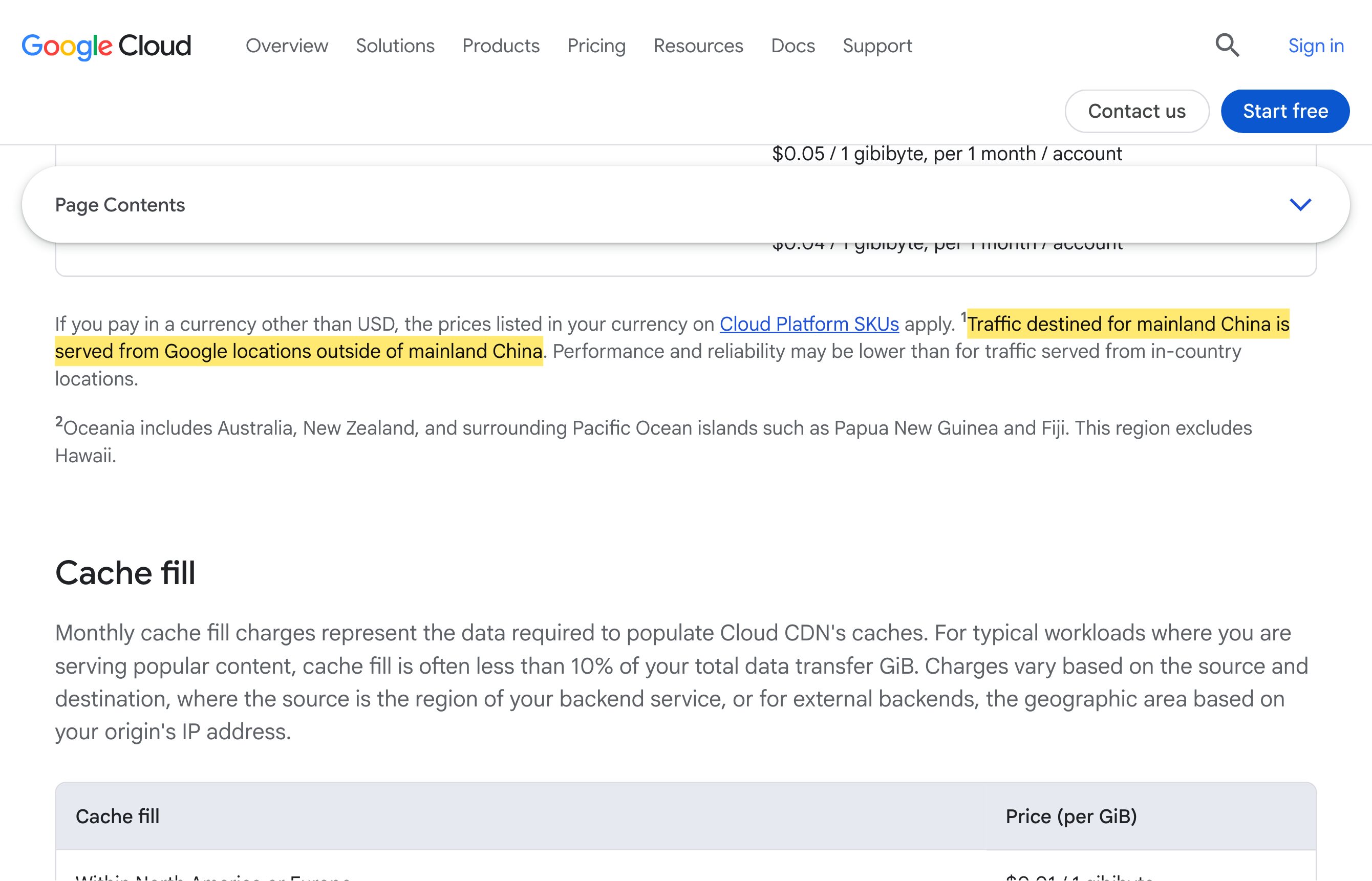
By Google's own documentation, traffic bound for mainland China is "served from Google locations outside of mainland China," and its region list stops at Hong Kong and Taiwan — both outside the mainland. That makes two obligations live at once: serving content to visitors in China legally requires an ICP filing bound to in-country infrastructure Google does not provide, and if your workload stores Chinese users' personal information, moving it to Google's out-of-mainland regions is a cross-border transfer that PIPL governs. The table below is Google's own wording and the rules it triggers — plus the compliant, in-country path.
This is a risk picture, not a verdict — your duties turn on your data volumes and whether you are a CIIO. Our China compliance team can map your Google Cloud exposure with you →
Compliance snapshot
- ✕ No Google Cloud region inside mainland China
- ! Your workload's data sits outside the mainland — Hong Kong or Taiwan at nearest
- ! Holding Chinese users' personal data there is a cross-border transfer under PIPL
- ✕ Mainland data-residency can't be satisfied on Google Cloud itself
- ✓ A compliant path exists: ICP-filed in-country delivery in front of your GCP origin
What Google Cloud's documentation says, and what we measured from inside China
| Fact | Primary source |
|---|---|
Google operates no region inside mainland China. In Google's own Compute Engine region list, the closest locations are asia-east1 — "Changhua County, Taiwan, APAC" — and asia-east2 — "Hong Kong, APAC." No zone is located in the mainland (no Beijing, Shanghai, Shenzhen or Guangzhou), and there is no Google Cloud equivalent of AWS China or Azure China to move to. Hong Kong and Taiwan are outside mainland China, so neither satisfies a mainland data-residency requirement. | Google Cloud — Compute Engine, Regions and zones (Available regions and zones), retrieved 2026-10-07 |
| In Google's own words, "traffic destined for mainland China is served from Google locations outside of mainland China" and "performance and reliability may be lower than for traffic served from in-country locations." Google states this as a footnote to its data-transfer pricing for "China destinations (excluding Hong Kong)" — Google itself counts Hong Kong as outside mainland China. | Google Cloud — Network pricing, data transfer to China destinations (footnote 1), retrieved 2026-10-07 |
| Because any personal information your workload holds for Chinese users is kept in a Google region outside the mainland, moving it there is a cross-border transfer of personal information under PIPL. The personal-information handler — you, the Google Cloud customer, not Google — must give notice, obtain separate consent, and satisfy one transfer mechanism: a CAC security assessment, the CAC standard contract, or certification. The CAC's March 2024 cross-border rules then set volume-based exemptions, so the exposure scales with your data volume and role, not merely with using the platform. | PIPL Chapter III, Articles 38–43 (cac.gov.cn); CAC — Regulations on Promoting and Regulating Cross-border Data Flows, March 2024 |
| For a CIIO or large-volume handler, personal information collected in China must be stored in mainland China (CSL Article 39 (formerly Article 37); PIPL Article 40) — an obligation Google Cloud cannot satisfy on its own platform, because it runs no mainland region. The compliant arrangement is separate in-country infrastructure placed in front of your Google Cloud origin, and serving that legally from inside the mainland is the act that requires an ICP filing (State Council Order No. 292; MIIT Order No. 33). | CSL Article 39 (formerly Article 37); PIPL Article 40; ICP filing regime — State Council Order No. 292, MIIT Order No. 33 |
Delivery evidence (separate from the compliance questions above): requested directly from a probe inside mainland China (Alibaba Cloud cn-zhangjiakou) on 2026-08-28, cloud.google.com returned no response in three of three attempts — no first byte, not a slow load. This was measured from a mainland datacenter rather than a home connection; it confirms that in-country delivery has to be arranged separately, and is a performance observation, not the legal basis. | 21YunBox — China delivery census, measured from inside mainland China |
Sources verified by the 21YunBox compliance team on 2026-10-07.
Whether Google Cloud “works” in mainland China is a data-residency question before it is a performance one. The deciding fact is structural: Google operates no cloud region inside the mainland. Its nearest locations sit in Taiwan and Hong Kong — both outside mainland China — and, unlike AWS and Azure, there is no separate Google Cloud China partition to move onto. So a China-facing launch runs into two regulatory gates at the same time — an ICP filing it has nothing on Google Cloud to satisfy, and a cross-border transfer of its users’ personal information — and Google states the underlying facts in its own words.
Google Cloud in China at a glance
| What decides it | In Google's own terms |
|---|---|
| Where it runs | No region inside mainland China. The nearest are asia-east1 — “Changhua County, Taiwan, APAC” — and asia-east2 — “Hong Kong, APAC” — both outside the mainland. |
| No China partition | Unlike AWS and Azure, which run separate mainland-China partitions through local operators, Google Cloud has none to move onto. |
| How China traffic is served | In Google's words, “traffic destined for mainland China is served from Google locations outside of mainland China,” where “performance and reliability may be lower.” |
| Serving the public | A public-facing site served to visitors in China requires an ICP filing — which binds to in-country infrastructure Google does not operate. |
| Your China users' data | Kept outside the mainland — Hong Kong or Taiwan at nearest: a cross-border transfer of personal information PIPL governs, on infrastructure that can neither be ICP-filed nor meet mainland data residency. |
No mainland region — and no China partition to move onto
Google’s own Compute Engine region list places its closest locations in Taiwan — asia-east1, “Changhua County, Taiwan, APAC” — and Hong Kong — asia-east2, “Hong Kong, APAC.” No zone is in the mainland: there is no Beijing, Shanghai, Shenzhen or Guangzhou region, and no Google Cloud equivalent of AWS China or Azure China to switch to. Google reinforces the point in its network documentation, stating that “traffic destined for mainland China is served from Google locations outside of mainland China.” In short, Google operates no in-country footprint you can host on, store on, or attach a filing to — Hong Kong and Taiwan are outside mainland China, so neither answers a mainland requirement. The gap is common rather than peculiar to Google — 633 of the 763 services we checked against Chinese law in October 2026, reading each one’s own documentation, run no mainland region for the core service either — but on a cloud platform it sits underneath everything else you deploy.
The ICP filing has nothing on Google Cloud to attach to
Serving a public-facing website to visitors in mainland China turns on an ICP filing, and that filing binds to in-country infrastructure — a mainland server or an in-country delivery layer operated under a Chinese entity. Because Google runs no mainland region, there is nothing on Google Cloud for the filing to attach to; the ICP door has to be opened on separate in-country infrastructure placed in front of your Google Cloud origin. This is the regime under State Council Order No. 292 and MIIT Order No. 33, and it is not optional for a site that serves the Chinese public.
The cross-border transfer your China users’ data makes
Keep serving China from Google Cloud and the personal information of your Chinese users is stored outside the mainland — Hong Kong or Taiwan at nearest. Under China’s Personal Information Protection Law that is a cross-border transfer: the handler — you, the Google Cloud customer, not Google — must give notice, obtain separate consent, and satisfy one transfer mechanism (a CAC security assessment, the CAC standard contract, or certification). The CAC’s March 2024 cross-border rules then add volume-based exemptions, so the exposure scales with your data volume and role, not merely with using the platform. For a CIIO or large-volume handler, personal information collected in China must be stored in the mainland (Cybersecurity Law Article 39 (formerly Article 37); PIPL Article 40) — which Google Cloud cannot do, because it has no mainland region to store it in.
This is a risk map, not a verdict: which duties bite turns on your entity, your data volumes and whether you are a critical information infrastructure operator — and it is worth confirming with counsel.
Where 21YunBox fits — a compliant overlay, not a migration
You keep building on Google Cloud. We add the piece Google Cloud leaves you to arrange yourself: compliant, ICP-filed delivery from inside the mainland, placed in front of your existing Google Cloud origin — no rebuild, no second codebase, and no move off GCP. Our China team maps your PIPL cross-border and data-residency exposure for your entity and data volumes, and stands up the in-country delivery — and storage where localization applies — that Google Cloud’s out-of-mainland regions cannot provide.
Related reading:
Frequently Asked Questions
Is there a Google Cloud region in mainland China?
No. Google Cloud's own region list places its nearest locations in Taiwan (asia-east1, Changhua County) and Hong Kong (asia-east2) — both outside mainland China. Unlike AWS and Azure, which run separate China partitions through local partners, Google Cloud has no mainland-China region, so it cannot host or store your workload in-country.
Is storing our data on Google Cloud a problem under PIPL?
It can be. Because Google keeps your data in regions outside the mainland, personal information you collect from Chinese users is transferred abroad — which PIPL permits only with notice, separate consent and one of its transfer mechanisms. Whether you also face a data-localization duty depends on your role (for example, whether you are a CIIO) and your data volume; since the CAC's March 2024 cross-border rules, smaller, non-sensitive transfers are exempt from the security assessment, standard contract and certification. Treat it as a risk to size with counsel, not a blanket ban.
Can 21YunBox help run Google Cloud compliantly in China?
Yes. You keep Google Cloud as your origin, and our China compliance team assesses your cross-border and data-residency exposure for your data volumes and role, then sets up the ICP-filed, in-country delivery — and storage where localization applies — that Google's out-of-mainland regions cannot provide. Get in touch to work through your specific case.