Does DigitalOcean Work in China? ICP, Data Residency & the Two Doors
DigitalOcean runs no datacenter in mainland China, so serving Chinese users is offshore delivery — a public site can't be ICP-filed on it, and China personal data becomes a PIPL cross-border transfer. A compliance-first look at your DigitalOcean stack.
Does DigitalOcean work in China?
Whether you can run a site or app on DigitalOcean for mainland China is a compliance question first and a speed question second — because DigitalOcean has no datacenter in the mainland, serving China from it is offshore delivery by construction.
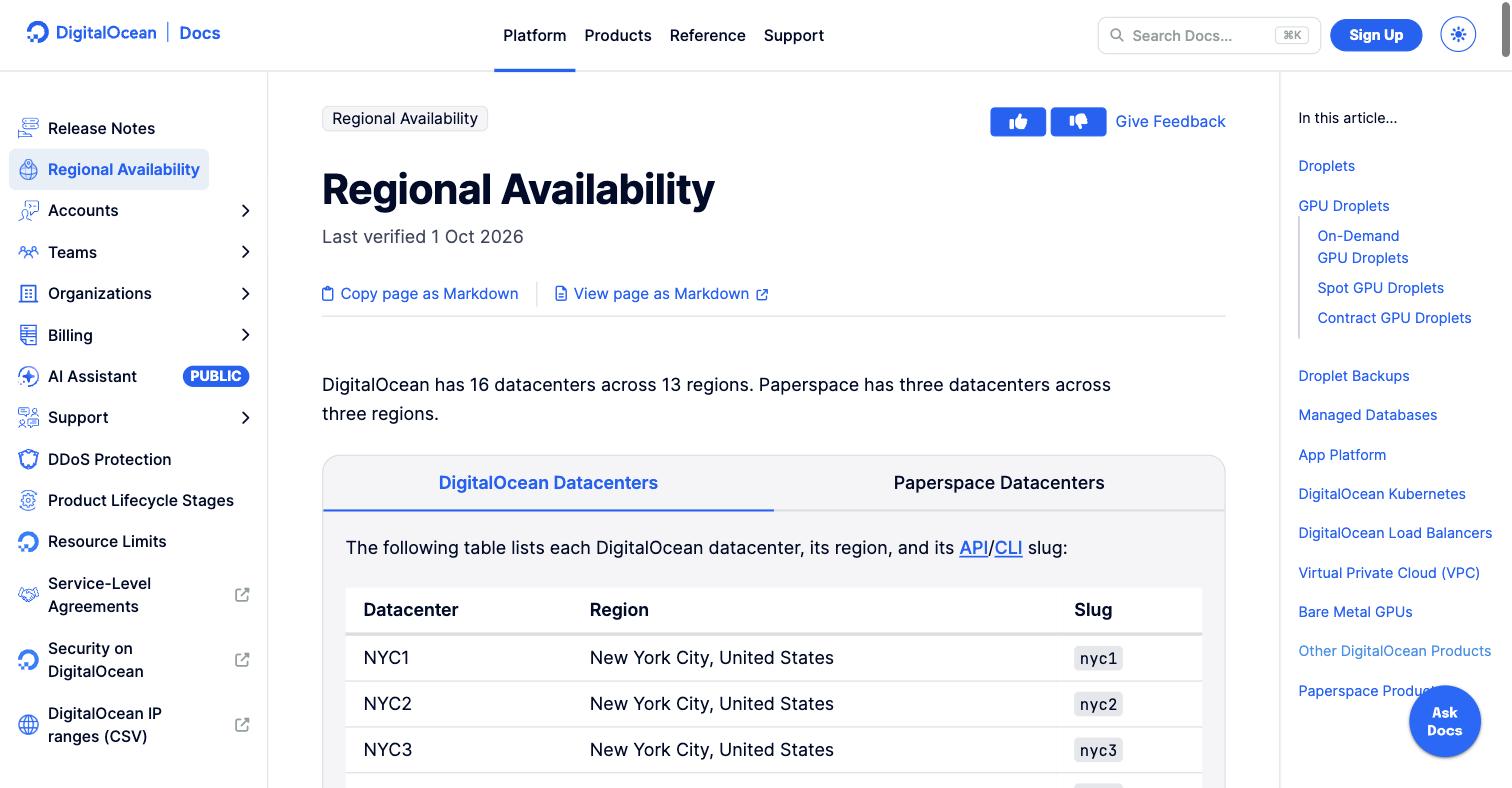
By DigitalOcean's own regional-availability documentation it runs "16 datacenters across 13 regions," and its only Asia-Pacific locations are Singapore (SGP1), Bangalore (BLR1) and Sydney (SYD1) — none in mainland China or Hong Kong. Two obligations follow from that. A public site or application you deliver to audiences in mainland China has to carry an ICP filing (备案); that filing can be issued only against a licensed mainland host, and DigitalOcean's offshore regions are not one — so a DigitalOcean-only stack has no lawful way to be filed and served from inside the country. And if that application holds personal information gathered in China, keeping it on a droplet or managed database in Singapore or Bangalore moves that data out of the mainland — a cross-border transfer of personal information PIPL regulates. The table below is DigitalOcean's own wording, the rule each obligation triggers, and the ICP-filed, in-country path that resolves them.
This is a risk picture, not a legal verdict — what applies to you turns on whether you serve the public in China, how much personal data you handle, and your role under the law. Our China team can walk your DigitalOcean setup through it with you →
What DigitalOcean's documentation says, and what we measured from inside China
| Fact | Primary source |
|---|---|
| In DigitalOcean's own words: it operates "16 datacenters across 13 regions," and its only Asia-Pacific datacenters are Singapore (SGP1), Bangalore (BLR1) and Sydney (SYD1). It lists no datacenter in mainland China (nor Hong Kong); the nearest to the mainland are Singapore and Bangalore. Anything you serve to Chinese users from DigitalOcean therefore originates offshore. | DigitalOcean Documentation — Regional Availability (DigitalOcean's own page stamp: last verified 2026-10-01), retrieved 2026-10-07 |
| To provide internet information services from inside mainland China, a site must complete an ICP filing (备案) — required by State Council Decree 292, with MII Decree 33, Article 18 barring any mainland network-access or hosting provider from carrying an unfiled site. Because the filing can bind only to a licensed mainland host, and DigitalOcean operates none, a deployment served solely from its offshore regions cannot be lawfully filed and served from within China. | State Council Decree 292 (2000); MII Decree 33 (2005), Articles 5 and 18 |
| If your application handles personal information collected in China, storing it on a DigitalOcean droplet or managed database in Singapore or Bangalore is a cross-border transfer of personal information under PIPL. The handler — you, DigitalOcean's customer — must give notice, obtain separate consent, and satisfy one of PIPL's transfer mechanisms (a CAC security assessment, the CAC standard contract, or certification). For a CIIO or large-volume handler, personal information collected in China must be stored in the mainland (CSL Article 39 (formerly Article 37); PIPL Article 40) — which DigitalOcean's offshore regions cannot do. | PIPL Chapter III, Articles 38–40; CSL Article 39 (formerly Article 37) |
| DigitalOcean's own site is reachable from inside mainland China — it is not blocked — so the deciding question is legal, not performance. From an Alibaba Cloud machine-room probe (cn-zhangjiakou), three runs on 2026-08-28, digitalocean.com completed 3 of 3 loads but slowly (median time to first byte 1,509ms, largest-contentful-paint 5,160ms, full load 17.6s), dragged mainly by third-party US trackers and consent hosts rather than DigitalOcean's own origin. From a mainland residential line, three runs on 2026-08-30, it completed 3 of 3 far faster (median first byte 932ms, largest-contentful-paint 1,764ms), with only Google Tag Manager failing to respond. This measures reachability of DigitalOcean's own property, not the compliance of hosting your app on its offshore regions. | 21YunBox — China delivery measurement, measured from inside mainland China (Alibaba Cloud cn-zhangjiakou machine-room line and a mainland residential line) |
Sources verified by the 21YunBox compliance team on 2026-10-07.
For DigitalOcean, the first question about mainland China is not how fast it loads but whether you may lawfully serve from it at all — and DigitalOcean answers part of that itself, in its own documentation: it keeps no datacenter in the mainland. It runs “16 datacenters across 13 regions,” and its only Asia-Pacific locations are Singapore, Bangalore and Sydney — none in mainland China or Hong Kong. Every byte you serve to Chinese users from DigitalOcean therefore originates offshore, and that single fact opens two compliance doors long before performance becomes the deciding factor.
DigitalOcean China at a glance
| What decides it | In DigitalOcean's own terms |
|---|---|
| Where it runs | “16 datacenters across 13 regions” — its only Asia-Pacific locations are Singapore (SGP1), Bangalore (BLR1) and Sydney (SYD1). None in mainland China or Hong Kong. |
| Serving China | With no mainland region, anything you deliver to Chinese users originates offshore; the nearest regions are Singapore and Bangalore. |
| Serving the public | A public, China-facing site must carry an ICP filing (备案), which attaches only to a licensed mainland host — and DigitalOcean operates none. |
| Your China data on DigitalOcean | Personal information collected in China and kept on a droplet or managed database in Singapore or Bangalore is a cross-border transfer that PIPL governs. |
| Reachable ≠ compliant | digitalocean.com itself loads from inside the mainland (3 of 3 probe loads, Aug 2026) — but that measures DigitalOcean's own site, not whether hosting your app offshore is compliant. |
Door one — a China-facing site needs an ICP filing, and DigitalOcean has no host to file it against
To provide internet information services to the public from inside mainland China, a site must complete an ICP filing (备案). State Council Decree 292 requires it, and MII Decree 33, Article 18 bars any mainland network-access or hosting provider from carrying an unfiled site. The filing does not attach to your company in the abstract — it binds to the licensed mainland host that actually serves the pages. DigitalOcean operates no such host; its nearest regions are Singapore and Bangalore. So a deployment delivered only from DigitalOcean has nothing in-country to file against and cannot be lawfully served to the Chinese public from within the country. “We’re already on DigitalOcean” does not reach across the border: the in-country door is a licensed mainland host and an ICP filing.
Door two — China users’ personal data on an offshore droplet is a cross-border transfer
Keep serving China from DigitalOcean and any personal information you collect there lands on a droplet or managed database in Singapore or Bangalore — outside the mainland. Under China’s Personal Information Protection Law that is a cross-border transfer: the handler — you, DigitalOcean’s customer, not DigitalOcean — must give notice, obtain separate consent, and satisfy one transfer mechanism (a CAC security assessment, the CAC standard contract, or certification). For a CIIO or a large-volume handler, personal information collected in China must additionally be stored inside the mainland (Cybersecurity Law Article 39 (formerly Article 37); PIPL Article 40) — which an offshore DigitalOcean region cannot do.
Reachable is not the same as compliant
DigitalOcean’s own website is reachable from inside mainland China — it is not blocked — and it is tempting to read that as a green light. Measured from inside the mainland, digitalocean.com loaded every time we asked it to: from an Alibaba Cloud machine-room line in cn-zhangjiakou, three runs on 2026-08-28, it completed 3 of 3 loads, though slowly (median time to first byte 1,509 ms, largest-contentful-paint 5,160 ms, full load 17.6 s), dragged mostly by third-party US trackers and consent hosts rather than DigitalOcean’s own origin; from a mainland residential line, three runs on 2026-08-30, it again completed 3 of 3, far faster (median time to first byte 932 ms, largest-contentful-paint 1,764 ms), with only Google Tag Manager failing to answer. But that measures the reachability of DigitalOcean’s own marketing property — not whether hosting your application on its offshore regions satisfies the ICP and data-residency rules above. Reachability is a performance fact; the two doors are legal ones.
This is a risk map, not a verdict. Which door applies to you depends on whether you serve the public in mainland China, how much personal information you handle, and your role under the law — all worth settling with counsel before you commit to an architecture.
Where 21YunBox fits — a compliant overlay, not a migration
You keep running on DigitalOcean. We add what a DigitalOcean-only stack structurally cannot: compliant, ICP-filed delivery and storage from inside the mainland, placed in front of your existing DigitalOcean origin — no rebuild, no second codebase, and no migration off your droplets or managed databases. Our China team maps which door applies to you, assesses your ICP and PIPL cross-border exposure for your entity and your data volumes, and stands up the in-country, ICP-filed delivery a compliant China presence requires — alongside your DigitalOcean stack, not instead of it.
Related reading: