Does Xata Work in China? Data Residency, PIPL & Where Your Data Lives
Xata is your database — and on its managed cloud your records sit in offshore regions with no mainland-China option, so storing Chinese users' personal data there is a cross-border transfer under PIPL. Its BYOC and self-host paths can keep data in-country, but hand you the whole compliance burden. A compliance-first look.
Does Xata work in China?
Xata is your database, so the question is not whether it loads in China but where the records it holds are allowed to live. On managed Xata Cloud they sit in offshore cloud regions with no mainland-China option, which makes storing Chinese users' personal information there a cross-border transfer under PIPL. The one honest exception: Xata's bring-your-own-cloud and self-host options can keep the data in your own account or on-premises — so this is not a flat no, but the burden of running it becomes entirely yours.
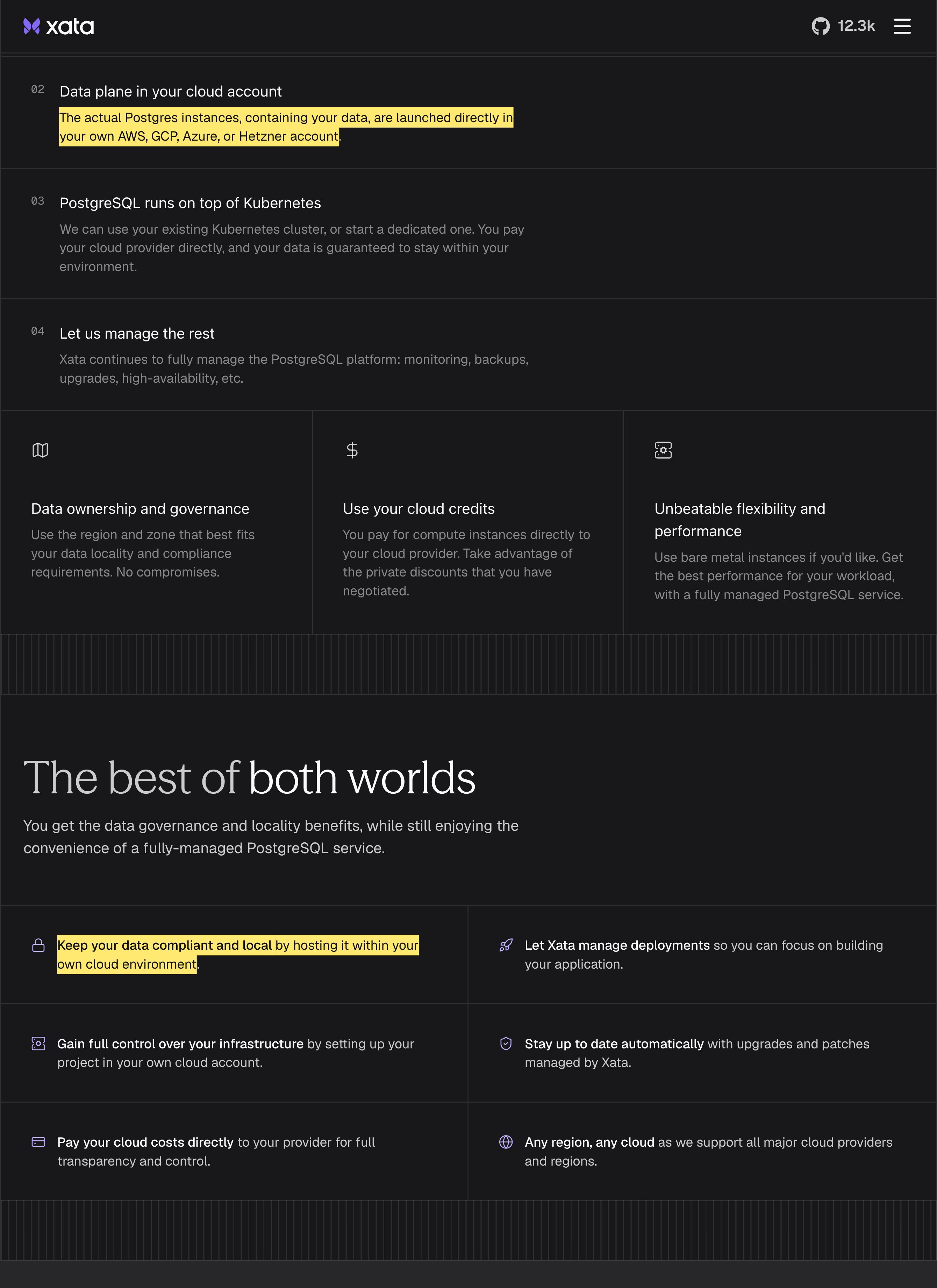
Xata documents three places to run your Postgres — you can "deploy PostgreSQL instances on our cloud, or in your cloud account or even on-prem (BYOC)." Only BYOC keeps data where you choose: there "the actual Postgres instances, containing your data, are launched directly in your own AWS, GCP, Azure, or Hetzner account," and "your data is guaranteed to stay within your environment" — while the "Xata control plane… continues to run in [Xata's] AWS account" offshore in every case. Store mainland users' personal information on the offshore managed cloud and PIPL treats it as a cross-border transfer (notice, separate consent, a transfer mechanism; Articles 38–43), with in-country storage required of CIIOs and large-volume handlers (PIPL Article 40; Cybersecurity Law Article 39 (formerly Article 37)). The ICP filing, note, attaches to the public app in front of the database, not to Xata. The table below is Xata's own wording and the rule each path triggers.
This is a risk map, not a verdict — which path fits turns on your entity, your data volumes and who your users are. Our China team can map your exposure with you →
Compliance snapshot
- ! Xata is your data — on managed Xata Cloud it lives in offshore cloud regions
- ✕ No mainland-China region on Xata's managed cloud
- ! China users' personal data stored offshore is a PIPL cross-border transfer
- ✓ BYOC and self-host can keep the data plane in your own cloud or on-prem
- ! Even under BYOC, Xata's control plane runs in its own AWS account offshore
What Xata's own documentation says about China
| Fact | Primary source |
|---|---|
| Xata is your data, and where it lives is a choice made at deploy time. Xata documents three deployment homes — in its own words you can "deploy PostgreSQL instances on our cloud, or in your cloud account or even on-prem (BYOC)." Under BYOC "the actual Postgres instances, containing your data, are launched directly in your own AWS, GCP, Azure, or Hetzner account," and Xata promises "your data is guaranteed to stay within your environment." On the managed cloud it does not stay where you choose — it sits in Xata's offshore regions. | Xata — Bring Your Own Cloud (xata.io/byoc) & Deployment docs, retrieved 2026-10-07 |
| Even when your data stays local, Xata's control plane does not. Xata's deployment docs state the "Xata control plane… continues to run in our AWS account," with "latency between the control and data planes… not critical, as it involves only control messages." So a BYOC or self-host setup can hold your records in your own environment while organization, user and instance metadata is still managed from Xata's offshore AWS account — a boundary to weigh against your cross-border data-transfer obligations under PIPL. | Xata — Deployment (xata.io/docs/core-concepts/deployment), retrieved 2026-10-07; PIPL Articles 38–43 |
| Keeping data in-country is something Xata asks you to arrange, not a default. Xata's own pitch for BYOC is to "keep your data compliant and local by hosting it within your own cloud environment" — the tell that its managed cloud is not the in-country option. Personal information collected from mainland users and stored in an offshore Xata region is a cross-border transfer under PIPL (notice, separate consent and a transfer mechanism, Articles 38–43), and a CIIO or large-volume handler must store that data in China (PIPL Article 40; Cybersecurity Law Article 39 (formerly Article 37)). | Xata — Bring Your Own Cloud (xata.io/byoc), retrieved 2026-10-07; PIPL Articles 38–43 & 40; Cybersecurity Law Article 39 (formerly Article 37) |
| There is a genuine in-country path — and it makes the whole compliance burden yours. Beyond managed hosting, Xata says "all major cloud providers are supported" and it "also support[s] bare metal and self-hosted options," installing "the whole dataplane part of Xata in a Kubernetes setup that you control," which "can be in your own cloud account (AWS, Azure, GCP, Hetzner, etc.) or on-premises." Run that data plane inside a mainland cloud and your records can stay in-country — but you then own choosing a compliant region, holding a Chinese entity, and filing an ICP record for the public app in front of the database (State Council Order No. 292; MIIT Order No. 33). The database is never the filing; the service you expose is. | Xata — Deployment & Bring Your Own Cloud docs (xata.io), retrieved 2026-10-07; State Council Order No. 292; MIIT Order No. 33 |
Sources verified by the 21YunBox compliance team on 2026-10-07.
For a mainland-China audience, the sharp question about Xata is not how quickly it answers a query — it is where the records it holds are allowed to live. Xata is your database: it stores your application’s data, and the personal information of your Chinese users sits inside it. On Xata’s managed cloud that data lives in offshore regions, which turns storing it into a cross-border transfer China’s law governs; the database is reachable, but reachability was never the exposure. Xata is unusual in offering a way out — a bring-your-own-cloud and self-host path that can keep the data in your own account or on-premises — so the answer here is not a flat no. It is that the compliant option exists, and the work of running it is entirely yours.
Xata in China at a glance
| What decides it | In Xata's own terms |
|---|---|
| Where your data runs | On the managed service, your Postgres runs on Xata's own cloud. Keeping data where you choose is the BYOC path, where “the actual Postgres instances, containing your data, are launched directly in your own AWS, GCP, Azure, or Hetzner account.” |
| Any mainland-China region? | None on the managed cloud. Xata documents deployment “on our cloud, or in your cloud account or even on-prem (BYOC)”; an in-country mainland location comes only from the BYOC or self-host route, which you operate yourself. |
| The control plane | Offshore in every configuration: the “Xata control plane… continues to run in our AWS account,” exchanging “only control messages” with the data plane. |
| Serving the public | A database is not what gets ICP-filed; the public app or API in front of it is. Served from offshore, that front end has no mainland footing for an ICP filing. |
| Your data under PIPL | Personal information of mainland users stored in an offshore Xata region is a cross-border transfer PIPL governs, with in-country storage required of CIIOs and large-volume handlers. |
Door one — on the managed cloud, your data lives offshore
Choose Xata’s managed service and your Postgres runs on Xata’s own cloud, outside mainland China. The deployment model is explicit that you can “deploy PostgreSQL instances on our cloud, or in your cloud account or even on-prem (BYOC)” — and only the second and third of those put the data where you decide. On the managed cloud the records sit in Xata’s offshore regions, and even then the “Xata control plane… continues to run in [Xata’s] AWS account.”
For a China-facing application that settles the data-residency question before performance ever enters it. Personal information you collect from mainland users and store in an offshore region is, under China’s Personal Information Protection Law, a cross-border transfer: the handler — you, not Xata — must give notice, obtain separate consent, and clear one transfer mechanism (a CAC security assessment, the CAC standard contract, or certification) under Articles 38–43. If you are a critical information infrastructure operator or a large-volume handler, that data must be stored in the mainland (PIPL Article 40; Cybersecurity Law Article 39 (formerly Article 37)) — a duty no offshore region can meet.
Door two — BYOC and self-host can keep the data in-country, and hand you the burden
Here Xata differs from a host that is simply offshore with no alternative. Its bring-your-own-cloud and self-host options move the data plane onto infrastructure you control: Xata says “all major cloud providers are supported” and it “also support[s] bare metal and self-hosted options,” installing “the whole dataplane part of Xata in a Kubernetes setup that you control,” which “can be in your own cloud account (AWS, Azure, GCP, Hetzner, etc.) or on-premises.” Run that data plane inside a mainland Chinese cloud and your records can stay in-country — Xata even promises that under BYOC “your data is guaranteed to stay within your environment.”
So the answer is not a flat no. But the in-country path is yours to operate. You choose and license a compliant mainland region, you hold the Chinese entity that a mainland cloud account and an ICP filing require, and you assess the one piece that does not move: the control plane that “continues to run in [Xata’s] AWS account” offshore, and the metadata that crosses to it. The compliant option is real; it is not turnkey, and it is not something Xata stands up inside China on your behalf.
The ICP filing belongs to the app in front, not to the database
A database is not an Internet information service, so Xata itself is not what gets filed. The requirement lands on the public website or API you expose to mainland visitors: that front end needs an ICP filing tied to a mainland hosting resource, under State Council Order No. 292 and MIIT Order No. 33. Serve that app from offshore and there is no mainland footing to file against; move Xata’s data plane in-country and you still have to stand up — and file for — the application that sits in front of it. Either way, “our database is on Xata” is not the thing that clears you to operate.
None of this is a verdict — it is a map of where the risk sits. Whether your obligation is in-country storage, an ICP filing for the service in front of Xata, or both turns on your data volumes, your role under the law, and who you are serving; confirm it with counsel before you commit a design.
Where 21YunBox fits — a compliant overlay, not a migration
You keep building on Xata. We supply the one part Xata hands back to you: compliant, ICP-filed delivery from inside the mainland, placed in front of the application that runs on your Xata database — no rebuild, no second codebase, and no move off Xata. Our China team maps your PIPL cross-border and data-residency obligations against your entity and data volumes, then stands up the in-country delivery and the filing a lawful China presence needs, while your database and application stay exactly where they already run.
Related reading:
Frequently Asked Questions
Does putting our Xata database in the EU or US keep us compliant for Chinese users?
No — that is the exposure, not the fix. If you collect personal information from mainland users and store it in an offshore Xata region, PIPL treats it as a cross-border transfer: you (the handler, not Xata) must give notice, obtain separate consent, and satisfy a transfer mechanism such as a CAC security assessment, the CAC standard contract, or certification (Articles 38–43). If you are a critical information infrastructure operator or a large-volume handler, that personal information has to be stored in China (PIPL Article 40; Cybersecurity Law Article 39 (formerly Article 37)), which an EU or US region cannot do. Choosing a region inside Xata changes which offshore country holds the data, not whether it left China.
Can we use Xata's BYOC or self-hosted option to keep data inside mainland China?
Technically yes, and that is the honest difference from a host that is simply offshore with no alternative. Xata says the data plane "can be in your own cloud account (AWS, Azure, GCP, Hetzner, etc.) or on-premises" and that under BYOC "your data is guaranteed to stay within your environment," so a Kubernetes install inside a mainland Chinese cloud can keep your records in-country. But two things follow: Xata's control plane still "continues to run in [its] AWS account" offshore, so any metadata crossing that boundary is worth assessing under PIPL; and you take on the full operational and licensing burden — a Chinese entity, a compliant region, and the ICP filing for the public app in front of the database. The in-country path exists; it is not turnkey, and Xata does not operate it for you inside China.
Can 21YunBox help make our Xata setup work in China?
Yes. Our China team can map your exposure — assessing your PIPL cross-border and data-residency position for your entity, your data volumes and your users — and stand up the ICP-filed, in-country delivery the public app in front of Xata needs, on top of the stack you already run. We work as a compliant overlay, not a migration: your Xata database and application stay where they are, and we add the mainland-China piece. Get in touch to work through your specific case.