Does Oracle Cloud Work in China? ICP, Data Residency & an Offshore Region
Oracle Cloud Infrastructure runs no region inside mainland China — its commercial realm's nearest regions are offshore (Tokyo, Osaka, Singapore, Seoul, Chuncheon) — so a China-facing site on OCI is served offshore with no ICP-filing path, and your users' personal data lands outside the mainland under PIPL. A compliance-first look at the one door that matters.
Does Oracle Cloud work in China?
Not on its own terms. Oracle Cloud Infrastructure operates no region inside mainland China — its commercial realm's nearest regions are offshore (Tokyo, Osaka, Singapore, Seoul, Chuncheon) — so a China-facing site on OCI is reachable but hosted outside the mainland, with no footing for an ICP filing and your users' data sitting offshore under PIPL.
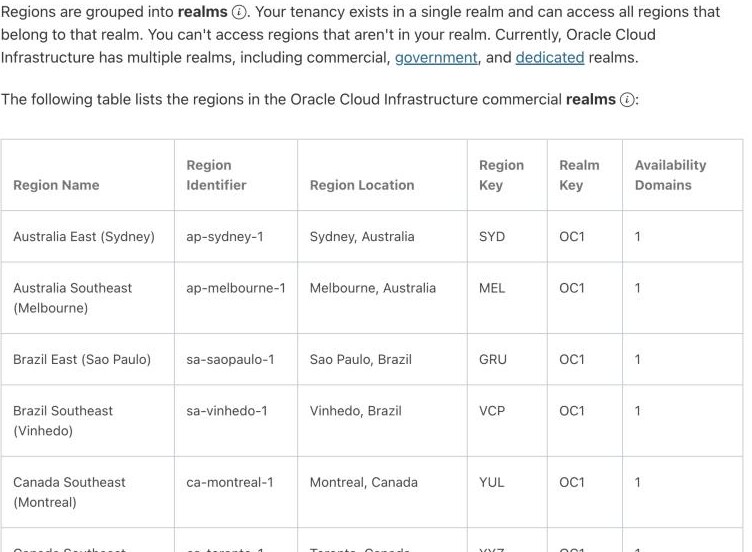
In Oracle's own documentation a region is "a localized geographic area," regions "are grouped into realms," and "your tenancy exists in a single realm and can access all regions that belong to that realm" — and the commercial realm's region table lists no mainland-China region to switch on. Serve China from the nearest OCI region instead and your users' personal information is stored offshore: a cross-border transfer of personal information PIPL governs, on infrastructure that cannot be ICP-filed in the mainland. The table below is Oracle's own wording and the rule each gap triggers.
This is a risk map, not a verdict — whether you owe an ICP filing, in-country storage, or both turns on your entity, your data and who your users are. Our China team can map your exposure with you →
What Oracle's own documentation says about China
| Fact | Primary source |
|---|---|
| OCI runs no region inside mainland China — the nearest are offshore. In Oracle's own documentation a region is "a localized geographic area, and an availability domain is one or more data centers located within a region," and the commercial realm's region table lists Japan East (Tokyo), Japan Central (Osaka), Singapore, South Korea Central (Seoul) and South Korea North (Chuncheon) as the closest Asia-Pacific regions — with no mainland-China region among them. The nearest footing OCI offers a China audience is still outside the mainland. | Oracle — Regions and Availability Domains (docs.oracle.com), retrieved 2026-10-07 |
| Your tenancy is bound to one realm, and there is no mainland-China region to add. Oracle: "Regions are grouped into realms. Your tenancy exists in a single realm and can access all regions that belong to that realm. You can't access regions that aren't in your realm." Because the commercial realm holds no mainland-China region, "we'll just add a China region" is not a switch an OCI tenancy can throw — the in-country footing an ICP filing needs simply is not there. | Oracle — Regions and Availability Domains (docs.oracle.com), retrieved 2026-10-07 |
| A public site served from offshore OCI cannot hold an ICP filing. A public-facing website shown to mainland visitors from inside China turns on an ICP filing (ICP 备案) bound to a hosting resource physically located in the mainland — the regime under State Council Order No. 292 and MIIT Order No. 33. With no OCI region inside the mainland, there is nothing on OCI to file against; a site that merely loads in China has not thereby been licensed to operate in China. | Oracle region list (docs.oracle.com), retrieved 2026-10-07; State Council Order No. 292; MIIT Order No. 33 |
| Where your China users' data sits is decided by that same geography. Serve mainland users from the nearest OCI region and their personal information is stored in Japan, Singapore or South Korea — outside the mainland. Under China's Personal Information Protection Law that is a cross-border transfer: notice, separate consent and one transfer mechanism — a CAC security assessment, the CAC standard contract, or certification (Articles 38–43). For a critical information infrastructure operator or a large-volume handler, personal information collected in China must be stored in the mainland (PIPL Article 40; Cybersecurity Law Article 39 (formerly Article 37)) — a residency duty no offshore OCI region can meet. | Oracle region list (docs.oracle.com), retrieved 2026-10-07; PIPL Articles 38–43 & 40; Cybersecurity Law Article 39 (formerly Article 37) |
Sources verified by the 21YunBox compliance team on 2026-10-07.
Ask whether Oracle Cloud “works” in mainland China and the honest answer starts with geography, not speed. Oracle Cloud Infrastructure publishes its regions openly, and that list settles the compliance question before a single byte is measured: OCI’s commercial realm holds no region inside mainland China, and — in Oracle’s own words — a tenancy “can access all regions that belong to [its] realm” and no others. So a China-facing OCI site is reachable, but it is hosted offshore, in Tokyo, Singapore or Seoul. Offshore hosting is what denies it an ICP filing and places your Chinese users’ personal data under China’s cross-border transfer rules. Being reachable is real; the licensing gap and the data residency are the exposure you actually carry.
Oracle Cloud in China at a glance
| What decides it | In Oracle's own terms |
|---|---|
| Where it runs | The commercial realm's regions span the Americas, Europe, the Middle East and Asia Pacific; the nearest to China are Japan East (Tokyo), Japan Central (Osaka), Singapore, South Korea Central (Seoul) and South Korea North (Chuncheon). None is inside mainland China. |
| One realm per tenancy | “Your tenancy exists in a single realm and can access all regions that belong to that realm. You can't access regions that aren't in your realm.” The commercial realm contains no mainland-China region to add. |
| Serving the public | A site served to mainland visitors from inside China needs an ICP filing tied to a mainland hosting resource. With no mainland region, OCI offers no ICP-filing path of its own. |
| Your data on OCI | Personal data of Chinese users stored in an offshore OCI region sits outside the mainland — a cross-border transfer PIPL governs, plus a localization duty for CIIOs and large-volume handlers that offshore regions cannot meet. |
| Is it reachable? | Yes — OCI's offshore regions are not wholesale-blocked in China. The distance from Tokyo, Singapore or Seoul shows up as delivery latency, not as a licensing or data-residency fix. |
No mainland region, so no footing for an ICP filing
Oracle’s commercial realm reaches across the Americas, Europe, the Middle East and Asia Pacific, but its nearest regions to China — Tokyo, Osaka, Singapore, Seoul, Chuncheon — all sit outside the mainland. In Oracle’s own words a region is “a localized geographic area,” regions “are grouped into realms,” and “your tenancy exists in a single realm and can access all regions that belong to that realm.” Not one region in that realm is inside mainland China, so “we’ll add a China region” is not a switch an OCI tenancy can throw.
That geography settles the licensing question before performance enters it. A public-facing website delivered to mainland visitors from inside China turns on an ICP filing (ICP 备案) under State Council Order No. 292 and MIIT Order No. 33, and that filing must attach to a hosting resource physically located in the mainland. OCI has none, so there is simply nothing on OCI to file against. This is where “we already run on Oracle Cloud” stops carrying: a site that loads in China has not thereby been licensed to operate in China, and tuning the stack never conjures the mainland footing a filing needs.
Your China users’ data stays offshore
Serve China from the nearest OCI region and your users’ personal information lives in Japan, Singapore or South Korea — outside the mainland. Under China’s Personal Information Protection Law that is a cross-border transfer, and the handler — you, not Oracle — has to give notice, obtain separate consent, and clear one transfer mechanism: a CAC security assessment, the CAC standard contract, or certification (Articles 38–43). If you are a critical information infrastructure operator or a large-volume handler, personal information collected in China must be stored in the mainland (PIPL Article 40; Cybersecurity Law Article 39 (formerly Article 37)) — a residency duty none of OCI’s offshore regions can satisfy.
Reachable from China, but still offshore — and that is the point
Oracle Cloud is not walled off from China: its offshore regions answer from the mainland, and the gap you feel from Tokyo, Singapore or Seoul is delivery latency, not a block. But reachability is only the delivery half of the question — never the legal half. A China-facing OCI site that loads perfectly well is still hosted outside the mainland, and that single fact is what denies it an ICP filing and leaves your users’ data subject to PIPL’s cross-border rules. Those gaps are compliance facts, and no amount of network tuning closes them.
This is a risk map, not a verdict: whether you need an ICP filing, in-country storage, or both depends on what you serve, how much personal data you hold, and who your users are — worth settling with counsel before you build.
Where 21YunBox fits — a compliant overlay, not a migration
Oracle Cloud stays your origin; nothing moves off it. What OCI cannot give a China audience — a lawful, ICP-filed point of delivery physically inside the mainland — we place in front of the region you already run, with no rebuild and no parallel codebase. Our China team first maps which obligations actually bind you — the ICP filing, the PIPL cross-border mechanism, any data-residency duty — against your entity and your data volumes, then stands up the in-country delivery and storage a compliant mainland presence requires. Your Oracle Cloud stack keeps doing exactly what it does today.
Related reading: