Does VWO Work in China? A/B Tests, Session Recordings, PIPL & Data Residency
VWO runs A/B tests and records your visitors — clicks, navigation, device, IP and geolocation — then stores those session recordings and experiment data in data centers in the US, the EU or India, with no mainland-China region. For China that is a PIPL cross-border transfer and a data-residency question, not a speed one. A compliance-first look.
Does VWO work in China?
Whether you can use VWO for mainland China is first a cross-border-data and residency question, not a speed one. VWO — the experimentation and behavior-analytics platform made by Wingify — runs A/B tests and records your visitors, so the moment it runs for a mainland user you are collecting and exporting that person's behavioral data.
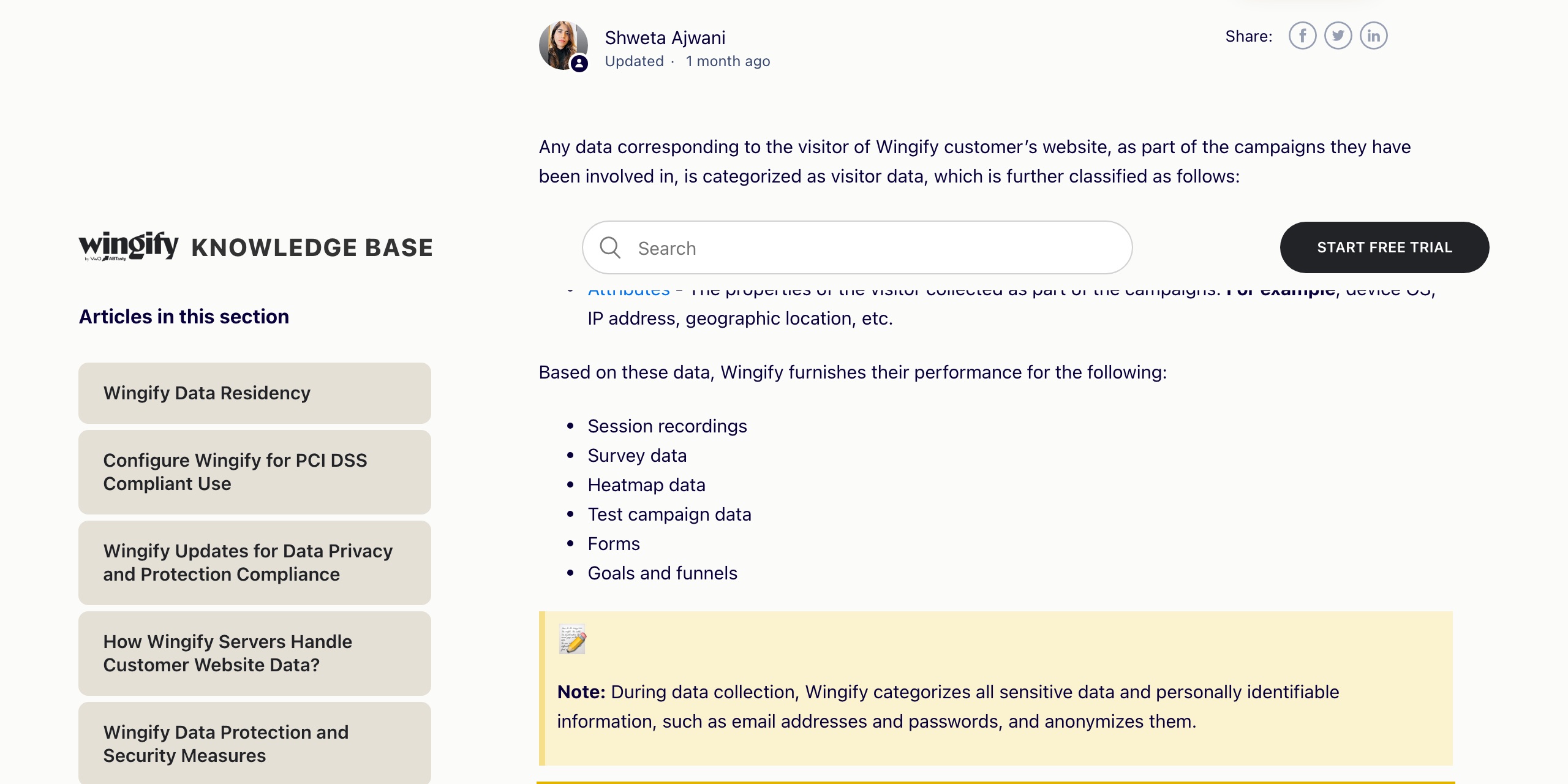
In VWO's own documentation (published under its maker, Wingify), the data it captures includes each visitor's "actions performed ... during the campaigns" — "purchasing a product, navigating to a specific page, clicking on a CTA" — and attributes such as "device OS, IP address, geographic location," turned into "Session recordings," "Heatmap data," "Test campaign data" and more. VWO "stores visitor data in three main data centers, positioned in the US, the European Union (EU), and India," and names no mainland-China region. So your China visitors' recordings and experiment data sit offshore, a cross-border transfer of personal information PIPL governs. VWO's default key-press anonymization narrows what typed data you export, but it doesn't move the data home. The table below is VWO's own wording and the rules it triggers.
This is a risk picture, not a verdict — your duties turn on what your recordings capture, your data volumes and your role. Our China team can map your VWO exposure with you →
Compliance snapshot
- ! Embeds a script that records your mainland visitors — their actions (clicks, page navigation, purchases) and attributes (device OS, IP address, geographic location) — rebuilt into session recordings, heatmaps, surveys and experiment data
- ✓ Anonymizes key presses by default — passwords, and digits of phone, card, social-security and CVV numbers — and flags PII such as emails and passwords before it reaches VWO's servers
- ! But masking on-screen (non-input) content is left to you, and VWO says notice and visitor consent are the customer's responsibility — the behavioral record and on-screen PII can still be captured
- ✕ Stores visitor data in three data centers — the US, the EU and India, with no mainland-China region, so recording China sessions there is a PIPL cross-border transfer
- ✓ A compliant in-country capture, delivery and storage path exists — no rebuild, no migration off VWO
What VWO's own documentation says about China
| Fact | Primary source |
|---|---|
| In VWO's own words, it records both what each visitor does and who they are. VWO's documentation classifies the data it collects from a customer's website visitors as "Events — The actions performed by the visitor during the campaigns" — its examples are "purchasing a product, navigating to a specific page, clicking on a CTA, etc." — and "Attributes — The properties of the visitor collected as part of the campaigns," such as "device OS, IP address, geographic location, etc." From these, it says, it "furnishes their performance for" "Session recordings," "Survey data," "Heatmap data," "Test campaign data," "Forms" and "Goals and funnels." A moment-by-moment record of what a real person did on your site, tied to their IP address and location, is behavioral personal information under Chinese law. | Wingify (VWO) Help Center — Where Does Wingify Store Visitor Data?, retrieved 2026-10-08 |
| Those recordings are stored offshore — in the US, the EU or India. VWO states that it "stores visitor data in three main data centers, positioned in the US, the European Union (EU), and India," that it "assigns a default data center during account signup based on the account location," and that these "data centers process their own visitor data independently and are not connected to each other." None of the three is inside mainland China, and the data center follows your account's region, not your visitor's — so a mainland visitor's recordings and experiment data are held outside China whichever region you are on. | Wingify (VWO) Help Center — Where Does Wingify Store Visitor Data?, retrieved 2026-10-08 |
| VWO anonymizes typed secrets by default — but leaves the rest to you. Its session-recording compliance guide says that "by default, Wingify anonymizes all key presses to avoid storing or transmitting any personal or sensitive data to Wingify servers," masking typed fields such as passwords and the digits of phone, card, social-security and CVV numbers, and its storage note adds that it "categorizes all sensitive data and personally identifiable information, such as email addresses and passwords, and anonymizes them." But VWO is explicit that masking on-screen, non-input content — "order summary, Checkout page, and others" — is something "you can provide" yourself. On-screen personal data, and the behavioral record itself, can still be captured and exported — and PIPL attaches heightened duties to sensitive personal information, a category that reaches location and financial data, wherever it rides along. | Wingify (VWO) — Data Privacy Compliance Guide: Session Recordings; Where Does Wingify Store Visitor Data?, retrieved 2026-10-08 |
| VWO puts the privacy duties on you — including consent for recordings. Its compliance guide tells customers to "recognize your role as the Data Controller while Wingify acts as the Data Processor," states that for session replay "consent is the legitimate ground in this case and it is mandatory for all data controllers to show all data subjects cookie notice, privacy notice and get consent," and confirms that "showing privacy notice and taking user consent is the responsibility of" the customer. The guide works its checklist through "data protection laws such as GDPR, CCPA, PIPEDA, and more" — China's PIPL it leaves to you, the handler. | Wingify (VWO) — Data Privacy Compliance Guide: Session Recordings, retrieved 2026-10-08 |
| Under PIPL that export is a regulated cross-border transfer, and for some handlers the data must stay in China. Session recordings and experiment data captured from mainland visitors are personal information; exporting them to VWO's offshore data centers is a cross-border transfer under PIPL needing notice, separate consent and a transfer mechanism (Articles 38–43). Since the CAC's March 2024 cross-border rules, a non-CIIO moving fewer than 100,000 individuals' non-sensitive personal information in a calendar year is exempt from the security assessment, standard contract and certification — but sensitive data and larger volumes carry stricter duties, and for a CIIO or large-volume handler personal information collected in China must be stored inside the mainland (PIPL Article 40; Cybersecurity Law Article 39 (formerly Article 37)), which VWO's US, EU and India regions cannot do. | CAC — Provisions on Promoting and Regulating Cross-border Data Flows, March 2024; PIPL Articles 38–43 and 40; Cybersecurity Law Article 39 (formerly Article 37) |
Sources verified by the 21YunBox compliance team on 2026-10-08.
For a mainland-China audience, the deciding question about VWO is not how quickly its tests and recordings render — it is whose behavior has to leave the country for them to run. VWO, the experimentation and behavior-analytics platform made by Wingify, works by watching your visitors: it records the actions they take and the attributes they carry, then stores and replays that data from its own data centers. Point it at your mainland visitors and you are exporting their session recordings, heatmaps and experiment data across the border — something China’s privacy law governs directly. Whether VWO’s script happens to load on a given mainland line is a delivery detail; where the data is stored, and what it captures, is the exposure.
VWO in China at a glance
| What decides it | In VWO's own terms |
|---|---|
| What it records | VWO collects visitor “events” — “the actions performed by the visitor during the campaigns,” such as “purchasing a product, navigating to a specific page, clicking on a CTA” — and “attributes” such as “device OS, IP address, geographic location,” and turns them into “Session recordings,” “Heatmap data,” “Survey data” and “Test campaign data.” That is behavioral personal data. |
| What it hides | “By default, Wingify anonymizes all key presses” — passwords and the digits of phone, card, social-security and CVV numbers — and “anonymizes” PII “such as email addresses and passwords.” But masking on-screen, non-input content is left to the customer. |
| Where it's stored | “Stores visitor data in three main data centers, positioned in the US, the European Union (EU), and India,” assigned “based on the account location.” No mainland-China region is named. |
| Who's responsible | VWO tells customers to “recognize your role as the Data Controller while Wingify acts as the Data Processor,” and that notice and visitor consent are “the responsibility of” the customer. Under PIPL you are the handler. |
| The residency rule | Exporting China users' recordings and experiment data is a cross-border transfer under PIPL (notice, separate consent, a transfer mechanism); CIIOs and large-volume handlers must store it in the mainland — which US, EU and India regions cannot do. |
A test script that records what your visitors do — and who they are
VWO doesn’t wait for you to gather anything extra — running the test is the data collection. In VWO’s own documentation, the data it collects from a customer’s website visitors falls into two buckets. “Events” are “the actions performed by the visitor during the campaigns” — VWO’s examples are “purchasing a product, navigating to a specific page, clicking on a CTA, etc.” “Attributes” are “the properties of the visitor collected as part of the campaigns,” such as “device OS, IP address, geographic location, etc.” From those, VWO says, it “furnishes their performance for” “Session recordings,” “Survey data,” “Heatmap data,” “Test campaign data,” “Forms” and “Goals and funnels.” A moment-by-moment reconstruction of what a real person did on your site, tied to their IP address and location, is behavioral personal information under China’s law — so the instant VWO runs for a mainland visitor, you are handling that visitor’s personal data, and handling it by sending it to VWO.
Anonymization narrows the capture — it doesn’t move it home
VWO builds in real privacy controls, and they matter here. Its session-recording compliance guide states that “by default, Wingify anonymizes all key presses to avoid storing or transmitting any personal or sensitive data to Wingify servers,” masking typed fields such as passwords and the digits of phone, card, social-security and CVV numbers, and its storage documentation adds that during collection it “categorizes all sensitive data and personally identifiable information, such as email addresses and passwords, and anonymizes them.” That genuinely lowers how much sensitive text a recording carries, and it is worth saying plainly. But VWO draws the line in the same guide: masking on-screen, non-input content — “order summary, Checkout page, and others” — is something “you can provide” yourself, and “showing privacy notice and taking user consent is the responsibility of” the customer. So personal data that simply appears on the page, and the behavioral record itself, can still be captured unless you mask it — and PIPL attaches heightened duties to sensitive personal information, a category that reaches location and financial data, wherever it rides along.
The data lives in the US, the EU or India — never the mainland
Asked plainly where it keeps this data, VWO answers in its own documentation: it “stores visitor data in three main data centers, positioned in the US, the European Union (EU), and India.” It “assigns a default data center during account signup based on the account location,” and those “data centers process their own visitor data independently and are not connected to each other.” The region follows your account, not your visitor — and none of the three is inside mainland China. VWO frames the roles too, telling customers to “recognize your role as the Data Controller while Wingify acts as the Data Processor” — which under China’s Personal Information Protection Law makes you, not VWO, the personal-information handler. Exporting your mainland visitors’ recordings and experiment data is therefore a cross-border transfer, and the handler must give notice, obtain separate consent, and clear one transfer mechanism: a CAC security assessment, the CAC standard contract, or certification (Articles 38–43). For a critical information infrastructure operator or a large-volume handler, personal information collected in China must be stored in the mainland (PIPL Article 40; Cybersecurity Law Article 39 (formerly Article 37)) — a residency duty three offshore data centers cannot meet, and one no account setting inside VWO changes. VWO’s own guide, tellingly, works its checklist through “data protection laws such as GDPR, CCPA, PIPEDA, and more”; China’s PIPL it leaves to you.
Reachable or not, the data still leaves the mainland
VWO runs by embedding a script that loads from VWO-operated endpoints and streams what it records back to one of those data centers. Whether that script loads cleanly from any given mainland line is a delivery question, and not the one that decides whether you may use VWO. Even on the sessions where it loads perfectly, it loads in order to carry your visitors’ recordings, heatmaps and experiment data offshore; a steadier path would only export that data more efficiently, not make the transfer lawful. The half that settles whether VWO is usable for China is the legal one — what the recordings capture, where they are stored, and under whose law they cross the border — not the network one.
This is a risk map, not a verdict: whether you owe separate consent, a transfer mechanism, in-country storage, stricter handling for sensitive data, or all of them turns on what your experiments and recordings capture, how much you leave unmasked, your data volumes, and who your users are — worth settling with counsel before you rely on it.
Where 21YunBox fits — a compliant overlay, not a migration
VWO can stay exactly where it is. What we add is the piece VWO leaves to you: ICP-filed, in-country delivery set in front of your existing origin inside mainland China — no rebuild, no second codebase, no move off your current experimentation stack. Our China team traces where your visitors’ recordings and experiment data travel today, weighs your PIPL cross-border and data-residency duties against your entity and your data volumes, and — where the law requires your China users’ behavioral data to stay on the mainland — stands up the lawful, in-country capture and storage VWO’s US, EU and India regions cannot provide, while VWO and the rest of your stack keep running where they already are.
Related reading:
Frequently Asked Questions
Does VWO store Chinese users' session recordings and test data in China?
No. By VWO's own documentation it "stores visitor data in three main data centers, positioned in the US, the European Union (EU), and India," assigned by your account's location, with no mainland-China region. So the session recordings, heatmaps, surveys and experiment data VWO captures from your mainland visitors are held offshore.
VWO anonymizes passwords and key presses — doesn't that make it safe for China?
It helps, but it doesn't settle it. VWO anonymizes key presses by default (passwords, and digits of phone, card, social-security and CVV numbers) and flags PII such as emails, and you can mask non-input fields yourself. But the recording itself — the clicks, page navigation and on-screen content, tied to a visitor's IP address and location — is still behavioral personal information; VWO says notice and visitor consent are your responsibility; and sending that data to VWO's US, EU or India data centers is still a cross-border transfer under PIPL. Treat it as a risk to assess with counsel, not a clearance.
Can 21YunBox help make our VWO setup compliant in China?
Yes. Our China team can assess your PIPL cross-border and data-residency exposure for what your recordings and experiments capture, your data volumes and your role, and stand up the compliant, ICP-filed in-country delivery — and, where the law requires your China users' behavioral data to stay on the mainland, in-country capture and storage — around the VWO stack you already run. Get in touch to work through your specific case.