Does PandaDoc Work in China? Data Residency, PIPL & the E-Signature Question
PandaDoc stores your signed documents, contacts and form inputs in only two regions — the US or the EU (Frankfurt) — with no mainland-China option, so every signature from China is a cross-border transfer of personal information PIPL governs. A compliance-first look at the data-residency, PIPL and e-signature-enforceability questions that decide whether you can use it.
Does PandaDoc work in China?
Whether you can use PandaDoc in China turns first on where your signed documents and your signers' personal data are stored — a data-residency question, not the network speed most teams notice first. However the signing page performs on a given day, performance is not the test that decides your legal exposure.
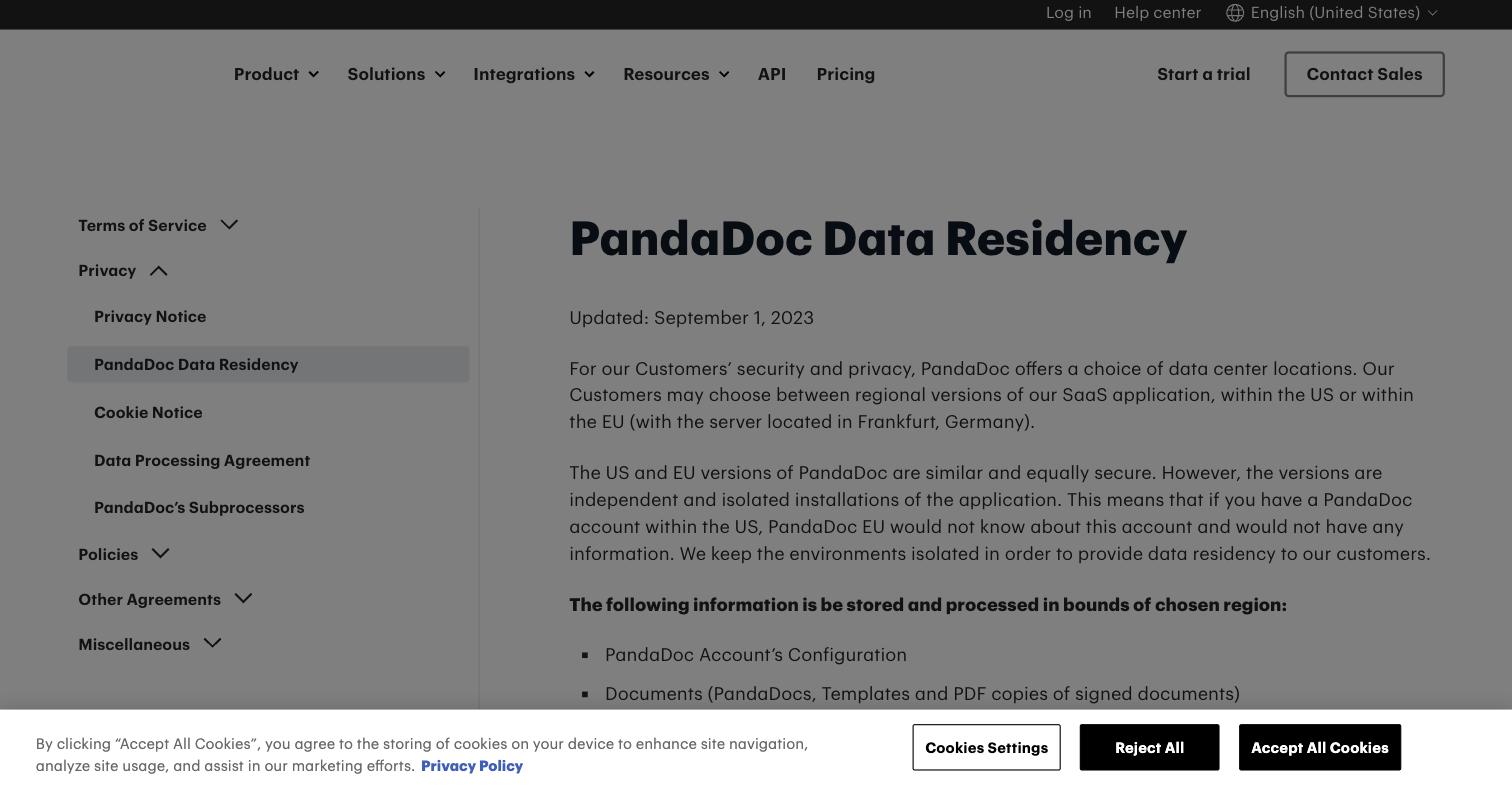
By PandaDoc's own Data Residency page, customers "may choose between regional versions of our SaaS application, within the US or within the EU (with the server located in Frankfurt, Germany)," and the documents, contacts and form inputs you collect are stored "in bounds of chosen region." Neither region is in mainland China — and some data is "transferred to the US" regardless of the region you pick. So when someone in China signs, the executed PDF and their identity details come to rest offshore — a cross-border transfer of personal information that PIPL governs, requiring notice, separate consent and a lawful transfer mechanism. A second question rides on top: whether that signature is a "reliable electronic signature," and the document even eligible, under China's Electronic Signature Law. The table below pairs PandaDoc's own wording with the rules each point triggers — and the compliant, ICP-filed in-country path they imply.
This is a risk picture, not a verdict — your obligations turn on your data volumes, the signer's location, and your role. Our China team can map your PandaDoc exposure with you →
Compliance snapshot
- ! Signed documents, contacts & form inputs stored only in the US or EU — never mainland China
- ! Each signature from China sends signer personal data across the border — PIPL applies
- ✕ No mainland-China data-residency region, and data can't move between PandaDoc regions
- ! E-signature enforceability under China's Electronic Signature Law is a separate question for counsel
- ✓ A compliant path exists — ICP-filed in-country delivery & storage, no rebuild
What PandaDoc's own documentation says about China
| Fact | Primary source |
|---|---|
| In PandaDoc's own words: PandaDoc "offers a choice of data center locations," and customers "may choose between regional versions of our SaaS application, within the US or within the EU (with the server located in Frankfurt, Germany)." The data stored "in bounds of chosen region" expressly includes your "Documents (PandaDocs, Templates and PDF copies of signed documents)," "Contacts" and "Forms (including information your customers enter)." Neither region is in mainland China — and your "communication with PandaDoc representatives" is "transferred to the US" regardless of the region you choose. | PandaDoc — Data Residency (updated September 1, 2023), retrieved 2026-10-07 |
| Because the documents and signer data of people in China come to rest in the US or EU, PIPL treats each signing as a cross-border transfer of personal information: the personal-information handler — PandaDoc's customer, not PandaDoc — must give notice, obtain separate consent for the overseas transfer, and satisfy one lawful mechanism (a CAC security assessment, the CAC standard contract, certification, or another permitted basis). | PIPL Chapter III, Articles 38–43 |
| The weight of that duty scales with volume and role, not with merely turning the tool on: under the CAC's March 2024 cross-border rules, a non-CIIO transferring fewer than 100,000 individuals' non-sensitive personal information in a calendar year is exempt from the security assessment, standard contract and certification. Signed contracts routinely carry sensitive personal information, and sensitive data, higher volumes or CIIO status each pull the heavier mechanisms back in. | CAC — Provisions on Promoting and Regulating Cross-border Data Flows, March 2024 |
| For a CIIO or large-volume handler, personal information collected in China must be stored inside mainland China (CSL Article 39 (formerly Article 37); PIPL Article 40). PandaDoc offers only US and EU regions and states you "cannot transfer data from PandaDoc one data center to another," so the only way to keep your China signers' documents on Chinese soil is to run that storage and delivery from inside the mainland — the act that brings an ICP filing into the picture. | PandaDoc — Data Residency (updated September 1, 2023), retrieved 2026-10-07; CSL Article 39 (formerly Article 37); PIPL Article 40 |
Sources verified by the 21YunBox compliance team on 2026-10-07.
For a mainland-China audience, the question that actually decides whether you can use PandaDoc is not how fast the signing page paints — it is where your signed documents and your signers’ personal data are allowed to live. PandaDoc answers that in its own Data Residency page: it runs in two regions, the US and the EU, and neither is in mainland China. So however the signing page performs on a given day, every contract a signer in China completes — and the identity details attached to it — is written to storage offshore, which turns each signing into a cross-border transfer of personal information China’s law governs. A second question rides on top: whether that signature is enforceable here at all. Whatever latency the network adds is a symptom; the data residency and the enforceability are the exposure to assess.
PandaDoc in China at a glance
| What decides it | In PandaDoc's own terms |
|---|---|
| Where your data lives | PandaDoc “offers a choice of data center locations,” and customers “may choose between regional versions of our SaaS application, within the US or within the EU (with the server located in Frankfurt, Germany).” Neither region is inside mainland China. |
| What's stored there | Held “in bounds of chosen region” are your “Documents (PandaDocs, Templates and PDF copies of signed documents),” “Contacts” and “Forms (including information your customers enter)” — the signer personal data and the executed contracts themselves. |
| Always sent to the US | Some data moves regardless of region: your “communication with PandaDoc representatives” — “video calls, account information, customer ticket information” — “can be accessed and transferred to the US.” |
| Cross-border transfer | When a signer in China signs, that personal data comes to rest offshore — a cross-border transfer of personal information PIPL governs. The handler (you, not PandaDoc) must give notice, obtain separate consent, and clear one transfer mechanism (PIPL Articles 38–43). |
| Data residency | A CIIO or large-volume handler must store personal information collected in China inside the mainland (CSL Article 39 (formerly Article 37); PIPL Article 40) — which PandaDoc's US and EU regions cannot satisfy, and you “cannot transfer data from PandaDoc one data center to another.” |
| Signature enforceability | Whether a foreign platform's signature is a “reliable electronic signature,” and whether the document is eligible at all, is a separate question under China's Electronic Signature Law — worth confirming with counsel. |
Where your signed documents come to rest
PandaDoc keeps your data in whichever of two regions you pick, and offers no third choice. In its own Data Residency page it “offers a choice of data center locations,” and customers “may choose between regional versions of our SaaS application, within the US or within the EU (with the server located in Frankfurt, Germany).” What lives in that region is not an abstraction: PandaDoc lists “Documents (PandaDocs, Templates and PDF copies of signed documents),” “Contacts” and “Forms (including information your customers enter)” among the data stored “in bounds of chosen region.”
Neither region is inside mainland China, and PandaDoc adds that you “cannot transfer data from PandaDoc one data center to another.” A further slice of data moves no matter which region you choose: your “communication with PandaDoc representatives” — including “video calls, account information, customer ticket information” — “can be accessed and transferred to the US.” So when someone in China signs, the executed PDF and their personal details are written to storage outside the mainland by design, not by a setting you can tune. That fact, not the page’s load time, is where the compliance analysis starts.
Every signature from China is a cross-border transfer under PIPL
Because that personal data leaves — or never enters — mainland China, the Personal Information Protection Law treats each signing as a cross-border transfer. The personal-information handler is PandaDoc’s customer, not PandaDoc: you must give notice, obtain separate consent for the overseas transfer, and clear one lawful mechanism — a CAC security assessment, the CAC standard contract, certification, or another permitted basis (PIPL Articles 38–43).
How heavy that duty is tracks your volume and role, not the mere act of switching the tool on. Under the CAC’s March 2024 cross-border rules, a non-CIIO that transfers fewer than 100,000 individuals’ non-sensitive personal information in a calendar year is exempt from the security assessment, the standard contract and certification. But signed contracts routinely carry sensitive personal information — identity-document numbers, financial terms — and sensitive data, higher volumes, or CIIO status each pull the heavier mechanisms back in.
There is a harder floor for a CIIO or large-volume handler: personal information collected in China must be stored inside the mainland (Cybersecurity Law Article 39 (formerly Article 37); PIPL Article 40). PandaDoc offers only US and EU regions, so meeting that duty means putting the in-country piece on your side of the line — serving and storing the signing workflow lawfully from inside the mainland, the act that turns on an ICP filing.
A second door: is the signature even enforceable?
Data residency is not the only question a signed document raises in China. Electronic signatures are governed here by China’s Electronic Signature Law, which gives legal effect to a signature where it qualifies as a reliable electronic signature, and which makes certain document types — such as some matters of personal relationships — ineligible for electronic signing altogether. Whether a signature produced by a foreign platform meets that reliable standard, and whether the specific document you are signing is eligible, is a legal-enforceability question that stands apart from where the data is stored. This is not legal advice: it is exactly the kind of point to settle with Chinese counsel before you rely on a PandaDoc signature for a China-governed agreement.
Speed is the symptom, not the test
Teams usually meet PandaDoc’s China problem as latency — a signing session that paints slowly or stalls. That experience is real, and it is also the wrong test to lean on. Even if the page loaded instantly, nothing about a faster paint would change where the signed document is stored or whether the signature is enforceable. Reachability is a delivery question; residency and enforceability are legal ones, and only the legal ones decide whether you may use the tool. We publish no mainland-China speed figures for PandaDoc because we have not measured it from inside China ourselves — and a number we could not stand behind would not change the analysis in any case.
This is a risk picture, not a verdict. Whether you owe separate consent, a transfer mechanism, in-country storage, or all three turns on your data volumes, your signers’ locations, and your role — worth settling with counsel before you rely on it.
Where 21YunBox fits — a compliant overlay, not a migration
You keep signing on PandaDoc. What we add is the piece PandaDoc leaves to you: lawful, ICP-filed delivery and storage inside mainland China, placed in front of the origin you already run — no rebuild, no parallel system, and no pulling PandaDoc out of your workflow. Our China team weighs your cross-border and data-residency duties against your signing volumes, your signers’ locations, and whether you count as a CIIO, then stands up the in-country layer that a document platform storing agreements in the US or EU cannot provide on its own.
Related reading:
- How to get an ICP filing for China
- Cross-border data transfers under PIPL
- China’s cross-border data-flow provisions (March 2024)
Frequently Asked Questions
Does PandaDoc store Chinese signers' data in China?
No. By PandaDoc's own Data Residency page, customers choose between two regions — the US or the EU (server in Frankfurt, Germany) — and the documents, contacts and form inputs you collect are stored in whichever region you pick. Neither is in mainland China, and some data, such as your communications with PandaDoc support, is transferred to the US regardless of the region. So the signed documents and personal data of people in China are held offshore.
Is it against the law to use PandaDoc in China?
Not inherently, but two separate questions decide your exposure. First, data: sending signers' personal information and signed documents to the US or EU is a cross-border transfer that PIPL permits only with notice, separate consent and a lawful transfer mechanism, and data-localization can apply depending on your role (for example, whether you are a CIIO) and the volume of personal information you handle. Second, enforceability: whether a foreign platform's signature is a "reliable electronic signature," and whether the document type is eligible, is governed by China's Electronic Signature Law and is worth confirming with counsel. Treat this as a risk to assess, not a blanket prohibition.
Can 21YunBox help make PandaDoc compliant and usable in China?
Yes. Our China team can help you assess the cross-border and data-residency exposure for your signing volumes and role, and provide the compliant, ICP-filed in-country delivery and storage that PandaDoc does not offer in the mainland — so you can keep PandaDoc rather than replace it. Get in touch to work through your specific case.