Does Elementor Work in China? ICP, Google Fonts & Where Your WordPress Site Is Hosted
Elementor is a WordPress builder, not a host — so whether an Elementor site works in mainland China is decided by where you host the WordPress site (ICP and data residency) and whether its default offshore assets, including Google Fonts loaded from Google's servers, reach the mainland. A compliance-first look at the layers.
Does Elementor work in China?
For a public, mainland-China audience the honest answer is "not on its own" — and the reason sits one layer below Elementor and one layer beside it, not in its speed. Elementor is a WordPress plugin: it builds the site, it doesn't host it, so what China's rules respond to is where that WordPress site runs and whether the assets an Elementor page loads by default reach the mainland.
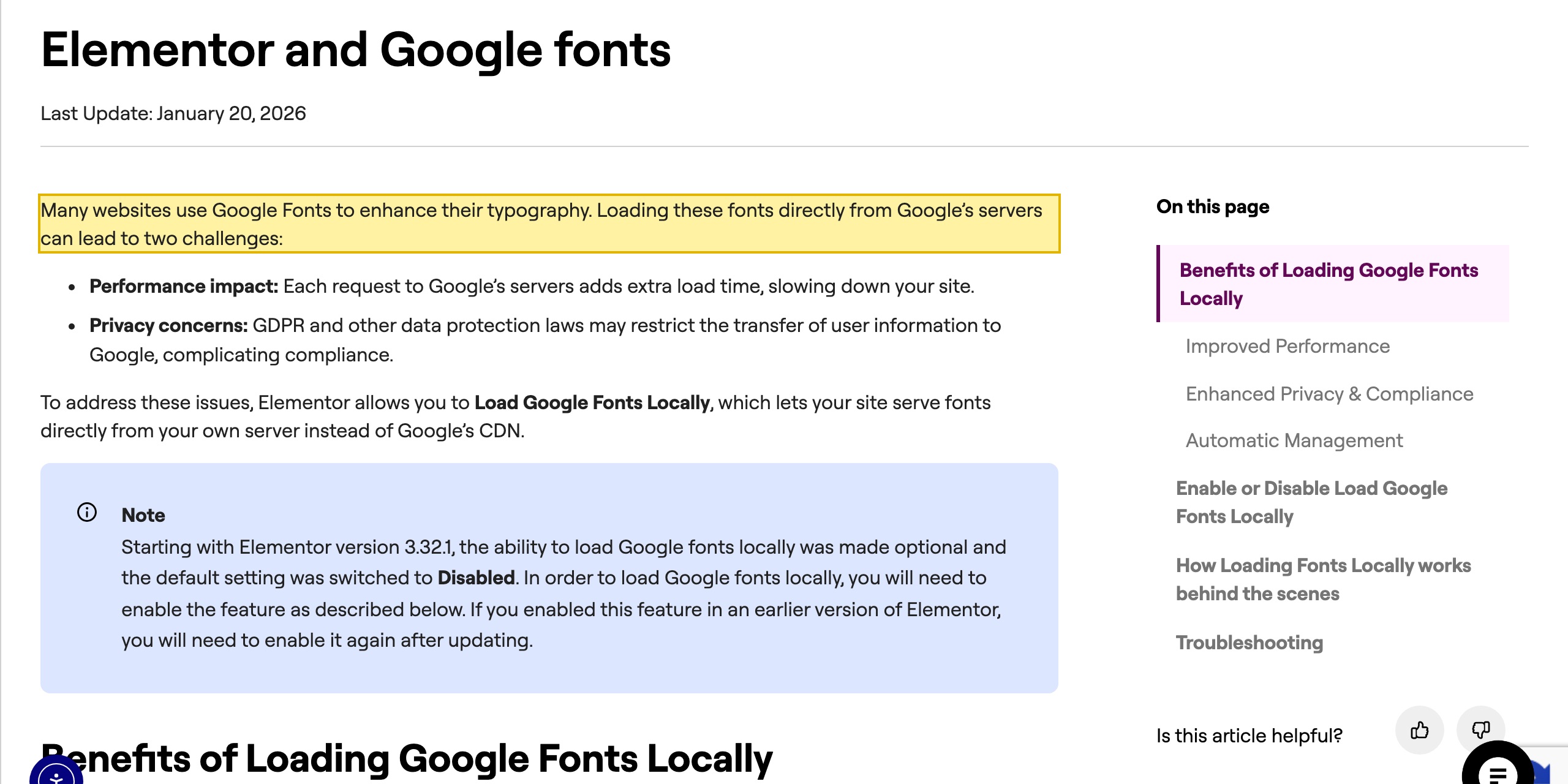
In Elementor's own words it is a builder "designed for WordPress web creators," and its help docs state that "by default, Elementor uses Google fonts for website creation," loaded directly from Google's servers. Two things follow for a public China site, and the table below sets them against Elementor's own wording: the WordPress site it builds, if hosted offshore, has no ICP filing to attach to in-country; and the default Google-font and asset calls go to servers that are throttled or blocked in the mainland, where — as Elementor notes — a fallback font is "used in case Google Fonts does not load." A lighter PIPL question rides on top: those requests carry each visitor's IP to Google abroad.
This is a risk picture to take to counsel, not a verdict — what applies turns on where you host, whether you serve the public in China, and the data your site handles. Our China team can map the Elementor + WordPress path with you →
What Elementor's own documentation says about China
| Fact | Primary source |
|---|---|
| Elementor is a WordPress plugin — a builder, not a host. In its own words, "the Elementor website builder is designed for WordPress web creators"; it shapes a site that runs on WordPress, which you host somewhere. That is why the China question doesn't resolve inside Elementor: the licensing and data-location decisions live at your WordPress host, not in the builder. Choosing Elementor settles your China standing no more than choosing a text editor would. | Elementor — homepage (product description), retrieved 2026-10-07 |
| A public mainland-China site needs an ICP filing, and a builder has nothing for it to attach to. Under State Council Order No. 292 (Article 4) and MIIT Order No. 33, an ICP filing (备案) attaches to a hosting resource physically inside mainland China and to a mainland legal entity. Elementor adds no mainland host and no entity, and a WordPress site hosted offshore has neither — so the ICP door isn't opened by the builder, it's opened at the host. That is a licensing-and-location boundary, not a defect in Elementor. | State Council Order No. 292 (Measures for the Administration of Internet Information Services), Article 4; MIIT Order No. 33 (ICP filing measures) |
| By default an Elementor page fetches Google Fonts from Google's servers — endpoints the mainland throttles or blocks. Elementor's help states that "by default, Elementor uses Google fonts for website creation" and that the CSS keeps a fallback font "used in case Google Fonts does not load." Its "Load Google Fonts Locally" option exists, but Elementor notes that since version 3.32.1 it ships Disabled by default — so the out-of-the-box behavior is still a cross-border request to Google. In mainland China, Google's font and asset hosts are among the services that are throttled or blocked, so a default Elementor page can stall and drop to that fallback font: reachable, but slow or unstyled. This is a delivery matter, separate from licensing. | Elementor — Choose a loading method for Google fonts; Elementor and Google fonts, retrieved 2026-10-07 |
| Those default font and asset calls carry each visitor's IP to Google abroad — which Elementor itself frames as a data-protection concern. Elementor's own guidance for serving fonts locally cites "Privacy concerns: GDPR and other data protection laws may restrict the transfer of user information to Google," and explains that serving fonts locally means "no font requests are made to Google, no user data is shared externally." A mainland visitor's IP is personal information, so loading assets from Google while serving China is a cross-border transfer under PIPL (Chapter III, Articles 38–43: notice, separate consent, and one permitted transfer mechanism). An Elementor Pro form that collects submissions raises the same question at a heavier weight. Lighter than an identity platform, but real. | Elementor — Elementor and Google fonts (privacy note), retrieved 2026-10-07; PIPL Chapter III, Articles 38–43 |
Sources verified by the 21YunBox compliance team on 2026-10-07.
For a mainland-China audience, the first thing to settle about Elementor is what Elementor actually is. It is a WordPress plugin — a builder that runs inside WordPress and, in its own words, is “designed for WordPress web creators.” It does not host your site; it designs the one you host somewhere else. So “does Elementor work in China” splits into two questions the builder cannot answer for you: where the WordPress site it builds is hosted — which decides your ICP filing and where your users’ data lives — and whether the offshore assets an Elementor page reaches for by default, Google Fonts among them, actually load from inside the mainland. The builder is the easy part; the licensing and the reachability are the exposure.
Elementor in China at a glance
| What decides it | In Elementor's own terms |
|---|---|
| What it is | A WordPress plugin — a builder “designed for WordPress web creators,” not a host. It shapes the site; where that site runs is a separate decision you make. |
| Where it runs | Wherever you host the WordPress site. Host it offshore and there is no mainland hosting resource for an ICP filing to attach to; Elementor adds no mainland region of its own. |
| Default assets | “By default, Elementor uses Google fonts for website creation,” loaded from Google's servers. Those servers are throttled or blocked in the mainland, so a default page can stall on the fallback font Elementor keeps “in case Google Fonts does not load.” |
| Serving the public | A site served to mainland visitors from inside China needs an ICP filing tied to a mainland host. The builder cannot hold it; the host must. |
| Your visitors' data | Loading fonts and assets from Google carries each visitor's IP abroad — Elementor's own docs flag it as a data-protection concern. Under PIPL that is a cross-border transfer of personal information. |
Elementor builds the site — it doesn’t host it, so the ICP question sits one layer down
Elementor is the builder layer. The WordPress site is what you host, and that host is where China’s licensing rules land. A public-facing website delivered to mainland visitors from inside China turns on an ICP filing (ICP 备案) under State Council Order No. 292 and MIIT Order No. 33, and that filing must attach to a hosting resource physically located in the mainland, held by a mainland entity. Elementor supplies neither, and a WordPress site hosted offshore has neither — so there is simply nothing for the filing to sit on.
That is where “we built it in Elementor” runs out. Being reachable in China and being licensed to operate there are two different things, and the choice of builder settles neither — any more than the choice of text editor would. Tuning the design, or switching Elementor templates, does not create the mainland hosting footing a filing needs; that footing is created at the host.
The default build reaches out to Google’s servers — which the mainland throttles or blocks
Elementor’s own help is explicit: “by default, Elementor uses Google fonts for website creation,” and its “Elementor and Google fonts” guidance explains those fonts load “directly from Google’s servers.” Elementor also notes that the site CSS carries a fallback font “used in case Google Fonts does not load” — which is exactly the state a mainland visitor can land in, because Google’s font and asset endpoints are among the services that are throttled or blocked inside the mainland. The page still reaches the visitor; it just arrives slowly, or unstyled, while the cross-border font request hangs.
Elementor added a “Load Google Fonts Locally” option to serve fonts from your own server instead, but it notes that since version 3.32.1 that setting ships Disabled by default — so out of the box the behavior is still a call to Google. Enabling local fonts removes one offshore dependency, yet this remains the reachability half of the problem: closing the font gap does not, by itself, give the site the ICP-filed, in-country footing that lawful public delivery in China requires.
A lighter but real data question — visitor IPs crossing to Google
Elementor frames the font behavior as a privacy matter in its own words: loading fonts from Google raises “Privacy concerns: GDPR and other data protection laws may restrict the transfer of user information to Google,” and it notes that when fonts are served locally “no font requests are made to Google, no user data is shared externally.” The same logic applies under China’s law. A mainland visitor’s IP address is personal information, so every default font or asset request that leaves for Google carries that visitor’s data across the border — a cross-border transfer under PIPL (Chapter III, Articles 38–43: notice, separate consent, and one permitted transfer mechanism). An Elementor Pro form that collects submissions raises the same question at a heavier weight, and for a CIIO or large-volume handler, PIPL Article 40 and Cybersecurity Law Article 39 (formerly Article 37) add an in-country storage duty on top.
This is a risk map, not a verdict: whether you need an ICP filing, in-country delivery, in-country storage, or some combination depends on where you host, what you serve, how much personal data you hold, and who your users are — all worth settling with counsel before you build.
Where 21YunBox fits — a compliant overlay, not a migration
You keep building in Elementor, on WordPress. We add the layer the builder cannot: compliant, ICP-filed delivery from inside the mainland, set in front of your existing WordPress origin — no rebuild, no second codebase, and no move off WordPress or Elementor. The offshore assets an Elementor page depends on, Google Fonts included, are served from an ICP-filed presence inside the mainland rather than left to a cross-border hop. Our China team maps your ICP and data-residency obligations against your entity and data volumes, then stands up the in-country delivery and storage a lawful China presence needs — while Elementor stays your builder and WordPress stays your platform.
Related reading: