Does Vidyard Work in China? Viewer Data, PIPL & Offshore Video
Vidyard is hosted on AWS in the United States with no mainland-China region, and its analytics tie every video view to an identified person — so for Chinese viewers you're transferring personal data across the border under PIPL before playback is even in question. A compliance-first look at the two doors.
Does Vidyard work in China?
Vidyard is reachable from mainland China, but reachability isn't the deciding question. Vidyard's whole model is tying each video view to an identified person, and the company says its "Services are hosted in the United States" — so for Chinese viewers you are transferring personal data across the border before playback is even in question.
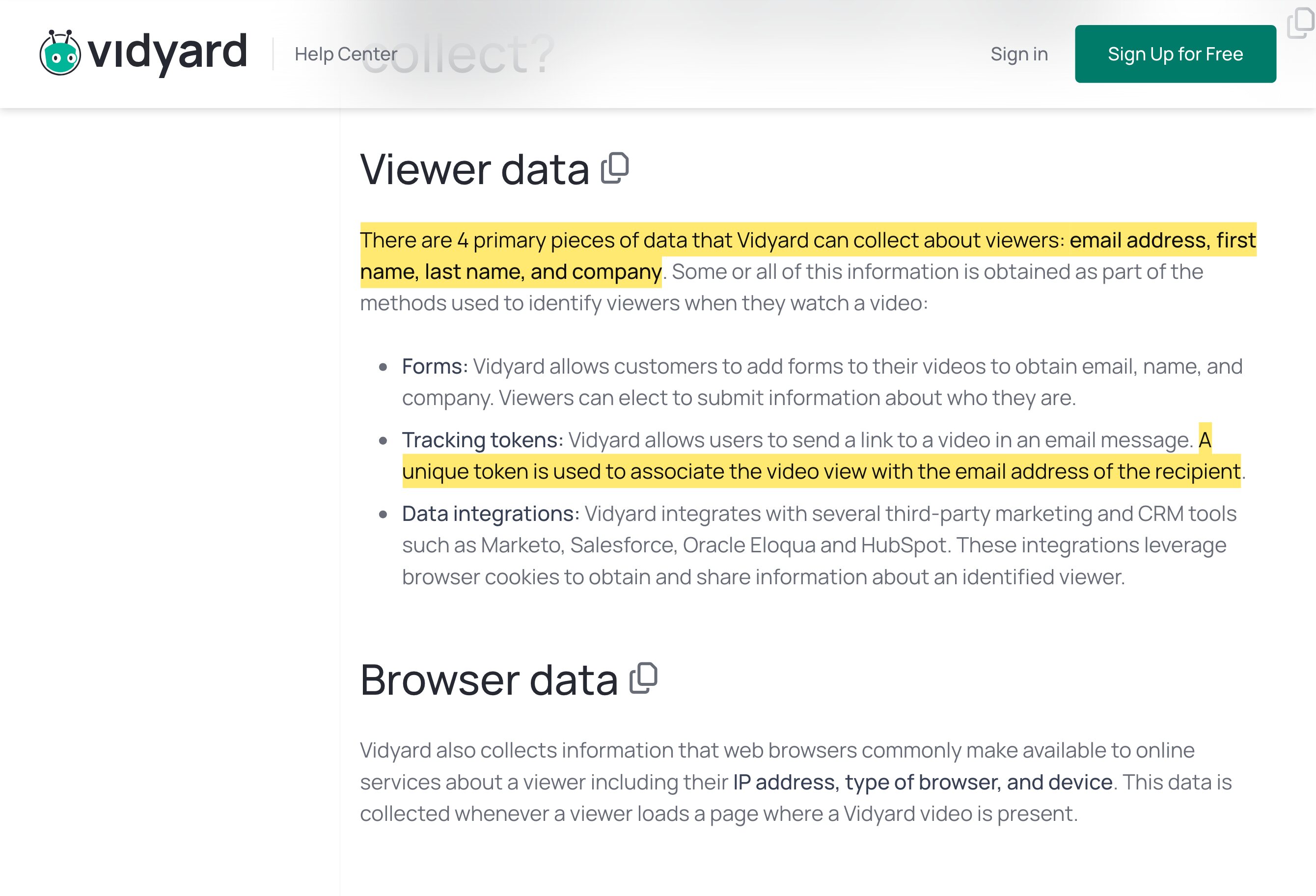
In Vidyard's own words, "there are 4 primary pieces of data that Vidyard can collect about viewers: email address, first name, last name, and company," and "a unique token is used to associate the video view with the email address of the recipient." Its infrastructure "is managed by Amazon Web Services (AWS)," and personal information "may be stored or processed on servers located in Canada and the United States, and in other jurisdictions." For a viewer in mainland China that is a cross-border transfer of personal information PIPL governs (notice, separate consent and a transfer mechanism, Articles 38–43), and for a CIIO or large-volume handler the data must stay in the mainland (PIPL Article 40; Cybersecurity Law Article 39 (formerly Article 37)) — a duty offshore hosting cannot meet. The table below is Vidyard's own wording and the rule each line triggers.
This is a risk map, not a verdict — how much exposure you carry turns on what your videos show, how much viewer data you hold and who is watching. Our China team can map your exposure with you →
Compliance snapshot
- ! Vidyard's analytics identify who watched — email, name, company per view
- ! Chinese viewers' data is recorded on US servers — PIPL cross-border applies
- ! The video itself may hold personal data — faces, voices, on-screen info
- ✕ Hosted on AWS in the US, no mainland region — no in-country footing
- ! Residency duty (CIIO / large-volume handlers) can't be met offshore
What Vidyard's own documentation says about China
| Fact | Primary source |
|---|---|
| Vidyard's analytics are built on identifying who watched. In Vidyard's own documentation, "there are 4 primary pieces of data that Vidyard can collect about viewers: email address, first name, last name, and company," and "a unique token is used to associate the video view with the email address of the recipient." Integrations with CRM and marketing tools "leverage browser cookies to obtain and share information about an identified viewer." For a viewer in mainland China, each recorded view is therefore personal information under PIPL. | Vidyard — "What data does Vidyard collect about viewers?" (knowledge.vidyard.com), retrieved 2026-10-07; PIPL Articles 38–43 |
| Vidyard runs on offshore cloud infrastructure. Vidyard's security page states plainly that "Vidyard's infrastructure is managed by Amazon Web Services (AWS)" — and there is no mainland-China region. A video platform is the heaviest thing on a page, so serving it from AWS outside the mainland means both the media and the analytics event behind it are produced and recorded offshore on every play. | Vidyard Security (vidyard.com/security), retrieved 2026-10-07 |
| Vidyard says the data is hosted in the United States and may leave the viewer's country. Its privacy policy: Vidyard "is headquartered in Canada, and the Services are hosted in the United States," personal information "may be stored or processed on servers located in Canada and the United States, and in other jurisdictions," and "we and our service providers may transfer your personal information to, or process it from, outside the country in which you reside." For a Chinese viewer that is a cross-border transfer under PIPL (Articles 38–43), and a CIIO or large-volume handler faces a mainland-storage duty (PIPL Article 40; Cybersecurity Law Article 39 (formerly Article 37)) offshore hosting cannot meet. | Vidyard Privacy Policy (vidyard.com/privacy), retrieved 2026-10-07; PIPL Articles 38–43 & 40; Cybersecurity Law Article 39 (formerly Article 37) |
| The video itself can carry personal data. Vidyard's privacy policy notes customers "may also use the Services and other third party tools to collect additional personal information about the viewers of their videos," including name, email and IP address — and a marketing or sales video routinely shows faces, voices and named on-screen detail that are personal information in their own right. So the exposure isn't only the analytics; it's the content, handled on offshore infrastructure. | Vidyard Privacy Policy (vidyard.com/privacy), retrieved 2026-10-07 |
Sources verified by the 21YunBox compliance team on 2026-10-07.
For a mainland-China audience, the question about Vidyard is not whether the video plays — it is whether you are allowed to collect what Vidyard collects when it does. Vidyard is a video platform built on identifying viewers: it ties each view to a person and records it on infrastructure the company says is “hosted in the United States.” That makes a China-facing deployment a personal-information question first and a playback question second. The video being reachable is real; the viewer data crossing the border, and the residency and filing gaps that come with offshore hosting, are the exposure.
Vidyard in China at a glance
| What decides it | In Vidyard's own terms |
|---|---|
| Where it runs | Hosted on Amazon Web Services; the privacy policy states the “Services are hosted in the United States,” with data “stored or processed on servers located in Canada and the United States.” No region is inside mainland China. |
| What it records per viewer | “4 primary pieces of data… email address, first name, last name, and company,” plus a browser's “IP address, type of browser, and device,” with a “unique token… to associate the video view with the email address of the recipient.” |
| Crossing the border | For a Chinese viewer, recording those views on US servers is a cross-border transfer of personal information PIPL governs — notice, separate consent and a transfer mechanism (Articles 38–43). |
| Data residency | A CIIO or large-volume handler must store mainland-collected personal information inside the mainland (PIPL Article 40; Cybersecurity Law Article 39 (formerly Article 37)) — a duty offshore AWS hosting cannot meet. |
| Is it reachable? | Reachable, but video is heavy and served from AWS outside the mainland, so it crosses the border on every play — the delivery half of the question, not the legal half. |
The data Vidyard keeps is personal — and that’s the point
Vidyard is not a passive video host; its value is knowing who watched. In its own documentation, “there are 4 primary pieces of data that Vidyard can collect about viewers: email address, first name, last name, and company,” and “a unique token is used to associate the video view with the email address of the recipient.” Where a customer wires in a CRM or marketing tool, those integrations “leverage browser cookies to obtain and share information about an identified viewer.” On top of that, Vidyard “collects information that web browsers commonly make available… including their IP address, type of browser, and device.”
For a viewer in mainland China, all of that is personal information. The analytics that make Vidyard worth buying are exactly what place a China-facing deployment under the Personal Information Protection Law. And the videos themselves often carry personal data of their own — a face on camera, a named customer on a slide, a voice — so even before anyone fills in a form, you are handling personal information about identifiable people.
Served from the US, so every view crosses the border
Vidyard states where it runs. Its security page: “Vidyard’s infrastructure is managed by Amazon Web Services (AWS).” Its privacy policy: the company “is headquartered in Canada, and the Services are hosted in the United States,” and personal information “may be stored or processed on servers located in Canada and the United States, and in other jurisdictions in which our service providers have operations.” The policy is explicit that “we and our service providers may transfer your personal information to, or process it from, outside the country in which you reside.” There is no mainland-China region.
So when a Chinese viewer plays a video, their view — and the personal data attached to it — is recorded on servers outside the mainland. Under PIPL that is a cross-border transfer of personal information: the handler (you, not Vidyard) must give notice, obtain separate consent, and satisfy one transfer mechanism — a CAC security assessment, the CAC standard contract, or certification (Articles 38–43). If you are a critical information infrastructure operator or a large-volume handler, personal information collected in China must be stored in the mainland (PIPL Article 40; Cybersecurity Law Article 39 (formerly Article 37)) — a residency duty US-hosted Vidyard cannot satisfy. And because the player and its data sit on offshore AWS, there is no mainland footing to attach an ICP filing to; the embed stays outside the in-country, filed delivery a compliant public site in China is built on.
Reachable, but video is heavy and offshore
None of this is about Vidyard being blocked. The second, smaller half of the question is simply that video is the heaviest thing on a page, and Vidyard serves it from AWS outside the mainland. Every play pulls that media across the border, where distance and the crossing itself make playback slower and less predictable than in-region delivery — a delivery problem, not the legal one. We are deliberately not attaching a number to that here: there is no clean first-party measurement for this page, and the honest point holds without one. Reaching the video is not the same as being cleared to collect what Vidyard collects while it plays.
This is a risk map, not a verdict. Whether PIPL notice and separate consent, a transfer mechanism, in-country storage, or all of them apply to you depends on what your videos show, how much viewer data you keep, and who is watching — settle it with counsel before you roll Vidyard out to a mainland audience.
Where 21YunBox fits — a compliant overlay, not a migration
Vidyard stays exactly where it is. What we add is the one thing an offshore video platform structurally cannot offer: compliant, ICP-filed delivery from inside the mainland, set in front of the origin you already run — no rebuild, no second codebase, and no migration off Vidyard. Our China team maps your PIPL cross-border and data-residency obligations against your entity, your data volumes and your audience, then stands up the in-country delivery and storage a lawful China presence requires — while your player and the viewer analytics you rely on keep running untouched.
Related reading:
Frequently Asked Questions
Is Vidyard blocked in mainland China?
Treat reachability as the smaller half of the question. Vidyard isn't a site you ICP-file; it's an embedded player and analytics layer served from Amazon Web Services outside the mainland. Heavy video pulled across the border tends to load slowly or unevenly for mainland viewers, but even where it plays fine, the deciding issue is that each view records a Chinese viewer's personal data to offshore servers. Whether you may use it that way is a PIPL question, not a bandwidth one.
What personal data does Vidyard hold on our Chinese viewers?
By Vidyard's own account, "there are 4 primary pieces of data that Vidyard can collect about viewers: email address, first name, last name, and company," plus the technical data a browser exposes — "IP address, type of browser, and device" — and a view can be tied to a named person through a unique email token or CRM cookies. For a viewer in mainland China that is personal information, and recording or storing it on US servers is a cross-border transfer PIPL governs (notice, separate consent and a transfer mechanism; Articles 38–43).
Can 21YunBox help us use Vidyard compliantly in China?
Yes. Our China team can map your exposure — what your videos show, how much viewer data you hold, and whether a data-residency duty applies to you — and stand up ICP-filed, in-country delivery in front of the stack you already run, so Vidyard's player and analytics stay where they are. Get in touch to work through your specific case.