Does AWeber Work in China? PIPL, Data Residency & Your Subscriber List
AWeber stores your subscribers' names, emails and engagement in the United States — it names a US-based data importer, certifies under the EU-U.S. Data Privacy Framework and publishes no mainland-China region — so a China list on AWeber is a cross-border transfer of personal data PIPL governs. A compliance-first look at the data-residency door.
Does AWeber work in China?
Yes — AWeber may well load and send from mainland China, but it keeps your subscribers' personal data in the United States, and nothing in AWeber lets you hold a mainland list in-country. "We use AWeber" is a cross-border data question before it is a deliverability one.
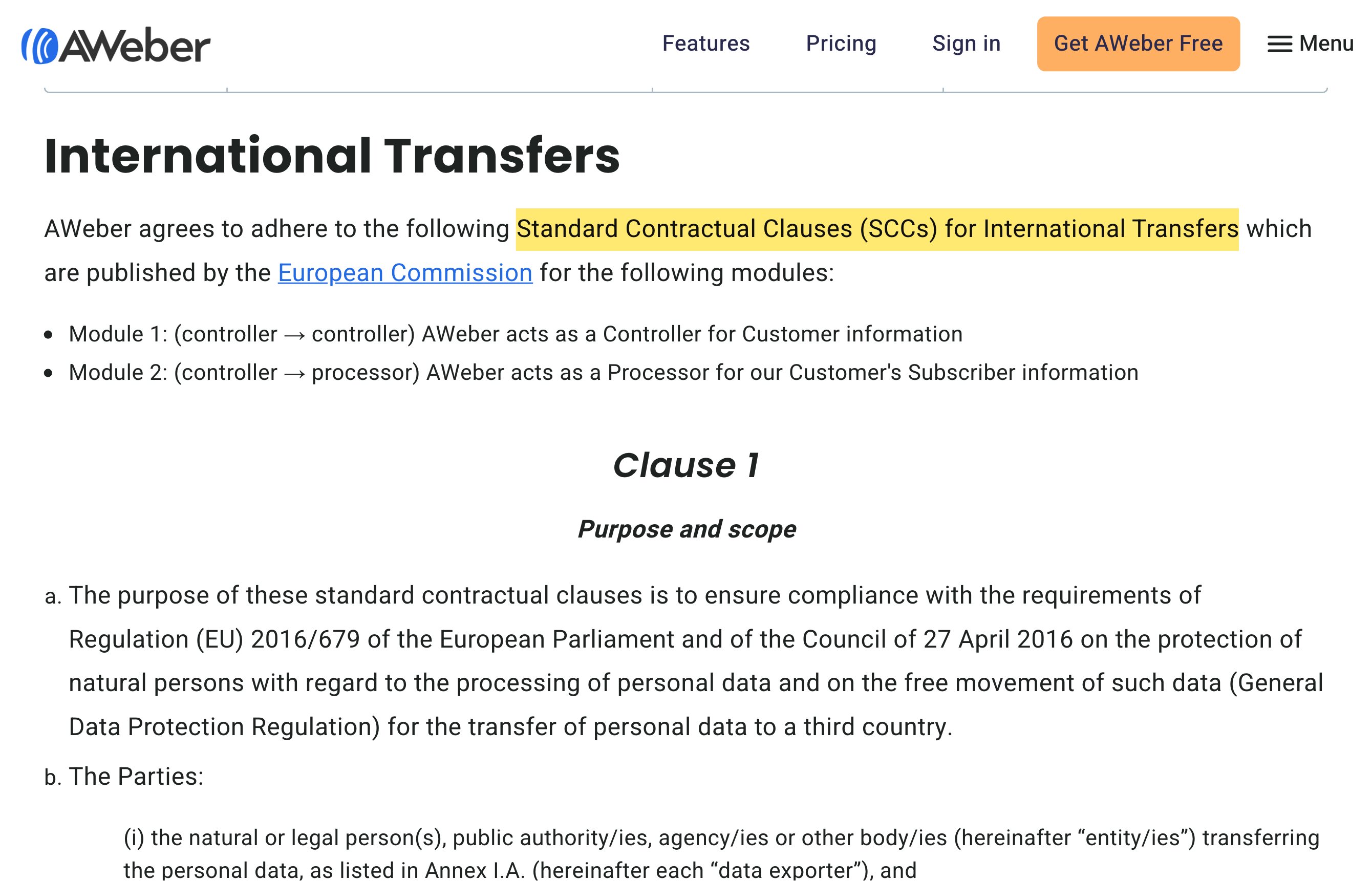
AWeber is an email-marketing platform, so what you store in it is personal information — in its privacy policy, "your name, email address, and other contact information" from your sign-up forms, plus engagement such as "the date and time you opened the email, any links you clicked." Its processing terms name a United States "data importer" — "AWeber Systems, Inc. … Chalfont, PA 18914, USA" — and bind AWeber to the European Commission's "Standard Contractual Clauses (SCCs) for International Transfers," and it publishes no mainland-China region. Hold mainland subscribers' records there and that is a cross-border transfer of personal information PIPL governs — notice, separate consent and a transfer mechanism (Articles 38–43) — on infrastructure that cannot keep the data in-country. The table below is AWeber's own wording and the rule each line triggers.
This is a risk map, not a verdict — what you owe turns on your entity, how many subscribers you hold and whether they sit in the mainland. Our China team can map your exposure with you →
Compliance snapshot
- ! AWeber keeps your subscribers' names, emails and engagement on US infrastructure
- ! Mainland subscribers' personal data crosses the border — PIPL governs it
- ✕ AWeber names only a US processing entity — no mainland-China data region
- ! AWeber's own EU terms cast it as the "data importer" — an international transfer
- ! Even where the dashboard loads, email delivery into China inboxes is a separate problem
What Aweber's own documentation says about China
| Fact | Primary source |
|---|---|
| AWeber's own EU terms cast it as the US "data importer." In its Data Processing and Security Terms AWeber names the "Processor (data importer): AWeber Systems, Inc. 4275 County Line Rd #20, PMB 186, Chalfont, PA 18914, USA," and agrees to the European Commission's "Standard Contractual Clauses (SCCs) for International Transfers." From the Chinese side the same movement is a cross-border transfer of personal information under PIPL — notice, separate consent and a transfer mechanism, Articles 38–43. | AWeber — GDPR Data Processing and Security Terms (aweber.com/dpst.htm), retrieved 2026-10-07; PIPL Articles 38–43 |
| The asset you put into AWeber is your subscribers' personal information. AWeber's privacy policy describes collecting, through your sign-up forms, "your name, email address, and other contact information," and — when subscribers open your campaigns — "the date and time you opened the email, any links you clicked." For mainland residents those names, contact details and engagement records are personal information in PIPL's sense, so where they are stored is a data-residency question, not a convenience. | AWeber — Privacy Policy (aweber.com/privacy.htm), retrieved 2026-10-07; PIPL |
| AWeber processes under US frameworks, with no mainland-China region. AWeber states it "complies with the EU-U.S. Data Privacy Framework (EU-U.S. DPF), the UK Extension to the EU-U.S. DPF, and the Swiss-U.S. Data Privacy Framework" and "has certified to the U.S. Department of Commerce that it adheres to the EU-U.S. Data Privacy Framework Principles" — frameworks whose whole purpose is to legitimize sending personal data into the United States, its only named processing locale. Its documents name no mainland-China data region (inference from AWeber's own privacy and processing terms), so a data-localization duty for a CIIO or large-volume handler cannot be met (PIPL Article 40; Cybersecurity Law Article 39 (formerly Article 37)). | AWeber — Privacy Policy (aweber.com/privacy.htm), retrieved 2026-10-07; PIPL Article 40; Cybersecurity Law Article 39 (formerly Article 37) |
| Even reachability is only the easy half. Where AWeber's dashboard and API are reachable from the mainland, any public sign-up form or landing page you publish on an AWeber domain is still served from offshore — a page facing mainland visitors with no footing for an ICP filing (State Council Order No. 292; MIIT Order No. 33). Getting campaign email delivered into Chinese inboxes is a separate, well-documented difficulty. Neither answers the data-residency question that actually decides whether you may use AWeber for a Chinese list. | AWeber product documentation (aweber.com), retrieved 2026-10-07; State Council Order No. 292; MIIT Order No. 33 |
Sources verified by the 21YunBox compliance team on 2026-10-07.
For a mainland-China audience, the first question about AWeber is not whether it loads — it is where your subscriber list is allowed to live. AWeber is an email-marketing platform, so the asset you put into it is personal data: the names, email addresses and engagement histories of the people on your list. AWeber’s own terms answer where that data sits — it names a United States entity as the “data importer” and certifies under US data-transfer frameworks, with no mainland-China region anywhere in its documents. So a China-facing list on AWeber may well load and send, yet it keeps your mainland subscribers’ personal information offshore, which is a cross-border transfer China’s law governs. The sending is the easy part; the data residency is the exposure.
AWeber in China at a glance
| What decides it | In AWeber's own terms |
|---|---|
| Where it runs | AWeber names a United States “data importer” — “AWeber Systems, Inc. … Chalfont, PA 18914, USA” — and certifies under the EU-U.S., UK and Swiss Data Privacy Frameworks. No mainland-China data region appears in its documents. |
| What data it holds | Your subscribers' personal information: “your name, email address, and other contact information” from your sign-up forms, plus engagement — “the date and time you opened the email, any links you clicked.” |
| Crossing the border | AWeber itself treats inbound data as an international transfer, adhering to the EU's “Standard Contractual Clauses (SCCs) for International Transfers.” From China, moving a mainland list to AWeber is a cross-border transfer PIPL governs. |
| Data residency | With no mainland region, subscriber data cannot be kept in-country. A data-localization duty for a CIIO or large-volume handler cannot be met on a US-only footprint. |
| Is it reachable? | Even where the dashboard loads and the API responds, getting campaign email into Chinese inboxes is a separate, well-documented problem — and neither reachability nor deliverability answers the legal question. |
No mainland region, so your subscriber data lives in the US
AWeber is a US company, and its documentation describes a US processing footprint. In its Data Processing and Security Terms AWeber names itself the “Processor (data importer): AWeber Systems, Inc. 4275 County Line Rd #20, PMB 186, Chalfont, PA 18914, USA,” and in its privacy policy it “complies with the EU-U.S. Data Privacy Framework (EU-U.S. DPF), the UK Extension to the EU-U.S. DPF, and the Swiss-U.S. Data Privacy Framework” — the very frameworks that exist to legitimize moving personal data into the United States. Nowhere in those documents is a mainland-China data region named.
That geography settles the residency question. The list you build in AWeber is personal data — in AWeber’s words, “your name, email address, and other contact information,” collected through your sign-up forms, plus the engagement it records when a subscriber opens a campaign: “the date and time you opened the email, any links you clicked.” For subscribers who are mainland residents, that information is held offshore, and AWeber offers no in-country option to hold it any other way.
A cross-border transfer, in AWeber’s own framing
AWeber already treats data arriving from outside the US as an international transfer: it is the “data importer,” and it adheres to the European Commission’s “Standard Contractual Clauses (SCCs) for International Transfers.” Run that logic from the Chinese side and the same movement is a cross-border transfer of personal information under China’s Personal Information Protection Law. The handler — you, the business that owns the list, not AWeber — has to give notice, obtain separate consent, and clear one transfer mechanism: a CAC security assessment, the CAC standard contract, or certification (PIPL Articles 38–43). And if you are a critical information infrastructure operator or a large-volume handler, personal information collected in China must be stored in the mainland (PIPL Article 40; Cybersecurity Law Article 39 (formerly Article 37)) — a residency duty AWeber’s US-only footprint cannot satisfy.
Reachable and sending — but that’s the easy half
None of this is about whether AWeber loads. Even where the dashboard and the API are reachable from the mainland, any public sign-up form, landing page or link-in-bio page you publish on an AWeber domain is served to your visitors from offshore — which, for a page facing mainland users, is also a page with no footing for an ICP filing (State Council Order No. 292; MIIT Order No. 33). Getting your campaigns actually delivered into Chinese inboxes is a separate, well-documented difficulty in its own right. But reachability and deliverability are the delivery half of the question; the half that decides whether you may use AWeber for a Chinese audience is where the personal data sits, and under which law.
This is a risk map, not a verdict: whether you owe notice and consent, a transfer mechanism, in-country storage, or all three depends on your entity, how many subscribers you hold and where they are — worth settling with counsel before you scale a China list.
Where 21YunBox fits — a compliant overlay, not a migration
You keep running your email program on AWeber. What we add is the piece a US-only platform cannot give a China audience: compliant, ICP-filed delivery and in-country storage from inside the mainland, set in front of the stack you already use — no rebuild, no second codebase, and no migrating your list off AWeber. Our China team maps your PIPL cross-border and data-residency obligations against your entity, your subscriber volumes and where your audience sits, then stands up the lawful in-mainland footing a China presence needs, while AWeber stays exactly where it is.
Related reading:
Frequently Asked Questions
Where does AWeber store our subscribers' data?
In the United States. AWeber's processing terms name it the "data importer" — "AWeber Systems, Inc. … Chalfont, PA 18914, USA" — and its privacy policy says it complies with and has certified under the EU-U.S. Data Privacy Framework, the mechanism for sending personal data to the US. Its documents name no mainland-China region, so your mainland subscribers' names, emails and engagement are held offshore. Under PIPL that is a cross-border transfer, and for a CIIO or large-volume handler a data-localization duty can also apply.
Is it illegal to use AWeber for mainland-China subscribers?
Treat it as a risk to assess with counsel, not a blanket yes or no. Storing mainland residents' personal information on AWeber's US infrastructure is a cross-border transfer PIPL governs: as the handler you must give notice, obtain separate consent and satisfy one transfer mechanism — a CAC security assessment, the CAC standard contract, or certification. Whether a data-localization duty also applies turns on your role (e.g. CIIO) and your data volumes. The difficulty of getting email delivered into Chinese inboxes is a separate, practical matter.
Can 21YunBox help us run email marketing compliantly for China?
Yes. Our China team can map your PIPL cross-border and data-residency exposure for your subscriber data — your entity, your subscriber volumes and where your audience sits — and stand up ICP-filed, in-country delivery and storage in front of the stack you already run, so your AWeber account stays exactly where it is. Get in touch to work through your specific case.