Does Google Forms Work in China? Reachability, Data Residency & PIPL
Google runs no data region inside mainland China — Workspace data rests in the US or EU — and its services are widely blocked behind the national firewall, so a Google Form is both frequently unreachable to mainland visitors and a cross-border transfer of their personal data under PIPL. A compliance-first look at the two exposures.
Does Google Forms work in China?
A Google Form placed in front of mainland-China visitors carries two separate exposures at once: it is frequently unreachable behind China's national firewall, and any response it does collect is personal data stored on Google infrastructure in the United States or the European Union — a cross-border transfer under Chinese law. Google operates no mainland-China region.
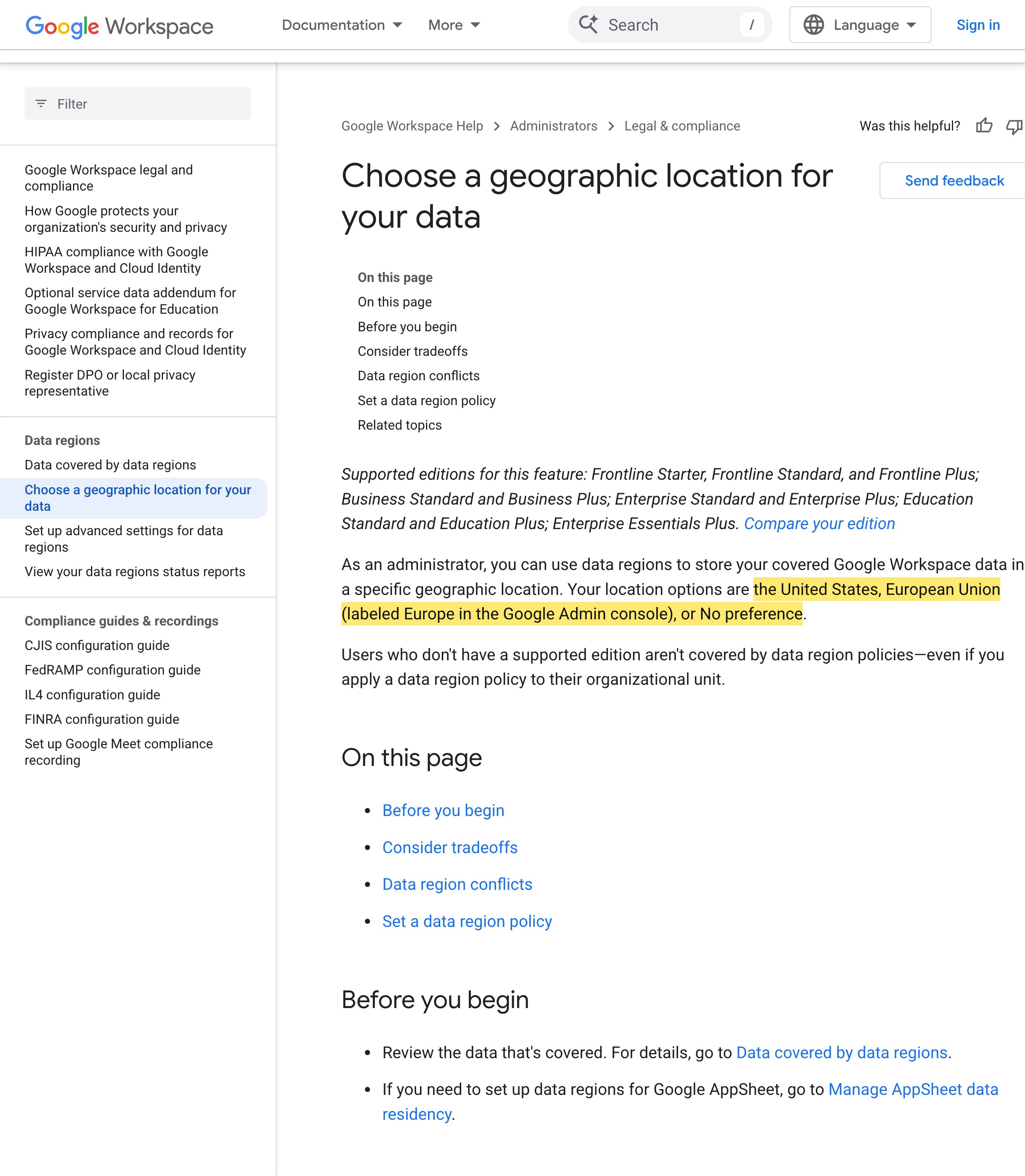
In Google's own words, covered Workspace data can be pinned only to "the United States, European Union (labeled Europe in the Google Admin console), or No preference" — there is no mainland option — and Google adds that "Selecting a specific region doesn't improve performance or fine-tune your network or data access." So responses from Chinese residents land offshore: a cross-border transfer of personal information PIPL governs (notice, separate consent and a transfer mechanism, Articles 38–43), and if you embed the form in a public mainland site you host, that site also needs an ICP filing. The table below pairs Google's own wording with the rule each point triggers.
This is a risk map, not a verdict — what applies turns on who your respondents are, how much personal data you gather and where the form lives. Our China team can map your exposure with you →
Compliance snapshot
- ✕ A Google-hosted form is frequently unreachable to mainland visitors
- ! Responses are personal data stored in the US or EU — no China region
- ! Collecting China users' responses is a PIPL cross-border transfer
- ! CIIOs and high-volume handlers owe in-country storage Forms can't give
- ! Embed the form in a public mainland site and ICP filing applies to the host
What Google Forms's own documentation says about China
| Fact | Primary source |
|---|---|
| Google offers no mainland-China data region — responses rest in the US or EU. Google's data-regions documentation states your only choices are "the United States, European Union (labeled Europe in the Google Admin console), or No preference." Google Forms responses live in Drive, Docs and Sheets, so for mainland respondents that storage is offshore — a cross-border transfer of personal information under PIPL (notice, separate consent and a transfer mechanism, Articles 38–43), and for a CIIO or large-volume handler, personal information collected in China must stay in the mainland (PIPL Article 40; Cybersecurity Law Article 39 (formerly Article 37)). | Google Workspace Admin Help — Choose a geographic location for your data (knowledge.workspace.google.com), retrieved 2026-10-07; PIPL Articles 38–43 & 40; Cybersecurity Law Article 39 (formerly Article 37) |
| Google says the region control sets where data rests, not whether China can reach it. The same documentation is explicit: "Selecting a specific region doesn't improve performance or fine-tune your network or data access." Both options it offers keep data outside the mainland, so no residency setting turns a Google-hosted form into an in-country, compliant one. | Google Workspace Admin Help — Choose a geographic location for your data (knowledge.workspace.google.com), retrieved 2026-10-07 |
| Google gates its business services by territory and runs no mainland-China presence. Google states "Google Workspace is available in most countries and regions," while it "restricts access to some of its business services in certain countries or regions," adding that "Certain Google services might be available in these countries or regions for personal use, but not for business or education use." China is not on that restricted list — but Google still offers no mainland region or data-residency option, which is what a compliant China deployment turns on. | Google Workspace Admin Help — Countries or regions where Google Workspace is available (knowledge.workspace.google.com), retrieved 2026-10-07 |
| In practice the form is often unreachable — Google sits behind China's firewall. Google's consumer and Workspace services, including the Docs editors that host and serve Forms, are widely blocked or throttled in mainland China by the national firewall, so a Google-hosted form frequently will not load for mainland visitors. This reachability block is imposed by the Chinese network, separate from the data-residency question of where the responses are stored — and both apply to the same form at once. | Well-documented reachability fact (China's national firewall); Google Transparency Report tracks access to Google services by country, retrieved 2026-10-07 |
Sources verified by the 21YunBox compliance team on 2026-10-07.
For a mainland-China audience, the question about Google Forms is not how quickly it renders — it is whether your visitors can reach it at all, and where the answers they type are allowed to live. Both answers run against you. Google’s services sit behind China’s national firewall, so a form on a Google URL is frequently unreachable to mainland visitors; and Google stores Workspace data only in the United States or the European Union, so every response you do collect from a Chinese resident is personal data crossing the border. Reachability is the visible half; data residency is the half Chinese law actually turns on.
Google Forms in China at a glance
| What decides it | In Google's own terms |
|---|---|
| Can visitors reach it | Google's services sit behind China's national firewall; its consumer and Workspace products, including the Docs editors that serve Forms, are widely blocked or throttled, so a Google-hosted form is frequently unreachable to mainland visitors. |
| Where responses are stored | Google's data-region choices are “the United States, European Union (labeled Europe in the Google Admin console), or No preference” — there is no mainland-China region. |
| Does a region setting help | “Selecting a specific region doesn't improve performance or fine-tune your network or data access,” and both choices keep data offshore. |
| The data you collect | Form responses are personal data; gathered from mainland residents and stored in the US or EU, that is a cross-border transfer PIPL governs (Articles 38–43), with in-country storage owed by CIIOs and large-volume handlers (Article 40; Cybersecurity Law Article 39 (formerly Article 37)). |
| If it's embedded in a mainland site | A public-facing site served to mainland visitors turns on an ICP filing — that duty attaches to the host site, not to the form widget itself. |
Reachable? Often not — Google sits behind the firewall
Google is not merely slow in mainland China; much of it is blocked. Its consumer services, and the Workspace apps built on them — the Docs, Sheets and Forms editors among them — are the ones China’s national firewall filters most consistently, which is why a form served from a Google domain so often simply fails to load inside the mainland. This is not Google withdrawing the product: Google’s own availability page says “Google Workspace is available in most countries and regions,” and it does not list China among the territories where it restricts business services. The block is imposed by the Chinese network, not by Google — but the practical result for your respondents is the same, and no setting inside your Google account changes it.
The responses are personal data, and they land offshore
Even where a form does load, the second exposure is where the answers go. Google lets administrators pin covered Workspace data to a region, but the only choices are “the United States, European Union (labeled Europe in the Google Admin console), or No preference,” and Google is explicit that “Selecting a specific region doesn’t improve performance or fine-tune your network or data access.” There is no mainland-China option at all. So responses submitted by people in China are stored outside the mainland, which under the Personal Information Protection Law is a cross-border transfer of personal information: you, as the handler, must give notice, obtain separate consent, and clear one transfer mechanism — a CAC security assessment, the CAC standard contract, or certification (Articles 38–43). If you are a critical information infrastructure operator or a large-volume handler, personal information collected in China has to be stored in the mainland (PIPL Article 40; Cybersecurity Law Article 39 (formerly Article 37)) — a duty no US or EU Google region can meet.
Where ICP enters — only if you host the form on a public mainland site
ICP filing is the narrower door here, and it is conditional. A standalone Google Form lives on a Google URL, so the ICP question does not attach to the form itself. But if you embed that form in a public-facing website you serve to mainland visitors, that website is what needs an ICP filing (ICP 备案) under State Council Order No. 292 and MIIT Order No. 33 — and a site served from outside the mainland has no footing to file. In other words, dropping a Google Form into a China-facing page you host pulls the host into the licensing regime, even though the form widget does not carry the filing.
This is a risk map, not a verdict: whether your use turns on reachability, PIPL cross-border rules, in-country storage, an ICP filing for the host site, or several of these at once depends on who your respondents are and what you do with their answers — worth settling with counsel before you rely on it.
Where 21YunBox fits — a compliant overlay, not a migration
You keep using the tools your team already knows. What we add is the part a Google-hosted form cannot give a China audience on its own: an ICP-filed, in-country delivery path set in front of the website you already serve — no rebuild, no second codebase, and no migration off your current stack — so a China-facing page that embeds your form actually reaches mainland visitors. Alongside it, our China team maps your PIPL cross-border and data-residency exposure for your entity, your data volumes and your respondents, and, where the answers have to stay in-country, helps you stand up compliant in-country collection rather than leaving them on offshore infrastructure.
Related reading:
Frequently Asked Questions
Will a Google Form even load for visitors in mainland China?
Often not. Google's consumer and Workspace services — including the Docs editors that host Google Forms — are widely blocked or throttled by China's national firewall, so a form on a Google URL is frequently unreachable, or slow to the point of abandonment, for mainland visitors. Treat reachability as the first problem and where the responses are stored as the second — both apply at once, and no setting inside your Google account changes the first.
Is collecting responses from China users on Google Forms a data-compliance problem?
Potentially, yes — treat it as a risk to assess with counsel. Google offers data regions only in the United States or the European Union, so responses from mainland residents are stored offshore. Under PIPL that is a cross-border transfer of personal information: you owe notice, separate consent and a transfer mechanism (a CAC security assessment, the CAC standard contract, or certification), and a CIIO or high-volume handler owes in-country storage (PIPL Article 40; Cybersecurity Law Article 39 (formerly Article 37)) that an offshore Google region cannot provide.
Can 21YunBox help us collect form data from China compliantly?
Yes. Our China team can map your exposure — whether the form is reachable from the mainland, and whether your response data triggers PIPL cross-border or data-residency duties for your entity and volumes — and, where the form is embedded in a site you serve to China, stand up ICP-filed, in-country delivery in front of your existing origin with no rebuild. Get in touch to work through your specific case.