Does SurveyMonkey Work in China? Data Residency, PIPL & Survey Rules
SurveyMonkey is reachable in mainland China, but it runs no data center there — responses default to the United States — so collecting answers from mainland residents is a cross-border transfer under PIPL, and a foreign-commissioned survey may also face China's foreign-related survey rules. A compliance-first look.
Does SurveyMonkey work in China?
SurveyMonkey loads in mainland China — but whether you may use it to collect answers there is a compliance question, not a speed one. By SurveyMonkey's own default, every response a Chinese participant submits is stored in the United States.
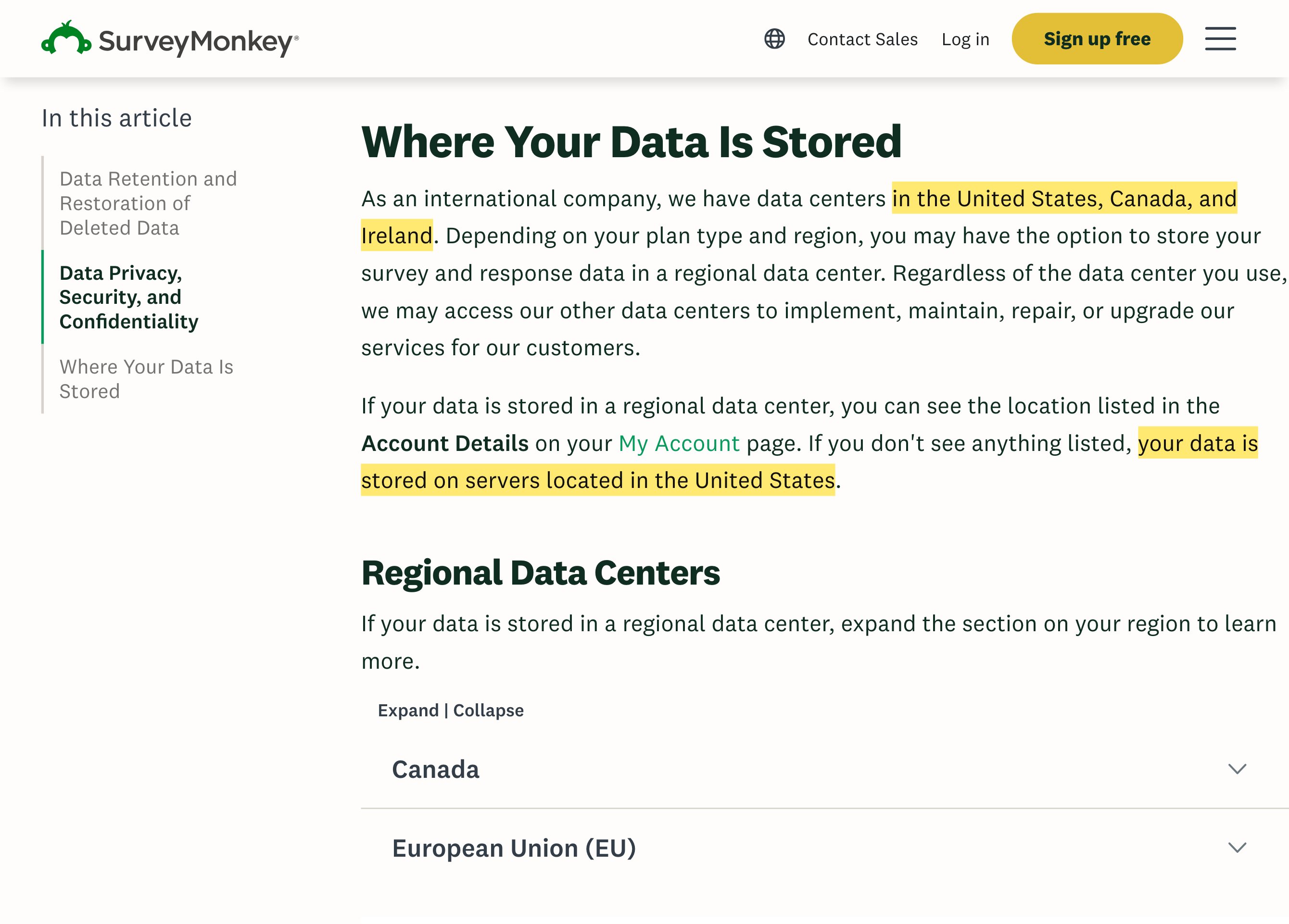
SurveyMonkey states it has "data centers in the United States, Canada, and Ireland," that by default "your data will be stored in our US data centers," and that "the European Union Data Center is only available for SurveyMonkey Enterprise Customers" — there is no mainland-China region on any plan. So a mainland respondent's personal information leaves the country the moment it is submitted: a cross-border transfer PIPL governs (notice, separate consent and a transfer mechanism), on servers that cannot sit in-country. And if a foreign organization is commissioning the research, China's foreign-related survey rules may also apply, independent of where the data lives. The table below is SurveyMonkey's own wording and the rule each line triggers.
This is a risk map, not a verdict — what applies turns on who your participants are, how much personal data you gather, and who is running the survey. Our China team can map your exposure with you →
Compliance snapshot
- ! Mainland respondents' answers are personal data, stored in the US by default
- ! Collecting them offshore is a cross-border transfer under PIPL
- ✕ SurveyMonkey runs no mainland-China data center — no in-country residency
- ! The EU data center is Enterprise-only, and still outside the mainland
- ! A foreign-run market or social survey may also need a survey license
What SurveyMonkey's own documentation says about China
| Fact | Primary source |
|---|---|
| By default, SurveyMonkey stores your data in the United States — and it runs no data center in mainland China. In its own words: "As an international company, we have data centers in the United States, Canada, and Ireland," and "If you don't see anything listed, your data is stored on servers located in the United States." None of the three is in the mainland, so a Chinese respondent's answers are held offshore the moment they are submitted — a cross-border transfer of personal information under PIPL (notice, separate consent and a transfer mechanism, Articles 38–43). | SurveyMonkey — Where Your Data Is Stored (help.surveymonkey.com), retrieved 2026-10-07; PIPL Articles 38–43 |
| The only non-US option is Enterprise-tier Ireland, and some data reaches the US regardless. SurveyMonkey: "Unless otherwise specified, your data will be stored in our US data centers," and "the European Union Data Center is only available for SurveyMonkey Enterprise Customers." Even on that EU plan, "de-identified response data may be transferred to the United States," and support staff "located in the U.S., Canada, Europe, India, Costa Rica, the Philippines, and Australia" may access the account. For a mainland audience, none of these paths keeps the data in China. | SurveyMonkey — International Data Center Overview (surveymonkey.com), retrieved 2026-10-07 |
| For higher-risk handlers, offshore storage is not just a transfer problem — it is a residency problem. Where the handler is a critical information infrastructure operator, or holds personal information above the regulatory volume thresholds, Chinese law requires that data collected in the mainland be stored inside China (PIPL Article 40; Cybersecurity Law Article 39 (formerly Article 37)). Because SurveyMonkey operates only US, Canadian and Irish data centers, there is no configuration of the service that keeps those responses in-country. | SurveyMonkey data-center locations (help.surveymonkey.com), retrieved 2026-10-07; PIPL Article 40; Cybersecurity Law Article 39 (formerly Article 37) |
| If a foreign organization is behind the survey, a separate approval regime may also apply — regardless of where the data sits. China regulates foreign-related market and social surveys under the Administrative Measures on Foreign-Related Surveys (National Bureau of Statistics Order No. 7, 2004). The trigger is the foreign relationship — an overseas party commissioning, funding, collaborating on, or receiving the results of a survey of people in the mainland — not the storage location, so keeping responses in China would not by itself remove it. Whether it reaches your project is a question for Chinese counsel, not something the tool settles. | China Administrative Measures on Foreign-Related Surveys (National Bureau of Statistics Order No. 7, 2004) — general legal fact |
Sources verified by the 21YunBox compliance team on 2026-10-07.
For a mainland-China audience, the real question about SurveyMonkey is not how quickly a survey paints — it is whether you are allowed to collect the answers the way SurveyMonkey collects them. SurveyMonkey is reachable from inside the mainland; it is not blocked at the network layer. But every response a Chinese participant submits is personal data, and SurveyMonkey’s own documentation places that data in the United States by default, with no data center inside mainland China. That is where the exposure lives: not in the loading time, but in a cross-border transfer the law governs — and, if a foreign organization is running the survey, in a second approval regime that turns on who is asking the questions.
SurveyMonkey in China at a glance
| What decides it | In SurveyMonkey's own terms |
|---|---|
| Where your data lives | “As an international company, we have data centers in the United States, Canada, and Ireland,” and by default “your data is stored on servers located in the United States.” No region is inside mainland China. |
| Your only non-US option | “The European Union Data Center is only available for SurveyMonkey Enterprise Customers,” hosted in Ireland — and even then “de-identified response data may be transferred to the United States.” There is no mainland-China data center on any plan. |
| What you're collecting | Responses from mainland participants are personal information. Held in the US (or Ireland), they leave the country — a cross-border transfer PIPL governs (notice, separate consent, a transfer mechanism). |
| Data residency | For a CIIO or a large-volume handler, personal information collected in China must stay in the mainland (PIPL Article 40; Cybersecurity Law Article 39 (formerly Article 37)) — a duty no US or Irish data center can satisfy. |
| If a foreign party is behind it | A foreign organization commissioning or funding market or social surveys of mainland residents may also fall under China's foreign-related survey rules (NBS Order No. 7) — triggered by the relationship, not the data location. Confirm with counsel. |
Your respondents’ answers are personal data that leaves China
A survey tool’s whole job is to gather answers, and under Chinese law those answers are the sensitive part. When a participant in the mainland fills out your SurveyMonkey form, what they type is personal information, and SurveyMonkey stores it — in its own words — in “the United States, Canada, and Ireland,” defaulting to the US whenever no regional center is set. The instant that data lands offshore you have made a cross-border transfer, and the obligations fall on you as the handler, not on SurveyMonkey: give participants clear notice, obtain their separate consent to the overseas transfer, and clear one of PIPL’s transfer mechanisms — a CAC security assessment, the CAC standard contract, or certification (Articles 38–43). An instantly loading survey does nothing to change this; the data still crosses the border, and using the tool may itself be the non-compliant act.
No mainland region — so no in-country residency, and no ICP footing
Because SurveyMonkey operates no data center in mainland China, there is no version of the service that keeps the responses in-country. For an ordinary handler that simply means the cross-border rules above apply. For a critical information infrastructure operator, or a handler above the regulatory volume thresholds, it is sharper: personal information collected in China must be stored inside the mainland (PIPL Article 40; Cybersecurity Law Article 39 (formerly Article 37)), and an Irish or US data center cannot meet that duty. The same absence has a second edge — if you present a survey to mainland visitors as part of your own public-facing site, that is internet information service, and a form served from SurveyMonkey’s offshore domain has no mainland host to carry an ICP filing (State Council Order No. 292; MIIT Order No. 33). Neither gap is something a faster connection can close.
If a foreign organization is running the survey, a second regime can apply
There is one more door, and it has nothing to do with where the data sits. China regulates foreign-related surveys — market and social research — under the Administrative Measures on Foreign-Related Surveys (National Bureau of Statistics Order No. 7). What triggers it is the relationship, not the infrastructure: if an overseas organization commissions, funds, collaborates on, or receives the results of a survey of people in the mainland, the survey is foreign-related, whether the responses end up in Shanghai or San Mateo. So a multinational using SurveyMonkey to run consumer or opinion research on mainland participants may need to work through a licensed Chinese survey body — a requirement that keeping the data in China would not remove. We flag this as a risk to confirm with Chinese counsel, not as a verdict on your project; classifying a given study is exactly the kind of question counsel exists to answer.
This is a risk map, not a verdict: whether PIPL’s cross-border rules, an in-country storage duty, the foreign-related survey regime, or some combination applies turns on who your participants are, how much personal data you gather, and who is commissioning the work — worth settling with counsel before you launch a mainland survey.
Where 21YunBox fits — a compliant overlay, not a migration
You keep running SurveyMonkey exactly as you do today. What we add is the half a US-hosted survey platform leaves to you: compliant, ICP-filed, in-country delivery set in front of your existing collection flow — no rebuild, no second codebase, and no migration off SurveyMonkey. Our China team maps your PIPL cross-border and data-residency exposure against your entity, your data volumes and your participants; and where a survey is foreign-related, we help you line up the in-country handling and the licensed Chinese survey partner the rules call for, with 21YunBox as the technical delivery layer rather than the license holder. Your surveys stay where they already live, and the compliance structure gets built around them.
Related reading:
Frequently Asked Questions
Where does SurveyMonkey store survey responses, and is any of it in China?
In its own documentation SurveyMonkey says it has "data centers in the United States, Canada, and Ireland," and that unless a regional center is set, "your data is stored on servers located in the United States." The only non-US choice, an EU data center in Ireland, is "only available for SurveyMonkey Enterprise Customers." None of the three countries is mainland China, so a Chinese respondent's answers are always held offshore — which is what makes collecting them a cross-border data question under PIPL rather than a loading-speed one.
Is it illegal to run SurveyMonkey surveys for people in mainland China?
Treat it as a risk to assess with counsel, not a blanket yes or no. Two things follow from the way SurveyMonkey stores data: your mainland respondents' personal information leaves the country, which PIPL governs as a cross-border transfer (notice, separate consent and a transfer mechanism), and for a critical information infrastructure operator or a large-volume handler there is also a duty to keep that data in China that an offshore platform cannot meet. Separately, if a foreign organization is commissioning or funding the research, China's foreign-related survey rules may apply as well — and that turns on the relationship, not on where the data sits.
Can 21YunBox help make our SurveyMonkey setup work in China?
Yes. Our China team can map which rules are actually in play — your PIPL cross-border and data-residency exposure for your entity, your data volumes and your participants, and whether the foreign-related survey regime applies — and stand up the ICP-filed, in-country delivery a compliant China presence needs in front of the SurveyMonkey workflow you already run. Where a survey is foreign-related, we help line up the licensed Chinese survey partner the rules call for, with 21YunBox as the technical delivery layer rather than the license holder. Get in touch to work through your specific case.