Does Sitecore Content Hub DAM Work in China? Offshore Azure Hosting, Data Residency & ICP
Sitecore Content Hub DAM is a Sitecore-hosted SaaS on Microsoft Azure with no mainland-China data center, so a China-facing site pulls its heaviest assets from offshore, your asset metadata and contacts sit outside the mainland under PIPL, and the public site still needs an ICP filing. A compliance-first look at the exposure.
Does Sitecore Content Hub DAM work in China?
Whether you can use Sitecore Content Hub DAM in mainland China is first a data-residency and delivery question, not a speed one. Content Hub DAM is the repository your heavy digital assets live in — the images, video and renditions a site requests — and Sitecore runs it as a hosted SaaS. Where those assets, and the personal data wrapped around them, are kept is what China's law responds to.
In Sitecore's own data-privacy documentation it "secures, manages, and monitors the cloud infrastructure used to run the Content Hub services in partnership with its public cloud partner: Microsoft Azure," holding "customer data through Elastic, Redislabs and Azure Blob storage" with "backups in geo-redundant locations" — and that documentation names no mainland-China data center. So a China-facing site pulls its assets from offshore, and any personal data the DAM's metadata, contacts and approval records carry sits offshore too: a cross-border transfer of personal information PIPL governs. The ICP filing, meanwhile, attaches to the public mainland site that serves those assets, not to Content Hub itself. The table below is Sitecore's own wording and the rule each line triggers.
This is a risk picture, not a verdict — what applies turns on what your assets and metadata hold, how much of it is personal, and who your users are. Our China team can map your Content Hub exposure with you →
Compliance snapshot
- ! Reachable, but every image, video and rendition your site pulls is served from Sitecore's offshore Azure cloud — the heaviest assets on the page cross the border
- ✕ Sitecore's own data-privacy documentation names its public cloud partner as Microsoft Azure and no mainland-China data center
- ! The DAM's metadata, contact records and approval workflows can hold personal data, and it is kept offshore — a PIPL cross-border transfer
- ! The ICP filing attaches to the public mainland site that serves the assets, not to Content Hub itself
- ✓ A compliant, ICP-filed in-country delivery path exists — no rebuild, no migration off Content Hub
What Sitecore Content Hub DAM's own documentation says about China
| Fact | Primary source |
|---|---|
| Content Hub is a Sitecore-hosted SaaS running on Microsoft Azure. Sitecore's own data-privacy documentation states it "secures, manages, and monitors the cloud infrastructure used to run the Content Hub services in partnership with its public cloud partner: Microsoft Azure." That documentation names no mainland-China data center, so for a China-facing site the repository your assets live in is hosted offshore. | Sitecore — Content Hub data privacy (doc.sitecore.com), retrieved 2026-10-07 |
| A DAM is the heaviest store behind a page, and it is kept and backed up offshore. Content Hub "manages customer data through Elastic, Redislabs and Azure Blob storage, with all data encrypted both at rest and in transit," and "maintains database and storage backups in geo-redundant locations." Those assets — full-size images, video and renditions — are usually the single largest thing a page requests, and every one your China-facing site pulls is delivered across the border from an offshore region. | Sitecore — Content Hub data privacy (doc.sitecore.com), retrieved 2026-10-07 |
| The DAM does not only hold files — it holds personal data. Asset metadata, contributor and contact records, and approval or review workflows routinely carry names, email addresses and the images of identifiable people. Gathered from people in China and kept in an offshore Content Hub tenant, that is a cross-border transfer of personal information under PIPL: the handler — you, Sitecore's customer, not Sitecore — must give notice, obtain separate consent, and satisfy one transfer mechanism (a CAC security assessment, the CAC standard contract, or certification). | PIPL Chapter III, Articles 38–43 |
| There is no documented way to keep the data on Chinese soil inside Content Hub. For a critical information infrastructure operator or a large-volume handler, personal information collected in China must be stored in the mainland (PIPL Article 40; Cybersecurity Law Article 39 (formerly Article 37)). Because Sitecore documents no mainland-China data center for Content Hub, meeting that duty means running the storage on infrastructure inside the mainland — a separate arrangement from your Content Hub tenant, not a setting in it. | PIPL Article 40; Cybersecurity Law Article 39 (formerly Article 37) |
| The ICP filing attaches to your public site, not to the DAM. Content Hub is a repository a site queries for assets; the ICP filing (State Council Order No. 292; MIIT Order No. 33) attaches to the public mainland website or app that serves those assets and the in-country host it runs on — not to Content Hub. With no mainland data center, Content Hub gives that site no footing to file against. | State Council Order No. 292; MIIT Order No. 33; Sitecore — Content Hub data privacy, retrieved 2026-10-07 |
Sources verified by the 21YunBox compliance team on 2026-10-07.
For a mainland-China audience, the deciding question about Sitecore Content Hub DAM is not how quickly a thumbnail paints — it is where your assets are allowed to live, where the personal data around them ends up, and whether the site that serves them can be licensed to operate. Content Hub is a repository Sitecore hosts for you as a SaaS, and it answers all three questions in its own documentation: it runs on Microsoft Azure, with no mainland-China data center named. A China-facing site built on it is reachable, but its heaviest assets are delivered from offshore, its users’ data is held offshore, and the public site in front of it still needs an ICP filing Content Hub cannot anchor. The reachability is real; the delivery, the residency and the licensing are the exposure.
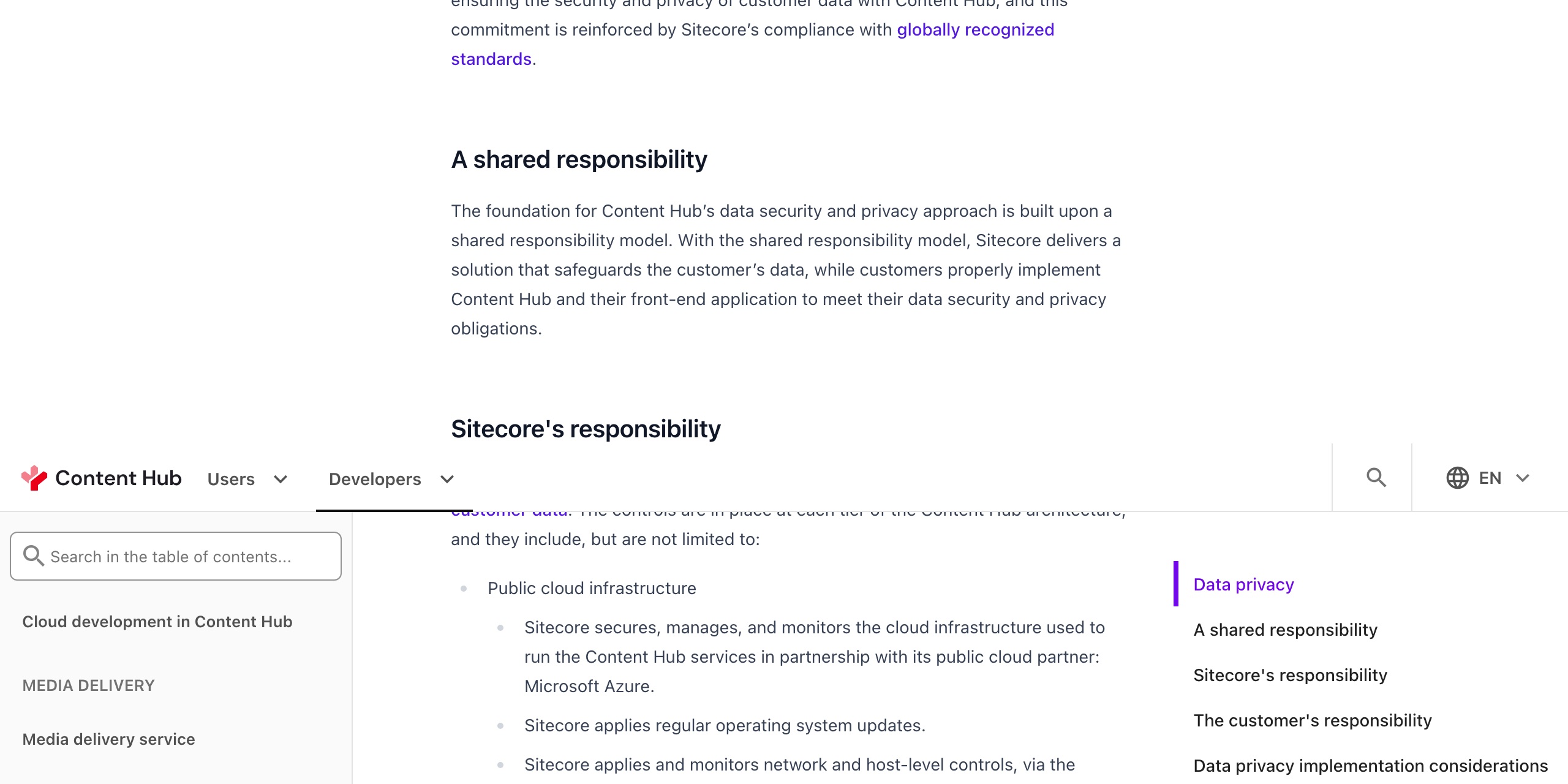
Sitecore Content Hub DAM in China at a glance
| What decides it | In Sitecore's own terms |
|---|---|
| Where it runs | Sitecore hosts Content Hub as a SaaS “in partnership with its public cloud partner: Microsoft Azure.” Its data-privacy documentation names no mainland-China data center, so the assets a China site requests are served from offshore. |
| What it stores | “Customer data through Elastic, Redislabs and Azure Blob storage,” encrypted at rest and in transit, with “backups in geo-redundant locations.” A DAM holds the heaviest files on a page — images, video, renditions — plus the metadata around them. |
| Personal data | Asset metadata, contact records and approval or review workflows can carry names, emails and the images of identifiable people. Gathered from China and held offshore, that is a cross-border transfer PIPL governs. |
| Serving the public | A mainland site that serves those assets from inside China needs an ICP filing tied to an in-country host. Content Hub, hosted offshore, offers no mainland footing of its own to file against. |
| Is it reachable? | Yes — Content Hub is not blocked. The exposure is that offshore delivery, data residency and the ICP filing are compliance facts, and network tuning does not change them. |
A Sitecore-hosted SaaS on Microsoft Azure, offshore from the mainland
Content Hub is not software you run — it is a repository Sitecore hosts and operates for you. In its own data-privacy documentation Sitecore “secures, manages, and monitors the cloud infrastructure used to run the Content Hub services in partnership with its public cloud partner: Microsoft Azure,” and that documentation names no data center inside mainland China. For a China-facing audience that settles the starting point before performance enters it: the repository your assets live in is hosted offshore, and the site that pulls from it reaches across the border for everything it shows.
A DAM is where the heavy assets and their metadata live
A digital asset manager is not a copy store — it is where the largest files on a page come from. Content Hub “manages customer data through Elastic, Redislabs and Azure Blob storage, with all data encrypted both at rest and in transit,” and “maintains database and storage backups in geo-redundant locations to ensure availability if a data center region is impacted.” Encryption and geo-redundancy are sound engineering, but they describe an offshore footprint: every full-size image, video and rendition your China-facing site requests is fetched from one of those offshore regions, and a DAM’s assets are usually the single heaviest thing a page loads.
The data that travels is not only the files. Asset metadata, contributor and contact records, and approval or review workflows routinely carry names, email addresses and the images of identifiable people. Gathered from people in China and held in an offshore Content Hub tenant, that is a cross-border transfer of personal information under China’s Personal Information Protection Law: the handler — you, Sitecore’s customer, not Sitecore — has to give notice, obtain separate consent, and clear one transfer mechanism (a CAC security assessment, the CAC standard contract, or certification).
No mainland data center, so neither the storage nor the filing has a home on Content Hub
Because Sitecore documents no mainland-China data center for Content Hub, two obligations have nowhere to land inside the product. First, residency: for a critical information infrastructure operator or a large-volume handler, personal information collected in China must be stored in the mainland (PIPL Article 40; Cybersecurity Law Article 39 (formerly Article 37)) — a duty an offshore-only tenant cannot meet, so keeping that data on Chinese soil means running its storage on infrastructure inside the mainland, separate from Content Hub. Second, licensing: a public-facing site that serves those assets to mainland visitors from inside China turns on an ICP filing (State Council Order No. 292; MIIT Order No. 33) tied to an in-country host — and Content Hub, hosted offshore, offers no mainland footing to file against.
So “the assets already live in Content Hub” settles nothing about China: a repository Sitecore hosts offshore gives a mainland site neither an in-country host to file against nor a place to keep Chinese users’ data on home soil. Reaching the DAM and being cleared to serve from it are different things, and tuning the pipeline does not create the mainland footing either one needs.
This is a risk map, not a verdict: whether you face a data-localization duty, need an ICP filing, or both depends on what your assets and metadata hold, how much personal data is involved, and who your users are — worth settling with counsel before you build.
Where 21YunBox fits — a compliant overlay, not a migration
You keep building on Content Hub. We add the piece a Sitecore-hosted, offshore DAM cannot: compliant, ICP-filed delivery from inside the mainland, set in front of the site that serves your Content Hub assets — no rebuild, no second repository, and no move off Sitecore. Our China team maps your ICP and data-residency obligations against your entity and the personal data your assets and metadata hold, then stands up the in-country delivery and, where the law requires it, the in-country storage a lawful China presence needs — while Content Hub stays exactly where it already runs.
Related reading:
Frequently Asked Questions
Does Sitecore Content Hub DAM store Chinese users' data in China?
No. Sitecore's own data-privacy documentation says it runs Content Hub on its public cloud partner, Microsoft Azure, storing customer data through Elastic, Redislabs and Azure Blob storage with backups in geo-redundant locations — and it names no mainland-China data center. So your assets and the personal data in their metadata, contacts and approval records are held offshore, not on Chinese soil.
Do I need an ICP filing to use Content Hub DAM in China?
The ICP filing does not attach to Content Hub — it is a hosted repository your site pulls assets from over an API. It attaches to the public mainland website or app that serves those assets to visitors from inside China, and to the in-country host that app runs on. Content Hub publishes no mainland data center to provide that host. Whether your particular setup triggers the filing is a risk to confirm with counsel, not a given.
Can 21YunBox help make our Content Hub DAM setup compliant in China?
Yes. Our China team can assess your PIPL cross-border and data-residency exposure for the personal data your assets and metadata hold, and stand up compliant, ICP-filed in-country delivery — and, where the law requires your China users' data to stay on the mainland, in-country storage — in front of the site you already run, so you keep building on Content Hub. Get in touch to work through your specific case.