Does ShareThis Work in China? Share Buttons, a Tracking Widget & PIPL Cross-Border Data
ShareThis adds free social share buttons, but the widget also tracks your visitors — its own privacy notice says it "generally process[es] data in the United States" and builds audience segments for targeted advertising. For mainland China that is a PIPL cross-border transfer of personal data, and the networks the buttons point to are blocked. A compliance-first look at the data question and the reachability one.
Does ShareThis work in China?
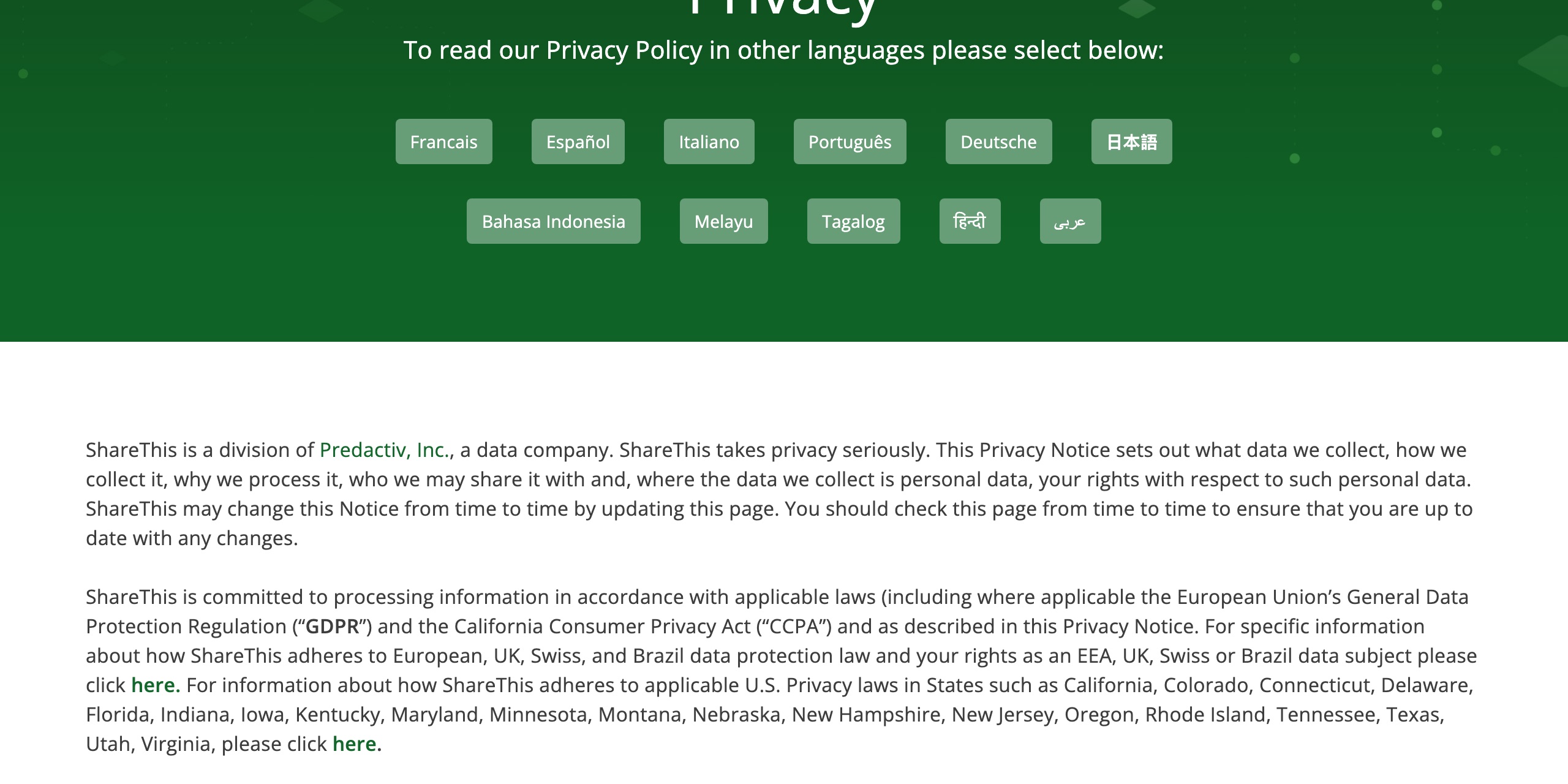
Whether you can use ShareThis in China is first a cross-border-data question — and only then a reachability one — not a speed problem. ShareThis gives you free "customizable social sharing tools," but it is, in its own words, "a division of Predactiv, Inc., a data company": the share buttons come with a widget that tracks your visitors.
Its own Privacy Notice is explicit about both halves. The widget's pixel "will see if your browser has a ShareThis cookie installed on it" and "enable[s] our systems to recognize your computer, device and/or browser over time" — data ShareThis concedes "is considered personal data and/or personal information under applicable law." And it says plainly where that data goes: "We generally process data in the United States," sharing it "to companies globally" and aggregating it into "audience segments" used to "deliver targeted advertising." For a mainland visitor, that export of behavioral data offshore is a cross-border transfer PIPL governs — and the social networks the buttons point to are themselves blocked in China. The table below is ShareThis's own wording and the rules it triggers.
This is a risk picture, not a verdict — your duties turn on consent, volume and your role. Our China team can map your ShareThis exposure with you →
Compliance snapshot
- ! ShareThis's free share buttons come from an offshore widget that also tracks your visitors — it calls itself "a division of Predactiv, Inc., a data company"
- ✕ ShareThis says it "generally process[es] data in the United States" and shares it "to companies globally" — no mainland-China location for your visitors' data
- ! Its pixel recognizes each visitor's device over time; ShareThis concedes this is "considered personal data … under applicable law" — a PIPL cross-border transfer
- ! What it collects is aggregated into "audience segments" used to "deliver targeted advertising" — the visitor data is monetized, not just measured
- ✓ Fixable with a compliant in-country path and proper consent — assess the exposure first; no rebuild, no migration
What ShareThis's own documentation says about China
| Fact | Primary source |
|---|---|
| ShareThis is a data company whose free buttons are the collection point. Its Privacy Notice opens by calling ShareThis "a division of Predactiv, Inc., a data company" that provides Publishers with "customizable social sharing tools." The buttons are the visible product; gathering and segmenting visitor data is the business behind them — so the China question is a personal-information one, not a widget-speed one. | ShareThis — Privacy Notice, retrieved 2026-10-08 |
| The widget tracks each visitor, and ShareThis admits the result is personal data. Per its Privacy Notice, "When you visit a webpage, ShareThis' pixel will see if your browser has a ShareThis cookie installed on it," and this "enable[s] our systems to recognize your computer, device and/or browser over time." ShareThis adds that "in many places, this pseudonymous data is considered personal data and/or personal information under applicable law" — which is exactly how China's PIPL treats it. | ShareThis — Privacy Notice, retrieved 2026-10-08 |
| That data is processed in the United States and shared worldwide. Under the heading "Cross-border transfers of EEA, Swiss, and UK personal data," ShareThis states: "We generally process data in the United States. When we share data, we provide data to companies globally." It names storage and processing facilities "such as Amazon Web Services," and no mainland-China location anywhere — so a mainland visitor's behavioral data leaves the country the moment the widget reports it. | ShareThis — Privacy Notice, retrieved 2026-10-08 |
| The collected data is monetized, which raises the stakes under PIPL. ShareThis says it "analyze[s] and aggregate[s] the data we collect to create groups of data (called audience segments)," and that "this is how we learn about your interests and enable our customers to deliver targeted advertising to you." Behavioral profiling and onward sharing for advertising widen both the purpose you must disclose and the consent you must obtain for any mainland visitor. | ShareThis — Privacy Notice, retrieved 2026-10-08 |
| Exporting that data is a cross-border transfer China's law governs. Sending a mainland visitor's behavioral and audience data offshore is a cross-border transfer under PIPL Chapter III, which requires notice, separate consent, and one statutory transfer mechanism. Scale matters: since the CAC's March 2024 cross-border rules, a non-CIIO moving fewer than 100,000 individuals' non-sensitive personal information in a calendar year is exempt from the security assessment, standard contract and certification — but a CIIO or large-volume handler must store mainland-collected personal information in China (PIPL Article 40; Cybersecurity Law Article 39 (formerly Article 37)). [Confirm your classification and thresholds with counsel — this is a risk map, not legal advice.] | PIPL Chapter III, Articles 38–43; CAC — Provisions on Promoting and Regulating Cross-border Data Flows, March 2024 |
Sources verified by the 21YunBox compliance team on 2026-10-08.
For a mainland-China audience, the real question about ShareThis is not how quickly a row of share buttons paints — it is what the widget behind them collects and where that data goes. ShareThis gives Publishers free “customizable social sharing tools,” but it describes itself, in the same breath, as “a division of Predactiv, Inc., a data company.” The buttons are the surface; a tracker that recognizes your visitors and ships their behavior offshore is the substance. So “does ShareThis work in China?” splits into two honest questions — is your visitors’ data allowed to leave the country the way ShareThis sends it, and can the widget (and the networks it points to) even be reached — and neither is about speed. This page takes the data question first, because it decides the most, and starts with ShareThis’s own words.
ShareThis in China at a glance
| What decides it | In ShareThis's own terms |
|---|---|
| What it is | ShareThis provides Publishers with “customizable social sharing tools,” from “a division of Predactiv, Inc., a data company.” The buttons are free because the data they help collect is the product — so the China question is personal-information, not widget-speed. |
| What the widget collects | Its pixel reads or places a ShareThis cookie and “recognize[s] your computer, device and/or browser over time,” along with “the time you viewed a webpage, the type of browser used and your IP address.” ShareThis says this “is considered personal data … under applicable law” — and PIPL agrees. |
| Where the data goes | “We generally process data in the United States,” shared “to companies globally” on facilities “such as Amazon Web Services.” No mainland-China location is named, so your visitors' data is handled offshore. |
| What it's used for | The data is aggregated into “audience segments” and used to “deliver targeted advertising.” Behavioral profiling and onward sharing widen the consent and disclosure you owe under PIPL. |
| The share destinations | The networks the buttons point to — Facebook, X, Instagram — are blocked in mainland China. Even a widget that loads cleanly leaves mainland users a bar that mostly leads nowhere. |
| Is it a speed problem? | No. A faster path would only export your visitors' data more efficiently; it cannot keep the data in-country, satisfy PIPL, or make blocked destinations reachable. These are compliance and reachability facts, not latency. |
The share buttons are the half you see — the tracking is the half that decides it
ShareThis is not a widget that merely draws icons. Its Privacy Notice describes a measurement pipeline that runs whenever the widget is present: “When you visit a webpage, ShareThis’ pixel will see if your browser has a ShareThis cookie installed on it,” placing one if none exists and reading it if one is already there. Across repeat visits that cookie lets ShareThis’s systems “recognize your computer, device and/or browser over time,” together with “the time you viewed a webpage, the type of browser used and your IP address.” ShareThis is candid about what this amounts to: “in many places, this pseudonymous data is considered personal data and/or personal information under applicable law.” China is one of those places — under PIPL, data that singles out and follows a device is personal information. So the moment the widget loads for a mainland visitor, you are collecting that visitor’s personal data, whether or not anyone ever clicks a button.
Where your visitors’ data goes: the United States
Having collected it, ShareThis says plainly where it takes it. Under the heading “Cross-border transfers of EEA, Swiss, and UK personal data,” the notice states: “We generally process data in the United States,” and “when we share data, we provide data to companies globally,” relying on facilities “such as Amazon Web Services.” Nowhere does it name a mainland-China location for this data. It also explains the purpose — the data is “analyze[d] and aggregate[d] … to create groups of data (called audience segments)” so ShareThis can “enable our customers to deliver targeted advertising to you.”
For a visitor in mainland China, that is a textbook cross-border transfer of personal information: PIPL Chapter III asks the personal-information handler — you, the site that embedded the widget, not ShareThis — to give notice, obtain separate consent, and satisfy one transfer mechanism (a CAC security assessment, the CAC standard contract, or certification). How heavy that duty is scales with volume and role: since the CAC’s March 2024 cross-border rules, a non-CIIO moving fewer than 100,000 individuals’ non-sensitive personal information in a calendar year is exempt from those mechanisms, while a critical information infrastructure operator or large-volume handler must keep mainland-collected personal information in China (PIPL Article 40; Cybersecurity Law Article 39 (formerly Article 37)) — something an offshore, US-processed pipeline cannot do. This is a risk map, not a verdict: what you owe depends on how much you collect, what it contains, and who your users are — worth settling with counsel before you rely on it.
Even a widget that loads points at networks China blocks
There is a second, simpler problem that no amount of network tuning solves. Share buttons exist to push content to social networks — and the large ones ShareThis fronts are themselves unreachable from inside the mainland: Facebook, X and Instagram are all blocked in China. A share bar that renders perfectly but points at destinations a mainland visitor cannot open is a row of buttons that mostly lead nowhere. We describe this qualitatively on purpose: we publish China performance numbers only with the method, sample and date behind them, and the facts that decide this page — where the data is processed, and which destinations are reachable — are not latency figures. To be clear, the answer to blocked destinations is not to try to reach them from inside China; it is to stop depending on them for a mainland audience.
Where 21YunBox fits — a compliant overlay, not a migration
Be precise about what we change and what we don’t. We do not make Facebook or X reachable from inside China, and we cannot move ShareThis’s own US processing onto Chinese soil — those are ShareThis’s facts and the destinations’ facts, not ours. What we do sits around your site: when you serve a site to mainland visitors, we stand up compliant, ICP-filed, in-country delivery in front of your existing origin — no rebuild, no second codebase, no move off the tools you already use. Our China team maps where third-party widgets like ShareThis send your visitors’ data, weighs that cross-border exposure against your entity and your volumes, and helps you decide whether a US-processing tracker belongs in your mainland deployment at all — so the personal data your site handles is managed lawfully instead of leaving the country unnoticed. Where any part of that delivery has to be served legally from inside the mainland, that in-country footing is the piece that triggers an ICP filing — and we set it up with you, around the stack you already run.
Related reading:
- Cross-border data transfers under PIPL — the law that governs the visitor data ShareThis sends to the United States
- How to get an ICP filing for China — relevant if you also serve your site to mainland visitors from in-country infrastructure
Frequently Asked Questions
Does ShareThis work in China?
It depends on what you mean by "work," and speed is the least of it. The share widget loads from an offshore host and, by ShareThis's own Privacy Notice, tracks each visitor — placing a cookie, recognizing the device "over time," and sending behavioral data to be "process[ed] … in the United States." For mainland visitors that export is a cross-border transfer of personal information under PIPL. On top of that, the networks the buttons point to — Facebook, X and Instagram — are blocked in mainland China, so even a widget that loads cleanly gives mainland users little to click. So it is a compliance-and-reachability question, not a speed one.
Is it against the law to use ShareThis in China?
Not inherently. The exposure is the cross-border transfer of personal information: the behavioral and audience data ShareThis collects from your mainland visitors is personal information under Chinese law, and PIPL permits sending it abroad only if you give notice, obtain separate consent, and meet one transfer mechanism. Whether you also face a data-localization duty turns on your role (for example, whether you are a CIIO) and the volume of personal information you handle. Treat it as a risk to assess with counsel, not a blanket prohibition.
Can 21YunBox help make our ShareThis setup compliant in China?
Yes. Our China team can map where your visitors' data travels today, weigh your PIPL cross-border and data-residency duties against your entity and your volumes, and stand up compliant, ICP-filed in-country delivery in front of the stack you already run — so the personal data your site handles is managed lawfully rather than silently exported. Where part of that delivery must be served legally from inside the mainland, that in-country footing is what triggers an ICP filing, and we set it up around your existing setup. Get in touch to work through your specific case.