Does Adobe Acrobat Sign Work in China? Data Residency, PIPL & E-Signature Validity
Adobe Acrobat Sign stores your agreements and signer data in its North America, Europe and Asia-Pacific regions — it runs no mainland-China data center — so a China signer's personal data lands offshore as a cross-border transfer under PIPL, and legal validity turns on China's Electronic Signature Law. A compliance-first look.
Does Adobe Acrobat Sign work in China?
Yes — Adobe Acrobat Sign is reachable from mainland China, but that is the easy half. Adobe stores your agreements and signer data in its North America, Europe and Asia-Pacific regions and operates no mainland-China data center, so every signature a China user makes is a cross-border transfer of personal information before it is anything else.
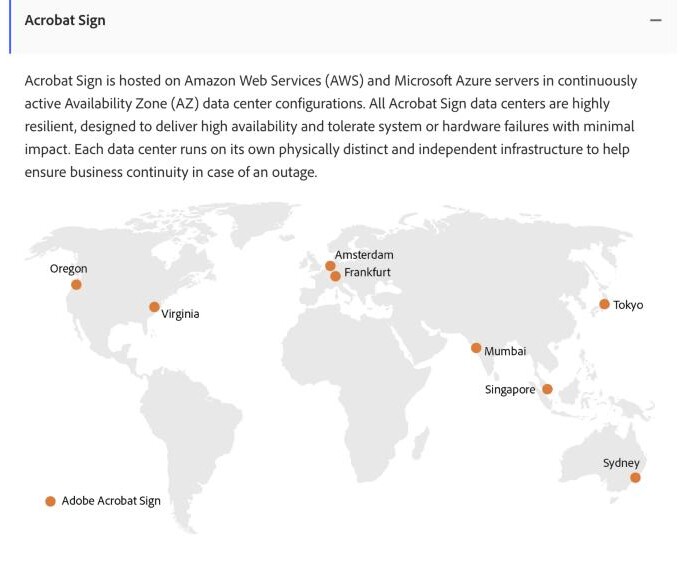
Adobe's own hosting page states that "Acrobat Sign is hosted on Amazon Web Services (AWS) and Microsoft Azure servers in continuously active Availability Zone (AZ) data center configurations," and the Acrobat Sign regions it lists are North America, Europe (EMEA) and Asia-Pacific (Tokyo, Mumbai, Singapore and Sydney) — none inside the mainland. So the names, email addresses, IP addresses, signed PDFs and audit trail of your Chinese signers come to rest offshore: a cross-border transfer of personal information the PIPL governs (notice, separate consent and a transfer mechanism), and for a CIIO or large-volume handler, data the law says must stay in China. Whether an Acrobat Sign signature counts as a legally "reliable electronic signature" for a given document is a further, separate question under China's Electronic Signature Law. The table below is Adobe's own wording and the rule each line triggers.
This is a risk map, not a verdict — which rules bite turns on your entity, your documents and whose data you collect. Our China team can map your exposure with you →
What Adobe Acrobat Sign's own documentation says about China
| Fact | Primary source |
|---|---|
| Adobe hosts Acrobat Sign in its own named regions — none in mainland China. On its hosting-locations page Adobe states that "Acrobat Sign is hosted on Amazon Web Services (AWS) and Microsoft Azure servers in continuously active Availability Zone (AZ) data center configurations," and the Acrobat Sign regions it lists are North America, Europe (EMEA) and Asia-Pacific (Tokyo, Mumbai, Singapore and Sydney). Adobe names no mainland-China data center, so a China tenant's agreements and signer data come to rest in one of those offshore regions — and a public-facing site or signing portal served to mainland visitors from inside China would separately need an ICP filing that an offshore platform gives you no footing for. | Adobe — Document Cloud & Acrobat Sign hosting locations (adobe.com/trust), retrieved 2026-10-07 |
| Every signature collected from China is a cross-border transfer of personal information. An e-signature workflow records the signer's name, email address and IP address, the signed document itself and a time-stamped audit trail. With Adobe's storage offshore, that personal information leaves the mainland the moment a China signer acts — a cross-border transfer the PIPL governs, requiring notice, separate consent and one transfer mechanism (a CAC security assessment, the CAC standard contract, or certification) under Articles 38–43. | Adobe — Acrobat Sign hosting locations (adobe.com/trust), retrieved 2026-10-07; PIPL Articles 38–43 |
| There is no in-country residency option to fall back on. Because Adobe runs no mainland-China region for Acrobat Sign, personal information collected from Chinese users cannot be kept inside China on the platform. For a critical information infrastructure operator or a large-volume handler, Chinese law requires such data to be stored in the mainland (PIPL Article 40; Cybersecurity Law Article 39 (formerly Article 37)) — a residency duty an offshore region cannot meet. | Adobe — Acrobat Sign hosting locations (adobe.com/trust), retrieved 2026-10-07; PIPL Article 40; Cybersecurity Law Article 39 (formerly Article 37) |
| Legal validity in China is a separate, document-by-document question. China's Electronic Signature Law (电子签名法) gives a "reliable" electronic signature the same legal effect as a handwritten signature, but it excludes certain documents and, for some uses, reliability can depend on certification by a China-approved certificate authority. Whether an Adobe Acrobat Sign signature qualifies for your specific documents is a legal determination to confirm with counsel — not something the platform settles for you. | China Electronic Signature Law (电子签名法), cited by name; official text via WIPO Lex, retrieved 2026-10-07 |
Sources verified by the 21YunBox compliance team on 2026-10-07.
For a mainland-China audience, the question about Adobe Acrobat Sign is not whether the signing page loads — it is where your signed documents and your signers’ personal data are allowed to live, and whether the signature will stand up legally. Adobe answers the first in its own documentation: Acrobat Sign is hosted on AWS and Microsoft Azure in its North America, Europe and Asia-Pacific regions, with no data center inside mainland China. A China-facing signing workflow is therefore reachable but entirely offshore — which turns every signature a Chinese user makes into a cross-border transfer of personal information, and leaves the question of legal validity to China’s Electronic Signature Law rather than to the product. The reachability is the easy part; the data residency and the validity are the exposure.
Adobe Acrobat Sign in China at a glance
| What decides it | In Adobe's own terms |
|---|---|
| Where it runs | “Acrobat Sign is hosted on Amazon Web Services (AWS) and Microsoft Azure servers,” in Adobe's North America, Europe (EMEA) and Asia-Pacific regions (Tokyo, Mumbai, Singapore, Sydney). No data center is inside mainland China. |
| Where your documents rest | Your agreements, signer identities and audit trail are stored in the region assigned to your account — all of them offshore for a China audience. |
| Your China signers' data | Personal information of mainland signers — names, emails, IP addresses, the signed PDFs — leaves China, a cross-border transfer PIPL governs (notice, separate consent, a transfer mechanism). |
| In-country residency | With no mainland region, data collected in China cannot stay in China on the platform — a storage duty for CIIOs and large-volume handlers that an offshore region cannot meet. |
| Legal validity | China's Electronic Signature Law recognizes a “reliable electronic signature,” but whether an Acrobat Sign signature qualifies for a given document is a legal question to confirm with counsel. |
No mainland region, so your signer data lives offshore
Adobe is explicit about where Acrobat Sign runs. On its own hosting-locations page it states that “Acrobat Sign is hosted on Amazon Web Services (AWS) and Microsoft Azure servers in continuously active Availability Zone (AZ) data center configurations,” and the regions it lists for Acrobat Sign span North America, Europe (EMEA) and Asia-Pacific — Oregon and Virginia; Amsterdam and Frankfurt; and Tokyo, Mumbai, Singapore and Sydney. Not one of them is inside mainland China.
That geography settles the data question before performance ever enters it. A signing workflow is not just a page that loads — it is a store of agreements, signer identities and a full audit trail, and on Acrobat Sign that store lives in whichever offshore region your account is provisioned into. A public-facing site or signing portal that you serve to mainland visitors from inside China would separately turn on an ICP filing (ICP 备案) under State Council Order No. 292 and MIIT Order No. 33 — and with no mainland presence on Adobe’s side, there is nothing in Acrobat Sign to anchor one against. But for an e-signature tool the sharper issue is not the website license; it is that the personal data of everyone who signs comes to rest outside the border.
Every China signature is a cross-border data transfer
Collect a signature from a user in China and their personal information — name, email, IP address, the signed document and the time-stamped trail that proves who signed and when — is written into Adobe’s offshore storage. Under China’s Personal Information Protection Law that is a cross-border transfer, and the handler — you, not Adobe — has to give notice, obtain separate consent, and clear one transfer mechanism: a CAC security assessment, the CAC standard contract, or certification (PIPL Articles 38–43). If you are a critical information infrastructure operator or a large-volume handler, personal information collected in China must be stored in the mainland (PIPL Article 40; Cybersecurity Law Article 39 (formerly Article 37)) — a residency duty none of Adobe’s three Acrobat Sign regions can satisfy, because none of them is in China.
Is the signature legally valid in China? A separate question
Reachability and data residency are not the whole of it. Even where the data question is handled, there is the question of whether the signature itself will be honored. China’s Electronic Signature Law (电子签名法) gives a reliable electronic signature the same legal effect as a handwritten signature — but it carves out certain documents, and for some uses the reliability of a signature can turn on certification by a China-approved certificate authority. Whether an Adobe Acrobat Sign signature is treated as reliable for your particular documents and counterparties is a legal determination, not a product setting. We are not saying an Acrobat Sign signature is invalid in China; we are saying it is a question for Chinese counsel to answer for your specific use, before you build the workflow around it.
This is a risk map, not a verdict: whether you face a cross-border-transfer duty, an in-country storage duty, a certificate-authority question, or all three depends on what you sign, how much personal data you hold, and whose it is — worth settling with counsel before you build it in.
Where 21YunBox fits — a compliant overlay, not a migration
You keep signing on Adobe Acrobat Sign. What a global e-signature platform cannot give you is a mainland footing: Adobe runs no China region, so neither your signer data nor the public property your signers reach can sit inside the border on Adobe alone. That is the gap we close. Our China team first maps the exposure your use of Acrobat Sign creates — which PIPL cross-border duties apply, whether an in-country storage obligation is triggered, and where the Electronic Signature Law leaves your documents — then, for the mainland-facing site or signing portal your users actually load, we put ICP-filed, in-country delivery in front of your existing origin. No rebuild, no second codebase, and no move off the Adobe stack you already run.
Related reading: