Does Barracuda Work in China? Appliances, Offshore Cloud & PIPL Exposure
Barracuda's security products split two ways for China: a self-managed appliance can run inside your own mainland infrastructure, but every Barracuda cloud and SaaS service runs on offshore AWS and Azure with no mainland-China region — turning the email, logs and request data it inspects for China users into a PIPL cross-border transfer. A compliance-first look at both doors.
Does Barracuda work in China?
It depends which Barracuda you run. A self-managed Barracuda appliance can sit inside your own China infrastructure — but every Barracuda cloud and SaaS service runs offshore, on AWS and Azure regions with none inside mainland China, so the email, logs and web-request data it inspects for your China users crosses the border the moment you switch it on.
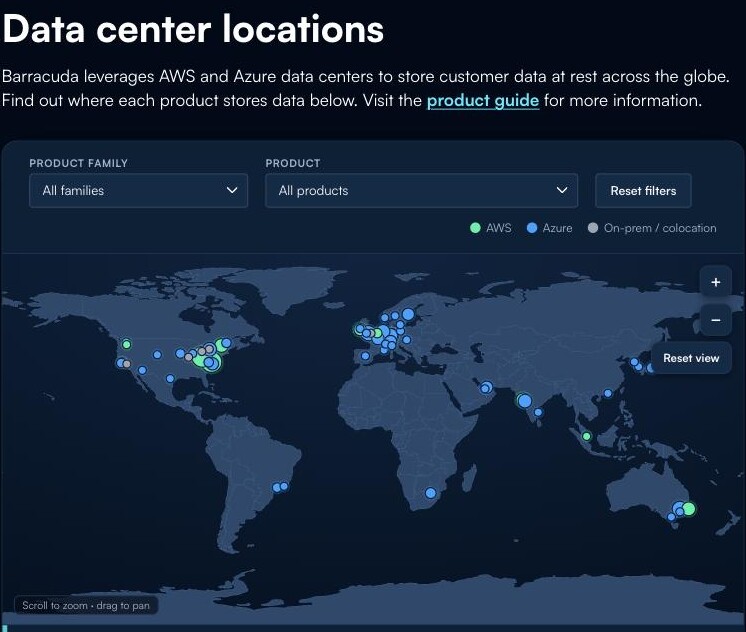
Barracuda's own Trust Center states it "leverages AWS and Azure data centers to store customer data at rest across the globe," and its Email Protection "is offered on the Amazon Web Services (AWS) cloud infrastructure" in regions it lists across the Americas, Europe and Asia-Pacific — none in mainland China. The email contents, logs and inspected requests those services handle routinely carry personal information, so serving China users makes it a cross-border transfer under PIPL (Articles 38–43). And where a Barracuda cloud service merely fronts a public mainland site, the ICP filing still sits on that site, not on Barracuda. The table below is Barracuda's own wording and the rule each door triggers.
This is a risk map, not a verdict — which Barracuda deployment keeps you compliant turns on your entity, your data and who your users are. Our China team can map your exposure with you →
What Barracuda's own documentation says about China
| Fact | Primary source |
|---|---|
| There are two Barracudas, and only the cloud one crosses the border. Barracuda's security products ship both as self-managed appliances and as cloud services. In its own WAF documentation Barracuda "offers the Barracuda Web Application Firewall Vx as a cloud-hosted virtual machine," and separately describes deploying it on-premises with "the Barracuda Web Application Firewall appliance." A self-managed appliance can sit inside your own China infrastructure — which keeps inspection and data in-country — but then lawful mainland hosting, any filing the public site needs, and compliant handling of the data it processes all fall to you, not to Barracuda. | Barracuda — Web Application Firewall deployment documentation (campus.barracuda.com), retrieved 2026-10-07 |
| Every Barracuda cloud service stores data offshore — there is no mainland-China region. Barracuda's Trust Center states it "leverages AWS and Azure data centers to store customer data at rest across the globe," and lists those regions across the Americas, Europe, the Middle East, Australia, India and Japan. None is inside mainland China; the nearest, Azure's "East Asia" region, is in Hong Kong. Serving China users from any of them puts their personal data abroad — a cross-border transfer under PIPL (Articles 38–43), and for a CIIO or large-volume handler the data must be stored in China (PIPL Article 40; Cybersecurity Law Article 39 (formerly Article 37)). | Barracuda Trust Center — Data center locations (trust.barracuda.com), retrieved 2026-10-07; PIPL Articles 38–43 & 40; Cybersecurity Law Article 39 (formerly Article 37) |
| Barracuda Email Protection is cloud-delivered on AWS, and it reads your users' mail. Barracuda's Email Protection Service Description (dated July 30, 2026) calls it "a comprehensive, cloud-delivered solution" and states it "is offered on the Amazon Web Services (AWS) cloud infrastructure," storing data "in the region the customer or its representative selects" — with Email Gateway Defense regions in N. Virginia, Canada Central, London, Frankfurt and Sydney, none in mainland China. Scanning a China user's inbound and outbound email means that email content — personal information — is processed offshore, squarely inside PIPL's cross-border rules (Articles 38–43). | Barracuda — Email Protection SaaS Service Description, dated July 30, 2026 (assets.barracuda.com), retrieved 2026-10-07; PIPL Articles 38–43 |
| Barracuda's own cross-border framework names Europe and the US — not China. The same Service Description says that where required Barracuda relies on "European Commission approved cross-border data transfer mechanisms including the EU's Standard Contractual Clauses," and that for US transfers it is "self-certified under the US Department of Commerce Data Privacy Framework." China's PIPL regime is not addressed. So meeting it — notice, separate consent, and a CAC security assessment, standard contract or certification — is the handler's duty: yours, not Barracuda's. | Barracuda — Email Protection SaaS Service Description, dated July 30, 2026 (assets.barracuda.com), retrieved 2026-10-07; PIPL Articles 38–43 |
| A Barracuda cloud WAF is a security layer, not a filing. Barracuda's Trust Center lists its WAF-as-a-Service data region as "East Asia" — Azure's Hong Kong region, outside the mainland, not Beijing or Shanghai. Fronting a public mainland website with a cloud WAF inspects and forwards request data (which carries personal information) through offshore infrastructure, and it does nothing for the site's licensing: a mainland site still needs its own ICP filing under State Council Order No. 292 and MIIT Order No. 33, held by the site's operator. | Barracuda Trust Center — Data center locations (trust.barracuda.com), retrieved 2026-10-07; State Council Order No. 292; MIIT Order No. 33 |
Sources verified by the 21YunBox compliance team on 2026-10-07.
For a mainland-China audience, whether Barracuda “works” is a compliance question before it is a performance one — and the honest answer splits in two. Barracuda sells its email protection, application and web security, network security, and data protection and backup both as self-managed appliances you deploy in your own environment and as cloud and SaaS services Barracuda runs for you. A self-managed appliance can sit inside your own China infrastructure, which keeps inspection and data in-country — but every Barracuda cloud or SaaS service runs offshore, on AWS and Azure regions with none inside mainland China. The moment such a service inspects your China users’ email, logs or web requests — data that routinely carries personal information — it is handling that personal data abroad. Reachability is the easy half; the licensing and the data residency are the exposure.
Barracuda in China at a glance
| What decides it | In Barracuda's own terms |
|---|---|
| Where it runs | Two ways: self-managed hardware and virtual appliances you host yourself, and cloud/SaaS services Barracuda runs. Barracuda offers its WAF “Vx as a cloud-hosted virtual machine” and also deploys “the Barracuda Web Application Firewall appliance” on your own network. |
| Cloud data at rest | Barracuda “leverages AWS and Azure data centers to store customer data at rest across the globe,” across the Americas, Europe, the Middle East, Australia, India and Japan — none in mainland China (the nearest, Azure's “East Asia,” is in Hong Kong). |
| Email Protection | “A comprehensive, cloud-delivered solution” that “is offered on the Amazon Web Services (AWS) cloud infrastructure,” stored “in the region the customer or its representative selects” — N. Virginia, Canada Central, London, Frankfurt or Sydney. |
| Barracuda's cross-border framework | Built on the EU's “Standard Contractual Clauses” and the “US Department of Commerce Data Privacy Framework.” China's PIPL is not addressed — meeting it is the handler's duty, which is yours. |
| Serving the public | A public mainland site needs an ICP filing tied to in-country hosting. A Barracuda cloud service that fronts that site carries no ICP of its own; the filing stays with the site operator. |
Two Barracudas — and only the cloud one crosses the border
Barracuda is not one product with one answer. Its security lines ship both as self-managed appliances and as cloud services, and the compliance picture turns on which you run. In its own WAF documentation Barracuda “offers the Barracuda Web Application Firewall Vx as a cloud-hosted virtual machine,” and separately describes a hardware deployment built around “the Barracuda Web Application Firewall appliance” — and on its product page the “on premises Barracuda Web Application Firewall remains the go-to web application firewall for mid-market” use.
That split matters in China. A self-managed appliance — physical or virtual — can be stood up inside your own mainland infrastructure, so the inspection and the data it holds stay in-country. That is why Barracuda is not a flat “no.” But the appliance only moves the hardware; it does not hand you the rest. Lawful mainland hosting, any ICP filing the public site requires, PIPL-compliant handling of the personal data the appliance processes, and the local security duties that follow all become your burden to carry and to document — not something the product settles on your behalf.
The cloud door — offshore AWS and Azure, no mainland region
Run Barracuda as a cloud or SaaS service instead and the data leaves the mainland. Barracuda’s Trust Center states plainly that it “leverages AWS and Azure data centers to store customer data at rest across the globe,” and the regions it lists span the Americas, Europe, the Middle East, Australia, India and Japan. Not one is inside mainland China; the closest, Azure’s “East Asia,” is in Hong Kong, which sits outside the mainland’s data regime. Its Email Protection is explicit: “a comprehensive, cloud-delivered solution” that “is offered on the Amazon Web Services (AWS) cloud infrastructure,” with data kept “in the region the customer or its representative selects” — N. Virginia, Canada Central, London, Frankfurt or Sydney.
The content those services touch is the point. Email bodies, delivery logs, incident records and the request data a web firewall inspects routinely contain personal information. Processing it for your China users on an offshore region is, under China’s Personal Information Protection Law, a cross-border transfer: the handler — you, not Barracuda — must give notice, obtain separate consent, and clear one transfer mechanism (a CAC security assessment, the CAC standard contract, or certification) under Articles 38–43. If you are a critical information infrastructure operator or a large-volume handler, personal information collected in China must be stored in the mainland (PIPL Article 40; Cybersecurity Law Article 39 (formerly Article 37)) — which an offshore AWS or Azure region cannot satisfy. And Barracuda’s own cross-border story confirms the gap: it leans on the EU’s “Standard Contractual Clauses” and the “US Department of Commerce Data Privacy Framework” — European and American instruments, with China’s regime left to the customer.
The ICP door — a security layer is not a filing
A Barracuda cloud security service placed in front of a public mainland website changes none of the licensing. Fronting a site inspects and forwards its traffic through offshore infrastructure, but the obligation to be filed stays where it always sits: on the operator of the site being served. A public-facing website delivered to mainland visitors needs an ICP filing (ICP 备案) under State Council Order No. 292 and MIIT Order No. 33, attached to a hosting resource physically in the mainland. Barracuda holds no mainland region and no ICP on your behalf, so bolting a cloud WAF in front of an unfiled site adds protection, not permission. “We put Barracuda in front of it” is a security statement, not a compliance one.
This is a risk map, not a verdict: which Barracuda deployment keeps you compliant depends on what you serve, how much personal data you hold, and who your users are — worth settling with counsel before you build.
Where 21YunBox fits — a compliant overlay, not a migration
You keep running Barracuda. What we add is the piece Barracuda’s cloud cannot carry for you: compliant, ICP-filed delivery from inside the mainland, set in front of your existing origin — no rebuild, no second codebase, and no move off the Barracuda stack you already operate. Our China team works out which of your Barracuda services create PIPL cross-border or data-residency exposure, weighs that against your entity and your data volumes, and stands up the ICP-filed, in-country delivery and storage a lawful China presence needs — while your Barracuda security layer stays exactly where it runs today.
Related reading: