
How do you run Adobe Experience Manager (AEM) in China — a China CDN, Adobe Managed Services, or a delivery layer?
Adobe keeps AEM global — Cloud Service has no mainland-China region — so a China launch is two questions, in order: can you legally operate, and can the whole page reach a visitor in China, not just the static files a CDN caches.
Gate one is legal. A site served to mainland users needs an ICP filing (备案) on a Chinese legal entity, renewed under the Measures for the Administration of Internet Information Services; Adobe's own documentation says caching inside China is allowed only “when the delivery domain is licensed,” and that license is the ICP.
Gate two is technical, and three architectures answer it. A China CDN in front of global AEM (Adobe's documented BYOCDN path) caches static files only — Dynamic Media, the Adobe tags, forms and search still cross the border. Adobe Managed Services hosted in China moves the publish tier, not the rest of the page. A licensed delivery layer — the 21YunBox Optimizer — keeps AEM where it runs and serves every request from a licensed China domain. Personal data is a cross-border transfer question under PIPL, regulated rather than automatically localized.
This is orientation, not legal advice — your obligations turn on your entity, your data volumes and your own risk appetite. Confirm the specifics with qualified counsel.
What actually decides an AEM launch in China
| Fact | Primary source |
|---|---|
| Adobe keeps AEM global and tells you to bring a China CDN and the license. Adobe's own China FAQ says Edge Delivery Services “are currently operated outside of China,” that serving visitors there “requires a customer-managed Content Delivery Network (BYOCDN),” and that “CDN operators in China require customers to provide an Internet Content Provider (ICP) license or ICP recordal.” AEM as a Cloud Service has no mainland-China region. | Adobe — Edge Delivery Services China FAQ (aem.live/docs/china), retrieved 2026-11-05 |
| The parts that break are mostly Adobe's own products, by Adobe's own documentation. Dynamic Media delivers through Akamai's CDN, which Adobe's knowledge base lists China as a restricted area for; Target “currently lacks an Edge Cluster in China”; Analytics offers a Beijing endpoint only as a paid add-on (AppMeasurement, not the Web SDK); and Tags in China is a paid feature on a .cn domain. A China CDN caches the static shell and touches none of these. | Adobe Experience League — Target, Dynamic Media (ka-33965) and Tags/Analytics China documentation, retrieved 2026-11-05 |
| Gate one is a filing, not a CDN or a host. A website served to mainland users must carry an ICP filing (备案) on a mainland hosting resource, held by a mainland legal entity, before it goes live — renewed and kept current. Adobe's Dynamic Media documentation states caching inside China is allowed only “when the delivery domain is licensed,” and the domain stays yours even when Adobe hosts the publish tier. | Measures for the Administration of Internet Information Services (State Council Order No. 292); Measures for Filing (MIIT Order No. 33) |
| Personal data is regulated transfer, not an automatic localization mandate. Moving Chinese users' personal information to a service outside the mainland is a cross-border transfer under PIPL (Articles 38–40): it requires notice, a lawful basis and an approved transfer mechanism — but it is permitted. In-country storage becomes mandatory only for critical-information-infrastructure operators and large-volume handlers. | Personal Information Protection Law, Articles 38–40; Cybersecurity Law Article 39 (formerly Article 37) |
Sources verified by the 21YunBox compliance team on 2026-11-05.
The short version. An Adobe Experience Manager site needs two things to work in mainland China: a Chinese legal entity with an ICP filing, and a way to deliver the whole page to a visitor inside China, not just the static files. There are three ways to do the second. A China CDN in front of your global AEM (Adobe’s documented “bring your own CDN” path) caches static files only. Adobe-hosted in China (Managed Services with publishers inside China) moves the publish tier, and Dynamic Media, the Adobe tags, forms and search still cross the border. A delivery layer (the 21YunBox Optimizer) keeps AEM where it is and serves every request on the page from a licensed domain inside China. None of the three needs a second AEM instance or a separate China site. Side-by-side table and FAQ below.
Adobe’s guidance for China is short. Edge Delivery Services “are currently operated outside of China,” and serving visitors there “requires a customer-managed Content Delivery Network (BYOCDN).” The same page adds that “CDN operators in China require customers to provide an Internet Content Provider (ICP) license or ICP recordal.” That’s Adobe’s own China FAQ, and it’s accurate. Read it plainly: Adobe keeps AEM global, you bring a China CDN, and you bring the license.
For most of the last decade the China CDN AEM customers brought was Akamai’s. Akamai decommissioned its China CDN on June 30, 2026. A lot of AEM teams are now looking at the “China CDN” line on their renewal and asking what replaces it. It’s a good moment to ask the better question: what did that line item actually cover?
The honest answer is: part of the problem. This is the rest of it.
Two gates, in order
Every China site has to get through two gates. The order matters, and a CDN sits in neither.
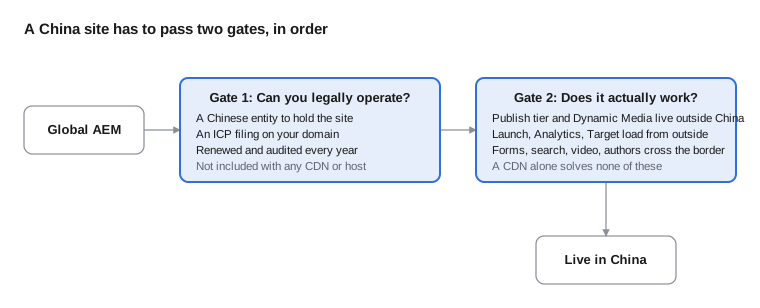
The first gate is legal. Without it, your site isn’t slow in China — it can’t legally be served at all. The second gate is technical. AEM’s publish tier, Dynamic Media, the Adobe tag stack, your authors’ login, your forms and your search all live outside China, and something has to make each of them work from inside.
A China CDN answers a narrow slice of the second gate: it moves your static files closer. It does nothing for the first gate and nothing for the rest of the second. That’s why it looks cheap, and why Adobe’s documentation describes it as something you bring rather than something Adobe provides.
Gate one: can you legally operate?
In mainland China, a website needs a government filing before it can be served. It’s called an ICP filing (备案). Without it, the domain can’t be served from inside China, full stop. No CDN and no hosting setup gets around it, including Adobe’s. Adobe’s Dynamic Media documentation says it directly: caching content inside China is only allowed “when the delivery domain is licensed,” and the license is the ICP.
To get one you need three things:
- A Chinese legal entity. The filing is issued to a company registered in China, not to your global parent. If you have a China subsidiary or a WFOE, that’s usually the one.
- The filing itself. It’s tied to the infrastructure that serves the site, so whoever delivers the site in China is involved in the paperwork. It takes weeks, not days, and under the Measures for the Administration of Internet Information Services it has to be renewed and kept current.
- Someone who owns it. Not a one-time project. Domain changes, entity changes, infrastructure changes and annual reviews all touch it. When your China CDN vendor leaves the market, as Akamai just did, the filing has to move with you.
This is the part a CDN quote never mentions. A China CDN can be switched on in an afternoon, which is exactly why it feels like the easy first step. Then the domain doesn’t resolve in China, and the question of who owns the entity and the filing lands on the project six weeks before launch.
One practical note for AEM projects: because the filing is tied to the China infrastructure, settle the architecture before starting the paperwork. Filing against a CDN and then moving to a delivery layer, or from in-China publishers to a delivery layer, means doing parts of it twice. We set the filing up on your entity and manage the renewals. If you already have one, we work with it and update it when the infrastructure changes.
Gate two: does it actually work?
Start with where AEM runs, because it decides what’s possible.
AEM as a Cloud Service runs in Adobe’s regions: US East and West, Canada, UK, West Europe, Germany, Singapore, Japan, Australia. None of them is in mainland China, and the Adobe-managed CDN in front of it (Fastly) has no points of presence on the mainland. Adobe Managed Services can be hosted in China; Adobe’s FAQ offers it for customers who, in Adobe’s words, need servers in-country for MLPS, data residency or Baidu SEO. AEM 6.5 on your own servers can run wherever you put it, with on-premise core support planned to end in February 2027.
Whichever you’re on, every China option is really an answer to one question: how does a visitor in Shanghai get the page, the Dynamic Media image, the Target decision, the form post and the search result, and on whose road? There are three answers.
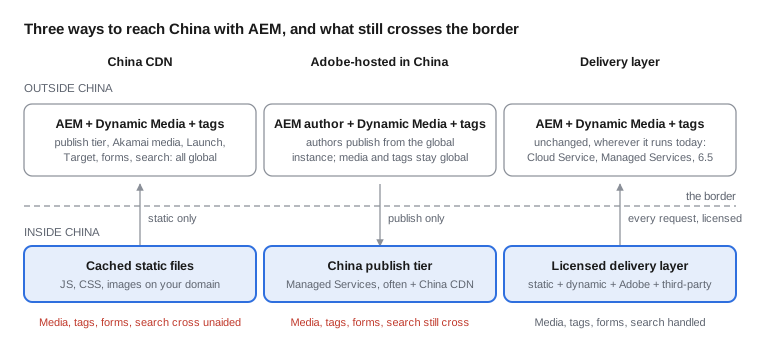
A China CDN in front of global AEM. This is Adobe’s documented path and the one that shows up as a line item: Cloudflare China, Alibaba Cloud, Tencent, Wangsu, and until June 2026, Akamai. Adobe supports a customer-managed CDN on the publish tier “on a case-by-case basis,” and the conditions are telling: you must have “engineering CDN experts that are on call” and “perform and successfully pass a load test before going to production.” The CDN is yours to run. What it does is cache your static files (JavaScript, CSS, images) on servers inside China. What it doesn’t do is touch anything else on the page: the Dynamic Media request to Akamai, the Launch script, the Target call, the Eloqua or Marketo form post, the search query. The CDN doesn’t see those, so it doesn’t help them. And your Dispatcher purge chain now has a third hop that needs an invalidation call.
For a brochure site with mostly static pages, this can be enough, and we’ve seen AEM sites work in China this way for years. If that’s your site, we run this option as a managed service, Managed China CDN (our Managed China Edge Delivery tier), with the ICP filed and maintained for you, so the CDN experts on call that Adobe asks for are ours.
For a site built the way AEM sites are built now, a CDN alone isn’t enough.
Adobe-hosted inside China. The option that gets called “just host it in China.” Adobe stands up a Managed Services publish tier inside the mainland; your authors publish from the global author instance to the China publishers, usually with a China CDN in front. It’s the right answer when your own internal policy says the servers must physically sit in China.
The cost is a second publish tier with its own releases and operations. The ICP is still yours (it’s tied to the delivery domain, not to Adobe). And everything the page calls that isn’t the HTML still crosses the border: Dynamic Media, the Adobe tags, forms, search, commerce.
We have tested sites in exactly this setup, with Adobe-managed publishers inside China, a China CDN in front and an ICP in place. The pattern repeats: the HTML arrives from the China publisher in a second or two, then the page waits on dozens of requests to domains outside China, and the last of them lands close to a minute later. That is full page load, not Core Web Vitals; the assessment reports both. The hosting was in China. The page wasn’t.
A delivery layer over your existing AEM. AEM stays exactly where it is, Cloud Service or Managed Services or 6.5, in whatever region it runs today. A licensed delivery layer inside China handles the visitor. Static files are cached on servers in China. Everything else on the page (the HTML, Dynamic Media, the Adobe tags, forms, search, third-party scripts) is served from your licensed China domain, so the browser sees it as same-origin, and the request back to your origin travels over a managed cross-border connection instead of the open internet. Anything that already works is left alone.
HTML is fetched fresh on every request, so a publish in AEM shows in China immediately with no purge workflow. The cost of that is one cross-border round trip per page, which the assessment measures on your site before anyone commits. If you want edge HTML caching, there’s a purge endpoint Dispatcher can call on publish and unpublish, the same way it called Akamai.
One author instance, one publish tier, one codebase, and the global and China sites stay in parity. This is our 21YunBox Optimizer, and it’s what we recommend for most AEM sites.
None of the three is wrong. They fit different sites. The trouble starts when a China CDN gets quoted for a site that needs the delivery layer, and nobody finds out until the product search returns nothing in Shanghai.
What a China CDN doesn’t touch
When a client first asks about China, they ask about hosting, a CDN and the ICP filing. That’s the part above the waterline. What decides whether the site actually works sits below it, in the application layer, and on an AEM site that layer is mostly Adobe’s own products.
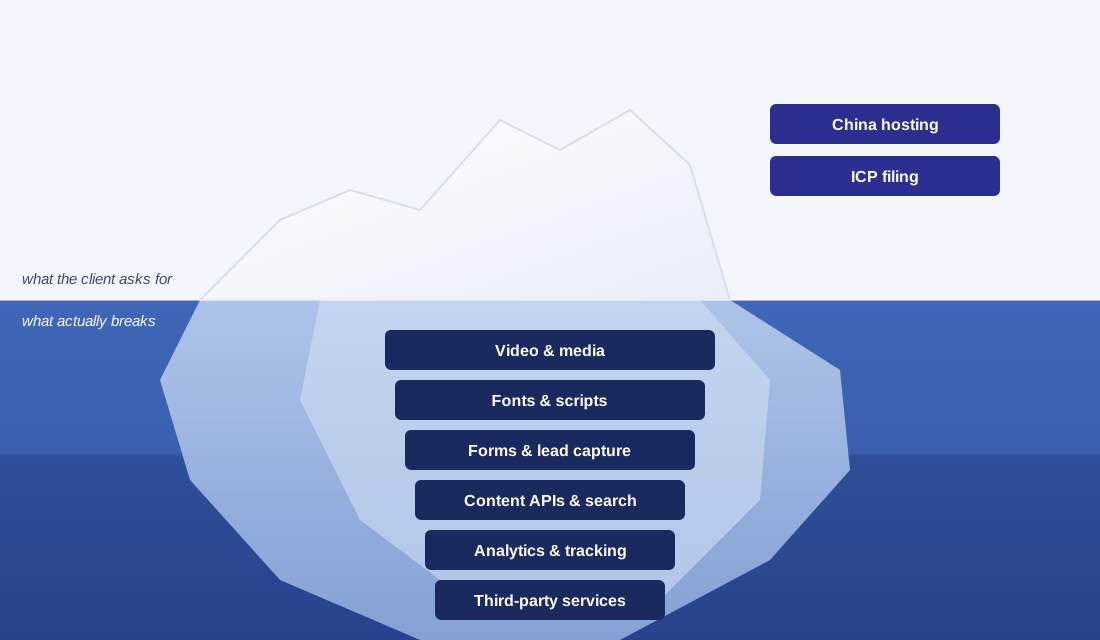
Say the CDN is on and the ICP is done. Here’s what’s still broken on an AEM site, because none of it is a static file served from your domain.
Dynamic Media. This is the one that surprises AEM teams. Your images and video don’t come from your publish tier; they come from Dynamic Media’s delivery domain, which is Akamai’s CDN, and Adobe’s own knowledge base lists China as one of two “restricted areas” for it. Adobe does offer a separate China delivery path, but it needs an ICP-licensed .cn subdomain set up for it. Behind a China CDN alone, every hero image and product video is a cross-border request to a CDN that doesn’t serve China. The page shell loads. The pictures don’t.
The Adobe tag stack. Launch (now Tags), Analytics and Target are scripts the visitor’s browser loads from outside China. Adobe’s own documentation is candid about it: Target “currently lacks an Edge Cluster in China,” Analytics has a Beijing collection endpoint only as a paid add-on that works with AppMeasurement and not the Web SDK, and Tags in China is a paid feature on a .cn domain. Blocked or slow tags mean your personalization doesn’t fire, your experiments don’t run, and your dashboards show a China audience that doesn’t exist, which usually gets read as “nobody in China visits us.”
Search, listings and commerce. Site search (Elasticsearch, Coveo, Algolia), product listings, real-time pricing, availability, a headless cart. Same pattern: a runtime call from the visitor’s browser to a service outside China. These are the requests your IT team will tell you must not be cached, and they’re right, which is exactly why a cache doesn’t help them.
Your forms. AEM Forms posts to AEM, so it follows whatever path your HTML takes. Eloqua, Marketo and HubSpot forms post to Eloqua, Marketo and HubSpot, all outside China, and none of them offers a China endpoint. If the browser can’t reach it, the form fails silently, and you find out when someone asks why China leads dried up.
Your video. YouTube and Vimeo are blocked outright, and there is no compliant way to unblock them. We don’t route around the Firewall, and neither should anyone you work with. That doesn’t mean you move off YouTube. Your team keeps publishing video exactly as it does today, and we enable the videos you control to work in mainland China, compliantly, with nothing changed on the global site. Dynamic Media video, Brightcove, Wistia and Vidyard are carried on the licensed path like everything else on the page.
Your other third-party scripts. Google Fonts, Google Maps, chat widgets, consent banners (OneTrust, TrustArc), RUM agents. Each one is a call from the browser to a server outside China. Some are blocked, some time out, and the page hangs while it waits. In the tests above, a single monitoring agent accounted for roughly a quarter of all requests on the page. This is what usually breaks a China site in practice. (For how far this reaches across a typical stack, we read 763 SaaS tools against China’s own rules.)
Your authors. Adobe’s own line is that “authoring content from China is possible with limitations and not fully supported by Adobe.” Your China content team logs in to the AEM author instance, which isn’t reliably reachable from inside China. The usual advice is a VPN. We don’t recommend that, and we’d be careful about any vendor who puts it in writing. We give authors a managed, licensed connection instead. No VPN, no China IT team pulled into it.
Your personal data. You’ll be told that personal data “must stay in China.” That’s one option, and the heaviest one. China’s privacy law (PIPL) regulates the cross-border transfer of personal information; it doesn’t ban it. For a marketing site with modest form volumes, nothing is usually required. As volumes grow, there’s a filing route with the regulator (the CAC) that lets you keep sending leads to your global CRM. Forced localization is for when volume, sensitivity or your own risk appetite calls for it. We help you pick the lighter one that still complies, and we set up localization when that’s the right call.
China CDN vs Adobe-hosted in China vs delivery layer, side by side
Here’s how we’d sort it. Be honest about which column your site is in.
| Consideration | China CDN in front of global AEM (Adobe's BYOCDN path) | Adobe-hosted in China (Managed Services) | 21YunBox Optimizer |
|---|---|---|---|
| What it moves into China | Static files only (JS, CSS, images on your domain) | The publish tier | Every request on the page |
| Where AEM runs | Unchanged | Author global, publishers inside China | Unchanged |
| Works with Cloud Service | Yes, case by case, with CDN experts on call and a load test | No; Cloud Service has no China region | Yes |
| Works with Managed Services / 6.5 | Yes | Yes | Yes |
| Changes to your stack | A CDN you run, plus a third purge hop | A second publish tier to operate and release to | None |
| Chinese entity | You need one | You need one | You need one |
| ICP filing | Yours to arrange and move when the CDN changes | Yours to arrange | Set up and managed on your entity |
| Dispatcher cache invalidation | Extend your purge chain to the China CDN | Extend to the China CDN if you add one | Fresh by default; optional purge endpoint, same as Akamai |
| Dynamic Media | Not addressed; needs Adobe's China delivery path on an ICP'd .cn subdomain | Same | Carried on the licensed path |
| Adobe tags (Launch, Analytics, Target) | Not addressed; Target has no China edge | Not addressed | Carried |
| Forms, search, commerce, third-party scripts | Not addressed | Not addressed | Handled |
| Video | Not addressed | Not addressed | Your videos enabled to work in China, compliantly; other players carried |
| Authors in China | Not addressed; Adobe calls it "not fully supported" | Not addressed | Managed, licensed access to the author instance |
| Personal data | Not addressed | Localized, if that's the goal | Filing or localize, whichever fits |
| Global and China in parity | Only for static content | Second publish tier to keep in step | Yes, one site |
| Good fit when | Mostly static site, no Dynamic Media, no forms that matter, CDN team in-house | Internal policy says the servers must physically sit in China | An AEM site built the way AEM sites are built now, that needs to just work in China |
If your China site is a handful of static pages and nothing on it talks to a server, a China CDN behind a proper ICP is a reasonable place to start, and some AEM sites have run that way for years. If your own internal policy says the servers must sit in China, Adobe-hosted is the right call. In both cases, budget for everything below the waterline separately, because neither includes it.
If your site uses Dynamic Media, runs the Adobe tag stack, has a form that matters, or needs search, pricing or a cart to work, the CDN will load the shell and the rest will fail. That’s most of the AEM sites we see, and the Optimizer is the fit. The same framework, for other stacks, is in How to Run SitecoreAI in China and Running an Optimizely Site in China.
Where to start
If China’s on the roadmap, or your China CDN just left the market, don’t start with a replacement line item. Start with two questions: do you have a Chinese entity, and does your site do anything at runtime that matters (Dynamic Media, Adobe tags, forms, search, pricing, video)? The answers decide the architecture, and the architecture decides the filing.
Wherever the answers leave you, there’s a fit. If your AEM site is mostly static and a China CDN is the right call, Managed China CDN (Managed China Edge Delivery) is that CDN tier run by us, with the ICP filed and maintained on your entity. If your site needs the whole page to work in China, the 21YunBox Optimizer is the licensed delivery layer described above, and a site that starts on the managed CDN can move up to it later without a rebuild. Either way, China compliance support comes with it: the entity and ICP work, annual renewals and audits, PIPL guidance on your forms and data, and managed, licensed access for your authors. One partner across every level, from “we have a China CDN and an ICP” to “every request on the page works in Shanghai.” For the ICP and data-residency specifics of running AEM in China, see our AEM China risk map and the AEM product page.
If you’d like a second opinion on where your site stands today, send us the URL and we’ll run the in-China assessment. No cost, no commitment, and you’ll get real numbers either way.
Frequently Asked Questions
Which option is best for an AEM site in China: a China CDN, Adobe Managed Services, or a delivery layer?
It depends on what the site does and what your policy requires. A China CDN in front of global AEM is enough for a mostly static site with a CDN team to run it. Adobe-hosted in China (Managed Services) fits when your own internal policy says the servers must physically sit in-country. A delivery layer fits any AEM site that uses Dynamic Media, the Adobe tag stack, forms, search or commerce and needs the whole page to work in China without a second publish tier. All three need a Chinese entity and an ICP filing first. The table on the page is the full comparison.
Do we need a separate China website or a second AEM instance?
No. With a China CDN or the delivery layer, your global AEM stays the only instance and the China site is the same site, served from a licensed domain inside China: one author instance, one codebase, one publishing workflow. Adobe-hosted in China adds a second publish tier that your authors publish to, but it is still one site and one author instance, not a separate China implementation. A separate China-specific build is a choice some companies make to control the China codebase; it is not a requirement of any of the three options.
Does AEM as a Cloud Service have a China region?
No. Adobe's regions are US East and West, Canada, UK, West Europe, Germany, Singapore, Japan and Australia, and Adobe says Edge Delivery Services are “currently operated outside of China.” The Adobe-managed CDN (Fastly) has no mainland points of presence. For China, Adobe's documented path is a customer-managed CDN in front, which you run.
Can Adobe host AEM inside China?
Yes, on Managed Services. Adobe's China FAQ says Managed Services for AEM are available in China for customers who need servers in-country. It moves the publish tier, not the rest of the page: Dynamic Media, the Adobe tags, forms, search and commerce still cross the border, and the ICP is still yours.
Akamai's China CDN is gone. What replaces it?
Akamai decommissioned its China CDN on June 30, 2026. The like-for-like replacement is another China CDN (Cloudflare China, Alibaba Cloud, Tencent, Wangsu), which means moving your ICP and extending your Dispatcher purge chain to the new vendor, and getting the same coverage you had: static files. If you're going to move the filing anyway, it's worth asking whether the replacement should cover the whole page instead.
Does Dynamic Media work in China?
Not by default. Dynamic Media delivers through Akamai's CDN, and Adobe's knowledge base lists China as a restricted area for it. Adobe offers a separate China delivery path that needs an ICP-licensed .cn subdomain. Behind the delivery layer, Dynamic Media requests are carried on the licensed path with no separate setup.
Do Adobe Analytics, Target and Launch work in China?
Only if the scripts can load. Adobe's own documentation says Target has no edge cluster in China, Analytics has a Beijing collection endpoint only as a paid add-on (AppMeasurement, not the Web SDK), and Tags in China is a paid feature on a .cn domain. Behind a China CDN alone the scripts usually can't load. Behind the delivery layer they can, so your experiments run in China and your results include China.
How does cache invalidation work with a China layer?
With a China CDN, your Dispatcher publish and unpublish events need to send a purge to it too, the same way they did to Akamai. With the Optimizer, HTML is fresh by default, so a publish in AEM shows in China immediately with nothing to purge. If you want edge HTML caching for mostly static sections, we give you a purge endpoint Dispatcher can call on publish, so your authors keep the workflow they have.
Can my China authors use the AEM author instance?
Adobe's own line is that authoring from China is “possible with limitations and not fully supported.” A VPN isn't the answer we'd put our name on. We give authors a managed, licensed connection so they log in the normal way.
Do we still need an ICP if Adobe hosts in China?
Yes. The ICP is tied to the delivery domain and the entity that holds it, not to the hosting vendor. Adobe's Dynamic Media documentation says caching inside China is only allowed “when the delivery domain is licensed.” Get the entity and the filing sorted before you pick a delivery model.
We're on AEM 6.5 on our own servers. Does this apply?
Yes, and it's simpler. The Optimizer sits in front of whatever serves your HTML, so a 6.5 publish tier in the US or Europe works the same way Cloud Service does. Core support for 6.5 on-premise is planned to end in February 2027, so if a migration to Cloud Service is on your roadmap, the China layer should be one that survives the move. A delivery layer does; a China publish tier doesn't.
Does my personal data have to stay in China?
Not necessarily. PIPL regulates transfer; it doesn't ban it. Low volumes often need nothing. Higher volumes have a filing route that lets you keep your global CRM. Localization is one option, not the only one, and we support either route.
How long does it take to go live?
Plan on two to three months end to end. The ICP filing and the technical work run on separate clocks: the filing takes weeks and depends on your entity paperwork being in order, while the delivery layer is set up and tested in parallel, so the filing is usually the long pole. If you already hold an ICP, the technical side alone is faster.
Can I see it working before I commit?
Yes. We run a free compliance and performance assessment of your current site from inside China, with the method, sample and date on every number. That tells you what's actually slow or blocked before anyone talks about a line item.