Does DocuSign Work in China? Data Residency, PIPL & E-Signature Law
DocuSign stores your signed agreements and signers' personal data in one of five regions — U.S., Canada, Europe, Australia or Japan — none inside mainland China, so each signature from China is a cross-border transfer of personal information PIPL governs. A compliance-first look at the data-residency, PIPL and e-signature-enforceability questions that actually decide whether you can use it.
Does DocuSign work in China?
Whether you can use DocuSign in China turns first on where your signers' personal data and signed agreements are stored — a data-residency question, not the slow load most teams notice first. DocuSign is reachable from the mainland; reachability is not the test that decides your legal exposure.
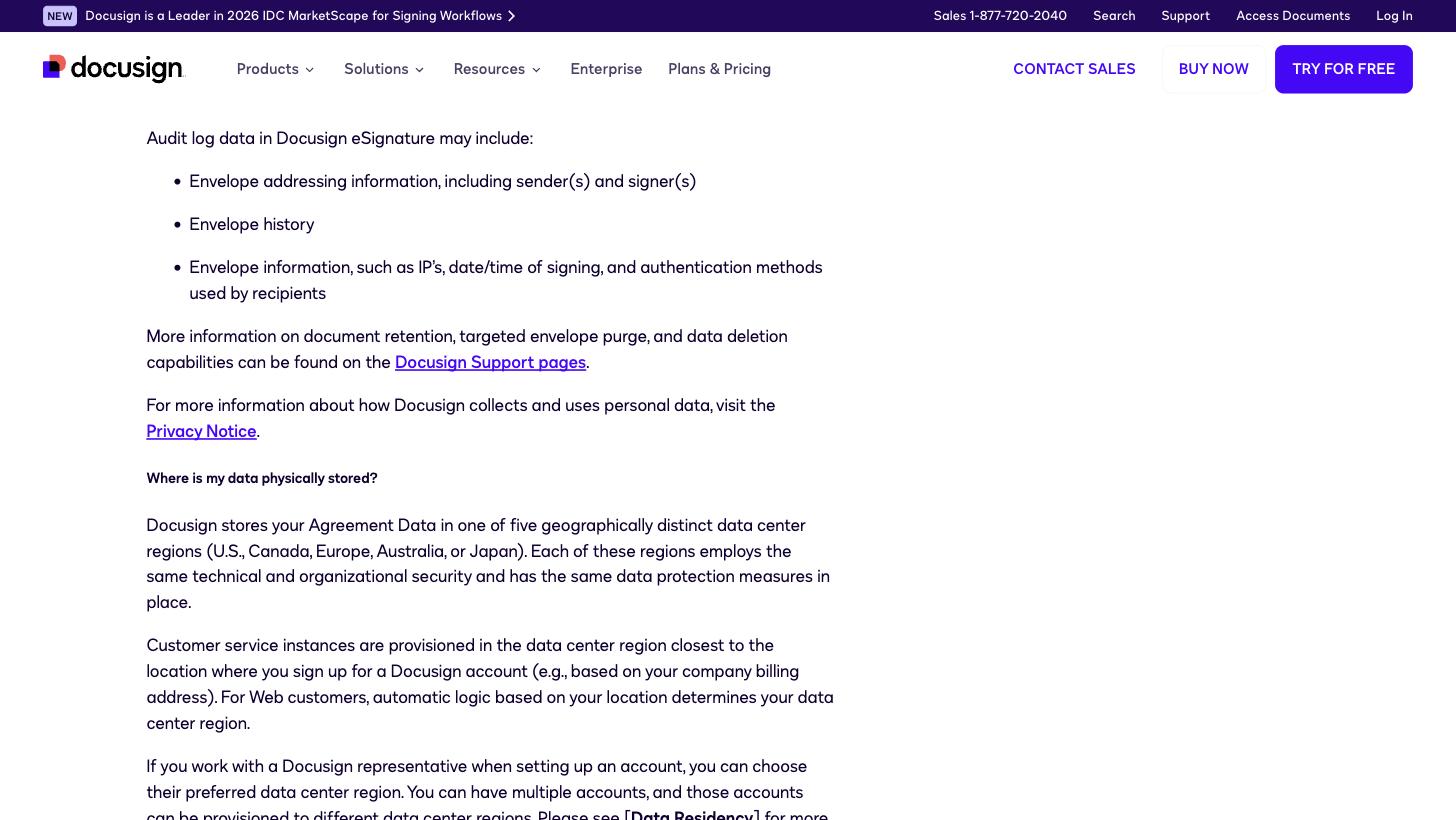
By DocuSign's own documentation, it "stores your Agreement Data in one of five geographically distinct data center regions (U.S., Canada, Europe, Australia, or Japan)," and the region is set by where the account is opened — not where the signer lives. None of the five is in mainland China. So when someone in China signs, their identity details and the executed contract come to rest outside the mainland — a cross-border transfer of personal information that PIPL governs, requiring separate consent and a lawful transfer mechanism. A second, e-signature-specific question rides on top: whether the signature is legally "reliable" and the document type is even eligible under China's Electronic Signature Law. The table below pairs DocuSign's own wording with the rules each point triggers — and the compliant, ICP-filed in-country path they imply.
This is a risk picture, not a verdict — your obligations turn on your data volumes, the signer's location, and your role. Our China team can map your exposure with you →
Compliance snapshot
- ! Reachable but slow from the mainland — signing sessions can stall
- ! Signer data & signed agreements stored outside China
- ! Cross-border PI transfer of signer data — PIPL applies
- ✕ No mainland-China data-residency region offered
- ✓ A compliant path exists — ICP-filed in-country delivery & storage
What DocuSign's documentation says, and what we measured from inside China
| Fact | Primary source |
|---|---|
| In DocuSign's own words: DocuSign "stores your Agreement Data in one of five geographically distinct data center regions (U.S., Canada, Europe, Australia, or Japan)," and for web accounts "automatic logic based on your location determines your data center region" (otherwise the region closest to the sign-up / billing address). None of the five regions is in mainland China — the nearest is Japan — so the personal data and signed agreements of signers in China come to rest outside the mainland. | DocuSign — Data management and privacy practices, and Data residency (both updated 2026-04-14), retrieved 2026-10-07 |
| Because that data leaves (or never enters) China, PIPL treats it as a cross-border transfer of personal information: the personal-information handler — DocuSign's customer, not DocuSign — must give notice and obtain separate consent for the overseas transfer and satisfy one of its lawful mechanisms (a CAC security assessment, the CAC standard contract, certification, or another permitted basis). | PIPL Chapter III, Articles 38–43 |
| The size of that obligation scales with volume and role, not merely with using the tool: under the CAC's March 2024 cross-border rules, a non-CIIO transferring fewer than 100,000 individuals' non-sensitive personal information in a calendar year is exempt from the security assessment, standard contract and certification. | CAC — Provisions on Promoting and Regulating Cross-border Data Flows, March 2024 |
| For a CIIO or large-volume handler, personal information collected in China must be stored inside mainland China (CSL Article 39 (formerly Article 37); PIPL Article 40). DocuSign offers no mainland-China region, so the compliant path puts the in-country piece on the customer: serve and store the signing workflow legally from inside the mainland — the act that requires an ICP filing. | DocuSign — Data residency (updated 2026-04-14), retrieved 2026-10-07; CSL Article 39 (formerly Article 37); PIPL Article 40 |
Delivery is degraded too, which is the symptom teams see first: from a probe inside mainland China (Alibaba Cloud cn-zhangjiakou), three runs on 2026-08-27, docusign.com completed all three loads with a median load time of 31.7 seconds (median largest-contentful-paint 4.8s). The page arrives — slowly — which is exactly why the deciding question is legal, not performance. | 21YunBox — China delivery measurement, measured from inside mainland China |
Sources verified by the 21YunBox compliance team on 2026-10-07.
For users in mainland China, the deciding question about DocuSign is not how quickly the signing page paints — it is where your signers’ personal data and the executed agreements themselves are allowed to come to rest. DocuSign answers that in its own Trust Center: it stores agreement data in one of five regions, and not one of them is in mainland China. So the signing page is reachable, but every signature a Chinese signer completes lands offshore — a cross-border transfer of personal information China’s law governs, with a second, e-signature-specific question riding on top of it about whether that signature is even enforceable here. The slow load most teams hit first is the symptom; the data residency and the enforceability are the exposure to assess.
DocuSign in China at a glance
| What decides it | In DocuSign's own terms |
|---|---|
| Where your data lives | DocuSign “stores your Agreement Data in one of five geographically distinct data center regions (U.S., Canada, Europe, Australia, or Japan),” with the region set by where the account is opened — not where the signer lives. None is inside mainland China; the nearest is Japan. |
| Cross-border transfer | Signer data and the signed agreement come to rest offshore — a cross-border transfer of personal information PIPL governs. The handler (you, not DocuSign) must give notice, obtain separate consent, and clear one transfer mechanism (PIPL Articles 38–43). |
| When the heavy rules bite | Duties scale with volume and role: under the CAC's March 2024 cross-border rules, a non-CIIO moving fewer than 100,000 individuals' non-sensitive personal information in a calendar year is exempt from the security assessment, standard contract and certification. Above that line — or as a CIIO, or with sensitive data — the heavier mechanisms return. |
| Data residency | A CIIO or large-volume handler must store personal information collected in China inside the mainland (CSL Article 39 (formerly Article 37); PIPL Article 40) — which DocuSign's five offshore regions cannot satisfy. |
| Signature enforceability | By DocuSign's own guidance, e-signatures “are legally recognized in China and are provided for in the Electronic Signature Law,” but only where the signature is “reliable” and the document type is eligible — it excludes matters such as “marriage, adoption and succession,” and adds that its guidance “is not intended to serve as legal advice.” |
| Is it reachable? | Yes — from an Alibaba Cloud probe in Zhangjiakou (cn-zhangjiakou), three runs on 2026-08-27, all three loads completed: median load time 31.7 seconds, median largest-contentful-paint 4.8 seconds. Reachable but slow — a symptom, not the test. |
Where your signed agreements come to rest
DocuSign sets the storage location by where the account is opened, not by where the signer sits. In its own documentation it “stores your Agreement Data in one of five geographically distinct data center regions (U.S., Canada, Europe, Australia, or Japan),” and for web accounts “automatic logic based on your location determines your data center region,” defaulting otherwise to the region closest to the sign-up or billing address. None of the five is in mainland China — the nearest is Japan.
So when someone in China signs, their identity details and the finished contract are written to storage outside the mainland. That single fact, not the page’s load time, is what starts the compliance analysis — and it is a fact baked into DocuSign’s architecture, not a setting you can tune your way out of. Nor is DocuSign an outlier: all seven e-signature services in our China SaaS compliance census, each read against its own documentation in October 2026, keep the core service outside the mainland.
Every signature from China is a cross-border transfer under PIPL
Because that personal data leaves — or never enters — mainland China, the Personal Information Protection Law treats each signing as a cross-border transfer. The personal-information handler is DocuSign’s customer, not DocuSign: you must give notice, obtain separate consent for the overseas transfer, and clear one lawful mechanism — a CAC security assessment, the CAC standard contract, certification, or another permitted basis (PIPL Articles 38–43).
How heavy that duty is scales with volume and role, not merely with switching the tool on. Under the CAC’s March 2024 cross-border rules, a non-CIIO that transfers fewer than 100,000 individuals’ non-sensitive personal information in a calendar year is exempt from the security assessment, the standard contract and certification. Cross that line, handle sensitive data, or act as a CIIO, and the heavier mechanisms come back into play.
For a CIIO or large-volume handler there is a harder floor still: personal information collected in China must be stored inside the mainland (Cybersecurity Law Article 39 (formerly Article 37); PIPL Article 40). DocuSign offers no mainland-China region, so meeting that duty means putting the in-country piece on your side of the line — serving and storing the signing workflow lawfully from inside the mainland, the act that turns on an ICP filing.
A second door: is the signature even enforceable?
Data residency is not the only question a signed document raises in China. By DocuSign’s own guidance, electronic signatures “are legally recognized in China and are provided for in the Electronic Signature Law” — but only where the signature is “reliable” and the document type is eligible. Its guide lists exclusions, including matters of “marriage, adoption and succession,” and states plainly that the guidance “is not intended to serve as legal advice.” So two separate tests ride together: whether the transfer of signer data is lawful, and whether the resulting signature is enforceable for the kind of document you are actually signing.
Reachable, but slow — the symptom, not the test
DocuSign is not blocked in China. In 21YunBox’s own measurement from inside the mainland — an Alibaba Cloud probe in Zhangjiakou (cn-zhangjiakou), three runs on 2026-08-27 — docusign.com completed all three loads, with a median load time of 31.7 seconds and a median largest-contentful-paint of 4.8 seconds. The page arrives; it simply arrives slowly.
That is exactly why reachability is the wrong test to lean on. A signing session that eventually loads is still a cross-border transfer of personal data, and a slow one does nothing to change where that data is stored or whether the signature holds up. The latency is an annoyance; the residency and the enforceability are the legal exposure.
This is a risk picture, not a verdict. Whether you owe separate consent, a transfer mechanism, in-country storage, or all three turns on your data volumes, the signer’s location, and your role — worth settling with counsel before you rely on it.
Where 21YunBox fits — a compliant overlay, not a migration
You keep signing on DocuSign. What we add is the piece DocuSign leaves to you: lawful, ICP-filed delivery and storage inside mainland China, placed in front of the origin you already run — no rebuild, no parallel system, and no pulling DocuSign out of your workflow. Our China team weighs your cross-border and data-residency duties against your signing volumes, your signers’ locations, and whether you count as a CIIO, then stands up the in-country layer that a signing platform storing agreements offshore cannot give you on its own.
Related reading:
Frequently Asked Questions
Does DocuSign store Chinese signers' data in China?
No. By DocuSign's own documentation it "stores your Agreement Data in one of five geographically distinct data center regions (U.S., Canada, Europe, Australia, or Japan)," with the region set by where the account is opened. None of the five is in mainland China — the nearest is Japan — so the personal data and signed documents of signers in China are held abroad, which is what makes it a cross-border transfer under PIPL.
Is it against the law to use DocuSign in China?
Not inherently, but two separate questions decide your exposure. First, data: sending signers' personal information abroad is a cross-border transfer that PIPL permits only with separate consent and a lawful transfer mechanism, and data-localization can apply depending on your role (for example, whether you are a CIIO) and the volume of personal information you handle. Second, enforceability: DocuSign's own China legality guide states electronic signatures "are legally recognized in China and are provided for in the Electronic Signature Law," but only where the signature is "reliable" and the document type is eligible — it lists exclusions such as matters of "marriage, adoption and succession." DocuSign adds that its guidance "is not intended to serve as legal advice." Treat this as a risk to assess with counsel, not a blanket prohibition.
Can 21YunBox help make DocuSign compliant and usable in China?
Yes. Our China team can help you assess the cross-border and data-residency exposure for your signing volumes and role, and provide the compliant, ICP-filed in-country delivery and storage that DocuSign does not offer in the mainland — so you can keep DocuSign rather than rip it out. Get in touch to work through your specific case.