Does Microsoft Forms Work in China? Data Residency, PIPL & Your Responses
Microsoft Forms is reachable in mainland China, but it stores responses on servers in the United States and Europe — with no mainland-China data-residency region — so data you collect from Chinese users crosses the border under PIPL. A compliance-first look at the data-residency door.
Does Microsoft Forms work in China?
Yes — Microsoft Forms loads in mainland China, but every response you collect from a China user is written to Microsoft's servers in the United States or Europe, never the mainland. That makes each submission a cross-border transfer of personal information, not a hosting detail.
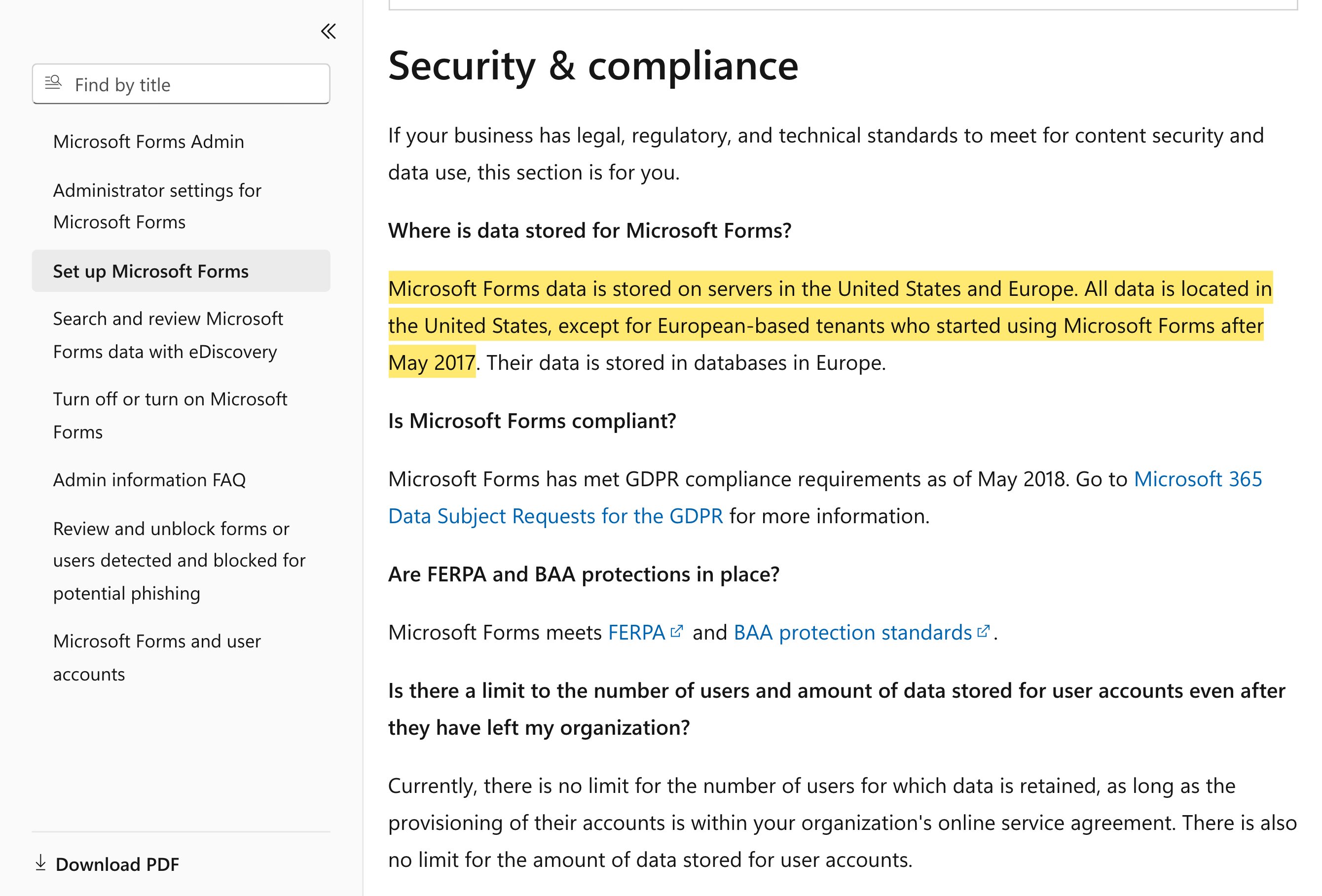
In Microsoft's own admin documentation, "Microsoft Forms data is stored on servers in the United States and Europe," and its data-residency overview deploys Forms "only" in the Americas and EU/EFTA geographies — there is no mainland-China region for it. Microsoft's China cloud, Microsoft 365 operated by 21Vianet, is "a physically separated instance service located in China," "independently operated and transacted by 21Vianet" — a separate tenant your global Forms data does not live in. So the answers you gather from Chinese residents leave the mainland by default: a cross-border transfer of personal information PIPL governs (notice, separate consent and a transfer mechanism, Articles 38–43). The table below is Microsoft's own wording and the rule each line triggers.
This is a risk map, not a verdict — whether PIPL's transfer rules or a data-localization duty apply turns on what you collect, how much, and who your respondents are. Our China team can map your exposure with you →
Compliance snapshot
- ! Forms responses from China users are stored in the US or Europe, not the mainland
- ! Those responses leaving China are personal data PIPL treats as a cross-border transfer
- ✕ Global Microsoft 365 has no mainland-China data-residency region for Forms
- ! Microsoft's China cloud (21Vianet) is a separate, partner-operated service, not your tenant
- ✓ Reachable from China — the exposure is where data lands, not whether the form opens
What Microsoft Forms's own documentation says about China
| Fact | Primary source |
|---|---|
| Microsoft Forms stores your responses in the United States or Europe — not mainland China. In Microsoft's own admin documentation: "Microsoft Forms data is stored on servers in the United States and Europe. All data is located in the United States, except for European-based tenants who started using Microsoft Forms after May 2017." For a respondent in China, that means every answer is written to disk offshore — a cross-border transfer of personal information under PIPL (Articles 38–43). | Microsoft — "Set up Microsoft Forms" admin documentation (learn.microsoft.com), retrieved 2026-10-07; PIPL Articles 38–43 |
| Global Microsoft 365 has no mainland-China region for Forms. Microsoft's data-residency overview states Forms "is only deployed in Macro Region Geography 3 - Americas and Macro Region Geography 4 - European Union/EFTA" — so even a Japan-based tenant's Forms data is "provisioned into Macro Region Geography 3 - Americas." None of Microsoft 365's listed data-residency geographies is mainland China; the nearest listings are Hong Kong SAR, Taiwan and Singapore, each outside it. | Microsoft — "Overview and Definitions," Microsoft 365 data residency (learn.microsoft.com), retrieved 2026-10-07 |
| Microsoft's China cloud is a separate service, not your tenant. Microsoft 365 operated by 21Vianet is, in Microsoft's words, "a physically separated instance service located in China," "independently operated and transacted by 21Vianet" and "powered by technology that Microsoft licensed to 21Vianet." Like AWS's China partition, it runs on a distinct tenant under a Chinese operator and a Chinese contracting entity — your global Forms data does not reside there, and moving to it is a separate arrangement, not a settings change. | Microsoft — "Teams operated by 21Vianet," Service Descriptions (learn.microsoft.com), retrieved 2026-10-07 |
| The exposure can reach past transfer rules. Because the responses are personal information gathered in China and stored offshore, PIPL's cross-border duties apply — notice, separate consent, and a CAC security assessment, the CAC standard contract or certification. And for a critical information infrastructure operator or large-volume handler, personal information collected in China must be stored in the mainland — a data-localization duty an offshore Forms tenant cannot meet (PIPL Article 40; Cybersecurity Law Article 39 (formerly Article 37)). | Microsoft — Microsoft 365 data residency (learn.microsoft.com), retrieved 2026-10-07; PIPL Articles 38–43 & 40; Cybersecurity Law Article 39 (formerly Article 37) |
Sources verified by the 21YunBox compliance team on 2026-10-07.
For a mainland-China audience, the question about Microsoft Forms isn’t whether it opens — it does — but where the answers it collects are allowed to live. Microsoft settles that in its own documentation: Forms stores response data on servers in the United States and Europe, and it runs no data-residency region inside mainland China. So a form you share with people in China is reachable, yet every submission is written offshore — turning the personal information you gather into a cross-border transfer China’s law governs. The reachability is real; the data residency is the exposure.
Microsoft Forms in China at a glance
| What decides it | In Microsoft's own terms |
|---|---|
| Where responses are stored | “Microsoft Forms data is stored on servers in the United States and Europe.” Microsoft's data-residency overview adds that Forms is “only deployed in Macro Region Geography 3 - Americas and Macro Region Geography 4 - European Union/EFTA.” No mainland-China region. |
| Data-residency geographies | Microsoft 365's published geographies run from Australia and Japan to the United Kingdom, and include Hong Kong SAR, Taiwan and Singapore — none of them is mainland China. |
| Microsoft's China cloud | Microsoft 365 operated by 21Vianet is “a physically separated instance service located in China,” “independently operated and transacted by 21Vianet” — a separate tenant needing a Chinese entity, not the global one your Forms data sits on. |
| Your China users' data | Responses from mainland residents leave the mainland by default — a cross-border transfer of personal information PIPL governs, plus a possible data-localization duty for CIIOs and large-volume handlers that offshore storage cannot meet. |
| Is it reachable? | Yes — Forms loads for mainland users. The exposure is where the data comes to rest, not whether the page opens. |
No mainland region, so your responses are written offshore
Microsoft is explicit about where Forms keeps its data. In its admin documentation, “Microsoft Forms data is stored on servers in the United States and Europe. All data is located in the United States, except for European-based tenants who started using Microsoft Forms after May 2017.” Its data-residency overview goes further: Forms “is only deployed in Macro Region Geography 3 - Americas and Macro Region Geography 4 - European Union/EFTA,” so even a Japan-based tenant’s Forms data is “provisioned into Macro Region Geography 3 - Americas.” Nowhere in Microsoft 365’s published list of data-residency geographies — which runs from Australia and Japan to the United Kingdom, and includes Hong Kong SAR, Taiwan and Singapore — does mainland China appear.
That settles the deciding question before performance enters it. When people in China fill out your form, their answers — names, contact details, whatever you ask — are written to disk in the United States or Europe. Under China’s Personal Information Protection Law that is a cross-border transfer of personal information, and the handler — you, not Microsoft — must give notice, obtain separate consent, and clear one transfer mechanism: a CAC security assessment, the CAC standard contract, or certification (Articles 38–43). “We already use Microsoft Forms” does not answer that question; it is precisely what raises it.
Microsoft’s China cloud (21Vianet) is a separate service, not a setting
Microsoft does run a cloud inside mainland China — but not the one your global tenant lives on. It describes Microsoft 365 operated by 21Vianet as “a physically separated instance service located in China,” one that is “independently operated and transacted by 21Vianet” and “powered by technology that Microsoft licensed to 21Vianet.” In shape this mirrors AWS’s China partition: a distinct tenant, a Chinese operator, and a Chinese contracting entity standing between you and the service. Your existing Forms data does not reside there, and reaching it is a separate commercial and legal arrangement — not a region you switch on, and not something every Microsoft 365 capability is offered through. Whether that route even fits your use is part of the assessment, not a given.
Reachable, not blocked — which is exactly the point
Microsoft Forms is not blocked in mainland China; forms.office.com opens for mainland users, and reachability is the delivery half of the question, not the legal half. That is what makes the residency fact easy to miss: the form loads, responses flow in, and nothing looks wrong — while every submission quietly lands offshore. So the exposure on a China-facing Microsoft Forms setup is not that people cannot reach it. It is that reaching it gives you neither in-country data residency nor a lawful cross-border posture by default. Those are compliance facts, and no amount of network tuning changes where the data comes to rest.
This is a risk map, not a verdict: whether PIPL’s cross-border rules, a data-localization duty, or both apply to you turns on what your forms collect, how much personal data you hold, and who your respondents are — worth settling with counsel before you build.
Where 21YunBox fits — a compliant overlay, not a migration
You keep collecting with Microsoft Forms. We add what a US- or Europe-resident form cannot give you on its own: compliant, ICP-filed delivery from inside the mainland, set in front of the origin you already run, together with the in-country storage path the personal data your forms gather needs — no rebuild, no second codebase, and no migration onto a separate China tenant. Our China team maps your PIPL cross-border and data-residency obligations against your entity, your respondent volumes and what you actually ask, then stands up the lawful in-mainland presence that collecting from Chinese users requires, while your existing setup stays exactly where it is.
Related reading:
Frequently Asked Questions
Is Microsoft Forms blocked in mainland China?
No — this isn't a reachability problem. Microsoft Forms loads for mainland users; the issue is where the responses go. Microsoft's own documentation puts Forms data "on servers in the United States and Europe," so answers collected from people in China are written offshore. That makes each submission a cross-border transfer of personal information under PIPL, regardless of how quickly the form opens.
Can't we just use Microsoft 365 operated by 21Vianet to keep the data in China?
It's a separate service, not a toggle. Microsoft describes the 21Vianet cloud as "a physically separated instance service located in China," "independently operated and transacted by 21Vianet." It runs on a distinct tenant under a Chinese operator and requires a China-based contracting entity — much like AWS's China partition — and your existing global Forms data does not live there. Whether that route even carries the capability you rely on, and whether moving is worth it, is part of the assessment, not a given.
Can 21YunBox help us collect form responses compliantly in China?
Yes. Our China team can assess your PIPL cross-border and data-residency exposure for the personal information your forms gather — mapping consent, notice and transfer-mechanism obligations against your entity and respondent volumes — and stand up ICP-filed, in-country delivery and storage in front of the stack you already run, so you don't have to rebuild on a separate China tenant. Get in touch to work through your specific case.