Does Meilisearch Work in China? Self-Host, Cloud, ICP & PIPL
Meilisearch is open source, so you can self-host it inside mainland China — but Meilisearch Cloud runs only in nine offshore regions, none in the mainland, which turns a China-facing search index into a PIPL cross-border transfer of your users' personal data. A compliance-first look at the self-host and Cloud doors, ICP and data residency.
Does Meilisearch work in China?
Not a flat no: because Meilisearch is open source, you can self-host the engine on your own infrastructure inside mainland China. But Meilisearch Cloud runs only offshore, with no mainland-China region — so a Cloud project indexes your users' personal data across the border, and whichever door you take, the ICP filing and data-residency duties are yours, not Meilisearch's.
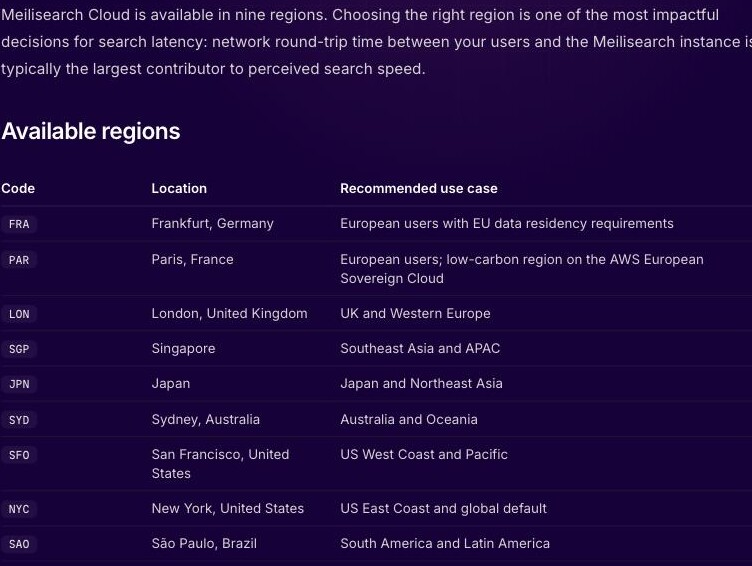
Meilisearch says its "Community Edition is open source under the MIT license" and that "self-hosting is free" — so you can run it in-country and keep the index on the mainland. Its managed service is the alternative, and the vendor states "Meilisearch Cloud is available in nine regions" — Frankfurt, Paris, London, Singapore, Japan, Sydney, San Francisco, New York and São Paulo — none in mainland China. A search index holds the personal information you feed it, so a Cloud project puts that data offshore: a cross-border transfer of personal information PIPL governs, while the ICP filing rides on the mainland app that embeds the search. The table below is Meilisearch's own wording and the rule each door triggers.
This is a risk map, not a verdict — which door fits turns on your entity, your data and whether your search is customer-facing. Our China team can map your exposure with you →
What Meilisearch Cloud's own documentation says about China
| Fact | Primary source |
|---|---|
| Meilisearch is open source, so self-hosting inside mainland China is on the table. Meilisearch states the "Community Edition is open source under the MIT license," that "self-hosting is free, but you own the upgrades, backups, scaling and on-call," and that "the same engine powers Meilisearch Cloud." Run that engine on your own mainland infrastructure and the index can stay in-country — but the ICP filing (State Council Order No. 292; MIIT Order No. 33) and data-residency duties then fall to you, not to Meilisearch. | Meilisearch — "Meilisearch loves open source" (meilisearch.com/open-source), retrieved 2026-10-07; State Council Order No. 292; MIIT Order No. 33 |
| Meilisearch Cloud has no mainland-China region. In its own documentation, "Meilisearch Cloud is available in nine regions" — Frankfurt, Paris, London, Singapore, Japan, Sydney, San Francisco, New York and São Paulo — not one inside mainland China, and "regions cannot be changed after a project is created." The vendor even tells you to "consider data residency requirements" when you choose — while publishing no in-country region that would let you meet them. | Meilisearch Docs — Regions (meilisearch.com), retrieved 2026-10-07 |
| A Meilisearch Cloud index puts your users' personal data offshore. A search index holds whatever you feed it — names, emails, order histories — and on Cloud that sits in one of the nine offshore regions. For a China-facing application that is a cross-border transfer of personal information under PIPL: notice, separate consent and a transfer mechanism (Articles 38–43). And for a critical information infrastructure operator or large-volume handler, personal information collected in China must be stored in the mainland (PIPL Article 40; Cybersecurity Law Article 39 (formerly Article 37)) — which no offshore region can satisfy. | Meilisearch Docs — Regions (meilisearch.com), retrieved 2026-10-07; PIPL Articles 38–43 & 40; Cybersecurity Law Article 39 (formerly Article 37) |
| Search is a backend layer, so the ICP filing attaches to the app that embeds it. Meilisearch is not a public website on its own — it answers queries for the application in front of it, which you can "move from a self-hosted instance to Cloud without rewriting your integration." So the ICP filing and public-facing duties ride on the mainland site or app that calls Meilisearch (State Council Order No. 292; MIIT Order No. 33), while the question for the engine itself narrows to where the index — and the personal data inside it — is allowed to live. | Meilisearch — "Meilisearch loves open source" (meilisearch.com/open-source), retrieved 2026-10-07; State Council Order No. 292; MIIT Order No. 33 |
Sources verified by the 21YunBox compliance team on 2026-10-07.
For a mainland-China audience, whether Meilisearch “works” is a compliance question before it is a performance one — and the honest answer has two halves. Because the engine is open source, you can run Meilisearch on your own infrastructure inside the mainland, so it is not a flat no. But Meilisearch Cloud, the managed service, runs only in offshore regions with none in mainland China, and a search index holds the personal information you feed it — so a China-facing Cloud project carries that data across the border. Reaching the service was never the hard part; where the index is allowed to live, and who holds the ICP filing in front of it, is.
Meilisearch in China at a glance
| What decides it | In Meilisearch's own terms |
|---|---|
| Where Cloud runs | "Meilisearch Cloud is available in nine regions" — Frankfurt, Paris, London, Singapore, Japan, Sydney, San Francisco, New York and São Paulo. None is in mainland China, and "regions cannot be changed after a project is created." |
| The open-source door | The "Community Edition is open source under the MIT license," and "self-hosting is free" — so you can run the engine on your own mainland infrastructure, keeping the index in-country. |
| Serving the public | Meilisearch is a backend search layer, not a public site; the ICP filing attaches to the mainland app or site that embeds it, under State Council Order No. 292 and MIIT Order No. 33. |
| Your data on Cloud | A search index holds the personal data you feed it. On Cloud that sits in an offshore region — a cross-border transfer of personal information PIPL governs. |
| Data residency | Meilisearch tells you to "consider data residency requirements" when you pick a region — but offers no mainland-China region to satisfy them. |
Door one — the open-source engine you can self-host in-country
Meilisearch began, in its own words, as “an open source project in 2018,” and its “Community Edition is open source under the MIT license.” That matters for China more than it first appears: an MIT-licensed engine you can install anywhere is an engine you can run on your own servers inside the mainland. Meilisearch states the trade-off plainly — “self-hosting is free, but you own the upgrades, backups, scaling and on-call” — and that the managed product is the same code: “the same engine powers Meilisearch Cloud.” Self-host in-country and your search index stays on the mainland, which answers the data-residency half. What it does not do is answer the licensing half for you: the public app that exposes the search still needs an ICP filing under State Council Order No. 292 and MIIT Order No. 33, and the PIPL duties on the personal data in your index are now yours to run. So the open-source door is real — it is just a door you have to walk through yourself.
Door two — Meilisearch Cloud keeps your index offshore
Reach for the managed service instead and the geography settles the question. Meilisearch’s own documentation states “Meilisearch Cloud is available in nine regions” — Frankfurt, Paris, London, Singapore, Japan, Sydney, San Francisco, New York and São Paulo — not one of them in mainland China, and a project’s “regions cannot be changed after a project is created.” The vendor even tells you to “consider data residency requirements” as you choose, yet publishes no in-country region that would let you meet them. A search index is not incidental data: it holds the names, emails, order histories and whatever else you index for lookup. Put that on a Cloud project and your Chinese users’ personal information lives offshore — under China’s Personal Information Protection Law a cross-border transfer, for which the handler (you, not Meilisearch) must give notice, obtain separate consent, and clear one transfer mechanism: a CAC security assessment, the CAC standard contract, or certification (Articles 38–43). If you are a critical information infrastructure operator or a large-volume handler, personal information collected in China must be stored in the mainland (PIPL Article 40; Cybersecurity Law Article 39 (formerly Article 37)) — which no offshore region can do.
Search is a backend layer — so the ICP rides on the app
One honest distinction separates Meilisearch from a host or a CDN: it is not a public website on its own. It answers queries for the application in front of it — which is why Meilisearch says you can “move from a self-hosted instance to Cloud without rewriting your integration.” That means the ICP filing and the public-facing obligations attach to the mainland site or app, not to the search engine underneath. For Meilisearch itself, then, the compliance question narrows to one thing: where the index, and the personal data inside it, is allowed to live. Self-host in-country and that answer is “on the mainland.” Run Meilisearch Cloud and the answer is “offshore,” with PIPL’s cross-border rules following the data. Either way, speed is not the deciding factor; residency and the filing in front of it are.
This is a risk map, not a verdict: whether you self-host in-country, keep Meilisearch Cloud behind a compliant boundary, or need in-country storage at all depends on what you index, how much personal data it holds, and who your users are — worth settling with counsel before you build.
Where 21YunBox fits — a compliant overlay, not a migration
You keep building on Meilisearch — the open-source engine or Cloud, whichever you already run. We add the piece neither the MIT license nor an offshore region gives you: compliant, ICP-filed delivery from inside the mainland, set in front of your existing origin — no rebuild, no second codebase, and no re-indexing onto a different search engine. Our China team maps which door fits, assesses your PIPL cross-border and data-residency exposure for your entity and data volumes, and stands up the in-country delivery and storage a lawful China presence needs, while your application and its search layer stay exactly where they already run.
Related reading: