Does Jetpack Work in China? The WordPress.com Cloud, Site Accelerator & Your ICP
Jetpack is a WordPress plugin, but it runs on a required connection to Automattic's offshore WordPress.com cloud — its Site Accelerator CDN serves images and assets from a "global network of servers" with no mainland point of presence, its Stats feature logs visitor IPs to Automattic, and the WordPress site itself needs its own ICP. A compliance-first look at reachability, light PIPL and the two doors.
Does Jetpack work in China?
Whether you can use Jetpack in China is first a reachability-and-cross-border question, not a speed one. Jetpack is a WordPress plugin, but it runs on a required connection to Automattic's WordPress.com cloud — its Site Accelerator CDN, Stats and protection features load from, and report back to, servers that sit outside mainland China.
In Jetpack's own support docs the Site Accelerator is a "content delivery network or CDN" that serves your images and static files "from our global network of servers," and the plugin "caches your site's data to WordPress.com servers", syncing it "to Automattic's servers" — none of them in the mainland. So mainland visitors fetch your Jetpack-served assets across the border, and the visitor data Stats collects, including IP addresses that PIPL treats as personal information, leaves the country. The table below is Jetpack's own wording and the rules it triggers; the WordPress site underneath still needs its own ICP filing.
This is a risk picture, not a verdict — your obligations turn on what you serve, your data volumes and your role. Our China team can map your Jetpack exposure with you →
Compliance snapshot
- ! Reachable, but Jetpack runs on Automattic's offshore WordPress.com cloud — its features load from and report to servers outside the mainland
- ! Site Accelerator (its image & asset CDN) serves from a "global network of servers" with no mainland point of presence — assets cross the border
- ! Jetpack Stats logs each visitor's IP address to Automattic (offshore) — a cross-border transfer of personal information PIPL governs
- ✕ No mainland-China cell for the Jetpack cloud, and the WordPress site it sits on has no ICP unless its host is in the mainland
- ✓ A compliant, ICP-filed in-country delivery path exists — no rebuild, no move off WordPress or Jetpack
What Jetpack's own documentation says about China
| Fact | Primary source |
|---|---|
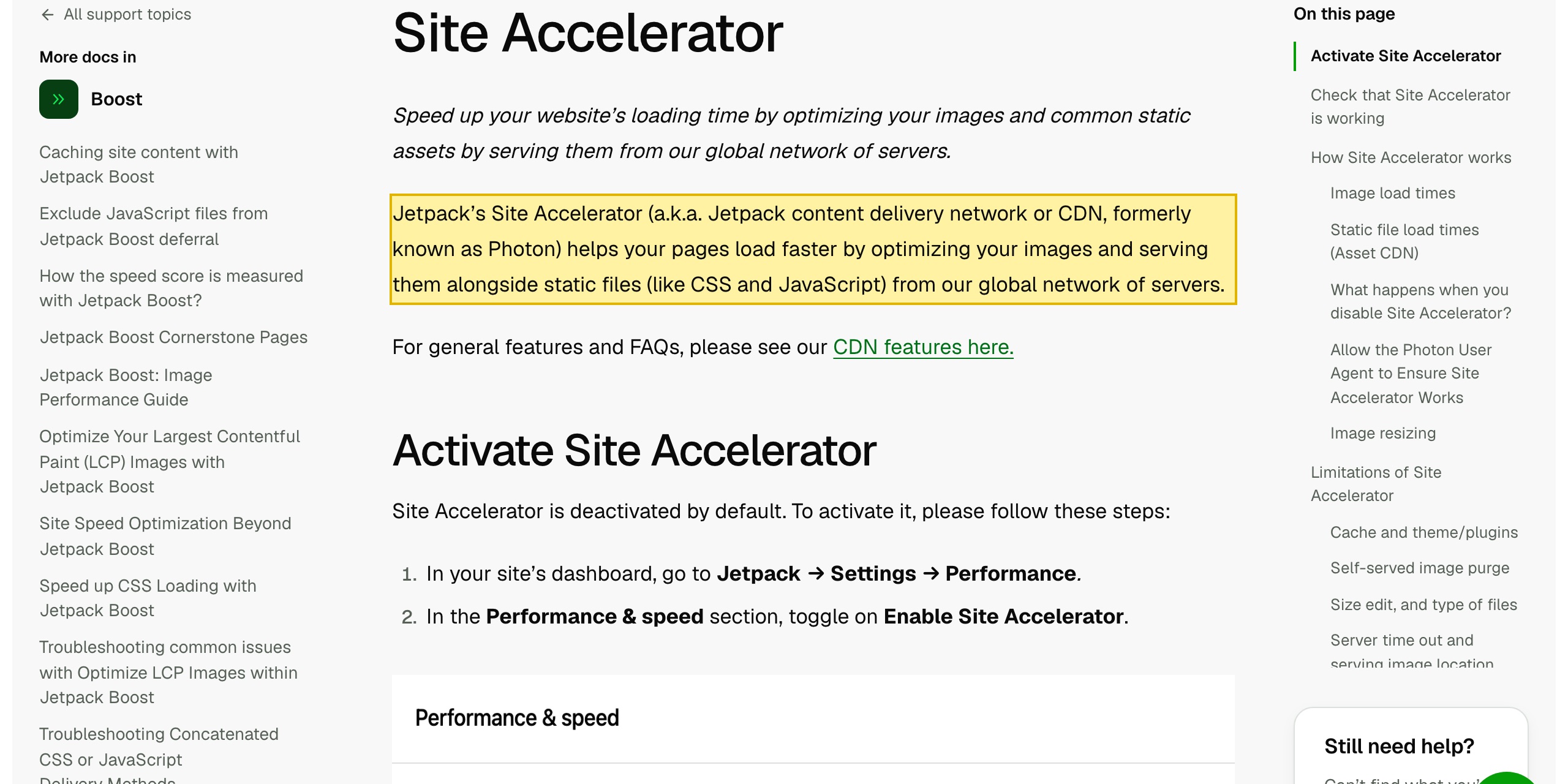
| In Jetpack's own words: its Site Accelerator is a "content delivery network or CDN, formerly known as Photon" that serves your images and static files (CSS and JavaScript) "from our global network of servers." Images routed through it carry URLs that "begin https://i0.wp.com, https://i1.wp.com, https://i2.wp.com or similar" — Automattic's offshore network, with no point of presence inside mainland China. Mainland browsers fetch them across the border. | Jetpack — Site Accelerator support doc, retrieved 2026-10-07 |
| Jetpack is bound to Automattic's cloud, not self-contained. Per its own documentation, "as part of the required connection to WordPress.com, Jetpack caches your site's data to WordPress.com servers (which power all of Jetpack's functionality)," and it "syncs all the data needed for all of its features, whether activated or not, to Automattic's servers" — all of them offshore. If that cloud is slow or unreachable from the mainland, the features that depend on it degrade with it. | Jetpack — What Data Does Jetpack Sync?, retrieved 2026-10-07 |
| Jetpack's Stats feature collects visitor data and sends it offshore. For activity tracking it records each visitor's "IP address," plus "visiting URL, referring URL, timestamp of event, browser language, country code," and its "Stats logs — containing visitor IP addresses and WordPress.com usernames (if available) — are retained by Automattic for 28 days." A visitor's IP address is personal information, so this is a cross-border transfer of personal information under PIPL. | Jetpack — Jetpack Stats support doc, retrieved 2026-10-07 |
| PIPL Chapter III (Articles 38–43) sets what a cross-border transfer of personal information requires: notice to the individual, separate consent, and one permitted mechanism — a CAC security assessment, the CAC standard contract, or certification. Under the CAC's March 2024 cross-border rules, a non-CIIO transferring fewer than 100,000 individuals' non-sensitive personal information in a calendar year is exempt from those three — so the visitor-analytics exposure scales with volume, not with merely switching the feature on. | PIPL Chapter III, Articles 38–43; CAC — Regulations on Promoting and Regulating Cross-border Data Flows, March 2024 |
| Jetpack is a plugin, not a host — it enhances a WordPress site but does not run it, so it carries no ICP filing of its own. A public-facing WordPress site served to mainland visitors from inside China needs an ICP filing (ICP 备案) under State Council Order No. 292 and MIIT Order No. 33, tied to a hosting resource physically inside the mainland. Host the WordPress site offshore and there is nothing for that filing to attach to; adding Jetpack changes none of this. | PRC Regulations on Telecommunications (State Council Order No. 292); Administrative Measures for the Filing of Non-operational Internet Information Services (MIIT Order No. 33) |
Sources verified by the 21YunBox compliance team on 2026-10-07.
For a mainland-China audience, the useful question about Jetpack is not how fast it makes a WordPress site — it is whether the plugin’s features will actually reach your visitors, and where the data it gathers on them ends up. Jetpack answers both in its own documentation: it is a WordPress plugin that runs on a required connection to Automattic’s WordPress.com cloud, its Site Accelerator serves your images and assets from an offshore “global network of servers,” and its Stats feature logs each visitor’s IP address to Automattic. None of that infrastructure sits inside the mainland. So the China exposure is a reachability one with a lighter cross-border-data question riding alongside it — and, one layer down, the WordPress site itself still needs its own license to be served from in-country.
Jetpack in China at a glance
| What decides it | In Jetpack's own terms |
|---|---|
| What it is | A WordPress plugin bound to Automattic's cloud — connecting your site to WordPress.com is “required to use many Jetpack features.” It enhances a site; it does not host one. |
| Where its features run | Site Accelerator (its CDN) serves images and static files “from our global network of servers”; Stats and protection report to WordPress.com. No point of presence is inside mainland China. |
| What crosses the border | Jetpack “syncs all the data needed for all of its features … to Automattic's servers,” and Stats logs each visitor's IP address, “retained by Automattic for 28 days.” A visitor's IP is personal information under PIPL. |
| Is it reachable? | Reachable, not blocked — but assets and features ride a cross-border hop to an offshore network, so they can stall in the tail even when Automattic's cloud is perfectly healthy. |
| Your own site | Separate from Jetpack: a public WordPress site served to mainland visitors from in-country needs its own ICP filing, tied to a mainland host. The plugin cannot hold it. |
Jetpack isn’t self-contained — it runs on Automattic’s offshore cloud
Jetpack is a WordPress plugin, but unlike a theme or a page builder it does not simply add code to your site and stop there. It is wired into Automattic’s WordPress.com cloud: in Jetpack’s own setup documentation, connecting your site to WordPress.com is “required to use many Jetpack features,” and once connected the plugin “caches your site’s data to WordPress.com servers (which power all of Jetpack’s functionality).” The features people install Jetpack for — the Site Accelerator CDN, Stats, downtime monitoring, brute-force protection — are answered from that cloud, not from your own server.
That is why the first China question about Jetpack is reachability, not speed. Every one of those features depends on a round trip to Automattic’s network, and Automattic runs no presence inside mainland China. When the cloud those features call is slow or unreachable from the mainland, the features that lean on it degrade with it — a dependency a fully self-hosted plugin would not carry.
The Site Accelerator is a CDN that serves from a “global network of servers” — offshore
The clearest example is Jetpack’s Site Accelerator. Jetpack describes it plainly as a “content delivery network or CDN, formerly known as Photon” that optimizes your images and serves them “alongside static files (like CSS and JavaScript) from our global network of servers.” Those servers are Automattic’s own: images routed through it, Jetpack notes, carry URLs that “begin https://i0.wp.com, https://i1.wp.com, https://i2.wp.com or similar.” None of that network sits inside the mainland.
So with the Site Accelerator switched on, a mainland visitor’s browser fetches your images — and your core WordPress, Jetpack and WooCommerce assets — across the border from an offshore network. “It usually loads” and “it loads every time, fast enough, for every visitor” are different promises, and for assets on a page’s critical path the gap between them is where pages stall or render unstyled. We describe this qualitatively on purpose: we publish China performance figures only with the method, sample and date behind them, and we hold no first-party Jetpack measurement to put one on here. Jetpack even lets you turn the Site Accelerator off, in which case images “start loading from your webhost’s server again instead of ours” — which removes the offshore hop but hands the delivery problem straight back to wherever that webhost sits.
A lighter but real data question — visitor data crossing to Automattic
Jetpack also sends data the other way. Its Stats feature, in Jetpack’s own description, records for each tracked event a visitor’s “IP address,” along with “visiting URL, referring URL, timestamp of event, browser language, country code,” and its “Stats logs — containing visitor IP addresses and WordPress.com usernames (if available) — are retained by Automattic for 28 days.” A visitor’s IP address is personal information, so a China-facing site running Jetpack Stats is sending its mainland visitors’ personal information to an offshore company — a cross-border transfer under PIPL (Chapter III, Articles 38–43: notice, separate consent, and one permitted transfer mechanism).
This is the lighter end of the compliance axis — Jetpack Stats is visitor analytics, not an identity store or a payment system — but it is not nothing, and it scales. Under the CAC’s March 2024 cross-border rules a non-CIIO moving fewer than 100,000 individuals’ non-sensitive personal information in a year is exempt from the assessment, standard contract and certification; a busy site, or one that layers on Jetpack features handling heavier data — a WooCommerce store’s order details, for instance — climbs past that line. Jetpack can be set to honor a visitor’s Do Not Track signal, which helps, but it does not change where the data goes when tracking is on.
This is a risk map, not a verdict: whether you need separate consent, a transfer mechanism, in-country storage, or some mix of them depends on what you serve, how much personal data you handle, and who your visitors are — worth settling with counsel before you build.
The WordPress site underneath still needs its own ICP
One layer sits below all of this: the WordPress site Jetpack enhances. Jetpack is a plugin, not a host — it carries no ICP filing of its own, any more than a theme would. A public-facing WordPress site delivered to mainland visitors from inside China turns on an ICP filing (ICP 备案) under State Council Order No. 292 and MIIT Order No. 33, and that filing must attach to a hosting resource physically located in the mainland. Host the WordPress site offshore and there is nothing for the filing to sit on; installing, configuring or upgrading Jetpack changes none of that. Being reachable in China and being licensed to operate there remain two different things, and the choice of plugin settles neither.
Where 21YunBox fits — a compliant overlay, not a migration
You keep running WordPress, and you keep Jetpack. We add the layer the plugin’s offshore cloud cannot: compliant, ICP-filed delivery from inside the mainland, set in front of your existing WordPress origin — no rebuild, no second codebase, and no move off WordPress or Jetpack. The assets a Jetpack page leans on are served to mainland visitors from an ICP-filed presence inside the mainland instead of across the border from a “global network of servers,” and our China team maps the cross-border-data and ICP obligations that your Stats data, your WooCommerce data and your own domain actually trigger — then stands up the in-country delivery, and where the law requires it the in-country storage, that a lawful China presence needs. WordPress stays your platform and Jetpack stays your plugin.
Related reading:
Frequently Asked Questions
Does Jetpack store Chinese visitors' data in China?
No. Jetpack runs on a required connection to Automattic's WordPress.com cloud and, in its own words, "caches your site's data to WordPress.com servers" and syncs it "to Automattic's servers" — all offshore. Its Stats feature logs each visitor's IP address, and those logs are "retained by Automattic for 28 days." Jetpack publishes no mainland-China location, so the data it collects on your China visitors is held outside the mainland.
Is it against the law to use Jetpack in China?
Not inherently. Jetpack is reachable, not blocked. The exposure is twofold: its features ride a cross-border hop to Automattic's offshore cloud, and the visitor data it collects — IP addresses among it — leaves the country, which PIPL permits only with notice, separate consent and one transfer mechanism. Separately, the WordPress site Jetpack sits on needs its own ICP filing to be served to mainland visitors from in-country. Whether a data-localization duty also applies turns on your role and your data volume. Treat it as a risk to assess with counsel, not a blanket prohibition.
Can 21YunBox help make our Jetpack-powered site compliant in China?
Yes. Our China team can assess your cross-border-data and ICP exposure for your WordPress site, its Jetpack features and your data volumes, then stand up compliant, ICP-filed in-country delivery in front of your existing origin — so the assets Jetpack serves reach mainland visitors from inside the mainland rather than across the border — and, where the law requires your visitors' data to stay on Chinese soil, in-country storage. No rebuild and no move off WordPress or Jetpack. Get in touch to work through your specific case.