Does SignNow Work in China? Data Residency, PIPL & E-Signature Validity
SignNow (airSlate) runs on US infrastructure and, in its own words, 'will not function without data transfers to the United States' — so every signed document and the signer data behind it leaves mainland China. A compliance-first look at PIPL cross-border exposure and e-signature validity.
Does SignNow work in China?
Yes — SignNow loads and signs inside mainland China, but it stores every signed document and the signer data behind it on its US cloud, and says plainly it cannot run without moving that data to the United States. The compliance question isn't whether it works — it's that using it carries your China signers' personal information offshore.
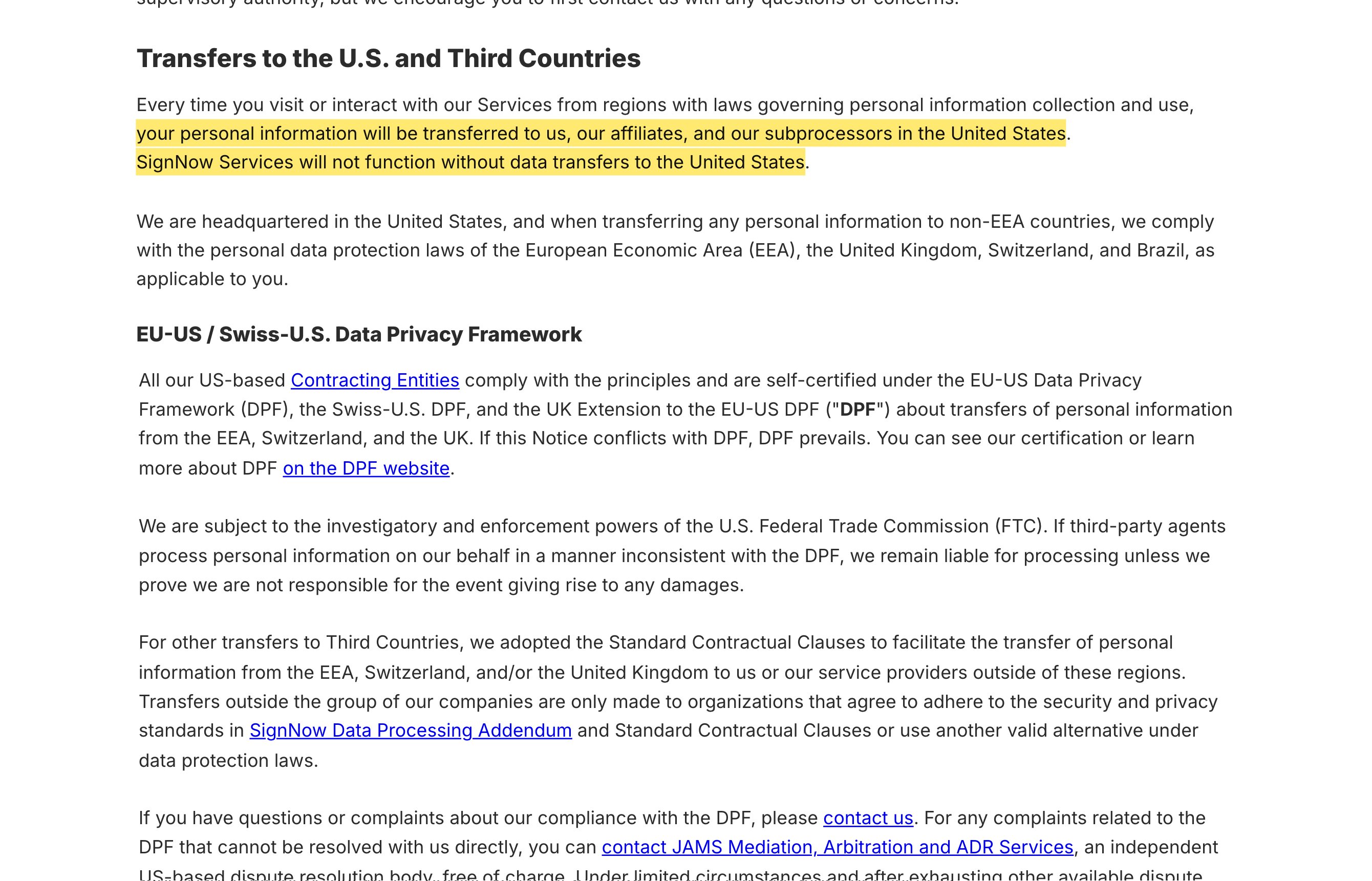
In SignNow's own privacy notice, "your personal information will be transferred to us, our affiliates, and our subprocessors in the United States," and "SignNow Services will not function without data transfers to the United States." Every completed signature keeps a "detailed document history… including full names, email and IP addresses, and time stamps." For a mainland signer that is a cross-border transfer of personal information PIPL governs (Articles 38–43), on servers outside the mainland — and whether that signature counts as a "reliable electronic signature" for a given document under China's Electronic Signature Law is a separate legal question. The table below is SignNow's own wording and the rule each line triggers.
This is a risk map, not a verdict — which obligations bite turns on your entity, your documents and who your signers are. Our China team can map your exposure with you →
Compliance snapshot
- ! SignNow stores signed documents and signer data on its US cloud
- ! China signers' names, emails and IPs cross the border — PIPL applies
- ✕ No mainland-China region; SignNow says it can't run without US transfer
- ! E-signature legal validity for some China documents is a counsel question
- ✓ Reachable from the mainland — but that's the delivery half, not the legal one
What SignNow's own documentation says about China
| Fact | Primary source |
|---|---|
| SignNow runs on US infrastructure and, by its own account, cannot operate without sending your data there. Its privacy notice states that "your personal information will be transferred to us, our affiliates, and our subprocessors in the United States," and bluntly that "SignNow Services will not function without data transfers to the United States." The controller is airSlate, Inc., a US company headquartered in Brookline, Massachusetts. Serve mainland-China signers and their personal information crosses the border under PIPL (Articles 38–43: notice, separate consent and a transfer mechanism). | airSlate SignNow Privacy Notice (legal.signnow.com), retrieved 2026-10-07; PIPL Articles 38–43 |
| A signed document is itself a bundle of personal data, and SignNow keeps it in the US. SignNow "creates and maintains a detailed document history, which shows all document activities and who performed them, including full names, email and IP addresses, and time stamps." Those identifiers and the signed records sit on SignNow's US cloud, so a China signer's personal information is stored outside the mainland — a cross-border transfer PIPL governs, and for a critical information infrastructure operator or large-volume handler, data that must instead be stored in China (Cybersecurity Law Article 39 (formerly Article 37); PIPL Article 40). | airSlate SignNow Security (signnow.com/security), retrieved 2026-10-07; PIPL Article 40; Cybersecurity Law Article 39 (formerly Article 37) |
| Strong encryption and SOC 2 are not the same as in-country residency. SignNow encrypts data with "TLS 1.2/1.3 to protect data in transfer" and "AES-256 bit encryption for storage and data at rest," and holds SOC 2 Type II, PCI DSS, HIPAA, GDPR and CCPA attestations. Every one of those is a Western framework — none is an ICP filing, PIPL compliance, or a mainland-China data region, which SignNow does not offer (inference from its US-only transfer statement). Encryption guards the data in motion; it does not keep it inside China. | airSlate SignNow Security (signnow.com/security), retrieved 2026-10-07 |
| Whether a SignNow signature is "reliable" in China is a legal question, not a product setting. China's Electronic Signature Law (电子签名法) gives legal effect to a "reliable electronic signature," and for certain documents that status can turn on signing methods or certificate authorities recognized in China. SignNow is built to US frameworks such as ESIGN and UETA, not to the Chinese regime — so whether a given SignNow-signed document would be treated as reliable before a Chinese court or authority is worth confirming with Chinese counsel before you rely on it. | airSlate SignNow Security (signnow.com/security), retrieved 2026-10-07; China Electronic Signature Law (电子签名法) |
Sources verified by the 21YunBox compliance team on 2026-10-07.
For a mainland-China audience, the deciding question about SignNow is not how fast the signing page paints — it is where your signed documents, and the people named inside them, are allowed to live. SignNow is airSlate’s e-signature platform, and it answers that in its own documentation: it runs on infrastructure in the United States and, by its own account, will not run at all without moving your data there. The page is reachable from inside China; the problem is what reaching it does. Every completed signature writes names, email addresses, IP addresses and a full audit trail onto a US cloud — so the exposure is not latency, it is a cross-border transfer of personal information, with the legal weight of the signature itself a second question stacked on top.
SignNow in China at a glance
| What decides it | In SignNow's own terms |
|---|---|
| Where it runs | US infrastructure, no mainland region. SignNow's privacy notice routes personal information “to us, our affiliates, and our subprocessors in the United States,” and states “SignNow Services will not function without data transfers to the United States.” |
| What a signed document holds | A “detailed document history… including full names, email and IP addresses, and time stamps” — signer personal information, stored alongside the signed file. |
| Your China signers' data | Collected in the mainland, held in the US: a cross-border transfer of personal information PIPL governs, plus a localization duty for CIIOs and large-volume handlers that a US-only service cannot meet. |
| Signature validity | China's Electronic Signature Law recognizes a “reliable electronic signature”; whether a SignNow signature qualifies for a given document is a legal question for counsel, not a setting. |
| Is it reachable? | Yes — the signing flow loads from inside the mainland. Reachability is the delivery half; it does not decide whether you may lawfully move the data offshore. |
US-only by design — your China signer data crosses the border
SignNow does not treat US hosting as a default you can change; it treats it as a precondition. The privacy notice is explicit that “your personal information will be transferred to us, our affiliates, and our subprocessors in the United States,” and that “SignNow Services will not function without data transfers to the United States.” The controller, airSlate, Inc., states it is “headquartered in the United States,” and there is no mainland-China region to select.
That settles the data question before performance enters it. When a person in China signs, their personal information is collected in the mainland and comes to rest in the United States — and under China’s Personal Information Protection Law that is a cross-border transfer. The handler — you, not SignNow — has to give notice, obtain separate consent, and clear one transfer mechanism: a CAC security assessment, the CAC standard contract, or certification (PIPL Articles 38–43). If you are a critical information infrastructure operator or a large-volume handler, personal information collected in China must be stored in the mainland (PIPL Article 40; Cybersecurity Law Article 39 (formerly Article 37)) — a residency duty a US-only platform cannot satisfy, however it is tuned.
A signed document is a bundle of personal information
The audit trail is not metadata you can wave away; it is personal data in its own right. SignNow “creates and maintains a detailed document history, which shows all document activities and who performed them, including full names, email and IP addresses, and time stamps.” Each of those identifiers belongs to a real signer, and each is stored with the signed file on SignNow’s US cloud.
Encryption is where this is most often misread. SignNow protects data with “TLS 1.2/1.3 to protect data in transfer” and “AES-256 bit encryption for storage and data at rest,” and carries SOC 2 Type II, PCI DSS, HIPAA, GDPR and CCPA attestations. All of that is real, and all of it is beside the residency point: encryption controls who can read the data, not which country it sits in, and every one of those frameworks is Western. None is an ICP filing or a PIPL transfer basis, and strong cryptography on a US server is still a US server.
Is a SignNow signature “reliable” in China? A separate legal question
Even where the data question is handled, the signature carries its own. China’s Electronic Signature Law (电子签名法) gives legal effect to a “reliable electronic signature,” and for some categories of document the weight a court or authority gives a signature can turn on the signing method or on certificate authorities recognized inside China. SignNow is built to US frameworks such as ESIGN and UETA; it does not hold itself out as meeting the Chinese regime. That does not make a SignNow signature invalid — it makes its standing a question to put to Chinese counsel for the specific documents you intend to sign, rather than an assumption carried over from your home jurisdiction.
One more door opens if you embed SignNow’s signing flow inside a mainland-facing website of your own: that site still needs its own ICP filing, and SignNow gives you no in-country hosting to anchor one.
This is a risk map, not a verdict: whether PIPL cross-border rules, a localization duty, signature-reliability requirements, or all three apply to you depends on your entity, the documents you sign and who your signers are — worth settling with counsel before you rely on it.
Where 21YunBox fits — a compliant overlay, not a migration
You keep SignNow as your signing engine. We add the piece a US-only platform cannot give you: compliant, ICP-filed delivery from inside the mainland, set in front of the stack you already run — no rebuild, no second codebase, and no move off SignNow. Our China team maps your PIPL cross-border and data-residency exposure against your entity and your data volumes, stands up the in-country delivery and storage a lawful China presence needs, and flags where a document’s legal standing is worth confirming with counsel under the Electronic Signature Law.
Related reading:
Frequently Asked Questions
Is it a problem to have our China staff or customers sign documents in SignNow?
Treat it as a PIPL risk to work through with counsel, not an automatic no. SignNow states that "SignNow Services will not function without data transfers to the United States," and every signed file carries "full names, email and IP addresses, and time stamps." So a mainland signer's personal information leaves China the moment they sign — a cross-border transfer that PIPL conditions on notice, separate consent and a transfer mechanism (a CAC security assessment, the CAC standard contract, or certification). Whether a data-localization duty also applies turns on your role and your data volumes.
Does SignNow have a China data center or region we can switch on?
SignNow publishes none. Its privacy notice sends personal information "to us, our affiliates, and our subprocessors in the United States," with no mainland-China region and no ICP-filing path of its own. Keeping China signer data inside the mainland is not a toggle inside SignNow — it takes a compliant, in-country layer placed around the flow.
Can 21YunBox help us use SignNow compliantly in China?
Yes. Our China team can map your PIPL cross-border and data-residency exposure — what signer data you collect, your entity and your volumes — and stand up ICP-filed, in-country delivery and storage in front of the stack you already run, so your China-facing flows have a lawful mainland footing while SignNow stays your signing engine. We can also flag where a document's legal weight is worth checking with Chinese counsel under the Electronic Signature Law. Get in touch to work through your case.