Does Typeform Work in China? Data Residency, PIPL & Survey Rules
Typeform is reachable in mainland China, but it runs no mainland region — form and survey responses are stored on its cloud in the US (EU only for Enterprise), so every mainland submission is a PIPL cross-border transfer with no ICP-filing path. A compliance-first look, including the foreign-related survey rule most survey teams miss.
Does Typeform work in China?
Typeform loads in China, but that is not the question. Every form and survey response you collect from a mainland resident is personal data that leaves the country the moment it is submitted — stored on Typeform's cloud in the US, or the EU for Enterprise, and never inside mainland China.
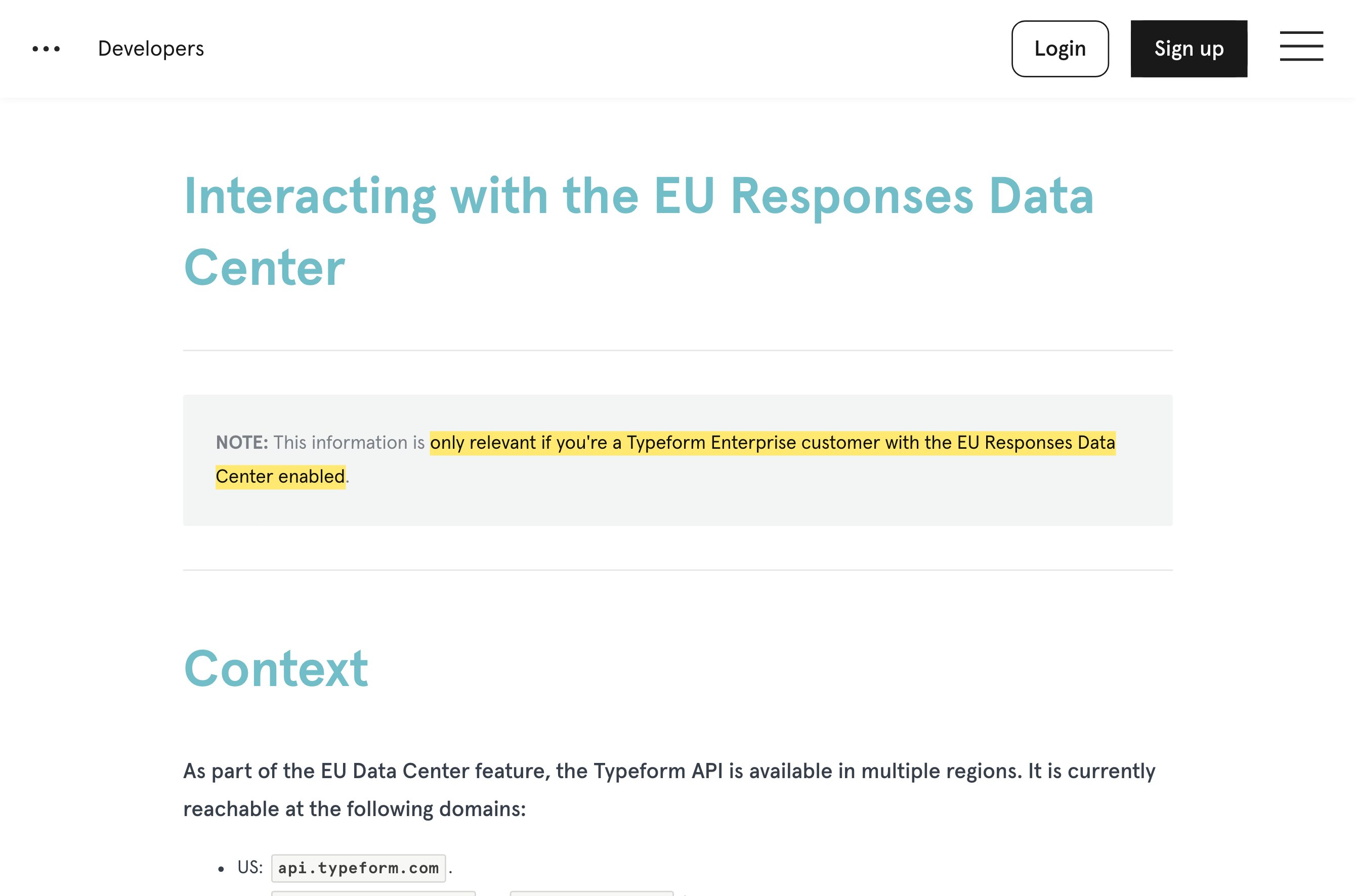
Typeform's own documents settle where the data sits. Its Data Processing Agreement names the operator as "TYPEFORM SL, a Spanish entity" and its host as "Amazon Web Services Inc., a US entity … for the provision of hosting services"; its developer docs list only two response data centers — the US by default and an EU one that is "only relevant if you're a Typeform Enterprise customer with the EU Responses Data Center enabled." None is in mainland China, so a China-facing form has no footing for an ICP filing, and each submission is a cross-border transfer of personal information under PIPL. And because Typeform's whole job is collecting surveys, a foreign operator may also meet China's foreign-related survey rules — independent of where the data lives. The table below is Typeform's own wording and the rule each line triggers.
This is a risk map, not a verdict — which rules bite turns on your entity, your data volumes and who your respondents are. Our China team can map your exposure with you →
Compliance snapshot
- ! Form & survey responses are personal data, stored on Typeform's cloud outside mainland China
- ! Mainland respondents' answers cross the border on submit — PIPL applies
- ✕ No mainland region, so a China-facing form can't be ICP-filed
- ! EU data residency is an Enterprise-only opt-in; the default stores responses in the US
- ! Foreign-run market or social surveys may also need China's survey approval — confirm with counsel
What Typeform's own documentation says about China
| Fact | Primary source |
|---|---|
Typeform keeps your responses on its own cloud — in the US by default, never in mainland China. Typeform's developer documentation describes only two places responses can live: the US (api.typeform.com) and an EU data center that is "only relevant if you're a Typeform Enterprise customer with the EU Responses Data Center enabled," where responses are stored "on the servers physically located within the EU." There is no mainland-China region. For a respondent in China, that makes every submission a cross-border transfer of personal information under PIPL (Articles 38–43). | Typeform Developer Docs — EU Responses Data Center (developer.typeform.com), retrieved 2026-10-07; PIPL Articles 38–43 |
| Typeform is a Spanish company hosting on AWS in the US — there is no Chinese entity and no mainland footprint. Its Data Processing Agreement names the operator as "TYPEFORM SL, a Spanish entity with registered address at … Barcelona (Spain)" and its hosting sub-processor as "Amazon Web Services Inc., a US entity … for the provision of hosting services." The sub-processors it lists sit in the US, UK, Germany and Spain — none in mainland China, which is why "we already use Typeform" does not create a compliant China presence on its own. | Typeform Data Processing Agreement (typeform.com/dpa), retrieved 2026-10-07 |
| A public form served from offshore has no footing for an ICP filing. Because Typeform runs no region inside mainland China, a China-facing Typeform form or embed is delivered from outside the mainland. A public-facing site reaching mainland visitors needs an ICP filing (ICP 备案) bound to a hosting resource physically in the mainland, under State Council Order No. 292 and MIIT Order No. 33 — and there is nothing on Typeform to anchor that filing to. | Typeform Developer Docs (developer.typeform.com), retrieved 2026-10-07; State Council Order No. 292; MIIT Order No. 33 |
| If you are a CIIO or a high-volume handler, the responses have to stay in China — and Typeform stores them abroad. Typeform's own DPA puts hosting with "Amazon Web Services Inc., a US entity," with an EU option only for Enterprise. Under PIPL Article 40 and Cybersecurity Law Article 39 (formerly Article 37), personal information collected in mainland China by those operators must be stored in-country, and every other handler still owes notice, separate consent and a lawful transfer mechanism before data leaves. Offshore storage cannot satisfy an in-country residency duty. | Typeform Data Processing Agreement (typeform.com/dpa), retrieved 2026-10-07; PIPL Articles 40 & 38–43; Cybersecurity Law Article 39 (formerly Article 37) |
| Because Typeform is a survey tool, a foreign operator may hit a second rule that has nothing to do with where the data sits. China's foreign-related survey regime (涉外调查管理办法, National Bureau of Statistics Order No. 7, 2004) applies when a foreign organization commissions, funds, cooperates on, or receives the results of market or social surveys of mainland residents — a relationship test, not a data-location one, so moving responses into China would not settle it. Social surveys are closed to foreign capital and market surveys are restricted. Whether your use counts is a question for counsel, not a default yes. Flagged as a risk to confirm, not a verdict. | China National Bureau of Statistics — Administrative Measures on Foreign-Related Surveys (涉外调查管理办法, Order No. 7, promulgated 2004-10-13), stats.gov.cn, retrieved 2026-10-07 |
Sources verified by the 21YunBox compliance team on 2026-10-07.
For a mainland-China audience, the real question about Typeform is not whether the form loads — it usually does — but where every answer goes the instant someone hits submit. Typeform is a Spanish company that stores responses on its own cloud in the US, with an EU data center reserved for Enterprise; it runs no region inside mainland China. So a China-facing Typeform form is reachable, yet each submission carries a mainland resident’s personal information out of the country, onto infrastructure that can neither be ICP-filed nor meet an in-country storage duty. And because Typeform’s entire purpose is collecting survey and form answers, a foreign operator can trip a second, less obvious rule on top of the data one. Reachability is the easy half; the licensing and the data residency are the exposure.
Typeform in China at a glance
| What decides it | In Typeform's own terms |
|---|---|
| Where it runs | Two response data centers only — the US by default (api.typeform.com) and an EU option (api.eu.typeform.com) that is “only relevant if you're a Typeform Enterprise customer with the EU Responses Data Center enabled.” No region is inside mainland China. |
| Who operates & hosts it | The operator is “TYPEFORM SL, a Spanish entity” in Barcelona; hosting is “Amazon Web Services Inc., a US entity … for the provision of hosting services.” Its listed sub-processors sit in the US, UK, Germany and Spain. |
| What a response is | Every form and survey answer is personal information about the respondent — and Typeform stores it “on the servers physically located within the EU” or, by default, in the US. |
| Serving the public | A mainland-facing form or embed is delivered from offshore. An ICP filing must bind to a mainland hosting resource, and Typeform offers none to anchor one to. |
| Where your data lands | Outside mainland China — a cross-border transfer of personal information PIPL governs, on infrastructure that cannot be ICP-filed or meet an in-country storage duty. |
Where your Typeform responses actually live
A form is only useful once someone answers it, and those answers are the exposure. Typeform’s developer documentation is explicit that responses are kept in one of two data centers: the US, reachable at api.typeform.com, and an EU data center at api.eu.typeform.com that the same docs describe as “only relevant if you’re a Typeform Enterprise customer with the EU Responses Data Center enabled,” where the platform must “store and process it on the servers physically located within the EU.” Neither is in mainland China, and Typeform publishes no mainland region. Its Data Processing Agreement reinforces the point, placing the operator — “TYPEFORM SL, a Spanish entity” — and its host — “Amazon Web Services Inc., a US entity … for the provision of hosting services” — firmly outside China.
That geography decides the data question before latency enters it. When a mainland resident submits a Typeform, their personal information moves out of the country, which under China’s Personal Information Protection Law is a cross-border transfer: the handler — you, not Typeform — must give notice, obtain separate consent, and clear one transfer mechanism (a CAC security assessment, the CAC standard contract, or certification) under PIPL Articles 38–43. If you are a critical information infrastructure operator or a large-volume handler, personal information collected in China must be stored in the mainland (PIPL Article 40; Cybersecurity Law Article 39 (formerly Article 37)) — a residency duty that a US-default, EU-optional platform cannot satisfy. The EU hosting feature narrows which foreign country holds the data; it does not bring the data home to China.
A public form served from offshore has no ICP footing
Reachability and licensing are different tests, and Typeform clears the first while leaving the second open. A public-facing website or form shown to mainland visitors turns on an ICP filing (ICP 备案) under State Council Order No. 292 and MIIT Order No. 33, and that filing has to attach to a hosting resource physically located in the mainland. Because Typeform runs nothing inside mainland China, a China-facing form or embed is delivered entirely from offshore, and there is simply no in-country resource to file against. “We already use Typeform” settles none of this: being able to open the form is not the same as being cleared to collect from mainland users, and no amount of embedding or tuning conjures the mainland footing a filing requires.
The survey-license catch a form tool quietly raises
Most of these pages stop at the data door. Typeform raises one more, precisely because it is a survey and form instrument. China regulates foreign-related surveys through the Administrative Measures on Foreign-Related Surveys (涉外调查管理办法, National Bureau of Statistics Order No. 7). The regime turns on the relationship, not the server: it reaches market and social surveys that a foreign organization commissions, funds, cooperates on, or whose results are provided to a party outside China. Read that way, a foreign company fielding a market or opinion survey of mainland residents through Typeform can fall inside the regime even though the form lives on a foreign platform — and localizing the data would not change the analysis, because the trigger is who is behind the survey and where the findings go. Social surveys are closed to foreign capital and market surveys are restricted, so the practical answer is usually to run the work through a licensed local party rather than to field it directly. This is a flag to confirm with counsel, not a verdict that your particular use is caught.
This is a risk map, not a verdict: whether PIPL’s transfer duties, an in-country storage obligation, the ICP rule, the foreign-related survey regime, or several at once apply to you depends on what you collect, how much of it, your role, and who your respondents are — worth settling with counsel before you launch.
Where 21YunBox fits — a compliant overlay, not a migration
You keep Typeform exactly as it is — the same forms, the same embeds, the same account and response pipeline. What we add is the one thing a survey platform built outside China cannot hand you: compliant, ICP-filed delivery from inside the mainland, placed in front of the Typeform endpoints you already publish, with no rebuild and no second codebase. Our China team maps your PIPL cross-border and data-residency exposure against your entity, your data volumes and who answers your forms; where the foreign-related survey rules may reach your work, we help you scope that with the right local, licensed footing before you proceed; and we stand up the in-country delivery a lawful China presence needs — while your Typeform stays right where it runs today.
Related reading:
Frequently Asked Questions
Does Typeform store our form data in China?
No. Typeform's documented infrastructure has two response data centers — the US, which is its default, and an EU option available only to Enterprise customers with the EU Responses Data Center enabled — and its DPA puts hosting with Amazon Web Services as a US entity. Neither location is in mainland China, and Typeform lists no mainland region. For a respondent in China, each submission is therefore a cross-border transfer of personal information that PIPL governs.
Is it against the rules to run a Typeform survey aimed at mainland China?
Treat it as a risk to assess with counsel rather than a flat yes or no. Two things stack up. First, the responses are personal information that leaves the mainland, so PIPL's cross-border duties apply — notice, separate consent and a lawful transfer mechanism — and a public form served from offshore has no ICP filing. Second, because the activity is a survey, a foreign organization that commissions, funds or receives the results of market or social surveys of mainland residents may fall under China's foreign-related survey regime, which turns on the relationship rather than on where the data is hosted.
Can 21YunBox help make our Typeform setup work in China?
Yes. Our China team can map your PIPL cross-border and data-residency exposure for your entity, your data volumes and your respondents, flag where the foreign-related survey rules may apply so you can scope them with the right local, licensed footing, and stand up the ICP-filed, in-country delivery a compliant China presence needs — in front of the Typeform forms you already run, with no rebuild. Get in touch to work through your case.