
Can you run SitecoreAI (formerly Sitecore XM Cloud) in China?
The content system does not run in mainland China, and it does not need to. What decides whether your site works there is two gates, in order: can you legally operate, and does the whole page actually work for a visitor in China.
Gate one is legal and comes first. A site served to mainland users needs an ICP filing (备案) issued to a Chinese legal entity, renewed and kept current under the Measures for the Administration of Internet Information Services. No hosting product supplies this; without it the domain cannot be served from inside China at all.
Gate two is technical. SitecoreAI's content, the editor portal, your forms, video, third-party scripts, content APIs and analytics all live outside China, so each has to be made to work from inside. Two honest architectures do that: redeploy the front end to a China cloud (in-country hosting), or keep your site where it runs today and put a licensed delivery layer inside China that fetches only what is slow or blocked (the 21YunBox Optimizer). Personal data is a cross-border transfer question under PIPL, regulated rather than automatically localized.
This is orientation, not legal advice — your obligations turn on your entity, your data volumes and your own risk appetite. Confirm the specifics with qualified counsel.
What actually decides a SitecoreAI launch in China
| Fact | Primary source |
|---|---|
| Gate one is a filing, not a hosting feature. A website served to mainland users must carry an ICP filing (备案) on a mainland hosting resource, held by a mainland legal entity, before it goes live — renewed and kept current. No hosting setup can substitute for it, and the domain cannot legally be served from inside China without it. | Measures for the Administration of Internet Information Services (State Council Order No. 292); Measures for Filing (MIIT Order No. 33) |
| Personal data is regulated transfer, not an automatic localization mandate. Moving Chinese users' personal information to a service outside the mainland is a cross-border transfer under PIPL (Articles 38–40): it requires notice, a lawful basis and an approved transfer mechanism — but it is permitted. In-country storage becomes mandatory only for critical-information-infrastructure operators and large-volume handlers. | Personal Information Protection Law, Articles 38–40; Cybersecurity Law Article 39 (formerly Article 37) |
| SitecoreAI's content system sits outside China. SitecoreAI is Sitecore's cloud platform — the former XM Cloud — and its content, editing and delivery services run on Sitecore's global cloud, with no mainland-China region; teams that must self-host stay on Sitecore XM/XP. Either way the content system is reached across the border, so every China architecture is an answer to how that content reaches the visitor. | Sitecore product documentation; XM Cloud → SitecoreAI platform naming, retrieved 2026-11-04 |
| Putting the front end in China does not fix what the browser calls. On a page served from inside China, requests the visitor's browser makes to services outside China still cross the border: YouTube and Vimeo are blocked, and Google Fonts, Tag Manager, Analytics and similar scripts are blocked or slow enough to time out. This — not hosting — is what usually breaks a China site in practice. | 21YunBox in-China measurements and observed availability of common third-party services, 2026 |
Sources verified by the 21YunBox compliance team on 2026-11-04.
If you run SitecoreAI and you have customers in mainland China, you’ll get asked where to host the China site. It’s the wrong first question. Hosting is the easy part. The hard part is being allowed to operate, and then making the whole site work once you are. This is how we think about it, including when in-country hosting is the right answer and when it isn’t.
Two gates, in order
Every China site has to get through two gates. The order matters.
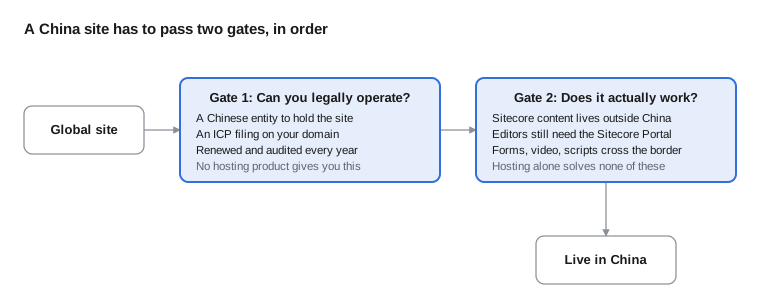
The first gate is legal. Without it, your site isn’t slow in China — it can’t legally be served at all. The second gate is technical. Sitecore’s content system, your editors’ tools, your forms and your scripts all live outside China, and something has to make each of them work from inside.
Most of the hosting conversation is about the second gate, and only part of it. That’s the problem.
Gate one: can you legally operate?
In mainland China, a website needs a government filing before it can be served. It’s called an ICP filing (备案). Without it, the domain can’t be served from inside China, full stop. No hosting setup gets around it.
To get one you need three things:
- A Chinese legal entity. The filing is issued to a company registered in China, not to your global parent. If you have a China subsidiary or a WFOE, that’s usually the one.
- The filing itself. It’s tied to the infrastructure that serves the site, so whoever hosts the site is involved in the paperwork. It takes weeks, not days, and under the Measures for the Administration of Internet Information Services it has to be renewed and kept current.
- Someone who owns it. Not a one-time project. Domain changes, entity changes and annual reviews all touch it.
This is the part most hosting pages skip. They’ll tell you that you need a “local business license” and stop there. That’s true, but the license is the prerequisite. The filing is the gate. We’ve seen teams stand up in-country infrastructure and only find out at launch that the domain can’t be served.
We set the filing up on your entity and manage the renewals. If you already have one, we work with it.
Gate two: does it actually work?
Here’s the thing about SitecoreAI (and XM Cloud before it): the content system doesn’t run in China and isn’t going to. Your pages, images and editor tools all sit on Sitecore’s global infrastructure. Every option for China is really an answer to one question: how does that content reach a visitor in Shanghai, and on whose road?
There are two honest answers.
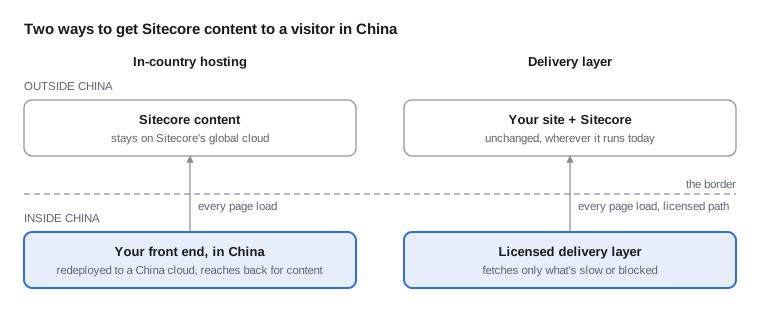
In-country hosting. You redeploy your front end to a cloud inside China (Azure China, Alibaba, whoever). Visitors hit a server in-country, and that server reaches back across the border to Sitecore for content on every page load. This is what “sovereign hosting” products for Sitecore do, including Arc by Dataweavers. It’s a real option when your organization has decided the front end must physically sit inside China. The cost is a second deployment target with its own pipeline, releases and cache, and the border crossing still happens, just from the server instead of the browser. The local cache these products add is a CDN for Sitecore’s own media and only that; everything else on the page still goes where it always went. Ask who holds the license for that crossing.
A delivery layer over your existing site. Your site stays exactly where it is: Vercel, Netlify, Azure, wherever. A licensed delivery layer inside China handles the visitor, fetches what’s slow or blocked over a compliant cross-border path, and leaves everything that already works alone. One codebase, one deploy, no China fork. This is our 21YunBox Optimizer, and it’s what we recommend for most global sites.
Neither one is wrong. They fit different companies. What matters is picking on the basis of what your site actually does, not on where the server sits.
What hosting alone doesn’t solve
When a client first asks about China, they ask about hosting and the ICP filing. That’s the part above the waterline. What decides whether the site actually works sits below it, in the application layer, and it’s what a hosting conversation never gets to.
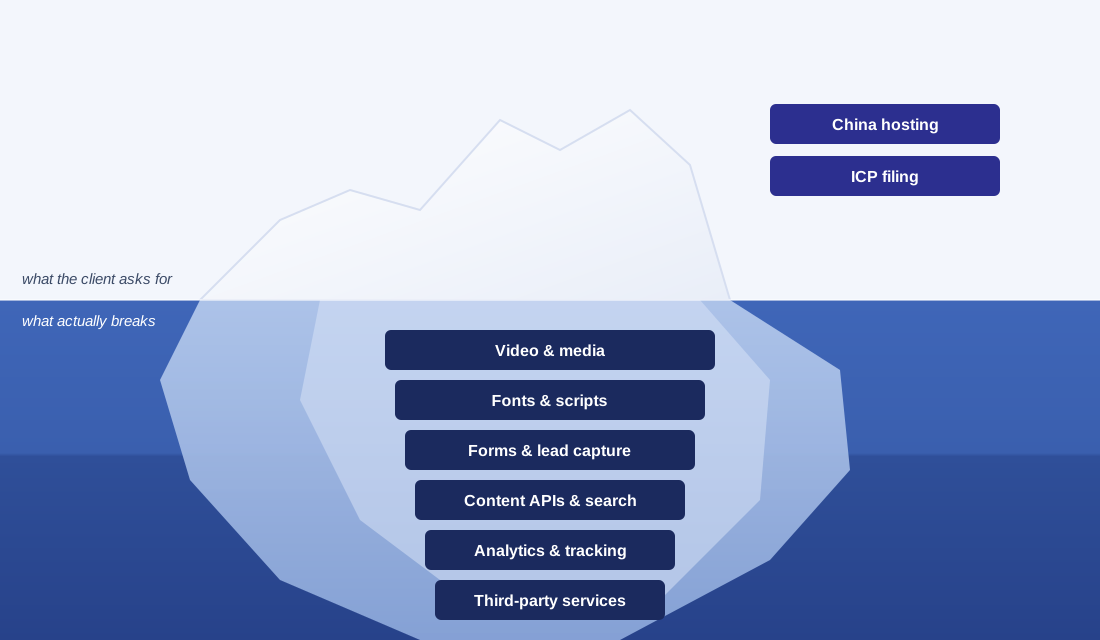
Say you’ve put the front end inside China and the ICP is done. Here’s what’s still broken, because none of it lives in the front end.
Your editors. The Sitecore Portal, where your China content team logs in to publish, isn’t reachable from inside China. The usual advice is a VPN. We don’t recommend that, and we’d be careful about any vendor who puts it in writing. VPN use for business in China sits in a gray area your China staff shouldn’t be carrying. We give editors a managed, licensed connection to the Portal instead. No VPN, no China IT team pulled into it.
Your forms. The form is on the page, but the submission goes somewhere. Sitecore Forms posts to Sitecore. HubSpot and Marketo forms post to HubSpot and Marketo. All outside China. If the visitor’s browser can’t reach that endpoint, the form fails silently, and you don’t find out until someone asks why China leads dried up. The submission has to travel over a path that works.
Your video. YouTube and Vimeo are blocked outright. Wistia, Brightcove and Vidyard are third-party players that may or may not load. A page hosted in China with a YouTube embed is a page with a blank box on it. Either the player gets routed or the video moves to a China-reachable host — the choices are laid out in our guide to video playback in China.
Your third-party scripts. Google Fonts, Google Tag Manager, Google Maps, chat widgets, consent banners, A/B tools. Each one is a call from the visitor’s browser to a server outside China. Some are blocked, some are just slow enough to time out, and the page hangs while it waits. This is what usually breaks a China site in practice, and it’s the thing hosting pages never mention.
Your content APIs and search. A SitecoreAI site isn’t a pile of static pages. Personalization, search, product listings and anything that updates without a redeploy call back to Sitecore’s APIs at runtime. Those calls cross the border. If they’re slow, the page renders late; if they fail, it renders empty. The front end being in China doesn’t move the API it talks to.
Your analytics and tracking. Google Analytics, Adobe Analytics, your tag manager, your ad pixels. Each one is a beacon from the visitor’s browser to a server outside China. Blocked beacons mean a China audience you can’t see in your dashboards, which usually gets read as “nobody in China visits us” when the real answer is “we’re not measuring them.”
Your personal data. You’ll be told that personal data “must stay in China.” That’s one option, and the heaviest one. China’s privacy law (PIPL) regulates the cross-border transfer of personal information; it doesn’t ban it. For a marketing site with modest form volumes, nothing is usually required. As volumes grow, there’s a filing route with the regulator (the CAC) that lets you keep sending leads to your global CRM. Forced localization is for when volume, sensitivity or your own risk appetite calls for it. The right answer depends on what data, how much, going where. We help you pick the lighter one that still complies. (If you want to see how far this reaches, we read 763 SaaS tools against China’s own rules — most of a typical stack lands on the wrong side of this line.)
Which approach fits you
Here’s how we’d sort it. Be honest about which column you’re in.
| Consideration | In-country hosting (e.g. Arc by Dataweavers) | 21YunBox Optimizer |
|---|---|---|
| Where the site runs | Inside China, on Azure China | Wherever it runs today |
| Changes to your stack | Redeploy the front end to a second target | None |
| Cloud | Azure only | Any |
| Chinese entity | You need one | You need one |
| ICP filing | Yours to arrange | Set up and managed on your entity |
| Content reaches China | Server reaches back on every page load | Licensed layer fetches what's needed |
| Editors in China | Vendor recommends a VPN | Managed, licensed Portal access |
| Forms, video, scripts, APIs, analytics | Not addressed | Handled |
| Personal data | Localize | Filing or localize, whichever fits |
| Good fit when | Azure shop, static site, entity and ICP already sorted, front end must sit in China | Global-first site that needs China to just work |
If you’re an Azure shop with a mostly static China site, a Chinese entity, someone who already owns the ICP, and a mandate that the front end sits in-country, in-country hosting is a reasonable choice. Add the delivery layer for the parts it doesn’t cover.
If you’re a global company with one site, one codebase and a China audience, and you’d rather not run a second platform, the Optimizer is the fit. That’s most of the companies we talk to. For a worked example, see how one global enterprise kept Sitecore XM Cloud and Vercel while making its China site fast, compliant and whole.
Where to start
If China’s on your roadmap, don’t start with hosting. Start with two questions: do you have a Chinese entity, and does your site do anything in the browser that matters (forms, video, scripts, search, analytics, personalization)? The answers decide the architecture.
If you’d like a second opinion on where your site stands today, send us the URL and we’ll run the in-China assessment. No cost, no commitment, and you’ll get real numbers either way.
Frequently Asked Questions
Can SitecoreAI run inside China?
The content system doesn't, and that's fine. What matters is how your site gets content to a visitor in China. Both common approaches — in-country hosting and a licensed delivery layer over your existing site — do that, and neither requires moving Sitecore.
Do I need a local business license to run a Sitecore site in China?
Yes — you need a Chinese legal entity, which is the prerequisite. The thing that actually lets your site be served is the ICP filing (备案) issued to that entity. Get both sorted before you pick a hosting model.
Can my China editors use the Sitecore Portal?
Not directly, because the Portal isn't reachable from inside China, and a VPN isn't an answer we'd put our name on. We give editors a managed, licensed connection instead, so they log in the normal way.
Does my personal data have to stay in China?
Not necessarily. PIPL regulates the cross-border transfer of personal information; it doesn't ban it. Low form volumes often need nothing extra, and higher volumes have a filing route with the regulator (the CAC) that lets you keep your global CRM. Localization is one option, not the only one.
Do I have to rebuild my site to run SitecoreAI in China?
With a delivery layer like the 21YunBox Optimizer, no — your site stays where it is. With in-country hosting you add a second deployment target inside China, which is less than a rebuild but more than nothing.
What about forms, video and third-party scripts?
They run in the visitor's browser, so where the server sits doesn't help them. Each one needs a delivery layer that makes it reachable, or a swap to a China-friendly alternative. Ask any vendor specifically how they handle forms, video, scripts, content APIs and analytics — not just hosting.
Will a China site built this way be fast?
Speed is table stakes, and either approach can be fast for the parts it covers. The more useful question is what an approach doesn't cover — the forms, video, scripts, APIs and analytics that run in the browser — because that's where a China page actually breaks.
