Does SurveySavvy Work in China? The Survey License & Cross-Border Data
SurveySavvy is a US survey panel run by Luth Research in San Diego — so a study of mainland-China respondents raises two questions a platform can't answer: whether China's Foreign-Related Survey License applies, and the PIPL cross-border transfer when answers leave the country. A compliance-first look at the doors.
Does SurveySavvy work in China?
The hard part about SurveySavvy in China isn't load time — it's that a survey of mainland respondents run for a foreign company can require a Chinese survey license, and the answers you collect leave the country. Neither is something a survey platform can clear for you.
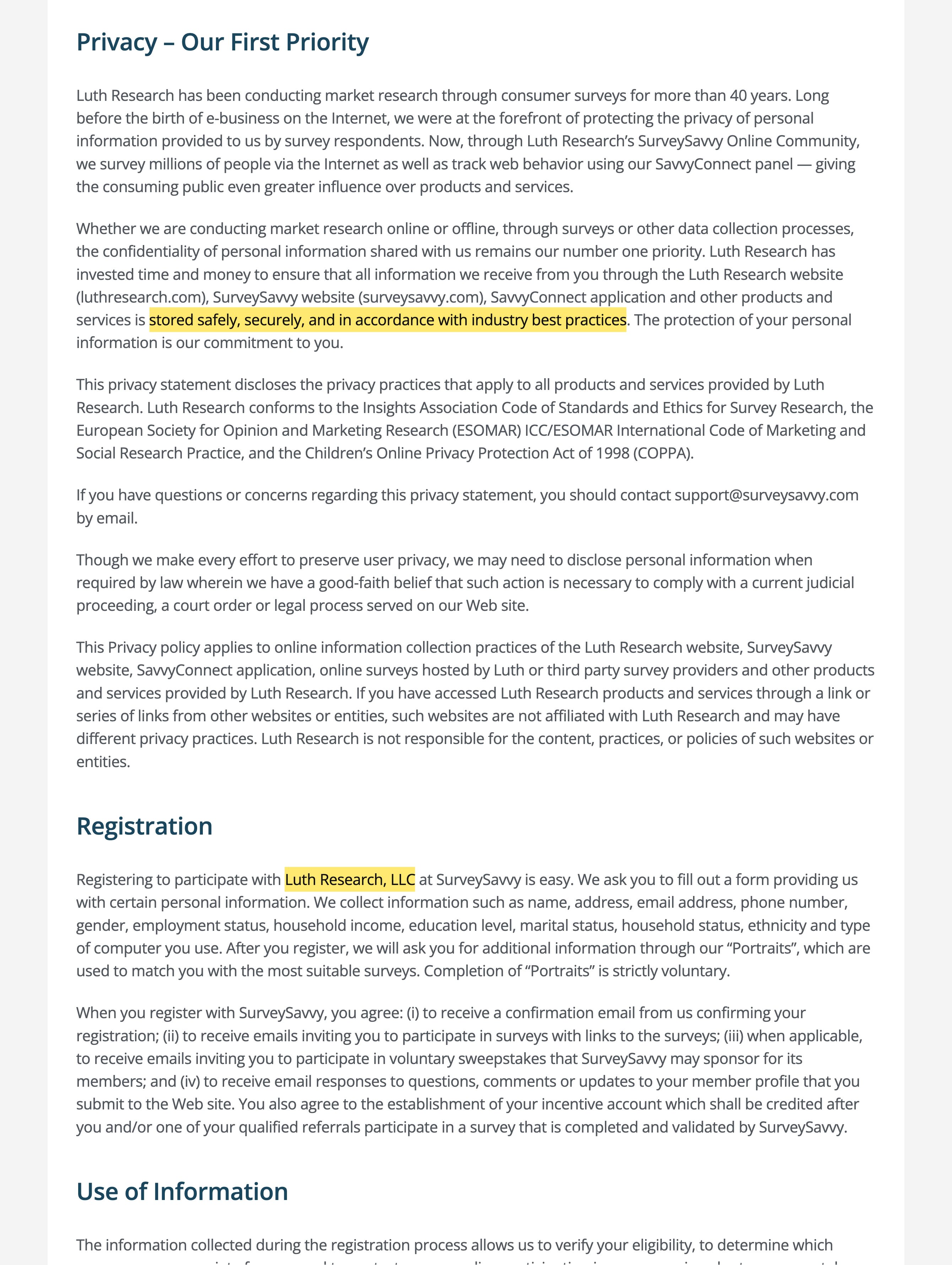
SurveySavvy is operated by “Luth Research, LLC … San Diego, California,” a US market-research firm whose privacy policy says panel data is “stored safely, securely, and in accordance with industry best practices” but names no mainland-China facility — so answers from Chinese respondents are held outside the mainland, a cross-border transfer of personal information PIPL governs (Articles 38–43). Separately, because such a study is commissioned by — or reported back to — a foreign party, China's Administrative Measures on the Administration of Foreign-Related Surveys can require it to run through a license-holding Chinese survey organization: a rule triggered by the foreign relationship, not by where the data sits, so keeping responses in China does not cure it. The table below pairs SurveySavvy's own words with the rule each door triggers.
This is a risk map, not a verdict — whether the survey license is engaged turns on who commissions the study, what you ask, and whether the results leave China. Our China team can map your exposure with you →
Compliance snapshot
- ! A foreign-commissioned survey of China respondents can trigger the Foreign-Related Survey License
- ! Chinese respondents' answers reach US-side servers — a PIPL cross-border transfer
- ✕ Keeping the data in China does not cure the survey-license door — it's relationship-based
- ! Social surveys are treated more strictly than market surveys — study type decides what's allowed
- ! A public survey microsite for mainland visitors needs an ICP filing
What Surveysavvy's own documentation says about China
| Fact | Primary source |
|---|---|
| SurveySavvy is a US market-research panel, run by Luth Research, LLC in San Diego. Its privacy policy names the operator as “Luth Research, LLC, 411 Camino del Rio South, Suite 107, San Diego, California 92108,” and says all information collected “through the Luth Research website…, SurveySavvy website…, SavvyConnect application and other products and services is stored safely, securely, and in accordance with industry best practices.” It names no mainland-China facility — so answers from Chinese respondents are held outside the mainland (inference from a US operation with no stated China region). | SurveySavvy / Luth Research Privacy Policy (surveysavvy.com), retrieved 2026-10-07 |
| A survey of mainland respondents commissioned by — or reported back to — a foreign company can require a Chinese survey license. China's Administrative Measures on the Administration of Foreign-Related Surveys (《涉外调查管理办法》, National Bureau of Statistics Order No. 7) define a “foreign-related survey” by the relationship: a survey an overseas party commissions, funds, or collaborates on, or whose results are provided abroad. The Measures require foreign-related market surveys to run through licensed institutions and foreign-related social surveys to be approved, and a survey spanning provinces needs a national-level license. Critically, this turns on the foreign involvement, not on where the data is stored — so keeping responses in China does not resolve it. | 《涉外调查管理办法》 Administrative Measures on the Administration of Foreign-Related Surveys, National Bureau of Statistics Order No. 7 (stats.gov.cn), retrieved 2026-10-07 |
| Chinese respondents' answers moving to Luth Research's US-side systems is a cross-border transfer of personal information. Survey responses are personal information; collected from people in the mainland and held outside it, they fall under PIPL as a cross-border transfer — requiring notice, separate consent, and one transfer mechanism (a CAC security assessment, the CAC standard contract, or certification) under Articles 38–43. For a critical-information-infrastructure operator or large-volume handler, personal information collected in China must be stored in the mainland (PIPL Article 40; Cybersecurity Law Article 39 (formerly Article 37)). | China Personal Information Protection Law, Articles 38–43 & 40; Cybersecurity Law Article 39 (formerly Article 37) — applied to SurveySavvy's stated US operation, retrieved 2026-10-07 |
| Whether your study reads as a “market” or a “social” survey changes what structure is even allowed. Under the same Measures, foreign-related social surveys are treated more strictly than market research — they require official approval, and China's foreign-investment access rules restrict foreign ownership of social-survey bodies while allowing market-survey bodies as joint ventures. A study that looks like social research rather than product research narrows the lawful options. Separately, if you publish a survey microsite to mainland visitors, that public site needs an ICP filing (State Council Order No. 292; MIIT Order No. 33), which a site served from outside the mainland cannot hold. | 《涉外调查管理办法》 (stats.gov.cn) and China's foreign-investment access rules; ICP regime — State Council Order No. 292, MIIT Order No. 33, retrieved 2026-10-07 |
Sources verified by the 21YunBox compliance team on 2026-10-07.
For a mainland-China audience, the question about SurveySavvy is not whether the survey page paints quickly — it is whether you are allowed to run the study at all, and where the answers are permitted to live. SurveySavvy is an online research panel operated from the United States by Luth Research, LLC, and that single fact opens two compliance doors long before performance matters. A survey of mainland respondents that a foreign company commissions, or whose results it receives, can fall under China’s rules for foreign-related surveys; and the responses those respondents give leave the country to reach US-side systems. Reachability is the easy half. The survey license and the data residency are the exposure.
SurveySavvy in China at a glance
| What decides it | In SurveySavvy's own terms |
|---|---|
| Who runs it, and where | Operated by “Luth Research, LLC … San Diego, California 92108.” Panel data is “stored safely, securely, and in accordance with industry best practices,” with no mainland-China facility named. |
| Who's commissioning it | SurveySavvy is a research panel, not a license-holder. Under China's foreign-related-survey rules, a mainland study commissioned by — or reported back to — a foreign party can have to run through a license-holding Chinese survey organization. |
| Where the answers live | Responses from Chinese respondents are personal information held on US-side systems — a cross-border transfer PIPL governs. Luth names no in-China storage of its own. |
| Market or social survey | China treats social research more strictly than market research: foreign-related social surveys require official approval, and foreign ownership of social-survey bodies is restricted. Which bucket your questions fall in changes what is allowed. |
| A public survey page | Host a survey microsite for mainland visitors and that public site needs an ICP filing — which a site served from outside the mainland cannot hold. |
The survey-license door — the one a platform can’t close for you
Start with the question SurveySavvy itself cannot answer: are you even permitted to run the study? China’s Administrative Measures on the Administration of Foreign-Related Surveys (《涉外调查管理办法》, National Bureau of Statistics Order No. 7) define a foreign-related survey by the relationship, not the plumbing. A survey of mainland respondents counts as foreign-related when an overseas party commissions it, funds it, collaborates on it, or receives the results. The Measures then require foreign-related market surveys to be conducted through licensed institutions, require foreign-related social surveys to be approved, and make a license covering surveys that span provinces a national-level one — a provincial permit only reaches inside its own region.
The part that trips people up is what does not change the answer. Because the trigger is the foreign involvement, moving the servers into China, or hiring a local field team, does not make the study domestic. You can store every response in the mainland and still be running a foreign-related survey that must go through a license-holder. This is a different law and a different regulator from the data question below, and clearing one does nothing for the other. SurveySavvy is a US research panel, not a holder of this permit — so on a foreign-commissioned mainland study, the license sits with a Chinese survey organization, not with the tool.
Your respondents’ answers leave China
Now the data door. Survey responses are personal information, and when they are collected from people in the mainland and come to rest on Luth Research’s US-side systems, they cross the border. Under China’s Personal Information Protection Law that is a cross-border transfer, and the handler — you, the organization running the study, not the panel vendor — must give notice, obtain separate consent, and satisfy one transfer mechanism: a CAC security assessment, the CAC standard contract, or certification (Articles 38–43). If you are a critical information infrastructure operator or a large-volume handler, personal information collected in China must be stored in the mainland (PIPL Article 40; Cybersecurity Law Article 39 (formerly Article 37)) — a residency duty an offshore panel cannot meet. Luth’s panel also reaches beyond questionnaires into behavioral tracking through its SavvyConnect application, which widens the personal-information footprint rather than narrowing it.
Market survey or social survey — and the public-page ICP door
One classification decides a great deal before any of this. China treats social research more strictly than market research: foreign-related social surveys require official approval, and China’s foreign-investment access rules bar or tightly limit foreign ownership of social-survey bodies while allowing market-survey bodies only as joint ventures. A study framed as consumer or product research lives on the market-survey side; one that reads as social or opinion research narrows the lawful options sharply, and that line is drawn by what you actually ask. On top of that, if your plan includes a public-facing survey microsite served to mainland visitors, the site itself turns on an ICP filing under State Council Order No. 292 and MIIT Order No. 33 — and a page served from outside the mainland has nothing in-country to file against.
This is a risk map, not a verdict: whether the survey license is engaged, whether your study is market or social, and whether a data-localization duty applies all turn on who commissions the work, what you ask, and whether the results leave China — worth settling with counsel before you field it.
Where 21YunBox fits — a compliant overlay, not a migration
You keep running SurveySavvy exactly as you do today. What a US research panel cannot hand you is the part China keeps local: a lawful route for a foreign-commissioned study, and in-country delivery that can actually be ICP-filed. Our China team maps both doors — the survey-license question against what you are asking and who commissions it, and your PIPL cross-border and data-residency position — then stands up ICP-filed, in-country delivery and storage in front of your existing SurveySavvy setup, with no rebuild and no second codebase. Where the law requires a licensed local party — a Chinese survey organization that holds the foreign-related permit and acts as the in-country data controller — we connect you to one and work in the technical layer, not in the license. Your research stays on SurveySavvy; the pieces China requires to be local sit where they belong.
Related reading:
Frequently Asked Questions
Does storing the survey data on servers in China fix the compliance problem?
No — these are two different laws with two different regulators. Keeping responses in the mainland addresses the PIPL cross-border question, but it does not touch the Foreign-Related Survey License, which is triggered by the relationship — who commissions the study and whether the results go to a foreign party — not by where the data sits. You could store every answer in Shanghai and still need to run the study through a license-holding Chinese survey organization. It's a point to settle with counsel.
Is a foreign company always required to hold the survey license?
Treat it as fact-specific, not automatic. China's Administrative Measures on the Administration of Foreign-Related Surveys turn on the relationship — whether a foreign party commissions, funds, collaborates on, or receives the results of a survey of mainland respondents — and on whether it is a market or a social survey, since social research is more restricted. Whether the license is engaged, and whether it must be national-level (surveys spanning provinces do), depends on your specific study and is a call for a China lawyer.
Can 21YunBox help us run a compliant survey in mainland China?
Yes. Our China team maps your exposure — the survey-license question against who commissions the study and what you ask, plus your PIPL cross-border and data-residency position — and stands up the ICP-filed, in-country delivery and storage a compliant presence needs, in front of the SurveySavvy setup you already run. Where the law requires a licensed local party, we connect you with a China survey organization that holds the foreign-related permit and sit in the technical layer, not in the license. Get in touch to work through your specific case.