Does Weglot Work in China? ICP, Offshore Reachability & a Translation Overlay
Weglot is a translation layer — a JavaScript snippet from its offshore CDN (cdn.weglot.com) plus subdirectory/subdomain language URLs — not a mainland host. A public mainland site still needs its own ICP filing, and where translation resolves in the browser it depends on reaching Weglot's offshore script. A compliance-first look at the two doors.
Does Weglot work in China?
For a public, mainland-China audience the honest answer is "yes, but not on Weglot's offshore layer alone" — and the deciding factors are licensing and reachability, not translation quality. You keep Weglot as your translation layer; what a public China site needs on top is an ICP-filed, in-country presence Weglot was never meant to provide — plus a route that keeps Weglot's own offshore script reachable where your translations resolve in the browser.
Weglot is an overlay you add to an existing site: its own setup has you include client code "right before the </head> tag" from cdn.weglot.com, and "Your API key is then used to retrieve the settings of your project from your Weglot dashboard." It then "automatically creates subdirectories or subdomains for each new language." Two things follow for a public China site, set against Weglot's own wording in the table below: your base site and those translated URLs still need an ICP filing on in-country hosting, which a translation overlay does not provide; and where translation resolves in the visitor's browser, that offshore script and settings call have to reach the mainland or the translated content stalls. A mainland visitor's IP and language seen by Weglot's offshore service add a lighter PIPL question on top.
This is a risk picture to take to counsel, not a verdict — what applies turns on whether you serve the public in China, your entity, how you integrate Weglot, and the data your site handles. Our China team can map the Weglot + 21YunBox path with you →
What Weglot's own documentation says about China
| Fact | Primary source |
|---|---|
In Weglot's own setup docs, the translation layer loads from Weglot's offshore infrastructure. Weglot's JavaScript integration has you add its client code "right before the </head> tag" — a script served from cdn.weglot.com — and states that "Your API key is then used to retrieve the settings of your project from your Weglot dashboard." Weglot also renders translations server-side for crawlers, but on the JavaScript integration the translation resolves in the visitor's browser against that offshore script and settings call. Where that is how your site runs, mainland reachability of Weglot's offshore delivery — not translation quality — decides whether the translated content loads. | Weglot Developer Documentation — JavaScript, Getting Started, retrieved 2026-10-07 |
Weglot gives each language its own URL on your domain — but the translation layer behind them is Weglot's. In Weglot's words it "automatically creates subdirectories or subdomains for each new language you add to your website," which it calls "mandatory if you want Google to index your translated pages." Those language URLs (for example yoursite.com/zh/) sit on your own domain, so they are part of the public mainland-facing site that needs an ICP filing — while the translations, settings and management that populate them live on Weglot's offshore infrastructure, not an in-country host. | Weglot — Multilingual SEO & GEO, retrieved 2026-10-07 |
| A public mainland-China site needs an ICP filing, and a translation overlay gives it nothing to attach to. Under State Council Order No. 292 (Article 4) and MIIT Order No. 33, an ICP filing (备案) attaches to a hosting resource physically inside mainland China and to a mainland legal entity. Weglot hosts no mainland region and is a translation layer, not a host — so neither your base site nor its Weglot-generated language URLs gain an ICP path from Weglot. That is a licensing-and-location boundary, not a defect in Weglot. | State Council Order No. 292 (Measures for the Administration of Internet Information Services), Article 4; MIIT Order No. 33 (ICP filing measures) |
| A mainland visitor's real IP and chosen language are personal information, so sending them to Weglot's offshore service is a cross-border question. Serving the mainland while the translation layer runs on offshore infrastructure carries visitor data out of the country — a cross-border transfer under PIPL (Chapter III, Articles 38–43: notice, separate consent, and one permitted transfer mechanism; Article 40, with Cybersecurity Law Article 39 (formerly Article 37), adds in-country storage for a CIIO or large-volume handler). A mostly-static translated marketing site is lighter here than a data-heavy app, but the compliant design still answers it the same way — an ICP-filed, in-country entry in front of your site. | PIPL Chapter III, Articles 38–43 and Article 40; Cybersecurity Law Article 39 (formerly Article 37) |
Sources verified by the 21YunBox compliance team on 2026-10-07.
For a mainland-China audience the deciding question about Weglot is not how good the translations are — it is where your site is licensed to be served, and whether Weglot’s offshore translation layer can reach your readers. Weglot does not host your site; it sits on top of one, adding translated language URLs and a client script that, in its own documentation, loads from cdn.weglot.com and pulls your project settings from the Weglot dashboard. That shape settles two compliance questions before performance ever enters: your public mainland site still needs its own ICP filing, which a translation overlay cannot carry; and where the translation resolves in the browser, that offshore script has to reach the mainland. A lighter data-residency question rides along on any visitor data Weglot’s offshore service sees.
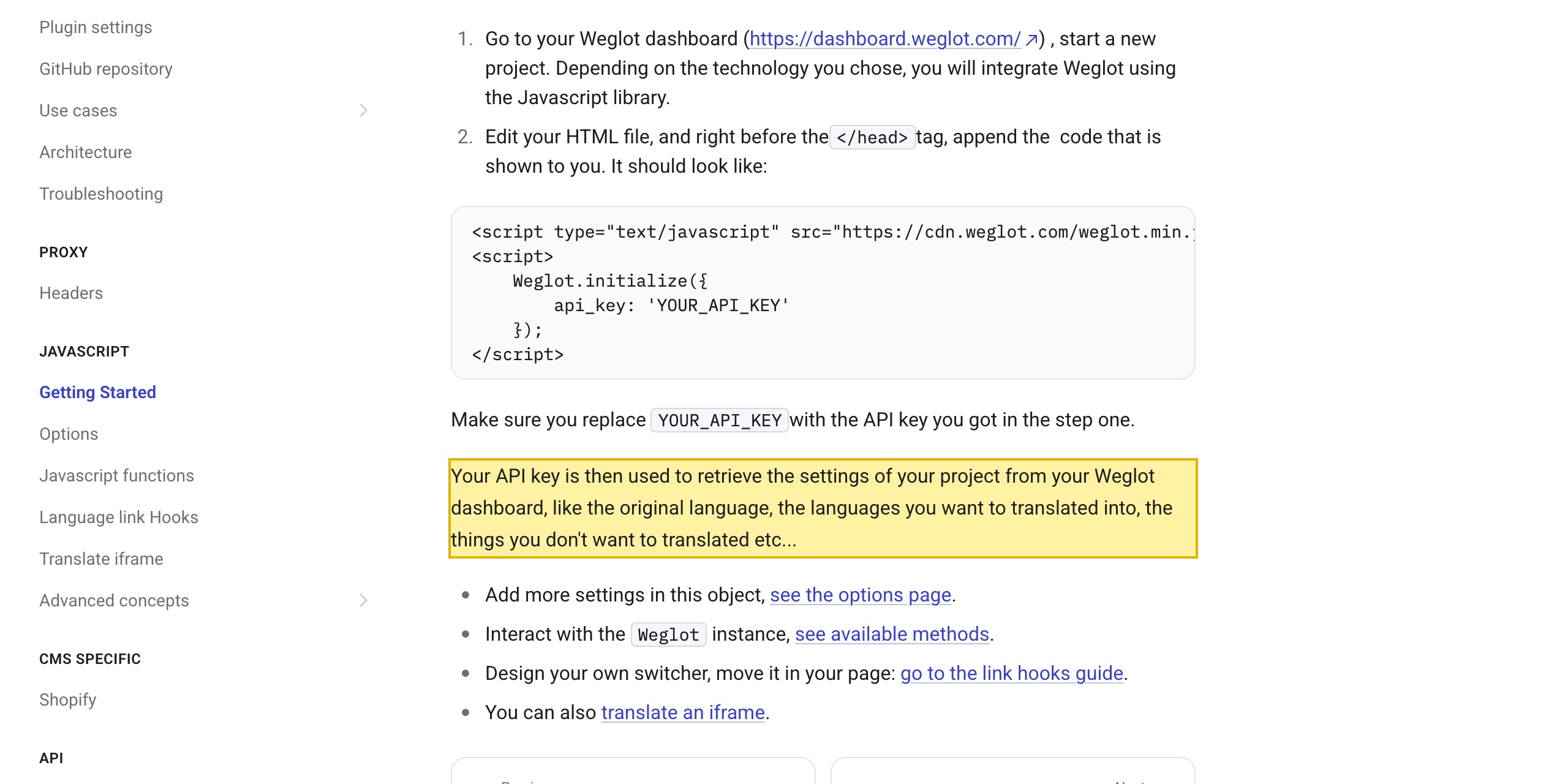
</head> tag” — a script loaded from cdn.weglot.com — and “Your API key is then used to retrieve the settings of your project from your Weglot dashboard.” Both the script and the settings call are served from Weglot's offshore infrastructure. Source: developers.weglot.com/javascriptWeglot in China at a glance
| What decides it | In Weglot's own terms |
|---|---|
| What it is | A website translation layer added to a site that already exists. In the JavaScript integration you include Weglot's client code “right before the </head> tag” from cdn.weglot.com. It translates — it does not host your site, and runs no mainland-China region. |
| Where the language pages live | Weglot “automatically creates subdirectories or subdomains for each new language” (for example yoursite.com/zh/). The URLs sit on your own domain; the translations, settings and management behind them sit on Weglot's offshore infrastructure. |
| Serving the public | Your public mainland site — the base pages and the Weglot-generated language URLs — needs an ICP filing tied to in-country hosting. Weglot is a translation overlay and offers no ICP-filing path of its own. |
| Where translation resolves | Weglot renders pages server-side for crawlers, but its JavaScript library resolves the translation in the visitor's browser by fetching its offshore script and project settings. Where that is your setup, mainland reachability of that offshore delivery decides whether translated content loads. |
| Visitor data | A mainland visitor's real IP and chosen language are seen by Weglot's offshore service — a cross-border transfer PIPL governs. Lighter for a mostly-static marketing site than a data-heavy app, but still a cross-border flow by design. |
A translation overlay, not a mainland host — the ICP filing stays yours
Weglot is added to a site you already run: you keep your host, your CMS and your domain, and Weglot layers translated language URLs on top. That is also why it cannot answer the licensing question for you. A public-facing website served to mainland visitors turns on an ICP filing (ICP 备案) under State Council Order No. 292 and MIIT Order No. 33, and that filing has to attach to hosting physically inside mainland China, held by a mainland legal entity. Weglot runs no mainland region and is a translation layer rather than a host, so there is nothing on Weglot — not your base pages, and not the subdirectory or subdomain URLs it generates — for a filing to sit on. “We already use Weglot” settles your languages, not your clearance to operate in China.
Where the translation resolves decides whether the offshore script matters
Weglot can render translated pages server-side — its own material describes translated pages as being “fully rendered before they reach the visitor’s browser” so crawlers see complete pages. But its JavaScript integration resolves the translation in the browser: the page first loads Weglot’s client code from cdn.weglot.com, then retrieves your project’s settings from the Weglot dashboard, before it can present the translated content. Where that is how your site runs, the translation layer depends on reaching Weglot’s offshore script and API from inside the mainland — if that offshore delivery is slow or unreachable, your base page can paint while the translated content stalls behind it. Server-rendered and CMS integrations move the dependency rather than remove it: the translations, settings and updates still come from Weglot’s offshore dashboard and API. This is the delivery half of the question, and it turns on where Weglot’s control plane sits — not on how good the translations are.
A lighter cross-border-data question rides along
Because Weglot’s translation layer runs offshore, a mainland visitor’s request — including their real IP address and the language they land in — is seen by infrastructure outside the mainland. Under China’s Personal Information Protection Law that is a cross-border transfer of personal information: the handler — you, not Weglot — gives notice, obtains separate consent, and clears one transfer mechanism (a CAC security assessment, the CAC standard contract, or certification). A mostly-static translated marketing site carries far less personal data than a logged-in application, so this door is lighter here — but the compliant design answers it the same way, with an in-country, ICP-filed entry in front of your site rather than each visitor’s request crossing the border to be translated.
This is a risk map, not a verdict: whether you need an ICP filing, an in-country delivery path, in-country storage, or some combination depends on what you serve, how you integrate Weglot, how much personal data you hold, and who your users are — worth settling with counsel before you build.
Where 21YunBox fits — a compliant overlay, not a migration
You keep Weglot as your translation layer — your project, your translations, your language URLs and the visual editor all stay exactly where they are. What we add is the piece a translation overlay was never meant to carry: compliant, ICP-filed delivery from inside the mainland, placed in front of your existing site so your base pages and Weglot’s translated URLs reach mainland readers from a licensed in-country presence. Our China team maps your ICP, reachability and cross-border-data obligations against your entity and the data you handle, then stands up the in-country delivery a lawful China presence needs — no rebuild, no second codebase, and no move off Weglot.
Related reading: