Does Stackbit Work in China? ICP, PIPL & the Editor-vs-Host Line
Stackbit — now Netlify Visual Editor — is an authoring layer, not a host, so it carries no ICP of its own. The China compliance questions land on the site you deploy and the personal data it collects. A compliance-first look at both doors.
Does Stackbit work in China?
Stackbit is a visual editor, not a host — today it ships as Netlify Visual Editor — so it carries no ICP filing of its own. Whether it "works" in mainland China is decided one layer down: on the site you publish and the personal data that site collects from Chinese users.
In Netlify's own words the editor is "an environment for content editors to work with structured content in a visual way" that "stores content back to the appropriate source" — an authoring layer that sits on top of your stack, not the thing China licenses. The gate is on the deployed origin: a public site served to mainland visitors needs an ICP filing bound to a mainland host, and Netlify runs no region inside mainland China — its own China guide says "you'll need to host it in China and bring your site's resources inside the firewall." Any personal data that site then collects from Chinese users leaves the mainland, a cross-border transfer PIPL governs. The table below maps each door in Stackbit's and Netlify's own words.
This is a risk map, not a verdict — which doors apply turns on where you deploy, what you serve, and whose data you hold. Our China team can map your exposure with you →
What Stackbit's own documentation says about China
| Fact | Primary source |
|---|---|
| Stackbit is an authoring layer, not a host — today it ships as Netlify Visual Editor. Netlify's documentation describes it as "an environment for content editors to work with structured content in a visual way," "compatible with any site framework and API-enabled content source," that "stores content back to the appropriate source." When it was acquired, Netlify said, "Today, we are thrilled to announce Netlify has acquired Stackbit!" A tool that reads and writes your content is not the thing mainland China licenses — the ICP duty lands on the site you deploy, not on the editor. | Netlify Visual Editor docs (docs.netlify.com) & Netlify acquisition announcement (netlify.com), retrieved 2026-10-07 |
| The compliance gate is on the deployed site, and it needs an ICP filing bound to a mainland host. Netlify's own guide to serving mainland China tells composable teams "you'll need to host it in China and bring your site's resources inside the firewall," and that "Content publication in China requires proper licensing, such as ICP Filing." A Stackbit-built site deployed on Netlify's edge is served from offshore, with no mainland hosting resource an ICP filing can attach to — the regime under State Council Order No. 292 and MIIT Order No. 33. | Netlify — How to bring your composable website inside the Chinese firewall (netlify.com), retrieved 2026-10-07; State Council Order No. 292; MIIT Order No. 33 |
| Personal data the published site collects from Chinese users leaves the mainland. A Stackbit-built site served from an offshore edge stores its visitors' personal information outside China — a cross-border transfer under PIPL for which the handler (you, not Stackbit or Netlify) must give notice, obtain separate consent and clear one transfer mechanism (Articles 38–43). For a critical information infrastructure operator or a large-volume handler, personal information collected in China must be stored in the mainland (PIPL Article 40; Cybersecurity Law Article 39 (formerly Article 37)) — a residency duty an offshore edge cannot meet. | PIPL Articles 38–43 & 40; Cybersecurity Law Article 39 (formerly Article 37); with Netlify's own China guidance (netlify.com), retrieved 2026-10-07 |
| Don't file an ICP for the editor — it is not what China licenses. Netlify notes Visual Editor "is run in a Node-based environment by default" and "is only available for teams that already have it enabled through Netlify Support" — it is where your team edits, not what mainland visitors load. Whether the authoring tool is reachable from a given office is a workflow question; the ICP and data-residency duties attach to the public site you deploy and the personal data it handles, not to the authoring layer. | Netlify Visual Editor docs (docs.netlify.com), retrieved 2026-10-07 |
Sources verified by the 21YunBox compliance team on 2026-10-07.
For a mainland-China audience, the first question about Stackbit is not how fast it renders — it is which layer of your stack the law attaches to. Stackbit is a visual editor, shipped today as Netlify Visual Editor, and an editor is where your team writes content, not what China licenses. So “does Stackbit work in China” splits cleanly in two: the authoring layer is a workflow detail, while the compliance exposure sits one level down — on the public site you deploy and the personal data that site gathers from Chinese visitors. ICP filing and PIPL decide the answer there; reachability is only the smaller, downstream half.
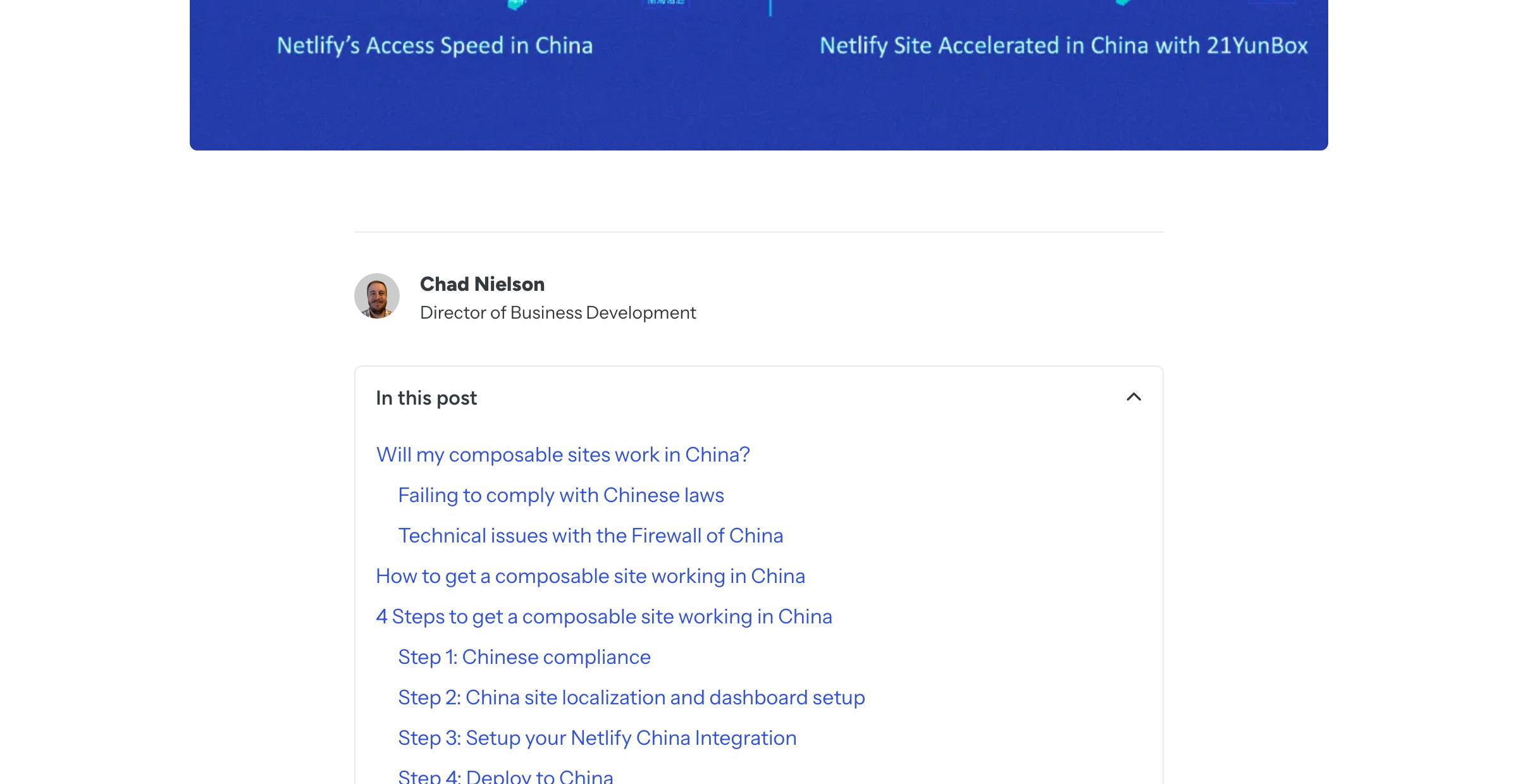
Stackbit in China at a glance
| What decides it | In Stackbit / Netlify's own words |
|---|---|
| What it is | Stackbit is now Netlify Visual Editor — “an environment for content editors to work with structured content in a visual way,” “compatible with any site framework and API-enabled content source.” An authoring layer, not a host. |
| Where it runs | The editor “is run in a Node-based environment” for your team; the public site runs wherever you deploy. On Netlify that is its global edge, with no region inside mainland China. |
| Does it carry an ICP? | No. A visual editor holds no ICP of its own. The filing attaches to the deployed site and its mainland host — and Netlify's guidance is that “you'll need to host it in China.” |
| Serving the public | “Content publication in China requires proper licensing, such as ICP Filing.” A site served from an offshore edge has no mainland host an ICP filing can bind to. |
| Your users' data | Personal data the published site collects from Chinese users sits offshore — a cross-border transfer PIPL governs, with an in-country storage duty for CIIOs and large-volume handlers. |
Stackbit is an editor, not a host — so it carries no ICP of its own
Stackbit joined Netlify and ships today as Netlify Visual Editor. Netlify’s documentation is explicit about what it is: “an environment for content editors to work with structured content in a visual way,” one that is “compatible with any site framework and API-enabled content source” and that “stores content back to the appropriate source.” It sits on top of whatever stack you already run — Netlify’s acquisition note described Stackbit as working “seamlessly with any CMS application, content source, and headless frontend platform, and framework.” That distinction is the whole game in China, because licensing there does not attach to the tool your marketers type into; it attaches to the website the public loads. Treating the editor as the thing that needs an ICP filing is the wrong door — and filing against it would clear nothing.
The ICP door is on the site you deploy
A public-facing website delivered to mainland visitors turns on an ICP filing (ICP 备案) under State Council Order No. 292 and MIIT Order No. 33, and that filing must bind to a hosting resource physically inside the mainland. A Stackbit-built site usually deploys to an offshore host — on Netlify that is its global edge, which runs no region inside mainland China. Netlify says as much in its own guide to serving the country: to make a composable site work there “you’ll need to host it in China and bring your site’s resources inside the firewall,” because “Content publication in China requires proper licensing, such as ICP Filing.” So the editor can be perfectly happy while the deployed origin has nothing in the mainland to file against. Authoring faster does not create the in-country footing a filing needs.
The data door — what your published site collects from Chinese users
The second exposure is the personal data your deployed site gathers — sign-ups, form entries, orders, support messages. Served from an offshore edge, that information comes to rest outside the mainland, and under China’s Personal Information Protection Law that is a cross-border transfer. The handler — you, not Stackbit or Netlify — has to give notice, obtain separate consent, and clear one transfer mechanism: a CAC security assessment, the CAC standard contract, or certification (Articles 38–43). If you are a critical information infrastructure operator or a large-volume handler, personal information collected in China must be stored in the mainland (PIPL Article 40; Cybersecurity Law Article 39 (formerly Article 37)) — a residency duty no offshore edge can satisfy, however you author the content.
This is a risk map, not a verdict: whether you need an ICP filing, in-country storage, or both depends on where you deploy, what your site serves, and how much personal data it holds — worth settling with counsel before you build.
Where 21YunBox fits — a compliant overlay, not a migration
You keep authoring in Stackbit, and you keep deploying the way you already do. What we add is the layer an editor was never meant to supply: compliant, ICP-filed delivery from inside the mainland, set in front of the origin you publish to — no rebuild, no second codebase, and no change to your editing workflow. Our China team works out which doors apply to you, weighs your PIPL cross-border and data-residency exposure against your entity and data volumes, and stands up the in-country delivery and storage a lawful China presence needs, while your content stays in the same place your team edits it today.
Related reading: