Does Sanity work in China?
For Sanity this is a delivery question first, not a data-residency one. Sanity is a headless content platform that keeps your editorial content on Google Cloud and hands it to your site through a global API CDN with no point of presence inside mainland China, so fetching it live from behind the Great Firewall is a reachability risk — while the ICP filing and PIPL duties that actually decide whether your site is lawful sit on the website that embeds Sanity, not on the CMS.
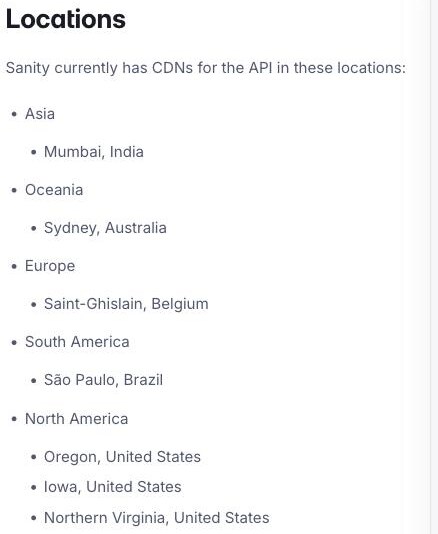
Sanity states it "is hosted on Google Cloud Platform," that its "backend systems currently run across three data centers in a single EU region (Belgium)," and it recommends its API CDN — "the CDN-distributed, cached API" — "if you are going to fetch content from a browser." Its published points of presence are in India, Australia, Belgium, Brazil and the United States, none inside the mainland, so a page that queries Sanity at request time leans on a cross-border round trip that can stall or drop. But what travels is your own copy, images and structured documents, not your visitors' personal information, so Sanity by itself generally does not create a cross-border transfer of user data under PIPL. The duties that do decide legality — an ICP filing on in-country hosting, and PIPL for whatever personal data your site collects — belong to the embedding site. The table below sets Sanity's own wording beside the rule each line triggers.
This is a risk map, not a verdict — where the line falls depends on how you host the site, what user data it collects, and whether you ever store personal data as content. Our China team can map your exposure with you →
What actually decides whether a Sanity-powered site works in mainland China
| Fact | Primary source |
|---|---|
| Sanity stores your content on Google Cloud in the EU, with no mainland-China presence. Sanity's security page states the platform "is hosted on Google Cloud Platform" and that "our backend systems currently run across three data centers in a single EU region (Belgium)," with uploaded content "stored in the EU/EEA, the US, or in regions where Sanity has an operational footprint." None of that footprint is inside mainland China, so content fetched from Sanity is always served from offshore. | Sanity — Security (sanity.io/security), retrieved 2026-10-07 |
Your site fetches Sanity content at request time from a global API CDN with no mainland edge. Sanity describes its CDN endpoint apicdn.sanity.io as "the CDN-distributed, cached API" and recommends it "if you are going to fetch content from a browser." Its published points of presence are in Mumbai, Sydney, Saint-Ghislain (Belgium), São Paulo and three US regions, with "a short-lived global CDN ... with points of presence on all continents" in front — and none of them inside the mainland. A page that pulls from Sanity live inside China therefore depends on a cross-border round trip through the Great Firewall, which is where slowness or intermittent failures appear. This is a delivery risk, not a legal one. | Sanity — API CDN docs (sanity.io/docs/content-lake/api-cdn), retrieved 2026-10-07 |
| The payload is your editorial content, not your users' data — so the compliance doors sit on your site, not on Sanity. What Sanity stores and delivers is the content your team authors for public display — copy, images, structured documents — not your end users' personal information, so moving it through Sanity's Google Cloud infrastructure does not by itself create a PIPL cross-border transfer of user data. What decides legality is the public site that shows that content to mainland visitors: it needs an ICP filing on in-country hosting (State Council Order No. 292; MIIT Order No. 33), and any personal information it collects from Chinese users is its own PIPL matter (Articles 38–43; Article 40; Cybersecurity Law Article 39 (formerly Article 37)). | Sanity — Security (sanity.io/security), retrieved 2026-10-07; State Council Order No. 292; MIIT Order No. 33; PIPL Articles 38–43 & 40; Cybersecurity Law Article 39 (formerly Article 37) |
| If you model personal data as content in Sanity, that content crosses the border too. A Sanity dataset holds whatever you choose to model as a document, so putting personal data — user profiles, form submissions, anything identifying a real person — into a Sanity field sends it offshore to Google Cloud like any other payload, and the PIPL cross-border rules (Articles 38–43) attach to it. The clean line is to keep Sanity for editorial content and keep personal data out of it, so data residency never becomes the CMS's problem. | Sanity — Content modeling & datasets docs (sanity.io/docs), retrieved 2026-10-07; PIPL Articles 38–43 |
Sources verified by the 21YunBox compliance team on 2026-10-07.
Because this is a how to make Sanity work in China question, it pays to split it in two before reaching for any fix — one half is a delivery problem you can engineer, the other is a compliance problem you cannot. Sanity is a headless content platform: it keeps your structured editorial content on Google Cloud and serves it to your site through a content API fronted by a global CDN. That CDN has points of presence spread across continents but none inside mainland China, so the honest Sanity-level risk is reachability — a site that fetches its content live from behind the Great Firewall can be slow or unreliable. What Sanity does not do is turn your project into a data-residency problem on its own, because what it carries is your own copy and images, not your visitors’ personal information. The filing and privacy duties that actually decide whether your China-facing site is lawful sit on the site that embeds Sanity — and reaching Sanity’s content is the easy half next to them.
Sanity in China at a glance
| What decides it | In Sanity's own terms |
|---|---|
| Where it runs | Sanity “is hosted on Google Cloud Platform,” with backend systems that “run across three data centers in a single EU region (Belgium)” and content “stored in the EU/EEA, the US, or in regions where Sanity has an operational footprint.” No region is inside mainland China. |
| How your site gets content | Your front end queries Sanity's content API — the CDN endpoint apicdn.sanity.io, “the CDN-distributed, cached API” — at request time. Its points of presence are offshore (Mumbai, Sydney, Belgium, São Paulo, the US); none is inside the mainland, so each fetch crosses the border. |
| What's in the payload | Your own editorial content — copy, images, structured documents — authored for public display, not your end users' personal information. By itself that is generally not a PIPL cross-border transfer of user data. |
| Serving the public | The public site that embeds Sanity and is shown to mainland visitors needs an ICP filing on in-country hosting. That duty belongs to the site and its host, not to the CMS. |
| The edge case | Model personal data as content inside Sanity and it leaves the mainland with every fetch — and PIPL's cross-border rules attach to it like any other payload. |
Reaching Sanity’s content is the easy half
Start with the part a network can actually fix. Sanity is open about where it runs: its security page says the platform “is hosted on Google Cloud Platform,” that “our backend systems currently run across three data centers in a single EU region (Belgium),” and it serves your front end through a content API fronted by a CDN. That CDN — apicdn.sanity.io, in Sanity’s words “the CDN-distributed, cached API” it recommends “if you are going to fetch content from a browser” — spreads its points of presence across continents: Mumbai, Sydney, Saint-Ghislain, São Paulo and three US regions, with “a short-lived global CDN … with points of presence on all continents” in front. Read that list closely and the gap is plain: every node sits outside mainland China, and the nearest Asian one is in India. A request made from Shanghai or Chengdu still has to leave the mainland and come back to reach Sanity’s edge, and that round trip — not any block aimed at Sanity — is where the slow loads and the occasional dropped fetch come from. It is a genuine delivery risk, and it is the half network design can steady. Treat it as reachability, not legality.
A content platform is not, by itself, a data-residency problem
Here is where teams most often over-correct. Seeing that the CMS runs on Google Cloud in Europe, they reach for the cross-border-data alarm — and for a pure content platform that alarm is usually pointed at the wrong thing. Sanity’s job is to hold and deliver what your editors publish: headlines, body copy, images, the structured documents that make up a page. That is material authored for the public, not the personal information of the people who read it, and shipping it through Sanity’s Google Cloud backend does not on its own constitute a cross-border transfer of user data under PIPL. Precision earns its keep here — call a content platform a data-residency breach and you manufacture a duty it never created, while the obligations that genuinely bind you fade into the background.
One edge does deserve a watch. A Sanity dataset will hold whatever you decide to model as a document, so the instant personal data — a customer record, a submitted form, any field that identifies a real individual — goes into Sanity, it rides offshore with every fetch just as a blog post would, and PIPL’s cross-border provisions (Articles 38–43) fasten onto it. The rule to hold is plain: let Sanity carry editorial content and keep personal data in systems you govern, and residency never becomes the CMS’s question.
The compliance doors live on your site, not the CMS
The rules that actually decide legality live one layer out — on the website that embeds Sanity, not on Sanity itself. Any public site shown to mainland visitors needs an ICP filing (ICP 备案) under State Council Order No. 292 and MIIT Order No. 33, and the filing can only attach to hosting that physically sits inside the mainland. The deciding fact is where your pages and your origin are served from — not where the CMS happens to live — so a headless front end powered by Sanity still has to stand on its own in-country, ICP-filed hosting before it serves Chinese users cleanly. On top of that, whatever personal information your site gathers from those users — registrations, orders, support requests — is yours to account for as the handler: notice, separate consent and a lawful transfer mechanism when that data leaves the mainland (Articles 38–43), and in-country storage if you are a critical information infrastructure operator or a high-volume handler (PIPL Article 40; Cybersecurity Law Article 39 (formerly Article 37)). None of this belongs to Sanity, and none of it is fixed by shortening the trip your content takes. This is the China work that counts, and it is the half no amount of tuning will clear for you.
This is a risk map, not a verdict: whether your site needs an ICP filing, in-country storage, or simply a steadier way to reach Sanity turns on how you host it, what personal data it collects, and who your users are — worth settling with counsel before you build.
Where 21YunBox fits — a compliant overlay, not a migration
You keep authoring in Sanity, exactly as you do today — same Studio, same datasets, same content API. What we add is the piece a Google-Cloud-hosted content platform cannot: compliant, ICP-filed delivery from inside the mainland, set in front of your existing Sanity-powered site so your pages reach Chinese users without waiting on a cross-border round trip to Sanity’s edge — no rebuild, no second codebase, and no change to your Sanity workflow. Our China team takes the two halves one at a time: how reliably your content arrives, and the ICP and PIPL duties that sit on your embedding site, weighed against your entity, your hosting and the personal data your site actually collects. Sanity stays your CMS; the compliant China presence is built around it.
Related reading:
