Does Google Docs Work in China? Data Residency & Cross-Border Risk
Google Docs stores document content and personal data on servers outside mainland China, and does not load from an ordinary China connection. A compliance-first look at the data-residency and PIPL questions.
Does Google Docs work in China?
Using Google Docs for people in mainland China is a data-residency and cross-border-transfer question before it is a speed one. Google Docs also does not load from an ordinary mainland connection — but even if it did, the documents and the personal information inside them would still sit on Google servers outside China.
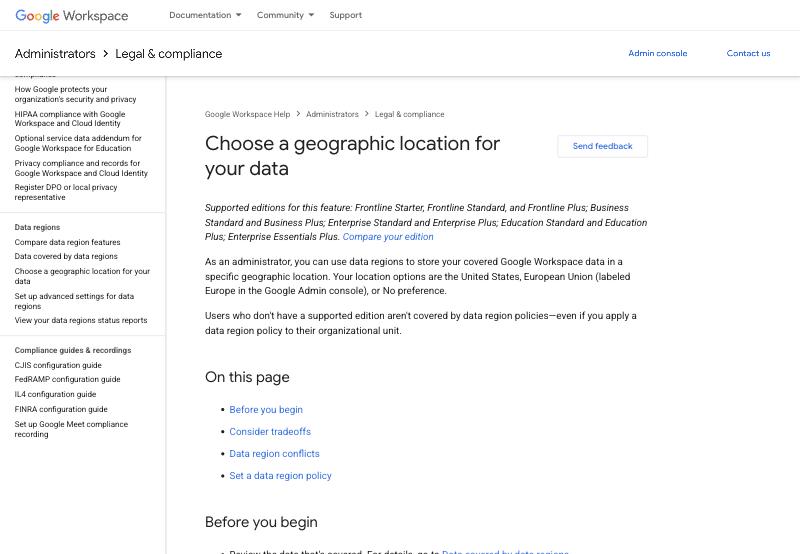
In Google's own documentation, your data-region choices are "the United States, European Union (labeled Europe in the Google Admin console), or No preference" — there is no mainland-China option, and Google lists no data center in the mainland. So any names, emails, contacts or records your team places in a Doc are held abroad: a cross-border transfer of personal information that PIPL governs, needing notice, separate consent, and a transfer mechanism — and for a CIIO or large-volume handler, in-country storage that Google structurally cannot offer. The table below is Google's own wording and the rules it triggers.
This is a risk picture, not a verdict — your obligations turn on your data volumes and your role. Our China team can map your exposure with you →
What Google Docs's documentation says, and what we measured from inside China
| Fact | Primary source |
|---|---|
| In Google's own words, there is no China option for where your data lives: for Google Workspace data regions, "Your location options are the United States, European Union (labeled Europe in the Google Admin console), or No preference." The data a region covers includes, for Google Docs, "File body texts, embedded images, drawings, and associated end user-generated comments," and for Contacts, "Contact names, email addresses, phone numbers, and other contact information." Google's own locations page lists its Asian data centers in Taiwan, Japan, Singapore, India, Thailand and Malaysia — none in mainland China. | Google Workspace Admin Help — "Choose a geographic location for your data" and "Data covered by data regions"; Google — "Locations of Google Data Centers" (datacenters.google/locations), all retrieved 2026-10-07 |
| Because that content leaves China (or is created on servers that were never in China), PIPL requires the personal-information handler — Google's customer, not Google — to give notice, obtain separate consent for the overseas transfer, and satisfy one of its mechanisms: a CAC security assessment, the CAC standard contract, certification, or another permitted basis. | PIPL Chapter III, Articles 38–43 |
| The exposure scales with volume and role, not merely with opening the app: since the CAC's March 2024 cross-border rules, a non-CIIO transferring fewer than 100,000 individuals' non-sensitive personal information in a calendar year is exempt from the security assessment, standard contract and certification. [Inference: a shared Doc can hold HR, health or financial details — sensitive personal information — which fall outside that exemption; confirm your category, volume and role with counsel.] | CAC — Regulations on Promoting and Regulating Cross-border Data Flows, March 2024 |
| For a CIIO or large-volume handler, personal information collected in China must be stored in mainland China (CSL Article 39 (formerly Article 37); PIPL Article 40). Google offers no mainland-China data region and lists no mainland data center, so Google Docs cannot meet a data-localization duty on its own. The compliant route is in-country storage and delivery you provide for your China-facing content — and serving that from inside the mainland is the step a website's ICP filing exists to authorize. | PIPL Article 40; CSL Article 39 (formerly Article 37); Google — "Locations of Google Data Centers" (datacenters.google/locations), retrieved 2026-10-07 |
Requested directly from a probe inside mainland China (Alibaba Cloud cn-zhangjiakou) on 2026-08-28, Google Docs (docs.google.com) produced no response at all in three of three attempts — no first byte, not a slow load. It was not alone: across the same census we requested twelve Google-owned properties three times each, and eleven of the twelve never answered. The one that did — the Google Fonts stylesheet endpoint — then failed 54 requests out of 54 when the same measurement ran on a Beijing China Mobile residential line on 2026-08-30. | 21YunBox — 280-site China delivery census and paired Beijing residential measurement, measured from inside mainland China |
Sources verified by the 21YunBox compliance team on 2026-10-07.
For a team in mainland China, the first question about Google Docs is not how fast it loads — it is where the data goes. Google Docs keeps your document bodies, and the names, emails and records your team types into them, on Google servers outside the mainland, and Google offers no setting to move them inside it. That storage choice, not page speed, is what turns everyday Docs use into a question for your compliance team: under China’s rules, personal information held abroad is a cross-border transfer. Google states where that data can live in its own documentation.
Google Docs in China at a glance
| What decides it | In Google's own terms |
|---|---|
| Where your data can live | Workspace data-region options are “the United States, European Union (labeled Europe in the Google Admin console), or No preference” — there is no mainland-China choice. |
| What those regions hold | For Docs, “File body texts, embedded images, drawings, and associated end user-generated comments”; for Contacts, “Contact names, email addresses, phone numbers, and other contact information.” |
| Where the data centers are | Google's locations page lists its Asian data centers in Taiwan, Japan, Singapore, India, Thailand and Malaysia — none in mainland China. |
| What that means under PIPL | Document bodies and the personal data inside them sit offshore — a cross-border transfer of personal information PIPL governs, on infrastructure that cannot be ICP-filed. |
| Reachability | From an ordinary mainland connection our probe (Alibaba Cloud cn-zhangjiakou, 2026-08-28) got no response in three of three attempts. |
The real question — where your document data lives
Google lets a Workspace administrator pick a geographic region for covered data, but the only places on the menu are the United States and the European Union, plus a “No preference” option — there is no mainland-China region to choose, and Google’s own locations page lists no data center on the mainland. For Google Docs, the data that choice governs is the substance of the work: “File body texts, embedded images, drawings, and associated end user-generated comments,” and, through Contacts, “Contact names, email addresses, phone numbers, and other contact information.”
So every name, email address or record a China-based colleague places in a Doc is created on, or moves to, a server abroad. Under China’s Personal Information Protection Law that is a cross-border transfer, and the obligation lands on the personal-information handler — you, Google’s customer, not Google. PIPL asks you to give notice, obtain separate consent for the overseas transfer, and meet one of its transfer mechanisms. And where you are a CIIO or a large-volume handler, personal information collected in China must be stored in the mainland (Cybersecurity Law Article 39 (formerly Article 37); PIPL Article 40) — a duty no Google Docs setting can satisfy, precisely because Google offers no China region to store it in. Docs is far from alone in that: 755 of the 763 tools in our SaaS compliance census, each checked against its own documentation in October 2026, hold personal data that becomes the same kind of transfer for users in mainland China.
It also doesn’t load from an ordinary mainland connection
Separate from where the data lives, Google Docs is hard to reach on the ground. Requested directly from a probe inside mainland China — an Alibaba Cloud instance in cn-zhangjiakou on 2026-08-28 — docs.google.com returned no response at all in three of three attempts: not a slow load, no first byte. Most Google-owned properties we requested in the same census behaved the same way.
Reaching a blocked overseas service through a workaround is its own regulatory question, and it changes nothing about where your documents are stored — the data still lives abroad. So reachability and residency point to the same conclusion: the durable place for your China-facing content is in-country infrastructure that is served legally, not a harder-to-reach copy of an offshore service.
What a compliant path looks like — and what it is not
The fix is not to “make Google Docs store your data in China.” Google publishes no mainland data region, so that option does not exist, and no vendor can conjure one on top of Google’s platform. A compliant approach has two honest moves instead:
- Treat your team’s Docs use as the cross-border transfer it is, and satisfy PIPL for it — notice, separate consent, and a transfer mechanism sized to your data volume and to how sensitive the information in the documents is. Since the CAC’s March 2024 cross-border rules, lower-volume, non-sensitive transfers can fall under an exemption, while HR, health or financial details in a shared Doc may not — which is why role and volume, not the act of opening the app, decide your exposure.
- Serve the China-facing content and sites your organization actually publishes from inside the mainland, on ICP-filed, in-country infrastructure. That is the piece an internal collaboration tool was never going to provide, and delivering to the public from inside the territory is exactly what a website’s ICP filing exists to authorize (State Council Order No. 292; MIIT Order No. 33).
This is a risk map, not a verdict: your obligations turn on your role, your data volumes and the sensitivity of what your team keeps in its documents — worth confirming with counsel before you rely on any single reading.
Where 21YunBox fits — a compliant overlay, not a migration
You keep using Google Docs the way your team already does. We don’t move you off it or pretend to relocate Google’s servers — neither is possible, and neither is the point. What we add is the piece Google leaves to you: a reading of your PIPL cross-border and data-residency exposure for the personal information your team keeps in Docs, and — where your China-facing site or content has to be delivered legally from inside the mainland — ICP-filed, in-country delivery and storage placed in front of your existing origin, with no rebuild and no second codebase. Our China team maps the exposure and stands up the in-country footing a compliant China presence requires.
Related reading: