
Does Bloomreach work in China?
Whether Bloomreach works in China is a data-residency and PIPL question before it is a speed one: Bloomreach hosts your content and the shopper behavior it captures only in offshore cloud regions, with none in mainland China. The search box responds; what needs review is where that data lives and the border every request has to cross.
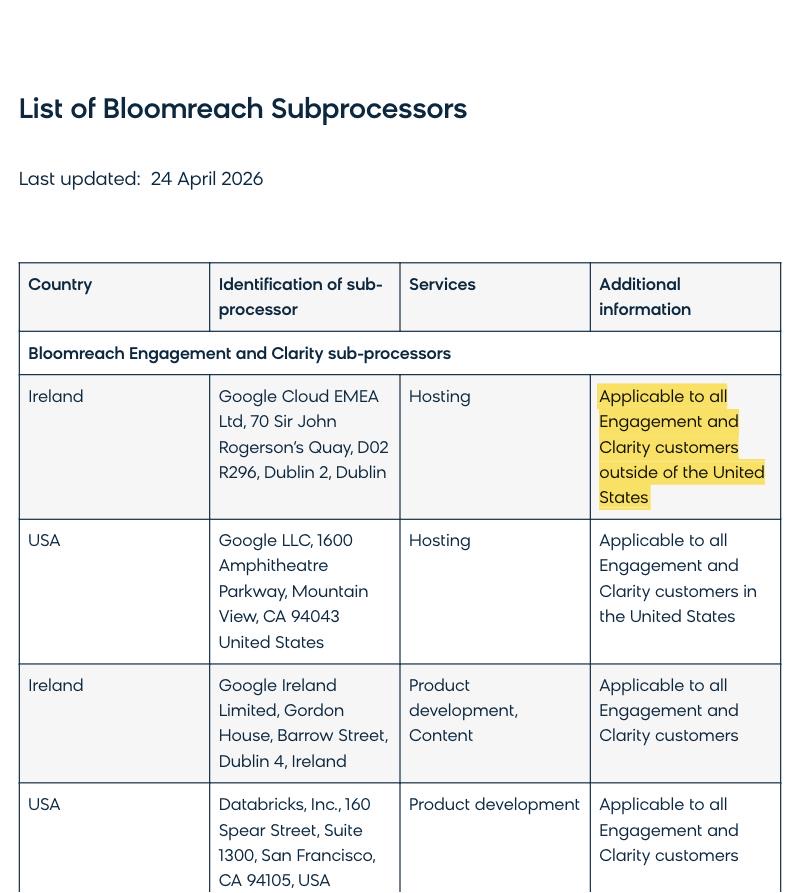
In its own List of Subprocessors, Bloomreach names its hosting providers as Google Cloud in Dublin, Ireland for customers "outside of the United States" and Google LLC in the United States, with its Discovery & Content stack hosted on Amazon Web Services in Luxembourg and Seattle — none inside mainland China. So the content, catalog, search queries and behavioral profiles Bloomreach keeps for a China audience sit abroad: under China's Personal Information Protection Law that personal data is a cross-border transfer, every discovery and personalization call is answered across the border, and the public storefront you run on Bloomreach still needs an ICP filing tied to an in-country host. The table below sets Bloomreach's own wording against the rule each one triggers.
This is a risk picture, not a verdict — what applies turns on the personal data your Bloomreach instance holds and whether you serve the public in China. Our China team can map your Bloomreach data and delivery exposure with you →
What actually decides whether you can run Bloomreach in China
| Fact | Primary source |
|---|---|
| In Bloomreach's own subprocessor list, its hosting is offshore — and no region is inside mainland China. Bloomreach names its "Hosting" sub-processors as Google Cloud EMEA in Dublin, Ireland ("Applicable to all Engagement and Clarity customers outside of the United States") and Google LLC in "Mountain View, CA 94043 United States," with its Discovery & Content stack hosted on Amazon Web Services in Luxembourg and Seattle. The content and catalog you publish, and the shopper data Bloomreach captures, live in whichever of those offshore regions your account runs in — there is no mainland-China option. | Bloomreach — List of Subprocessors (last updated 24 April 2026), retrieved 2026-10-08 |
| The shopper behavior Bloomreach captures is personal data, and offshore that is a cross-border transfer under PIPL. Bloomreach's discovery, personalization and engagement features record what visitors search, click and buy, along with identifiers, consent and the profiles its models build. Collected from people in China and stored in an offshore region, that information leaves the country, and China's Personal Information Protection Law governs it (Chapter III, Articles 38–43: notice, separate consent, and one transfer mechanism — a CAC security assessment, the CAC standard contract, or certification). A CIIO or large-volume handler must keep personal information collected in China inside the mainland (PIPL Article 40; Cybersecurity Law Article 39 (formerly Article 37)); under the CAC's March 2024 cross-border rules a non-CIIO moving fewer than 100,000 individuals' non-sensitive personal information in a calendar year is exempt from those mechanisms. | PIPL Chapter III, Articles 38–43 and Article 40; Cybersecurity Law Article 39 (formerly Article 37); CAC Regulations on Promoting and Regulating Cross-border Data Flows (March 2024) |
| Bloomreach delivers search and personalization over APIs served from those offshore regions, so every China request crosses the border. Its discovery, recommendation and content APIs resolve against the region your account is hosted in — Google Cloud or AWS in Ireland, the US or Luxembourg per its subprocessor list, fronted by a US-based Cloudflare CDN. With no deployment inside mainland China, each dynamic query and personalization call from a China shopper is answered across the border and is exposed to the same cross-border interruption any offshore API faces from the mainland; caching static assets does not move the API that answers them. This is a delivery exposure, not a block. | Bloomreach — List of Subprocessors (last updated 24 April 2026), retrieved 2026-10-08 |
| A public mainland storefront built on Bloomreach still needs an ICP filing, and an offshore backend has nothing to file against. Under State Council Order No. 292 (Article 4) and MIIT Order No. 33, an ICP filing (备案) attaches to a hosting resource physically inside mainland China and to a mainland legal entity. Because Bloomreach is a hosted backend reached over an API, the filing falls on the public site or storefront you run on top of it — and Bloomreach's offshore regions give that site no in-country footing to file. | State Council Order No. 292 (Measures for the Administration of Internet Information Services), Article 4; MIIT Order No. 33 |
Sources verified by the 21YunBox compliance team on 2026-10-07.
Bloomreach is an enterprise digital experience platform — commerce search, merchandising, recommendations, personalization and a headless CMS — and for a mainland-China audience the deciding question about it is not how quickly its search box responds. It is where the content and the shopper behavior Bloomreach captures are stored, across which border each search and personalization call travels, and who files for the public storefront you build on top of it. Those are compliance questions, and they are the half of “does Bloomreach work in China” that no amount of merchandising or caching work answers.
Bloomreach settles the first one in its own documentation: it hosts on Google Cloud and Amazon Web Services in Ireland, the United States and Luxembourg, with no region inside mainland China. That makes a China-facing Bloomreach deployment reachable but entirely offshore — which leaves your China shoppers’ personal data sitting abroad under China’s data law, routes every discovery call across the border, and still leaves the public site needing an ICP filing of its own. Below is what Bloomreach documents and the China rule each fact triggers — in Bloomreach’s own words and China’s own law, so you can take it to counsel rather than to a benchmark.
Bloomreach in China at a glance
| What decides it | In Bloomreach's own words — and China's own law |
|---|---|
| What Bloomreach is | An enterprise digital experience platform — commerce search, merchandising, recommendations, personalization and a headless CMS. It stores your content and catalog and the shopper behavior it captures, and serves them through APIs from the offshore region your account runs in. It is a hosted SaaS, not software you place on a server of your own inside China. |
| Where it is hosted | Bloomreach's subprocessor list names Google Cloud EMEA in Dublin, Ireland and Google LLC in the US, plus Amazon Web Services in Luxembourg and Seattle for Discovery and Content, as its "Hosting" providers. None is inside mainland China; the data lives offshore. |
| The shopper data it captures | Search queries, clicks, purchases, identifiers, consent records and personalization profiles are personal information. Gathered from people in China and written to an offshore region, that is a cross-border transfer PIPL governs. |
| Serving each request | Discovery, recommendation, personalization and content APIs answer from the offshore region, fronted by a US CDN. With no deployment in mainland China, every query from China is answered across the border. |
| The ICP question | A public mainland storefront turns on an ICP filing tied to an in-country hosting resource and a mainland entity. As an offshore backend, Bloomreach is not what gets filed — the site you build on it is, and it has no mainland footing. |
| The working design | Keep your Bloomreach stack; add ICP-filed, in-country delivery in front of it for mainland shoppers — and where the law requires, keep the China personal data on in-country storage. An overlay, not a re-platform. |
No mainland region — your content and the shopper data it captures sit offshore
Bloomreach’s own List of Subprocessors is the place to start, because it answers the question a speed test never does: where your data actually lives. It names Google Cloud EMEA in Dublin, Ireland as the “Hosting” provider “Applicable to all Engagement and Clarity customers outside of the United States,” and Google LLC in “Mountain View, CA 94043 United States” for customers “in the United States.” For its Discovery and Content stack it adds Amazon Web Services in Luxembourg and Seattle. Not one of those locations is in mainland China.
Because Bloomreach is a hosted platform rather than software you install on a server of your choosing, you do not get to put that region on Chinese soil. Your content and catalog, the search queries your shoppers run, the clicks and purchases its relevance models learn from, and the personalization profiles it builds all live in whichever offshore region your account was provisioned in. That settles the residency question before performance is ever in frame: for a China audience, the data Bloomreach holds is, by its own documentation, kept abroad.
Your China shoppers’ data is a cross-border transfer under PIPL
What Bloomreach stores is not just your product catalog. To rank results, drive recommendations and personalize experiences, it records what visitors type into search, what they click and buy, and the identifiers and consent that tie those actions to a person. Those signals are personal information, and collected from shoppers in China and written to an Ireland, US or Luxembourg region, they leave the country.
Under China’s Personal Information Protection Law that is a cross-border transfer, and the handler — you, Bloomreach’s customer, not Bloomreach — must give notice, obtain separate consent, and clear one transfer mechanism: a CAC security assessment, the CAC standard contract, or certification. If you are a critical information infrastructure operator or a large-volume handler, personal information collected in China has to be stored in the mainland (PIPL Article 40; Cybersecurity Law Article 39 (formerly Article 37)) — a residency duty none of Bloomreach’s offshore regions can meet. Whether a mechanism, in-country storage, or both apply to you depends on how much personal data you handle and who your shoppers are, so treat this as a risk picture to settle with counsel rather than a verdict.
Reachable, but every discovery call is answered across the border
Bloomreach is a set of hosted APIs, not a page you can simply cache and forget. Each search, recommendation and personalization request your China shoppers trigger is answered by the region your account runs in, fronted by a US-based content delivery network. With no deployment inside mainland China, that request and its response cross the border every time.
So the delivery exposure on a China-facing Bloomreach deployment is not a licensing gap in the search box itself — it is that the endpoints your on-site search and merchandising depend on sit offshore, exposed to the same congestion and interruption that affects any cross-border call from China, where a disruption to that path takes the dynamic experience down with it. Caching static assets at the edge helps the shell of the page; it does not move the API that answers the query, and that is the part shoppers feel.
Who gets ICP-filed — your storefront, not the backend
Because Bloomreach is reached over an API, the licensing question does not attach to it the way it attaches to a host. It attaches to the public-facing storefront or site you run on top of it. A website delivered to mainland visitors from inside China turns on an ICP filing (备案) under State Council Order No. 292 and MIIT Order No. 33, and that filing must bind to a hosting resource physically inside the mainland and to a mainland legal entity. Bloomreach publishes no mainland region, so it offers nothing to file against — the filing is yours to arrange for the site you build on it.
So “we already run on Bloomreach” does not carry a storefront into China: calling an offshore commerce API from Shanghai is not the same as being licensed to operate a public site there. This is a risk map rather than a verdict — whether an ICP filing, in-country storage for the personal data you capture, or both apply to you is worth settling with counsel before you build.
Where 21YunBox fits — a compliant overlay, not a migration
You keep building on Bloomreach, and your content, catalog, region settings and relevance models stay exactly where they are. We supply the one piece a hosted platform with no mainland footprint leaves to you: compliant, ICP-filed delivery from inside the mainland, placed in front of your existing Bloomreach endpoints — no rebuild, no second commerce platform, and no move off Bloomreach. Our China team weighs your PIPL cross-border and data-residency obligations against your entity and the personal data your discovery and engagement features capture, then stands up the in-country delivery — and, where the law requires your China shoppers’ data to stay on the mainland, the in-country storage a lawful China presence needs.
Related reading:
