Does Prismic Work in China? Offshore Content Delivery, ICP & the PIPL Line
Prismic serves your editorial content from a single US AWS region (us-east-1) with no mainland-China presence, so fetching it live from inside China is a delivery risk — while the ICP filing and PIPL duties that decide legality sit on the site that embeds Prismic, not on the CMS. An honest, compliance-first look.
Does Prismic work in China?
Mostly a delivery question, not a data-residency one. Prismic serves your editorial content from an offshore CDN edge in a single US region with no mainland-China presence, so fetching it live from inside China is a reachability risk — while the ICP filing and PIPL duties that decide whether your site is lawful sit on the website that embeds Prismic, not on the CMS itself.
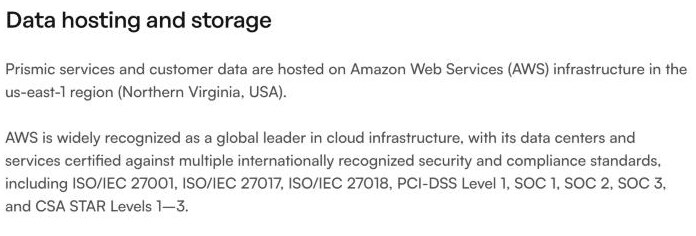
Prismic states its "services and customer data are hosted on Amazon Web Services (AWS) infrastructure in the us-east-1 region (Northern Virginia, USA)," "deployed redundantly across three Availability Zones within a single AWS region," and your front end fetches that content at request time from its cdn.prismic.io edge. There is no mainland region, so that round trip can be slow or unstable from behind the Great Firewall. But the payload is normally your own copy and images, not your visitors' personal information, so Prismic by itself generally does not create a cross-border transfer of user data under PIPL. The duties that do decide legality — an ICP filing on in-country hosting, and PIPL for whatever personal data your site collects — belong to the embedding site. The table below keeps Prismic's own words and the law each door triggers side by side.
This is a risk map, not a verdict — where the line actually falls depends on how you host the site, what user data it collects, and whether you ever model personal data as content. Our China team can map your exposure with you →
What Prismic's own documentation says about China
| Fact | Primary source |
|---|---|
| Prismic runs from a single US region, with no mainland-China presence. Its security documentation states that "Prismic services and customer data are hosted on Amazon Web Services (AWS) infrastructure in the us-east-1 region (Northern Virginia, USA)," and that those services are "deployed redundantly across three Availability Zones within a single AWS region." Every one of those zones sits inside that one US region — none is inside mainland China — so content fetched from Prismic is always served from offshore. | Prismic — Security (prismic.io/legal/security), retrieved 2026-10-07 |
Your site fetches Prismic content at request time from an offshore CDN edge. Prismic's content API is served from the cdn.prismic.io host — the Repository API endpoint takes the form https://<your-repo>.cdn.prismic.io/api/v2 — which your front end queries to build or render pages. Because that edge has no mainland point of presence, a page that pulls from Prismic live inside China depends on a cross-border round trip through the Great Firewall, which is where slowness or intermittent failures appear. This is a delivery risk, not a legal one. | Prismic — REST API reference (prismic.io/docs/api), retrieved 2026-10-07 |
| The payload is your editorial content, not your users' data — so the compliance doors sit on your site, not on Prismic. What Prismic stores and delivers is the content your team authors for public display — copy, images, documentation — not your end users' personal information, so moving it through Prismic's US infrastructure does not by itself create a PIPL cross-border transfer of user data. What does decide legality is the public site that shows that content to mainland visitors: it needs an ICP filing on in-country hosting (State Council Order No. 292; MIIT Order No. 33), and any personal information it collects from Chinese users is its own PIPL matter (Articles 38–43; Article 40; Cybersecurity Law Article 39 (formerly Article 37)). | Prismic — Security (prismic.io/legal/security), retrieved 2026-10-07; State Council Order No. 292; MIIT Order No. 33; PIPL Articles 38–43 & 40; Cybersecurity Law Article 39 (formerly Article 37) |
| If you model personal data as content in Prismic, that content crosses the border too. Prismic stores whatever you choose to model as content, so putting personal data — user profiles, form submissions, anything identifying a real person — into a Prismic field sends it offshore to us-east-1 like any other payload, and the PIPL cross-border rules (Articles 38–43) attach to it. The clean line is to keep Prismic for editorial content and keep personal data out of it, so the data-residency question stays off the CMS. | Prismic — content modeling (prismic.io/docs), retrieved 2026-10-07; PIPL Articles 38–43 |
Sources verified by the 21YunBox compliance team on 2026-10-07.
For a mainland-China audience, the useful question about Prismic is which half of “does it work” you are actually asking. Prismic is a headless CMS: it stores your editorial content and hands it to your site through a content API served from its own CDN edge. That edge sits in a single United States region with no presence inside mainland China, so the honest Prismic-level risk is reachability — a site that fetches content from Prismic at request time can be slow or unstable from behind the Great Firewall. What Prismic does not do is turn your project into a data-residency problem on its own: the payload it carries is normally your own copy and images, not your visitors’ personal information. The filing and privacy duties that actually decide whether your China-facing site is lawful live on the site that embeds Prismic — and those are worth separating cleanly from the delivery question.
Prismic in China at a glance
| What decides it | In Prismic's own terms |
|---|---|
| Where it runs | “Services and customer data are hosted on Amazon Web Services (AWS) infrastructure in the us-east-1 region (Northern Virginia, USA),” across three Availability Zones within a single AWS region. No region is inside mainland China. |
| How your site gets content | Your front end queries Prismic's content API on the cdn.prismic.io host at request time. That edge is offshore with no mainland point of presence, so each fetch crosses the border. |
| What's in the payload | Your own editorial content — copy, images, documentation — authored for public display, not your end users' personal information. By itself that is generally not a PIPL cross-border transfer of user data. |
| Serving the public | The public site that embeds Prismic and is shown to mainland visitors needs an ICP filing on in-country hosting. That duty belongs to the site and its host, not to the CMS. |
| The edge case | If you model personal data as content inside Prismic, that data leaves the mainland with every fetch — and PIPL's cross-border rules attach to it like any other payload. |
Reachability is the real Prismic-level question
Prismic tells you where it runs. Its security documentation states that its “services and customer data are hosted on Amazon Web Services (AWS) infrastructure in the us-east-1 region (Northern Virginia, USA),” “deployed redundantly across three Availability Zones within a single AWS region.” Your front end reaches that content through Prismic’s content API on the cdn.prismic.io host, which it queries when a page is built or rendered. Because every one of those Availability Zones is inside one US region and none is inside the mainland, a request made from inside China has to cross the border to reach Prismic’s edge. That is where the slowness and the occasional failure to load come from — not from any block aimed at Prismic, but from the plain distance and the filtering in between. It is a genuine delivery risk, and it is also the half of the question that network design can address. Treat it as reachability, not legality.
Don’t mistake a content CMS for a data-residency problem
It is tempting to read “my CMS is hosted in the US” as a cross-border data problem, and for a content CMS that is usually the wrong frame. What Prismic holds and delivers is your editorial content — marketing copy, images, documentation — authored by your team for public display. That is not your end users’ personal information, so moving it through Prismic’s US infrastructure does not, by itself, create a cross-border transfer of user data under PIPL. Being honest about that matters: overstating it invents an obligation Prismic does not trigger, and distracts from the duties that are real.
There is one edge to watch. Prismic will store whatever you model as content, so if you ever put personal data — user profiles, form submissions, anything identifying a real person — into a Prismic field, that content now leaves the mainland exactly like any other payload, and the PIPL cross-border rules (Articles 38–43) attach to it. The rule of thumb is simple: keep Prismic for content, keep personal data out of it, and the data-residency question stays off Prismic’s side of the line.
The compliance doors live on your site, not the CMS
The obligations that decide whether your China-facing site is lawful do not sit on Prismic at all — they sit on the website that embeds it. A public-facing site shown to mainland visitors needs an ICP filing (ICP 备案) under State Council Order No. 292 and MIIT Order No. 33, and that filing has to attach to hosting physically inside the mainland. Where your HTML and your origin are served from decides that, not where your CMS lives; a headless front end backed by Prismic still needs its own in-country, ICP-filed hosting to operate cleanly for Chinese users. Separately, any personal information your site itself collects from those users — accounts, checkout details, support tickets — is your PIPL responsibility as the handler: notice, separate consent and a transfer mechanism if that data leaves the mainland (Articles 38–43), in-country storage if you are a critical information infrastructure operator or a large-volume handler (PIPL Article 40; Cybersecurity Law Article 39 (formerly Article 37)). None of that is Prismic’s to carry, and none of it is solved by speeding up content delivery.
This is a risk map, not a verdict: whether your site needs an ICP filing, in-country storage, or only a steadier way to reach Prismic depends on how you host it, what personal data it collects, and who your users are — worth settling with counsel before you build.
Where 21YunBox fits — a compliant overlay, not a migration
You keep authoring in Prismic, exactly as you do now. What we add is the part a US-hosted content API cannot: compliant, ICP-filed delivery from inside the mainland, placed in front of your existing origin so your pages reach Chinese users reliably instead of waiting on a cross-border round trip to Prismic’s edge — with no rebuild, no second codebase, and no change to your Prismic workflow. Our China team maps the two halves separately: the reachability of your content, and the ICP and PIPL duties that sit on your embedding site, assessed against your entity, your hosting and the personal data your site actually collects. Prismic stays your CMS; the compliant China presence sits around it.
Related reading: