Does Ghost Work in China? Member Data Residency, PIPL & ICP
Ghost reaches mainland China, so speed isn't the question. Ghost(Pro) runs its servers in one offshore region — Amsterdam, The Netherlands — so the member list a China-facing publication collects (subscriber emails, names, newsletter and Stripe membership status) rests outside the mainland, a cross-border transfer under PIPL with no ICP-filing footing. Because Ghost is open source, the lawful path is to self-host the China publication in-country on ICP-filed infrastructure — keeping member data in the mainland while Ghost(Pro) stays in place for other markets.
Does Ghost work in China?
Ghost reaches mainland China, so speed is not the question. What decides it is where your member list lives and whether the publication is ICP-filed — Ghost is a membership platform, not just a blog, and the subscriber data it holds is personal information under China's law.
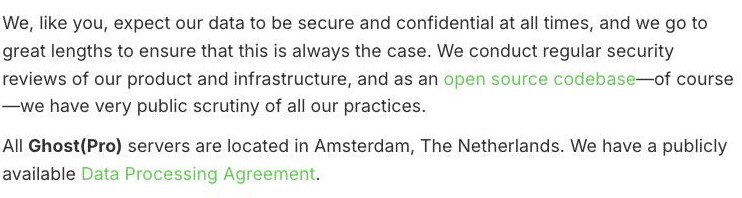
On Ghost(Pro), Ghost's own Help Center states that "All Ghost(Pro) servers are located in Amsterdam, The Netherlands" — one offshore region, with no mainland-China location. So the member list a China-facing publication collects — subscriber emails, names, newsletter subscriptions and, via Stripe, payment and membership status — rests outside the mainland, which makes its collection a cross-border transfer under PIPL (notice, a separate consent and a transfer mechanism, Articles 38–40), with an in-country storage duty for a CIIO or large-volume handler (PIPL Article 40; Cybersecurity Law Article 39 (formerly Article 37)). A publication served from inside China also needs an ICP filing, and Ghost(Pro) names no mainland resource to carry it.
Because Ghost is open source and self-hostable, the lawful path is real: self-host the China publication in-country on ICP-filed infrastructure, keep its member data in the mainland, and keep Ghost(Pro) for other markets — 21YunBox maps, localizes and delivers, and never uses or suggests circumvention. What actually applies to you is a risk to confirm with counsel. Our China team can map your exposure with you →
What Ghost's own documentation says about China
| Fact | Primary source |
|---|---|
| Ghost(Pro) runs in a single offshore region — Amsterdam, The Netherlands — with no mainland-China location. Ghost's Help Center, describing its security and data practices, states: "All Ghost(Pro) servers are located in Amsterdam, The Netherlands." So the member list a China-facing Ghost(Pro) publication collects — subscriber emails, names, newsletter and Stripe membership status — is held offshore, which makes its collection a cross-border transfer of personal information under PIPL. | Ghost Help Center — Can you describe your security and data practices?, retrieved 2026-10-09 |
| Ghost is open source and self-hostable — which is what makes a lawful in-country path possible. Ghost's own install documentation offers a self-hosted deployment (the Ghost-CLI on an Ubuntu server, a Docker image, or a build from source) alongside the managed Ghost(Pro) service. Because the software can run on infrastructure you control, the China publication can be stood up on China-resident, ICP-filed infrastructure with its member data kept in the mainland, while Ghost(Pro) stays in place for other markets. | Ghost Developer Docs — Install / self-host, retrieved 2026-10-09 |
| Writing China members' data to an offshore Ghost(Pro) is a PIPL cross-border transfer. Moving personal information collected from users in mainland China to infrastructure outside the country triggers PIPL Articles 38–40: notice, a separate consent distinct from the general sign-up, and one transfer mechanism — a CAC security assessment, the CAC standard contract, or certification. | Personal Information Protection Law of the PRC, Articles 38–40 (cac.gov.cn), retrieved 2026-10-09 |
| For some handlers the data must stay in China, and serving from inside the mainland triggers an ICP filing. Where the handler is a critical information infrastructure operator or moves personal information at volume, personal information collected in China must be stored in the mainland (PIPL Article 40; Cybersecurity Law Article 39, formerly Article 37) — a duty a single offshore Ghost(Pro) region cannot meet. And any public publication actually served from inside China must carry an ICP filing (State Council Order No. 292) bound to a mainland hosting resource Ghost(Pro) does not provide. | PIPL Article 40; Cybersecurity Law Article 39 (formerly Article 37); State Council Order No. 292, retrieved 2026-10-09 |
Sources verified by the 21YunBox compliance team on 2026-10-09.
For a publication aimed at mainland China, the Ghost question looks at first like a speed question — will the site load, will the editor work from Shanghai. On the wire Ghost reaches the mainland, so that is not where the China decision is settled. The thing to notice is that Ghost is not only a place to publish posts. On a membership site it also holds the subscriber list — member email addresses, names, which newsletters they take, and, through Stripe, their payment and membership status — plus your author and staff accounts. That member list is a store of personal information, and where it comes to rest is a question of China’s law, not of latency. Ghost answers the “where” in its own documentation.
Ghost in China at a glance
| What decides it | In Ghost's own terms — and China's law |
|---|---|
| What it is | Ghost is an open-source publishing and membership platform, offered two ways: Ghost(Pro), the managed service Ghost hosts, and self-hosted Ghost, which you run on your own infrastructure. Beyond posts it holds a member list — subscriber emails, names, newsletter subscriptions, and via Stripe payment and membership status — plus author and staff accounts. |
| Where the data lives (Ghost(Pro)) | Ghost states that “All Ghost(Pro) servers are located in Amsterdam, The Netherlands” — a single offshore region. There is no mainland-China location, so a China-facing publication's member data rests outside the country. |
| Your China members' data | Subscriber emails, names, and subscription and payment status are personal information. Held in an offshore Ghost(Pro), their collection is a cross-border transfer under PIPL (Articles 38–40): notice, a separate consent, and one transfer mechanism. A newsletter or membership opt-in does not by itself carry the overseas-transfer consent. |
| Serving the public | A publication served to mainland readers from inside China needs an ICP filing (备案) bound to a mainland hosting resource. Ghost(Pro) names none, so there is nothing of its own to file against. |
| The open-source opening | Ghost is open-source and self-hostable (Ghost-CLI, Docker, or a build from source). A self-hosted Ghost can run on China-resident, ICP-filed infrastructure, keeping the China member list in the mainland — the lawful in-country pattern. |
| Reachability | A Ghost(Pro) site can be reached from the mainland, but cross-border delivery can be inconsistent. That is operational, not the decision — and the answer is never a network workaround. |
The member list is personal information — and Ghost(Pro) keeps it offshore
The structural point is easy to miss because Ghost is usually filed under “CMS.” A blog’s posts are public content you want everyone to read. But a Ghost membership site is also a database of the people who subscribed: their email addresses, their names, which newsletters they take, and — where you take payments through Stripe — their membership and payment status. On Ghost(Pro), the managed service Ghost runs, that database lives on Ghost’s own servers, and Ghost states plainly where those are: “All Ghost(Pro) servers are located in Amsterdam, The Netherlands.” One region, and it is offshore.
The moment a reader in mainland China subscribes, their personal information is written to that offshore member store — and under China’s Personal Information Protection Law that is a cross-border transfer. The duty lands on the personal-information handler — you, the publisher, not Ghost the processor: notice, a separate consent for the overseas transfer distinct from any general sign-up, and one cleared transfer mechanism — a CAC security assessment, the CAC standard contract, or certification (PIPL Articles 38–40). A newsletter opt-in collected in China does not, on its own, carry the consent that moving that subscriber record to the Netherlands requires.
No mainland region — so no in-country storage, and nothing to ICP-file
Because every Ghost(Pro) server sits in Amsterdam, two separate questions are answered before performance is ever in play.
First, residency. If you are a critical information infrastructure operator, or you handle personal information at volume, personal information collected in China has to be stored in the mainland — the Cybersecurity Law’s Article 39 (formerly Article 37; the data-localization provision was renumbered by the 2025 amendment that took effect on January 1, 2026, its substance unchanged), together with PIPL Article 40. A single offshore region cannot meet that duty, and above certain thresholds the transfer of that member data may itself require China’s data-export security assessment (数据出境安全评估) before anything leaves.
Second, licensing. A publication actually served to mainland readers from inside China turns on an ICP filing (ICP 备案), and that filing has to attach to a hosting resource physically in the mainland. Ghost(Pro) names no mainland region, so there is no Ghost(Pro) resource to file against. “We already run our blog on Ghost” does not carry across the border; the managed service that is so quick to stand up elsewhere is exactly the part that has no in-country footing here.
Because Ghost is open source, the lawful path runs in-country
Here Ghost is in a stronger position than a closed SaaS, and it is worth being plain about why. Ghost is open-source software you can run yourself: its own documentation offers a self-hosted install — the Ghost-CLI on an Ubuntu server, a Docker image, or a build from source — alongside the managed Ghost(Pro) service. That means the China publication does not have to live on offshore infrastructure at all. A self-hosted Ghost can run on China-resident, ICP-filed infrastructure, with the member list for your China audience stored in the mainland — while you keep Ghost(Pro) for the markets where its managed hosting already serves you.
One operational note, so it is not mistaken for the decision: a Ghost(Pro) site served from Amsterdam can be reached from the mainland, but cross-border delivery can be inconsistent. That is a delivery matter, not the legal one, and the temptation to force it through a network workaround is one to resist. 21YunBox never uses or suggests circumvention of any kind — it is both a compliance risk and beside the point. The productive question is how to keep the China publication and its member data on a lawful in-country footing.
None of this is a verdict that Ghost is “blocked” or “illegal.” It is a risk map: whether you owe a separate consent, a transfer mechanism, in-country storage, a data-export assessment, an ICP filing, or some combination turns on your entity, your data volumes, your role as handler, and who your readers are — worth settling with counsel before your China publication depends on it.
The lawful path — map, localize, deliver
There is a compliant way to publish into China with Ghost, and it has a shape. First, map: our China team charts the exposure that attaches to the member and account data your publication collects — which subscriber records gathered in China must stay in the country, what may lawfully leave, where a data-export assessment or an in-country storage duty bites, and what your consent and notice flow has to cover. The legal conclusions are settled with counsel; we build the technical picture that feeds them.
Then localize: because Ghost is open source, we stand up a self-hosted Ghost for the China publication on China-resident infrastructure and integrate it with the stack you already run, so the subscriber list for your China audience stops leaving the mainland by default — while Ghost(Pro) stays in place for your other markets.
Then deliver: the China-facing publication is a public service in the mainland, so it carries an ICP filing duty and needs compliant, in-country delivery. 21YunBox delivers it in-country — the 21YunBox Optimizer — in front of what you run, with no rebuild and no re-platform. The result is a China publication that runs legally and compliantly for your readers in China. What we never do — and what no one lawfully can — is hand you a route around China’s data-export rules or around any network restriction.
Related reading:
- Cross-border data transfers under PIPL
- China’s Cybersecurity Law (data localization, Article 39)
- China’s data-export security assessment
- How to get an ICP filing for China