Does Adobe Experience Manager Work in China? ICP, Data Residency & an Offshore Cloud
Adobe Experience Manager as a Cloud Service runs on offshore cloud regions: Adobe's own China FAQ says its Edge Delivery Services "are currently operated outside of China," that serving the mainland "requires a customer-managed Content Delivery Network (BYOCDN)," and that the China CDN operator will "require customers to provide an Internet Content Provider (ICP) license or ICP recordal." So the gate is ICP footing and data residency, not speed — the content, author accounts and visitor data AEM holds for China sit offshore, a cross-border transfer under PIPL, and the only in-country option Adobe names is its legacy Managed Services, not the Cloud Service. A compliance-first look at the ICP, data-residency and cross-border questions, and the lawful in-country path.
Does Adobe Experience Manager work in China?
Reachability isn't the obstacle — AEM content is deliverable to China. What decides whether you may run Adobe Experience Manager compliantly for the mainland is ICP footing and data residency, and Adobe answers both in its own documentation.
Adobe operates no mainland-China region for Experience Manager as a Cloud Service. Its own China FAQ says the Edge Delivery Services "are currently operated outside of China," that serving visitors in China "requires a customer-managed Content Delivery Network (BYOCDN)," and that the China CDN operator will "require customers to provide an Internet Content Provider (ICP) license or ICP recordal." So the content, author accounts and visitor data AEM holds for China sit offshore — a cross-border transfer under PIPL (notice, separate consent and a transfer mechanism, Articles 38–40), possibly triggering a data-export security assessment, with an in-country storage duty for a CIIO under the Cybersecurity Law's Article 39 (formerly Article 37). Serving the mainland in-country needs an ICP filing Adobe conditions its China path on but leaves to you, and the only in-country hosting Adobe names is its legacy Managed Services, not the Cloud Service.
21YunBox maps your ICP, cross-border and residency exposure, localizes the China content and data onto a China-resident footing, and delivers your China-facing experience in-country on ICP-filed infrastructure in front of the AEM you already run — with no rebuild, and never any form of circumvention. Treat the specifics as a risk to confirm with counsel. Our China team can map your exposure with you →
What Adobe Experience Manager's own documentation says about China
| Fact | Primary source |
|---|---|
| Adobe says AEM's delivery runs outside China, and that serving the mainland is handed back to you. In its own China FAQ, Adobe states that Experience Manager Edge Delivery Services "are currently operated outside of China," and that to reach the mainland "customers should use customer-managed CDN (BYOCDN) in China to serve visitors from China." There is no Adobe-operated China delivery path for AEM Sites — the in-country CDN is yours to stand up. | Adobe, AEM “China FAQ” (aem.live), retrieved 2026-10-09 |
| Adobe puts the ICP license on you, not on Adobe. The same China FAQ states that "CDN operators in China require customers to provide an Internet Content Provider (ICP) license or ICP recordal." Serving a public site from inside the mainland turns on an ICP filing (State Council Order No. 292; MIIT Order No. 33) bound to an in-country hosting resource — a license issued to a mainland entity, which Adobe conditions its China delivery on but does not provide. | Adobe, AEM “China FAQ” (aem.live); State Council Order No. 292; MIIT Order No. 33, retrieved 2026-10-09 |
| The only in-country option Adobe names is its legacy Managed Services — not the Cloud Service. Adobe writes that its Edge Delivery Services "are currently operated outside of China," and that for customers who "require all AEM servers to be hosted in China" — for "compliance such as Multi-Level Protection Scheme (MLPS), data residency, Baidu SEO" — "Adobe Managed Services for Adobe Experience Manager are available in China." Moving your China presence in-country is a migration onto a different product, not a region toggle on AEM as a Cloud Service. | Adobe, AEM “China FAQ” (aem.live), retrieved 2026-10-09 |
| China content and data held in an offshore AEM is a PIPL cross-border transfer. The content, author and admin accounts, and visitor data AEM holds for people in China, stored in Adobe's offshore cloud regions, is a cross-border transfer of personal information under PIPL Articles 38–40: notice, a separate consent, and one transfer mechanism — a CAC security assessment, the CAC standard contract, or certification. For a critical information infrastructure operator, Cybersecurity Law Article 39 (formerly Article 37) adds an in-country storage duty an offshore region cannot meet. | Personal Information Protection Law of the PRC, Articles 38–40; Cybersecurity Law Article 39 (formerly Article 37) (cac.gov.cn), retrieved 2026-10-09 |
Sources verified by the 21YunBox compliance team on 2026-10-09.
For a brand running Adobe Experience Manager against a mainland-China audience, the first instinct is to ask whether the site will even render from inside the country — and that is not where the China decision is settled. AEM content is deliverable to China; Adobe runs Experience Manager on a global cloud, and its Edge Delivery Services ride two global content delivery networks. What settles whether you may run it compliantly for China is licensing and data residency: where the content, author accounts and visitor data AEM holds come to rest, and on what footing the experience is served to the mainland. Adobe answers those questions in its own documentation — and the answer puts an ICP license and an offshore cloud, not a performance dial, at the center.
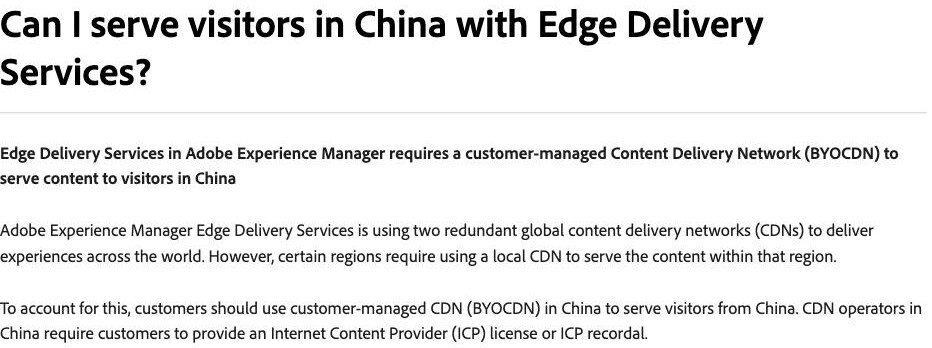
That is because Adobe operates no mainland-China region for Experience Manager as a Cloud Service. In its own China FAQ, Adobe says its Edge Delivery Services “are currently operated outside of China,” that serving visitors in China “requires a customer-managed Content Delivery Network (BYOCDN),” and that the China CDN operator will “require customers to provide an Internet Content Provider (ICP) license or ICP recordal.” So the moment your China-facing experience is served — and the content, author identities and visitor data behind it are stored — in an offshore AEM, a different body of law decides whether that was allowed.
Adobe Experience Manager in China at a glance
| What decides it | In Adobe's own terms — and China's law |
|---|---|
| What it is | Adobe's enterprise digital experience platform: content management (Sites) and digital asset management (Assets), delivered mainly as AEM as a Cloud Service (Adobe-managed), with legacy Managed Services and on-prem options. It holds your web content and assets, the author and admin accounts that edit them, and the visitor data the experiences it serves collect. |
| Reachable — and is there a China region? | Reachable, but there is no in-country region. Adobe's Edge Delivery Services ride “two redundant global content delivery networks,” yet Adobe states they “are currently operated outside of China,” and that “certain regions require using a local CDN to serve the content within that region.” No mainland-China AEM as a Cloud Service region exists. |
| How China delivery is meant to work | It is handed to you. Adobe says serving China “requires a customer-managed Content Delivery Network (BYOCDN),” and that the China CDN operator will “require customers to provide an Internet Content Provider (ICP) license or ICP recordal.” Adobe documents no Adobe-operated China delivery path for AEM Sites — the in-country CDN and the ICP are yours. |
| The only in-country hosting option | Adobe names one: for customers that “require all AEM servers to be hosted in China” — for “compliance such as Multi-Level Protection Scheme (MLPS), data residency, Baidu SEO” — “Adobe Managed Services for Adobe Experience Manager are available in China.” That is the legacy product, not the Cloud Service: a re-platform, not a region toggle. |
| Where the content & data sit | Offshore. Content, assets, author and admin identities, and the visitor data AEM collects rest in Adobe's offshore cloud regions. For people in China that is a cross-border transfer (数据出境) under PIPL (Articles 38–40): notice, a separate consent, and one transfer mechanism; it may trigger China's data-export security assessment, and for a critical information infrastructure operator the Cybersecurity Law's Article 39 (formerly Article 37) sets an in-country storage duty an offshore region cannot meet. |
| Serving the public | A China-facing site served from inside the mainland needs an ICP filing (State Council Order No. 292; MIIT Order No. 33), bound to an in-country hosting resource. Adobe conditions its own China delivery on that license but provides neither it nor the in-country resource for the Cloud Service. |
| The lawful path | Keep the China content, author and visitor data on a China-resident footing, and deliver the China-facing experience in-country on ICP-filed infrastructure in front of the AEM you already run. 21YunBox maps, localizes and delivers; it never uses or suggests circumvention of any kind. |
No mainland region — delivery runs offshore, and the ICP gate lands on you
Adobe Experience Manager’s position in China is set in Adobe’s own documentation, not by a load-time check. AEM is reachable, and Adobe describes a modern delivery model — Edge Delivery Services — that uses “two redundant global content delivery networks (CDNs) to deliver experiences across the world.” But Adobe is candid about the gap: those services, it says, “are currently operated outside of China,” and “certain regions require using a local CDN to serve the content within that region.” For China, that responsibility is handed back to you: “customers should use customer-managed CDN (BYOCDN) in China to serve visitors from China,” and the China CDN operator will “require customers to provide an Internet Content Provider (ICP) license or ICP recordal.”
Read closely, that is an ICP question wearing a CDN’s clothes. Adobe’s global delivery stops at the border; the in-country leg is a separate, customer-built CDN; and standing that CDN up turns on an ICP filing (备案) under State Council Order No. 292 and MIIT Order No. 33 — issued to a mainland entity against an in-country hosting resource, not supplied by Adobe. This is a sharper handoff than Adobe makes for some of its other products: for its media CDN, Dynamic Media, Adobe documents its own ICP-backed China delivery path (see Does Adobe Scene7 (Dynamic Media) work in China?); for Experience Manager Sites it documents no Adobe-operated China path at all, and leaves the CDN and the license to you. “We already run AEM” therefore does not carry into the mainland on its own.
For that reason this page publishes no first-party China latency figure for Adobe Experience Manager: a performance dial is not the axis a licensing-and-residency decision turns on. And to be unambiguous — 21YunBox neither uses nor suggests any form of circumvention; the productive question is where your China content and data lawfully live, and on what licensed footing they are served.
The content, author accounts and visitor data sit offshore — a cross-border transfer
Here is the gate most teams miss: where AEM runs is where your China content and data come to rest. Because Adobe operates Experience Manager as a Cloud Service from regions outside the mainland, the web content and digital assets you manage, the author and administrator accounts that sign in to edit them, and the visitor data the published experiences collect — form entries, account profiles, behavioral and request data — are all held offshore. Where any of that is personal information belonging to people in China, holding it in an offshore AEM is a cross-border transfer of personal information under China’s Personal Information Protection Law. PIPL puts the duty on the handler — you, not Adobe the processor: Articles 38–40 require notice, a separate consent distinct from a user’s general agreement to use your site, and one transfer mechanism — a CAC security assessment, the CAC standard contract, or certification.
Above certain thresholds, or where the data is “important data,” that transfer may also require China’s data-export security assessment (数据出境安全评估) before anything leaves. And if your organization is a critical information infrastructure operator, the Cybersecurity Law’s Article 39 (formerly Article 37 — the data-localization provision was renumbered by the 2025 Cybersecurity Law amendment that took effect on January 1, 2026, with its substance unchanged) requires that personal information generated in China be stored in China — a duty an offshore AEM region cannot satisfy. Adobe itself lists “data residency” among the reasons customers move AEM hosting into the country. None of this turns on how quickly a page renders; it turns on whether the content and data had a lawful basis to sit and to move where they do. Which duties bite your specific setup is a risk to confirm with counsel against what you actually publish, store and collect.
”In-country” means the legacy Managed Services — a re-platform, not a switch
If the answer to residency is “then host AEM in China,” Adobe is specific about what that takes — and what it costs you in platform. Its China FAQ says plainly that the Edge Delivery Services “are currently operated outside of China,” and that only “Adobe Managed Services for Adobe Experience Manager are available in China,” for customers that “require all AEM servers to be hosted in China” for reasons such as “compliance such as Multi-Level Protection Scheme (MLPS), data residency, Baidu SEO.”
The catch is in which product that is. In-country hosting is offered on Adobe Managed Services — the older, single-tenant AEM — not on AEM as a Cloud Service. So moving your China presence in-country is not a region toggle inside your existing Cloud Service program; it is a migration onto a different operating model, with its own build, release and operations path. Adobe names a related limit for the Cloud Service’s document-based authoring, too: “Authoring content from China is possible with limitations and not fully supported by Adobe,” because the document source — Adobe notes that “Google Docs, Sheets, and Drive are not available in China” — and the preview and publish APIs are reached from outside the mainland. In short, the Cloud Service is an offshore product; the in-country answer Adobe points to is a different one, and neither settles the ICP and residency duties on its own.
None of this is a verdict that Adobe Experience Manager is “blocked” or “illegal.” It is a risk map: which duties apply, and how, turns on your entity, the personal data your experiences collect, your role under Chinese law, and who your users are — worth settling with counsel before your China presence depends on it.
The lawful path — map, localize, deliver
There is a lawful way to run Adobe Experience Manager for a China-facing audience, and it has a shape — three moves, and none of them is a route around China’s rules.
First, map: our China team works out which of your AEM sites and experiences serve the mainland, what personal information their content, forms and visitor tracking collect, where your author accounts and that data are stored under your current AEM setup, and where the obligations attach — the ICP footing for in-country delivery, the PIPL cross-border and consent duties, any data-export security assessment, and any Article 39 (formerly Article 37) residency duty for your entity. The legal conclusions are settled with counsel; we build the technical picture that feeds them.
Then localize: we put the China content, author and visitor data on a China-resident footing — consented, in-country processing and storage for what must stay in the mainland — so residency is established on purpose rather than assumed from a delivery endpoint Adobe says sits offshore, while you keep AEM as your authoring platform and for the markets it already serves.
Then deliver: the China-facing experience AEM renders is a public service in the mainland, so it carries an ICP filing (备案) duty and needs compliant, in-country delivery — exactly the customer-managed, ICP-backed CDN leg Adobe hands back to you. The 21YunBox Optimizer serves it in-country, set in front of the AEM you already run, with no rebuild, no re-platform and no second codebase. The result is a China-facing experience that runs legally and compliantly for your users in China. What we never do — and what no one lawfully can — is move personal information out of China by stealth or route around any restriction: we localize what must stay in-country and deliver on a licensed footing, and we neither use nor suggest circumvention of any kind.
Related reading:
- How to get an ICP filing for China
- Cross-border data transfers under PIPL
- China’s data-export security assessment
- China’s Cybersecurity Law (data localization, Article 39)
- Does Adobe Scene7 (Dynamic Media) work in China?